Psoriasis, Lichen Planus and Pityriasis Rosea for NEET PG Dermatology: Auspitz Sign, Variants, ICMR Treatment, Wickham Striae, Herald Patch
Start Here
🎯 Exam priority: High. Expect: Auspitz sign and grattage, Koebner phenomenon, drugs that worsen psoriasis, nail pitting, psoriatic arthritis, the variants, why systemic steroids are banned, the ICMR treatment by body surface area, acitretin and pregnancy, lichen planus with Wickham striae and hepatitis C, and the herald patch of pityriasis rosea.
CBME mapping: DR 3.1–3.3, DR 4.1. Psoriatic arthritis is also in Medicine (rheumatology).
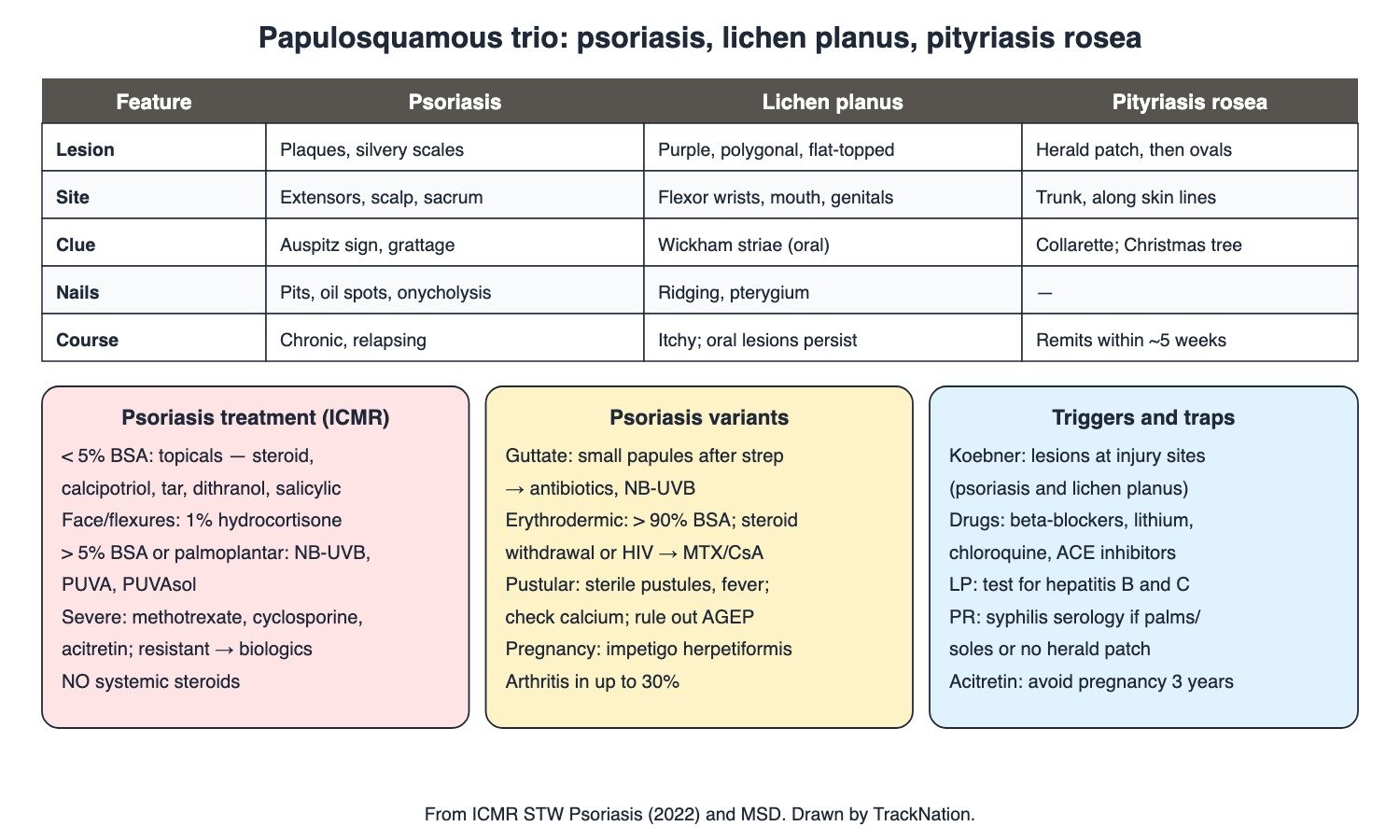
Psoriasis, lichen planus and pityriasis rosea compared; psoriasis treatment and variants. Drawn by TrackNation.
Psoriasis
Chronic, relapsing immune disease: dendritic cells release IL-12 and IL-23, driving Th17 cells (IL-17, IL-22) and keratinocyte hyperproliferation. HLA-Cw6 is associated.
Lesions: well-circumscribed erythematous plaques with silvery scales on the scalp, extensor elbows and knees, sacrum, gluteal cleft and genitals. Bedside: Auspitz sign (pinpoint bleeding when scale is removed) and grattage test (ICMR); biopsy only if in doubt.
Triggers: injury (Koebner phenomenon), sunburn, streptococcal (guttate) and HIV infection, drugs — beta-blockers, chloroquine, lithium, ACE inhibitors, indomethacin, terbinafine, TNF inhibitors — alcohol, smoking, obesity and withdrawal of systemic steroids (erythrodermic or pustular flare).
Nails: pitting, oil spots, leukonychia, subungual hyperkeratosis, distal onycholysis. Psoriatic arthritis in about 30%, and nail lesions in up to 90% of them. Screen for metabolic syndrome (ICMR).
Psoriasis variant | Clue (ICMR, MSD) | Treatment pointer |
Plaque (about 90%) | Plaques with silvery white scales; extensors, scalp, sacrum | Topicals if < 5% BSA |
Guttate | Shower of papules < 1 cm on trunk and limbs; younger patients; streptococcal infection | Antibiotics, NB-UVB |
Palmoplantar | Symmetric well-defined plaques on palms and soles; tell from palmoplantar eczema | Steroid–salicylic acid, PUVA soaks |
Inverse (flexural) | Red shiny patches in axillae, groins, under breasts, sometimes without scale | Low-potency steroid |
Erythrodermic | Erythema and scaling > 90% BSA; after steroid withdrawal or HIV | Admit; methotrexate or cyclosporine |
Generalised pustular | Sterile pustules, lakes of pus, fever; low calcium; in pregnancy = impetigo herpetiformis | Admit; acitretin, MTX, CsA |
Psoriasis Treatment (ICMR)
Limited (< 5% BSA): emollients plus topicals — steroids, calcipotriol (vitamin D3 analogue), tazarotene, tacrolimus, coal tar, dithranol (irritant and stains; caution in flexures), salicylic acid. Face and flexures: 1% hydrocortisone for 2 weeks; trunk and limbs: betamethasone (± salicylic acid 3–6%) for 2–4 weeks. Scalp: tar shampoo, steroid ± salicylic acid lotions.
> 5% BSA or palmoplantar: phototherapy — narrowband UVB, PUVA, PUVAsol. Coal tar with UVB is the Goeckerman regimen.
Severe, recalcitrant, palmoplantar or arthritis: methotrexate, cyclosporine, retinoids (acitretin; isotretinoin may be preferred in adolescent girls), antibiotics for guttate; resistant → biologics. Spesolimab (anti-IL-36) is used for generalised pustular psoriasis.
Before systemic immunosuppression rule out TB, HIV, hepatitis B and C and do a pregnancy test. Avoid methotrexate and cyclosporine in children due for live vaccines. Acitretin: avoid in women of child-bearing age; no pregnancy for at least 3 years after stopping.
No systemic steroids in psoriasis (they precipitate pustular flares) — the single ICMR exception is generalised pustular psoriasis of pregnancy.
Lichen Planus and Pityriasis Rosea
Lichen planus: pruritic, polygonal, flat-topped, violaceous (purple) papules on the flexor wrists, legs, trunk, glans and oral or vaginal mucosa; Koebner phenomenon. Wickham striae — lacy white lines — are the hallmark of oral LP (the commonest subtype). Nails (up to 10%): ridging, thinning, pterygium. Scalp: scarring alopecia (lichen planopilaris). Long-standing erosive oral LP rarely turns malignant.
LP associations: hepatitis C (and B) — test liver function and hepatitis serology; drugs (beta-blockers, NSAIDs, ACE inhibitors, antimalarials, thiazides, gold) cause lichenoid eruptions. Treatment: topical steroids first line; intralesional for thick lesions; generalised — oral steroids short course, acitretin or NB-UVB.
Pityriasis rosea: ages 10–35; a single large herald patch, then smaller oval scaly plaques with a collarette of scale along skin lines on the trunk (Christmas-tree pattern); HHV-6/7 implicated. Remits within about 5 weeks; recurrence rare. Do syphilis serology if palms or soles are involved or there is no herald patch. In the first 15 weeks of pregnancy it is linked to preterm birth or fetal loss — offer acyclovir.
Traps the Examiner Sets
Systemic steroids worsen psoriasis; their withdrawal triggers erythroderma or pustular flares.
Koebner phenomenon occurs in both psoriasis and lichen planus.
Generalised pustular psoriasis: check serum calcium; exclude AGEP from drugs.
Pityriasis rosea look-alike on palms and soles: think secondary syphilis.
Memory Hooks & Shortcuts
Shortcuts to lock in this article's numbers and lists. Each one only re-packages facts proven above.
🧠 Psoriasis triggers 'BLACK': Beta-blockers, Lithium, Antimalarials, Corticosteroid withdrawal, Koebner (injury) — triggers
🧠 Lichen planus '5 Ps': Purple, Polygonal, Planar, Pruritic Papules — lichen planus
🧠 'Psoriasis bleeds when scraped' — Auspitz — bedside sign
🧠 Pityriasis rosea: 'one herald, then a Christmas tree' — pityriasis rosea
🧠 'Steroids in, steroids out' — never start them, stopping them flares psoriasis — steroid trap
Rapid-Revision Cards
Psoriasis lesion
Plaques with silvery scales, extensors.
Bedside signs
Auspitz, grattage.
Pathway
IL-23 → Th17 (IL-17, IL-22).
Koebner
Lesions at injury: psoriasis, LP.
Psoriasis drugs
Beta-blockers, lithium, chloroquine, ACEi.
Steroid withdrawal
Erythrodermic or pustular flare.
Nails
Pits, oil spots, onycholysis.
Arthritis
About 30%.
Guttate
Strep; small papules; antibiotics.
Erythrodermic
> 90% BSA.
Pustular
Sterile pustules; check calcium; exclude AGEP.
Pregnancy pustular
Impetigo herpetiformis.
< 5% BSA
Topicals.
> 5% BSA
NB-UVB, PUVA.
Severe
MTX, cyclosporine, acitretin, biologics.
Acitretin
No pregnancy for 3 years.
Systemic steroids
Never in psoriasis (except GPP of pregnancy).
Lichen planus
Purple polygonal flat papules, flexor wrists.
Wickham striae
Oral LP.
LP association
Hepatitis C.
Pityriasis rosea
Herald patch, Christmas tree.
PR + palms/soles
Syphilis serology.
Sources
Facts in this article were checked against these documents.
Standard Treatment Workflow: Psoriasis — Indian Council of Medical Research, DHR, 2022 (link)
MSD Manual Professional: Psoriasis; Lichen Planus; Pityriasis Rosea — Merck & Co. (MSD Manuals), reviewed 2025–26 (link)
Competency Based Undergraduate Curriculum, Dermatology (DR 3, DR 4) — National Medical Commission, 2024
Test Yourself: Practice Questions
Thirty questions in NEET PG style, most of them clinical vignettes.
Practice Questions (NEET PG pattern)
Original questions written in the style of the exam: +4 for a correct answer, −1 for a wrong one. Every answer was checked against the sources listed above. NEET PG papers are not published by NBEMS, so these are not past-paper questions.
Q1. A patient has well-defined erythematous plaques with silvery white scales on both elbows and knees. Scraping a plaque produces pinpoint bleeding. The sign and diagnosis are
(a) Auspitz sign — psoriasis
(b) Darier sign — mastocytosis
(c) Nikolsky sign — pemphigus
(d) Koebner — lichen planus only
Show answer
Answer: (a) — ICMR bedside tests: Auspitz and grattage.
Q2. The cytokine axis central to psoriasis is
(a) IL-5 / eosinophils
(b) IgE / mast cells
(c) IL-4 / Th2
(d) IL-23 / Th17 (IL-17, IL-22)
Show answer
Answer: (d) — Basis of IL-17 and IL-23 biologics.
Q3. New psoriatic plaques appear along a recent scratch. This is the
(a) Auspitz sign
(b) Koebner phenomenon
(c) Nikolsky sign
(d) Wickham striae
Show answer
Answer: (b) — Injury-induced lesions.
Q4. Which drug is a recognised trigger for psoriasis?
(a) metformin
(b) paracetamol
(c) lithium
(d) amoxicillin
Show answer
Answer: (c) — Also beta-blockers, chloroquine, ACE inhibitors.
Q5. A young patient develops a shower of small papules under 1 cm on the trunk and limbs after a streptococcal throat infection. The likely diagnosis and primary-level treatment are
(a) guttate psoriasis — antibiotics for the streptococcal infection
(b) scabies — permethrin
(c) lichen planus — oral steroids
(d) pityriasis rosea — acyclovir
Show answer
Answer: (a) — Streptococcus is the trigger.
Q6. Nail changes typical of psoriasis include
(a) clubbing
(b) koilonychia only
(c) pitting, oil spots and distal onycholysis
(d) pterygium
Show answer
Answer: (c) — Pterygium suggests lichen planus.
Q7. Psoriatic arthritis develops in about what proportion of psoriasis patients?
(a) about 75%
(b) all
(c) about 30%
(d) about 1%
Show answer
Answer: (c) — Nails are involved in up to 90% of them.
Q8. Which drug class should NOT be used to treat psoriasis because it can precipitate pustular flares?
(a) systemic glucocorticoids
(b) narrowband UVB
(c) topical calcipotriol
(d) methotrexate
Show answer
Answer: (a) — ICMR exception: generalised pustular psoriasis of pregnancy.
Q9. The only situation in which ICMR allows systemic steroids for psoriasis is
(a) scalp psoriasis
(b) guttate psoriasis
(c) generalised pustular psoriasis of pregnancy
(d) nail psoriasis
Show answer
Answer: (c) — Impetigo herpetiformis.
Q10. A patient has plaque psoriasis over less than 5% of body surface area. ICMR first-line treatment is
(a) systemic steroids
(b) methotrexate
(c) topical therapy (steroid, calcipotriol, tar, salicylic acid) with emollients
(d) biologics
Show answer
Answer: (c) — Topicals below 5% BSA.
Q11. For psoriasis on the face and flexures, ICMR recommends
(a) dithranol
(b) betamethasone with salicylic acid
(c) clobetasol
(d) 1% hydrocortisone or another low-potency steroid
Show answer
Answer: (d) — Thin skin.
Q12. Calcipotriol acts in psoriasis as a
(a) TNF blocker
(b) retinoid
(c) vitamin D3 analogue normalising keratinocyte proliferation
(d) calcineurin inhibitor
Show answer
Answer: (c) — Can be combined with topical steroids.
Q13. Coal tar combined with UVB exposure is called the
(a) Goeckerman regimen
(b) Koebner regimen
(c) PUVA
(d) Ingram regimen
Show answer
Answer: (a) — Coal tar plus broad-band UVB.
Q14. A topical psoriasis agent that irritates, stains and should be used with caution in skin folds is
(a) hydrocortisone
(b) calcipotriol
(c) dithranol (anthralin)
(d) tacrolimus
Show answer
Answer: (c) — Wash off after 20–30 minutes.
Q15. Psoriasis over more than 5% BSA or on the palms and soles is treated (ICMR) next with
(a) systemic steroids
(b) only emollients
(c) phototherapy — narrowband UVB, PUVA or PUVAsol
(d) antihistamines
Show answer
Answer: (c) — Systemic drugs for severe disease.
Q16. Before starting methotrexate or cyclosporine for psoriasis, ICMR advises ruling out
(a) iron deficiency
(b) vitamin D deficiency
(c) diabetes only
(d) tuberculosis, HIV, hepatitis B and C
Show answer
Answer: (d) — Plus pregnancy test.
Q17. A woman treated with acitretin for psoriasis must avoid pregnancy for at least
(a) 3 years after stopping
(b) 1 month
(c) 1 week
(d) 6 months
Show answer
Answer: (a) — Long retention in the body.
Q18. A psoriasis patient stops long-term oral steroids and develops generalised erythema and scaling over more than 90% of the body. The diagnosis is
(a) erythrodermic psoriasis
(b) lichen planus
(c) pityriasis rosea
(d) guttate psoriasis
Show answer
Answer: (a) — Also triggered by HIV.
Q19. A patient has crops of sterile pustules with lakes of pus and fever. ICMR advises measuring which electrolyte?
(a) serum magnesium only
(b) serum potassium only
(c) serum sodium only
(d) serum calcium (hypocalcaemia)
Show answer
Answer: (d) — Generalised pustular psoriasis.
Q20. In a patient with sudden widespread pustules, the drug history (beta-lactams, macrolides, calcium channel blockers) is taken to rule out
(a) acute generalised exanthematous pustulosis
(b) pityriasis rosea
(c) scabies
(d) lichen planus
Show answer
Answer: (a) — AGEP mimics pustular psoriasis.
Q21. Generalised pustular psoriasis in pregnancy, which may cause growth restriction or stillbirth, is called
(a) PUPPP
(b) impetigo herpetiformis
(c) prurigo of pregnancy
(d) pemphigoid gestationis
Show answer
Answer: (b) — Per ICMR.
Q22. A patient has itchy, purple, polygonal, flat-topped papules on the flexor wrists and lacy white lines on the buccal mucosa. The diagnosis is
(a) psoriasis
(b) pityriasis rosea
(c) lichen planus
(d) secondary syphilis
Show answer
Answer: (c) — Wickham striae.
Q23. After diagnosing lichen planus, which tests should be considered?
(a) thyroid function only
(b) liver function and hepatitis B and C serology
(c) skin prick tests
(d) serum IgE
Show answer
Answer: (b) — Association with hepatitis C.
Q24. Scarring of the proximal nail fold onto the nail bed in lichen planus is called
(a) Beau lines
(b) pterygium
(c) pitting
(d) koilonychia
Show answer
Answer: (b) — Nails involved in up to 10%.
Q25. Lichen planus of the scalp causes
(a) non-scarring alopecia areata
(b) patchy scarring alopecia (lichen planopilaris)
(c) no hair loss
(d) telogen effluvium
Show answer
Answer: (b) — Scarring.
Q26. First-line treatment for localised lichen planus is
(a) topical glucocorticoids
(b) biologics
(c) antifungals
(d) methotrexate
Show answer
Answer: (a) — Intralesional for thick plaques.
Q27. A young adult has a single large scaly oval plaque on the trunk, followed a week or two later by many smaller oval plaques with a collarette of scale along skin lines on the back. The diagnosis is
(a) lichen planus
(b) pityriasis rosea
(c) guttate psoriasis
(d) tinea corporis
Show answer
Answer: (b) — Herald patch, Christmas-tree pattern.
Q28. In suspected pityriasis rosea with lesions on the palms and soles and no herald patch, the test to order is
(a) skin biopsy for DIF
(b) patch test
(c) KOH mount
(d) syphilis serology
Show answer
Answer: (d) — Rule out secondary syphilis.
Q29. Pityriasis rosea usually
(a) needs methotrexate
(b) remits within about 5 weeks and rarely recurs
(c) scars
(d) lasts lifelong
Show answer
Answer: (b) — Supportive care.
Q30. Pityriasis rosea in the first 15 weeks of pregnancy is significant because it is associated with
(a) preterm birth or fetal demise — offer acyclovir
(b) neonatal herpes
(c) no risk
(d) pre-eclampsia only
Show answer
Answer: (a) — Antivirals not proven to prevent complications.
Active Recall
From memory: describe psoriasis lesions, bedside signs, triggers, nails and variants, give the ICMR treatment by body surface area and the steroid rule, then contrast lichen planus and pityriasis rosea.