Acute Abdomen, Peritonitis and Intestinal Obstruction for NEET PG Surgery: Perforation, Strangulation, Ileus, Volvulus and Abscess
Start Here
🎯 Exam priority: High. Expect: visceral vs somatic and referred pain, peritonitis, free air and the lateral film, barium in perforation, small- vs large-bowel obstruction, strangulation signs and timing, caecal diameter, volvulus signs and decompression, ileus vs obstruction, Ogilvie syndrome, abscess drainage rules, intussusception, and abdominal TB in India.
CBME mapping: SU28.3–28.4 (peritonitis, intra-abdominal abscess, intestinal obstruction). Gut-specific diseases follow in 16–22.
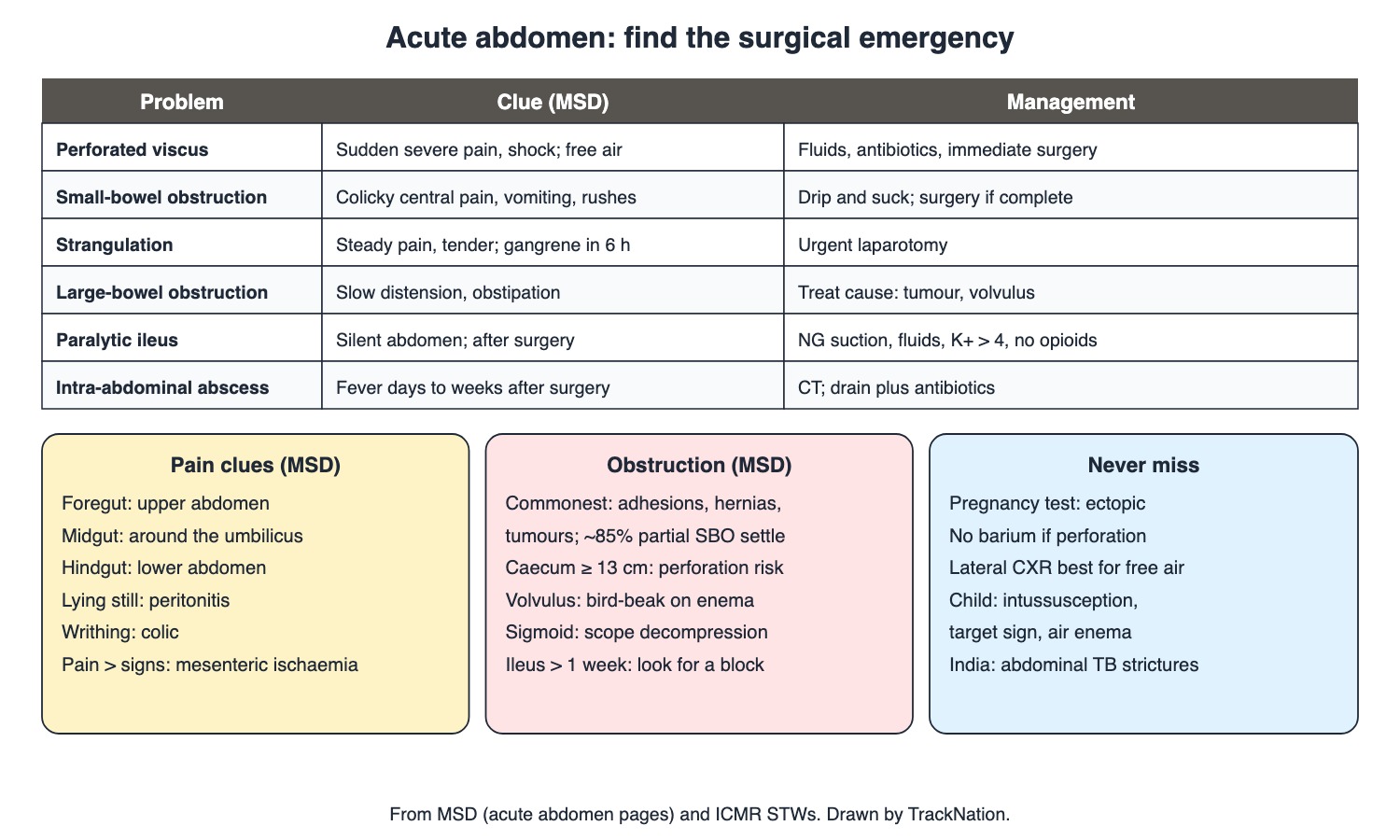
Perforation, obstruction, strangulation, ileus and abscess, with pain clues. Drawn by TrackNation.
Approach to Acute Abdominal Pain (MSD)
Visceral pain is dull, poorly localised and follows embryology: foregut → upper abdomen, midgut → periumbilical, hindgut → lower abdomen. Somatic (parietal peritoneum) pain is sharp and well localised. Referred: biliary → scapula, renal → groin, diaphragm irritation → shoulder.
Rule out the killers first: ruptured AAA, perforated viscus, mesenteric ischaemia, ruptured ectopic. Gut gangrene can occur in under 6 hours.
Clues: lying still = peritonitis; writhing = colic; pain out of proportion to signs = mesenteric ischaemia; back pain + shock + pulsatile mass = ruptured AAA; Grey Turner/Cullen = haemorrhagic pancreatitis. Steroids blunt pain and signs. Guarding is involuntary; rebound is a flinch on release.
Tests: urine pregnancy test in every woman of childbearing age; lipase for pancreatitis; abdominal series if perforation or obstruction suspected; CT with contrast diagnoses ≥95% — but must not delay surgery. Analgesia does not mask peritoneal signs.
Peritonitis and Perforation (MSD)
Peritonitis: most serious cause is GI perforation (chemical, then bacterial). Also appendicitis, diverticulitis, strangulation, pancreatitis, PID, blood. Barium causes severe peritonitis — never give it if perforation is suspected; water-soluble contrast is safe. Spontaneous bacterial peritonitis: cirrhosis with ascites.
Perforation: sudden severe pain, then shock; pain may go to the shoulder. Oesophagus after forceful vomiting = Boerhaave. Peptic ulcer for stomach/duodenum; obstructed colon perforates at the caecum.
Free air under the diaphragm in 50–75%; a lateral chest film is more sensitive than PA; CT if unclear. Treatment: fluids, broad-spectrum antibiotics, immediate surgery.
Intestinal Obstruction and Ileus (MSD)
Commonest causes: adhesions, hernias, tumours; no previous surgery or hernia → think tumour. Colon: tumour, diverticulitis, volvulus. About 85% of partial SBO settle without surgery; most complete SBO need surgery.
Small bowel: early central colic, vomiting, obstipation, high-pitched rushes, step-ladder loops with fluid levels. Large bowel: gradual distension and obstipation, late vomiting, empty rectum; caecum ≥13 cm = high perforation risk.
Strangulation (~25% of SBO; hernia, volvulus, intussusception): venous then arterial block; severe steady pain, tenderness, leucocytosis, acidosis; gangrene in 6 hours; bowel-wall gas = gangrene.
Treat: NG suction, IV saline or Ringer lactate, catheter; antibiotics if ischaemia. Complete SBO → early laparotomy. Adhesive or early postoperative obstruction without peritoneal signs → trial of NG decompression. Gallstone ileus → enterotomy, no cholecystectomy needed. Volvulus: bird-beak on contrast enema; sigmoid can be decompressed by scope or rectal tube, then resected (else it recurs); caecal → resection.
Paralytic ileus: commonest after abdominal surgery; also hypokalaemia, opioids, anticholinergics. Silent abdomen, no colic. Colon recovers last (48–72 h). Treat with NG suction, fluids, K⁺ >4, avoid opioids; >1 week → suspect mechanical obstruction. Ogilvie syndrome (colonic pseudo-obstruction): colonoscopic decompression or IV neostigmine with cardiac monitoring.
Abscess, Intussusception and Abdominal TB
Intra-abdominal abscess: after perforation or surgery (postoperative ones may take 2–3 weeks). Polymicrobial (E. coli, Klebsiella, enterococci, Bacteroides fragilis). Subphrenic: cough, hiccups, shoulder pain; pelvic: diarrhoea. CT is best. Drain almost all (percutaneous or surgical); small (<2 cm) pericolic abscesses may not need it; antibiotics are not curative. ICMR: image-guided drainage for large abscesses (>100 mL), sepsis, persistent leucocytosis or impending rupture.
Intussusception: 6 months–3 years; ileocolic; colic every 15–20 min, sausage mass, late currant-jelly stool; ultrasound target sign; air enema reduction, surgery if it fails or perforation.
Abdominal TB (ICMR): recurrent subacute obstruction from strictures, ascites with ADA >39 U/L; treat with 2HRZE/4HRE; surgery for complications; Crohn disease is the hard differential.
Traps the Examiner Sets
No barium in suspected perforation.
Tenderness in obstruction means strangulation until proved otherwise.
Ileus is silent; obstruction has rushes.
Painkillers do not hide peritonitis.
Memory Hooks & Shortcuts
Shortcuts to lock in this article's numbers and lists. Each one only re-packages facts proven above.
🧠 Fore-Mid-Hind = Top-Middle-Bottom pain — visceral pain
🧠 'Still = Peritonitis, Writhing = Colic' — examination
🧠 'Tender obstruction is a strangled one' — strangulation
🧠 'No barium near a hole' — perforation
🧠 Ileus is quiet, obstruction has a voice — ileus
Rapid-Revision Cards
Midgut pain
Periumbilical.
Somatic pain
Sharp, localised.
Shoulder pain
Diaphragm irritation.
Pain > signs
Mesenteric ischaemia.
Lies still
Peritonitis.
Back pain + shock
Ruptured AAA.
Woman with pain
Urine pregnancy test.
Analgesia
Does not mask signs.
Perforation contrast
Never barium.
Free air
50–75%; lateral CXR best.
Boerhaave
Oesophagus after vomiting.
Obstruction causes
Adhesions, hernias, tumours.
Partial SBO
~85% settle.
Strangulation
Steady pain, tenderness; 6 h.
Caecum
≥13 cm: perforation risk.
Volvulus
Bird-beak; decompress sigmoid.
Ileus
Silent; K⁺ >4; avoid opioids.
Ileus > 1 week
Think mechanical.
Ogilvie
Neostigmine or colonoscopy.
Abscess
CT; drain.
Intussusception
Target sign; air enema.
Sources
Facts in this article were checked against these documents.
MSD Manual Professional: Acute Abdominal Pain; Acute Perforation of the GI Tract; Intestinal Obstruction; Ileus; Intra-abdominal Abscesses; Intussusception — Merck & Co. (MSD Manuals), 2024–25 (link)
Standard Treatment Workflows: Adult Abdominal Tuberculosis (2022); Image Guided Drainage of Intra-abdominal Abscess (2024) — ICMR / Department of Health Research, 2022–24
Competency Based Undergraduate Curriculum, Vol III: General Surgery (SU28) — National Medical Commission, 2024
Test Yourself: Practice Questions
Thirty questions in NEET PG style, most of them clinical vignettes.
Practice Questions (NEET PG pattern)
Original questions written in the style of the exam: +4 for a correct answer, −1 for a wrong one. Every answer was checked against the sources listed above. NEET PG papers are not published by NBEMS, so these are not past-paper questions.
Q1. Early appendicitis causes vague pain around the umbilicus because the appendix is a
(a) foregut structure
(b) retroperitoneal organ
(c) hindgut structure
(d) midgut structure
Show answer
Answer: (d) — Visceral pain follows embryology.
Q2. Pain from inflamed parietal peritoneum is
(a) always referred
(b) relieved by movement
(c) dull and poorly localised
(d) sharp and well localised
Show answer
Answer: (d) — Somatic nerves.
Q3. Left shoulder-tip pain after abdominal trauma suggests
(a) renal colic
(b) blood irritating the diaphragm
(c) appendicitis
(d) biliary colic
Show answer
Answer: (b) — Referred pain.
Q4. A patient has severe abdominal pain but a soft, barely tender abdomen. Suspect
(a) renal colic
(b) gastroenteritis
(c) IBS
(d) mesenteric ischaemia
Show answer
Answer: (d) — Pain out of proportion.
Q5. A patient lies absolutely still with a rigid, silent abdomen. The likely process is
(a) early SBO
(b) generalised peritonitis
(c) renal colic
(d) biliary colic
Show answer
Answer: (b) — Movement hurts.
Q6. A patient with back pain, hypotension and a tender pulsatile abdominal mass most likely has
(a) ruptured abdominal aortic aneurysm
(b) perforated ulcer
(c) renal colic
(d) pancreatitis
Show answer
Answer: (a) — Straight to theatre.
Q7. In every woman of childbearing age with acute abdominal pain, a key bedside test is
(a) stool culture
(b) serum amylase
(c) ECG only
(d) urine pregnancy test
Show answer
Answer: (d) — Negative excludes ruptured ectopic.
Q8. Giving moderate IV opioid analgesia to a patient with acute abdomen before diagnosis
(a) hides perforation
(b) does not mask peritoneal signs
(c) must always be avoided
(d) is contraindicated by law
Show answer
Answer: (b) — Makes examination easier.
Q9. A patient on long-term prednisone has a perforated diverticulum. Compared with others, they may show
(a) earlier shock only
(b) less pain, tenderness and leucocytosis
(c) higher fever always
(d) more severe rigidity
Show answer
Answer: (b) — Blunted response.
Q10. A contrast study is needed in suspected bowel perforation. Avoid
(a) barium
(b) CT
(c) water-soluble contrast
(d) ultrasound
Show answer
Answer: (a) — Barium causes severe peritonitis.
Q11. A man with ulcer dyspepsia develops sudden severe epigastric pain spreading over the abdomen, with shock. Upright chest X-ray shows free air in about
(a) never
(b) 100% of cases
(c) 50–75% of cases
(d) 5% of cases
Show answer
Answer: (c) — Lateral film more sensitive.
Q12. The most sensitive plain film for free intraperitoneal air is
(a) lateral chest radiograph
(b) PA chest radiograph
(c) skull film
(d) supine abdominal film
Show answer
Answer: (a) — Then CT.
Q13. Oesophageal rupture after forceful vomiting is called
(a) Ogilvie syndrome
(b) Plummer-Vinson syndrome
(c) Boerhaave syndrome
(d) Mallory-Weiss tear
Show answer
Answer: (c) — Full thickness.
Q14. The commonest causes of mechanical intestinal obstruction overall are
(a) volvulus and intussusception
(b) gallstones and worms
(c) adhesions, hernias and tumours
(d) TB and Crohn disease
Show answer
Answer: (c) — MSD.
Q15. A patient with no previous surgery and no hernia develops small-bowel obstruction. The likely cause is
(a) ileus
(b) a tumour
(c) an incisional hernia
(d) adhesions
Show answer
Answer: (b) — No scar, no hernia.
Q16. Central colicky pain, early vomiting, distension and high-pitched rushes indicate
(a) peritonitis
(b) large-bowel obstruction
(c) paralytic ileus
(d) small-bowel obstruction
Show answer
Answer: (d) — Step-ladder loops on X-ray.
Q17. A patient with obstruction develops severe, steady pain and abdominal tenderness. This suggests
(a) ileus
(b) resolution
(c) strangulation
(d) partial obstruction
Show answer
Answer: (c) — Urgent surgery.
Q18. Strangulating obstruction can progress to gangrene in as little as
(a) 48 hours minimum
(b) 6 hours
(c) 6 weeks
(d) 6 days
Show answer
Answer: (b) — Venous then arterial.
Q19. Large-bowel obstruction compared with small-bowel obstruction usually has
(a) a full rectum
(b) sudden colic only
(c) gradual onset with late or absent vomiting
(d) early profuse vomiting
Show answer
Answer: (c) — Rectum usually empty.
Q20. In large-bowel obstruction, perforation risk is high when the caecum dilates to at least
(a) 13 cm
(b) 6 cm
(c) 25 cm
(d) 3 cm
Show answer
Answer: (a) — Caecum perforates.
Q21. A patient with obstipation and gross distension has a bird-beak deformity at the sigmoid on contrast enema. First treatment:
(a) endoscopic or rectal-tube decompression, then resection
(b) laxatives
(c) immediate colectomy without decompression
(d) observe
Show answer
Answer: (a) — Sigmoid volvulus.
Q22. A patient with a known adhesive obstruction and no peritoneal signs should first have
(a) laxatives
(b) immediate laparotomy
(c) a trial of nasogastric decompression
(d) barium follow-through
Show answer
Answer: (c) — Surgery if it fails.
Q23. In gallstone ileus, the obstructing stone is removed through an enterotomy and
(a) cholecystectomy need not be done
(b) cholecystectomy is mandatory at once
(c) the colon is resected
(d) a stent is placed
Show answer
Answer: (a) — Relieve the block.
Q24. Gas in the bowel wall on X-ray in obstruction means
(a) gangrene
(b) resolution
(c) normal finding
(d) ileus
Show answer
Answer: (a) — Pneumatosis intestinalis.
Q25. Two days after laparotomy a patient is distended with a silent abdomen and no colic. Potassium is 3.0. The diagnosis and key step are
(a) strangulation; operate
(b) peritonitis; barium
(c) SBO; laparotomy
(d) paralytic ileus; correct potassium
Show answer
Answer: (d) — Keep K⁺ above 4.
Q26. Postoperative ileus that persists beyond one week suggests
(a) hyperkalaemia
(b) opioid deficiency
(c) normal recovery
(d) a mechanical obstruction
Show answer
Answer: (d) — Consider laparotomy.
Q27. Acute colonic pseudo-obstruction (Ogilvie syndrome) may be treated with
(a) opioids
(b) IV neostigmine with cardiac monitoring or colonoscopic decompression
(c) immediate colectomy always
(d) barium enema
Show answer
Answer: (b) — Apparent block at the splenic flexure.
Q28. Two weeks after bowel surgery a patient has fever, hiccups and right shoulder pain. Best test and treatment:
(a) ECG, aspirin
(b) observe
(c) CT, then drainage of a subphrenic abscess
(d) barium meal, antacids
Show answer
Answer: (c) — Antibiotics are not curative alone.
Q29. An infant has colicky pain every 15–20 minutes, a sausage-shaped mass and a target sign on ultrasound. Treatment:
(a) air enema reduction
(b) antibiotics only
(c) immediate laparotomy for all
(d) barium meal
Show answer
Answer: (a) — Ileocolic intussusception.
Q30. An adult has recurrent subacute intestinal obstruction, weight loss and ascites with ADA above 39 U/L. Per ICMR, treat with
(a) 2HRZE/4HRE anti-tubercular therapy
(b) mesalazine
(c) steroids alone
(d) immediate resection
Show answer
Answer: (a) — Abdominal TB.
Active Recall
From memory: explain visceral, somatic and referred abdominal pain and the life-threatening causes to exclude, describe peritonitis and perforation with diagnosis and treatment, contrast small- and large-bowel obstruction and strangulation with management, distinguish ileus, and outline abscess management.