Oesophagus for NEET PG Surgery: Achalasia, GERD and Barrett, Hiatus Hernia, Oesophageal Cancer, Rupture, Diverticula and Caustic Injury
Start Here
🎯 Exam priority: High. Expect: achalasia (solids and liquids, manometry, bird-beak, Heller/POEM), GERD and its surgery, Barrett surveillance, sliding vs paraoesophageal hernia, squamous (upper two-thirds) vs adenocarcinoma (lower third), progressive dysphagia, oesophagectomy and pyloroplasty, Boerhaave and Hamman sign, Zenker diverticulum, Mallory-Weiss, Plummer-Vinson, and caustic injury.
CBME mapping: SU28.5–28.6.
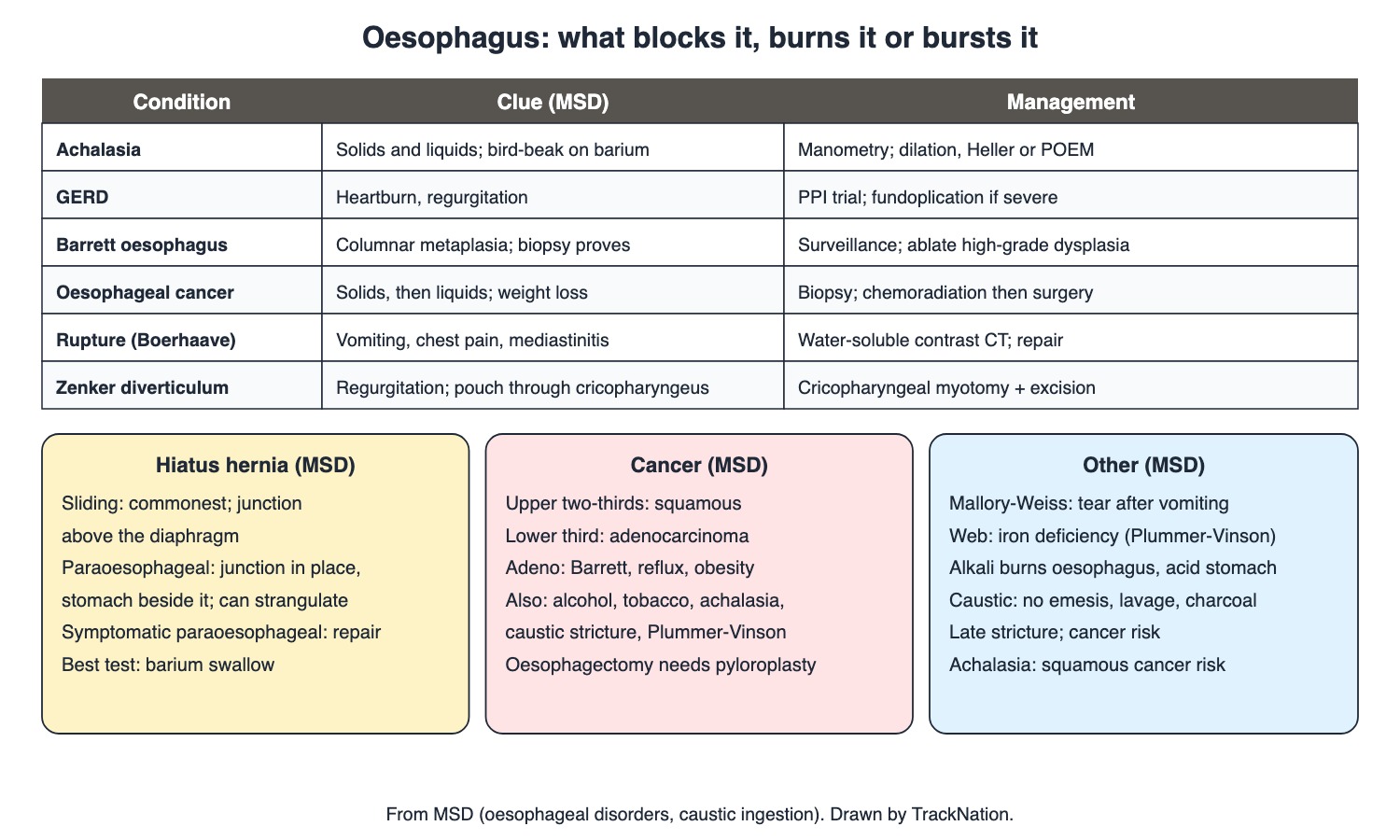
Oesophageal disorders at a glance. Drawn by TrackNation.
Achalasia (MSD)
Loss of myenteric ganglion cells → no peristalsis and an LES that fails to relax. Chagas disease and tumours (pseudoachalasia) can mimic it.
Slow dysphagia to both solids and liquids, nocturnal regurgitation of undigested food, aspiration, mild weight loss. Rapid dysphagia with marked weight loss in an older patient → think cancer at the GE junction.
High-resolution manometry is the test of choice (incomplete LES relaxation, absent peristalsis; types I–III). Barium: dilated oesophagus with a beak-like LES. Endoscope may "pop" through.
Treatment lowers LES pressure; nothing restores peristalsis. First line: pneumatic dilation, laparoscopic Heller myotomy (with fundoplication), or POEM (best for type III). Botulinum toxin for unfit patients; nitrates and CCBs do not work. Type II has the best prognosis. Raised squamous cancer risk.
GERD, Barrett and Hiatus Hernia (MSD)
GERD: LES incompetence and transient relaxations; worsened by obesity, smoking, fatty food, alcohol and drugs that lower LES pressure (anticholinergics, TCAs, CCBs, progesterone, nitrates). Heartburn and regurgitation; complications: oesophagitis (LA grades A–D), ulcer, peptic stricture (slowly progressive dysphagia to solids), Barrett, adenocarcinoma.
Typical symptoms → PPI trial; responders need no tests. Endoscopy if no response, long-standing symptoms or complications. Lifestyle: weight loss, no food within 4 h of bed, raise the bed head ~15 cm. PPIs beat H2 blockers.
Laparoscopic fundoplication for LA grade C/D, large hiatus hernia, bleeding, stricture, ulcer, or drug intolerance. Strictures: repeated endoscopic dilation.
Barrett oesophagus: columnar (intestinal) metaplasia replacing squamous epithelium; only biopsy proves it. Surveillance every 3–5 years without dysplasia; high-grade dysplasia → endoscopic ablation.
Hiatus hernia: sliding (commonest; GE junction above the diaphragm) vs paraoesophageal (GE junction in place; stomach beside it; can incarcerate and strangulate). Test of choice: barium swallow. Repair symptomatic paraoesophageal hernias; sliding hernia with GERD → reduction plus fundoplication.
Oesophageal Cancer (MSD)
Squamous in the upper two-thirds (commonest worldwide); adenocarcinoma in the lower third, mostly from Barrett; obesity and reflux raise it; alcohol matters little for adenocarcinoma. Other risks: tobacco, alcohol, achalasia, HPV, caustic stricture, Plummer-Vinson webs, tylosis, radiation.
Progressive dysphagia: solids → semisolids → liquids, weight loss, pain to the back, hoarseness (recurrent laryngeal nerve), tracheo-oesophageal fistula with aspiration.
Endoscopy and biopsy; CT and PET-CT for spread; then EUS for depth and nodes.
Tis/T1a → endoscopic resection; T1b → surgery alone; T2+ or node-positive → chemoradiation then surgery; stage IV → palliation. Oesophagectomy (gastric pull-up) needs pyloroplasty because of bilateral vagotomy; operative mortality ~5%. Radiation is contraindicated with a tracheo-oesophageal fistula.
Rupture, Diverticula, Tears, Webs and Caustics (MSD)
Rupture: most often after endoscopy; spontaneous after vomiting = Boerhaave, usually the distal left side. Chest pain, fever, shock, subcutaneous emphysema, Hamman crunch. Test: CT with water-soluble oral contrast (not barium). Antibiotics, fluids, stent or surgery; mortality 19–28%.
Zenker: posterior pouch through cricopharyngeus; regurgitation on bending, aspiration, neck mass → cricopharyngeal myotomy with diverticulectomy. Traction (mid-oesophagus; historically TB) and epiphrenic (with motility disorders) are rarely symptomatic.
Mallory-Weiss: non-penetrating mucosal tear after vomiting; haematemesis after non-bloody vomits; ~10% of upper GI bleeds; most stop on their own.
Web: upper oesophagus, dysphagia to solids; commonest cause severe iron deficiency (Plummer-Vinson).
Caustics: acid → coagulation necrosis (stomach more); alkali → liquefaction necrosis (oesophagus more). No mouth burns does not exclude deep injury → endoscopy once stable. No emesis, lavage, neutralisation or charcoal. Late strictures and higher cancer risk.
Traps the Examiner Sets
Achalasia: solids and liquids from the start; cancer: solids first, then liquids.
Paraoesophageal, not sliding, hernias strangulate.
Water-soluble contrast for suspected rupture, not barium.
Alkali burns the oesophagus; acid the stomach.
Memory Hooks & Shortcuts
Shortcuts to lock in this article's numbers and lists. Each one only re-packages facts proven above.
🧠 Achalasia: 'All at once' (solids and liquids); Cancer: 'Climbing' (solids, then liquids) — dysphagia
🧠 'Squamous on top, Adeno at the bottom' — cancer site
🧠 'Para Perils': paraoesophageal hernias strangulate — hiatus hernia
🧠 Boerhaave: 'Bursts Below, on the Left' — rupture
🧠 'Alkali: Liquefies the Lumen (oesophagus); Acid: Clots the Stomach' — caustics
Rapid-Revision Cards
Achalasia
Solids + liquids; LES won't relax.
Achalasia test
High-resolution manometry.
Barium
Bird-beak.
Pseudoachalasia
GE-junction tumour.
Achalasia Rx
Dilation, Heller + fundo, POEM.
Type III
POEM best.
LES-lowering drugs
CCB, nitrates, TCA, progesterone.
GERD first step
PPI trial.
Barrett proof
Biopsy.
Barrett HGD
Endoscopic ablation.
Fundoplication
LA C/D, stricture, bleed.
Paraoesophageal
Can strangulate; repair.
Hiatus test
Barium swallow.
Upper 2/3 cancer
Squamous.
Lower 1/3 cancer
Adenocarcinoma (Barrett).
Cancer dysphagia
Solids → liquids.
Oesophagectomy
Plus pyloroplasty.
TE fistula
No radiation.
Boerhaave
Distal left; Hamman; contrast CT.
Zenker
Through cricopharyngeus.
Alkali
Oesophagus; no emesis/charcoal.
Sources
Facts in this article were checked against these documents.
MSD Manual Professional: Achalasia; GERD; Hiatus Hernia; Esophageal Cancer; Esophageal Rupture; Esophageal Diverticula; Mallory-Weiss Syndrome; Esophageal Web; Caustic Ingestion — Merck & Co. (MSD Manuals), 2025–26 (link)
Competency Based Undergraduate Curriculum, Vol III: General Surgery (SU28) — National Medical Commission, 2024
Test Yourself: Practice Questions
Thirty questions in NEET PG style, most of them clinical vignettes.
Practice Questions (NEET PG pattern)
Original questions written in the style of the exam: +4 for a correct answer, −1 for a wrong one. Every answer was checked against the sources listed above. NEET PG papers are not published by NBEMS, so these are not past-paper questions.
Q1. A patient has slowly worsening dysphagia to both solids and liquids with regurgitation of undigested food at night. The likely diagnosis is
(a) Plummer-Vinson web
(b) oesophageal cancer
(c) achalasia
(d) peptic stricture
Show answer
Answer: (c) — Motility from the start.
Q2. The basic defect in achalasia is
(a) a mucosal web
(b) excess acid
(c) an LES that is too weak
(d) loss of myenteric ganglion cells with failed LES relaxation
Show answer
Answer: (d) — Denervation.
Q3. The preferred test to diagnose achalasia is
(a) barium meal follow-through
(b) high-resolution oesophageal manometry
(c) CT chest
(d) pH study
Show answer
Answer: (b) — Incomplete LES relaxation, no peristalsis.
Q4. Barium swallow in achalasia classically shows
(a) a posterior neck pouch
(b) an apple-core stricture
(c) a corkscrew oesophagus only
(d) a dilated oesophagus narrowing to a beak at the LES
Show answer
Answer: (d) — Bird-beak.
Q5. An older patient develops achalasia-like dysphagia over a few weeks with marked weight loss. Exclude
(a) a gastro-oesophageal junction tumour (pseudoachalasia)
(b) Zenker diverticulum
(c) hiatus hernia
(d) GERD
Show answer
Answer: (a) — Rapid course, weight loss.
Q6. Which is NOT a first-line treatment for achalasia?
(a) POEM
(b) oral nitrates or calcium channel blockers
(c) pneumatic dilation
(d) laparoscopic Heller myotomy
Show answer
Answer: (b) — Drugs are not effective.
Q7. When a surgical (Heller) myotomy is performed for achalasia, it is combined with
(a) vagotomy
(b) gastrectomy
(c) pyloromyotomy
(d) fundoplication
Show answer
Answer: (d) — To reduce reflux.
Q8. For spastic (type III) achalasia the most effective option is
(a) peroral endoscopic myotomy
(b) pneumatic dilation
(c) nifedipine
(d) botulinum toxin
Show answer
Answer: (a) — Longer myotomy.
Q9. Which drug class lowers LES pressure and can worsen reflux?
(a) prokinetics
(b) calcium channel blockers
(c) proton pump inhibitors
(d) H2 blockers
Show answer
Answer: (b) — Also nitrates, TCAs, progesterone.
Q10. A patient with typical heartburn and regurgitation and no symptoms of complications should first get
(a) fundoplication
(b) an empirical PPI trial
(c) manometry
(d) immediate endoscopy
Show answer
Answer: (b) — Responders need no tests.
Q11. Barrett oesophagus is confirmed by
(a) manometry
(b) endoscopic biopsy showing columnar metaplasia
(c) pH study
(d) barium swallow
Show answer
Answer: (b) — Only biopsy.
Q12. Barrett oesophagus with confirmed high-grade dysplasia in a fit patient is managed by
(a) endoscopic ablative therapy
(b) oesophagectomy for all
(c) surveillance every 5 years
(d) PPI alone
Show answer
Answer: (a) — Ablate.
Q13. Non-dysplastic Barrett oesophagus needs endoscopic surveillance every
(a) monthly
(b) 3–5 years
(c) 3 months
(d) never
Show answer
Answer: (b) — MSD.
Q14. An indication for laparoscopic fundoplication in GERD is
(a) achalasia type II
(b) Mallory-Weiss tear
(c) mild heartburn responding to PPI
(d) severe (LA grade C/D) oesophagitis or stricture
Show answer
Answer: (d) — Also bleeding, large hiatus hernia.
Q15. Slowly progressive dysphagia to solids only in a patient with long-standing heartburn suggests
(a) peptic stricture
(b) achalasia
(c) Zenker diverticulum
(d) Boerhaave
Show answer
Answer: (a) — Dilate endoscopically.
Q16. In a sliding hiatus hernia
(a) surgery is always needed
(b) strangulation is common
(c) the GE junction and part of the stomach lie above the diaphragm
(d) the GE junction stays in place
Show answer
Answer: (c) — Commonest type.
Q17. A hiatus hernia that can incarcerate and strangulate is
(a) sliding
(b) paraoesophageal
(c) neither
(d) both equally
Show answer
Answer: (b) — Repair if symptomatic.
Q18. The test of choice to diagnose a hiatus hernia is
(a) manometry alone
(b) barium swallow
(c) CT abdomen
(d) pH study
Show answer
Answer: (b) — Endoscopy is less sensitive.
Q19. A tumour of the lower third of the oesophagus arising in Barrett mucosa is most likely
(a) leiomyoma
(b) melanoma
(c) adenocarcinoma
(d) squamous cell carcinoma
Show answer
Answer: (c) — Upper two-thirds: squamous.
Q20. A smoker has difficulty swallowing solids, then soft food and now liquids, with weight loss. The next investigation is
(a) PPI trial
(b) endoscopy with biopsy
(c) manometry
(d) barium enema
Show answer
Answer: (b) — Progressive = malignant.
Q21. A patient with oesophageal cancer develops hoarseness. This is due to
(a) phrenic palsy
(b) laryngeal metastasis always
(c) vagal stimulation
(d) recurrent laryngeal nerve compression
Show answer
Answer: (d) — Advanced disease.
Q22. After CT and PET-CT show no metastases in oesophageal cancer, depth and nodes are assessed by
(a) barium swallow
(b) manometry
(c) bronchoscopy
(d) endoscopic ultrasound
Show answer
Answer: (d) — Guides therapy.
Q23. A T3 node-positive oesophageal cancer in a fit patient is best treated with
(a) radiation alone
(b) chemoradiation followed by surgery
(c) surgery alone
(d) endoscopic resection
Show answer
Answer: (b) — Neoadjuvant.
Q24. Pyloroplasty is added to oesophagectomy because
(a) it improves nodes harvest
(b) it prevents reflux
(c) it lowers cancer recurrence
(d) oesophagectomy causes bilateral vagotomy
Show answer
Answer: (d) — Gastric drainage.
Q25. Radiotherapy is contraindicated in oesophageal cancer with
(a) dysphagia
(b) hoarseness
(c) weight loss
(d) a tracheo-oesophageal fistula
Show answer
Answer: (d) — Shrinkage enlarges the fistula.
Q26. After forceful vomiting a man has severe chest pain, fever and a crunching sound with each heartbeat. Best test:
(a) barium swallow
(b) upper GI endoscopy first
(c) ECG only
(d) CT with water-soluble oral contrast
Show answer
Answer: (d) — Boerhaave; Hamman sign.
Q27. Spontaneous oesophageal rupture most often occurs in the
(a) mid-oesophagus on the right
(b) cervical oesophagus
(c) upper sphincter
(d) distal oesophagus on the left side
Show answer
Answer: (d) — Mediastinitis.
Q28. A patient regurgitates undigested food when bending and has a soft neck swelling. A posterior pouch through cricopharyngeus is
(a) achalasia
(b) Zenker diverticulum
(c) traction diverticulum
(d) epiphrenic diverticulum
Show answer
Answer: (b) — Myotomy and excision.
Q29. After an alcohol binge with repeated non-bloody vomiting, a patient vomits fresh blood. Likely cause:
(a) variceal bleed always
(b) Boerhaave rupture
(c) oesophageal cancer
(d) Mallory-Weiss tear
Show answer
Answer: (d) — ~10% of upper GI bleeds.
Q30. A child swallowed a liquid alkaline drain cleaner and has no mouth burns. Correct statement:
(a) absence of oral burns does not exclude oesophageal injury; avoid emesis and charcoal
(b) neutralise with acid
(c) induce vomiting
(d) no mouth burns means no injury
Show answer
Answer: (a) — Endoscopy when stable.
Active Recall
From memory: describe achalasia and its tests and treatment, outline GERD, Barrett and hiatus hernia management, contrast squamous and adenocarcinoma of the oesophagus with presentation, staging and treatment, and summarise rupture, Zenker diverticulum, Mallory-Weiss and caustic injury.