Gallbladder, Bile Ducts and Pancreas for NEET PG Surgery: Gallstones, Cholecystitis, Cholangitis, CBD Stones, Pancreatitis and Pancreatic Cancer
Start Here
🎯 Exam priority: High. Expect: ultrasound for gallstones, colic vs cholecystitis, Murphy sign, HIDA for acalculous disease, early vs delayed laparoscopic cholecystectomy (ICMR), cholecystectomy for silent stones, Mirizzi, CBD stones (MRCP, ERCP, T-tube), Charcot and Reynolds, Klatskin tumour, porcelain gallbladder, gallstone pancreatitis timing, pancreatic head cancer and Whipple, and Kasai for biliary atresia.
CBME mapping: SU28.12 (biliary system) and SU24.1 (pancreatitis). Indian anchor: ICMR STWs on gallstone disease and CBD stones (2022).
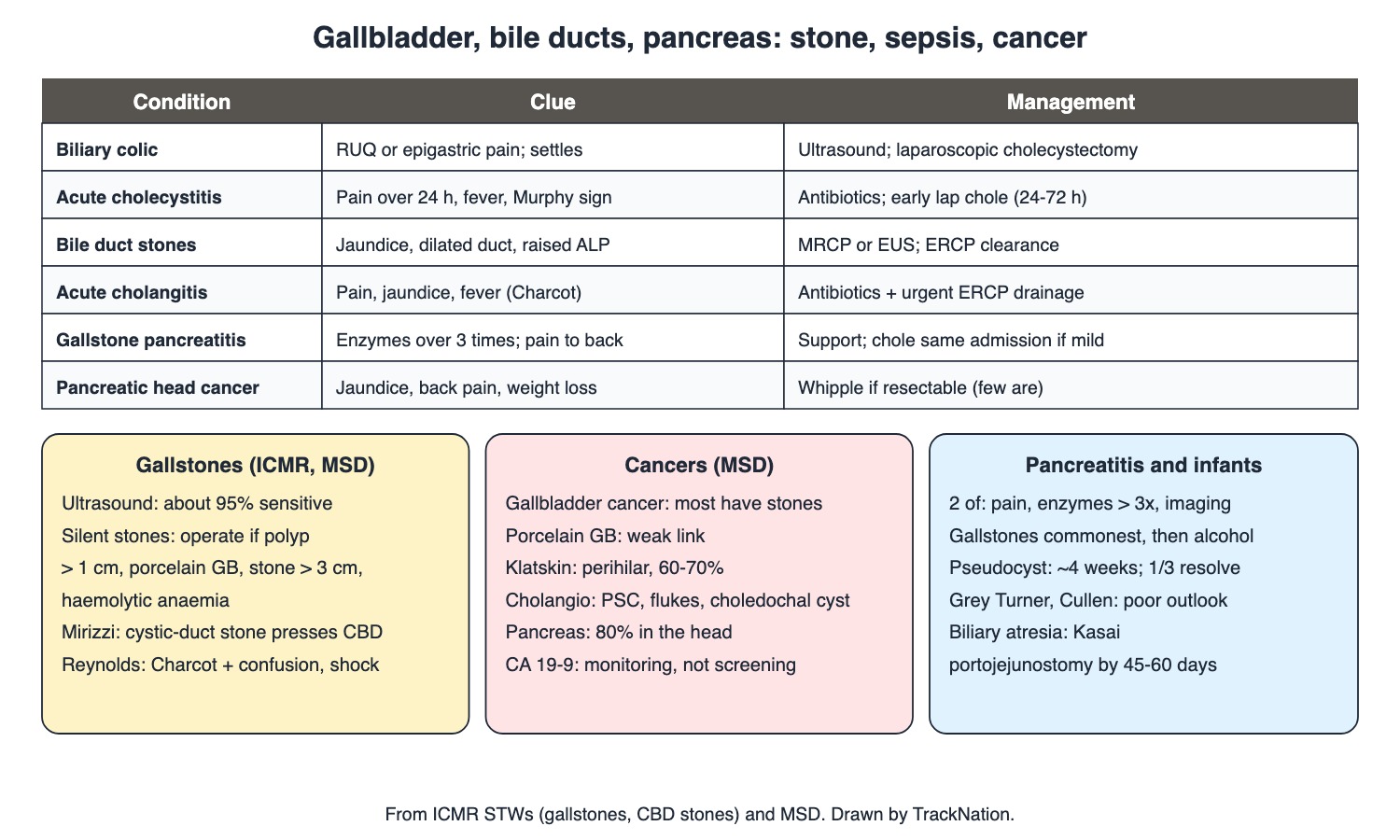
Gallbladder, bile duct and pancreatic conditions at a glance. Drawn by TrackNation.
Gallstones and Cholecystitis (ICMR, MSD)
Risk: female sex, obesity, older age, inactivity, insulin resistance, family history; cholesterol stones >85% in the West; sludge with pregnancy or parenteral nutrition. Ultrasound is the investigation of choice (~95% sensitive).
Biliary colic: RUQ/epigastric crescendo pain that settles. Acute cholecystitis: pain >24 h with fever, right subcostal tenderness, Murphy sign (inspiration halts on palpation); ultrasound shows wall thickening and pericholecystic fluid; HIDA (cholescintigraphy) if ultrasound equivocal or acalculous disease suspected.
Acalculous cholecystitis (5–10%): critically ill, burns, sepsis, trauma, prolonged fasting/TPN.
ICMR: symptomatic stones → laparoscopic cholecystectomy. Acute cholecystitis: antibiotics (third-generation cephalosporin + metronidazole ± aminoglycoside), then early LC within 24–72 h if expertise is available, otherwise delayed LC after 6 weeks; unstable or non-resolving → cholecystostomy. Convert early if in doubt.
Asymptomatic stones — operate (ICMR absolute) for polyp >1 cm, porcelain gallbladder, stones >3 cm, chronic haemolytic anaemia, transplant patients, concomitant malignancy. Oral bile acids only for small radiolucent stones in a working gallbladder.
Complications: empyema, gangrene, perforation, Mirizzi syndrome (cystic-duct stone compresses the CBD → jaundice; MRCP), cholecystoenteric fistula and gallstone ileus.
Bile Duct Stones and Cholangitis (ICMR, MSD)
Up to 10% of symptomatic gallstone patients have CBD stones. Secondary (cholesterol, from gallbladder) vs primary (brown pigment, formed in ducts). Suspect with jaundice, deranged LFTs, dilated CBD, cholangitis or pancreatitis. MRCP or EUS is the investigation of choice before intervention.
Acute cholangitis is a surgical emergency: Charcot triad — pain, jaundice, fever/chills; add confusion and hypotension = Reynolds pentad. Gram-negatives (E. coli, Klebsiella). Antibiotics and urgent drainage by ERCP.
Options: ERCP with sphincterotomy and clearance then laparoscopic cholecystectomy, or laparoscopic/open CBD exploration with cholecystectomy. After exploration: primary closure, stent, or T-tube (purulent cholangitis, incomplete clearance); drainage (choledochoduodenostomy, hepaticojejunostomy) for multiple stones, hepatolithiasis, CBD >2 cm.
ICMR red flags: palpable gallbladder with jaundice → think malignancy; grossly dilated CBD → think choledochal cyst. Recurrent pyogenic cholangitis (intrahepatic brown stones) is seen in Asians.
Tumours, Pancreatitis and Biliary Atresia (MSD, ICMR)
Gallbladder cancer: commoner in older people, women and those with gallstones (stones in 69–95%); porcelain gallbladder is a weak link; cure if found early (incidentally at cholecystectomy). Polyps >10 mm → cholecystectomy. Cholangiocarcinoma: 60–70% perihilar (Klatskin); risks PSC, liver flukes, choledochal cyst, cirrhosis.
Acute pancreatitis: 2 of — typical pain, amylase/lipase >3× normal, imaging. Gallstones are the commonest cause, alcohol second; also hypertriglyceridaemia, hypercalcaemia, ERCP. Collections encapsulate at ~4 weeks: pseudocyst (fluid; a third resolve) vs walled-off necrosis. Grey Turner/Cullen signs are rare and ominous. ICMR: mild gallstone pancreatitis → cholecystectomy in the same admission; severe → after 4–6 weeks.
Pancreatic cancer: ductal adenocarcinoma, 80% in the head; smoking, chronic pancreatitis, obesity. Upper pain to the back, weight loss, obstructive jaundice in 80–90% of head tumours, new diabetes; body/tail → splenic vein block. Pancreas-protocol CT or MRI → EUS-FNA; CA 19-9 for monitoring, not screening. 80–90% unresectable at diagnosis. Head: Whipple; body/tail: distal pancreatectomy.
Biliary atresia: progressive sclerosis of extrahepatic ducts; Kasai portojejunostomy before 45–60 days, else transplant.
Traps the Examiner Sets
Charcot = pain, jaundice, fever; Reynolds adds confusion and shock.
Palpable gallbladder with jaundice suggests malignancy, not stones.
CA 19-9 monitors pancreatic cancer; it does not screen.
Mild gallstone pancreatitis: remove the gallbladder before discharge.
Memory Hooks & Shortcuts
Shortcuts to lock in this article's numbers and lists. Each one only re-packages facts proven above.
🧠 Charcot 'PJF' (Pain, Jaundice, Fever) + 'CS' (Confusion, Shock) = Reynolds — cholangitis
🧠 'Mirizzi: the neighbour (cystic duct) squeezes the main road (CBD)' — Mirizzi
🧠 ICMR: 'Hot gallbladder: cut early (24–72 h) or wait 6 weeks' — timing
🧠 'Palpable GB + yellow = suspect tumour' — malignancy
🧠 'Kasai before the second month' — biliary atresia
Rapid-Revision Cards
Gallstone test
Ultrasound (~95%).
Cholecystitis
>24 h pain, fever, Murphy.
Acalculous
ICU, TPN; HIDA.
ICMR timing
Early LC 24–72 h; else after 6 wk.
Silent stones op
Polyp >1 cm, porcelain, >3 cm.
Mirizzi
Cystic-duct stone compresses CBD.
Gallstone ileus
Fistula; SBO.
CBD stones
Up to 10%; MRCP/EUS.
Charcot
Pain, jaundice, fever.
Reynolds
+ confusion, hypotension.
Cholangitis Rx
Antibiotics + ERCP.
T-tube
Purulent cholangitis.
Palpable GB + jaundice
Think malignancy.
Klatskin
Perihilar cholangiocarcinoma.
GB cancer
Gallstones in most.
Pancreatitis Dx
2 of pain, enzymes >3×, imaging.
Commonest cause
Gallstones; then alcohol.
Mild biliary pancreatitis
Chole same admission.
Pancreatic cancer
80% head; jaundice.
CA 19-9
Monitoring only.
Biliary atresia
Kasai by 45–60 days.
Sources
Facts in this article were checked against these documents.
Standard Treatment Workflows: Gall Stone Disease; Common Bile Duct Stone — ICMR / Department of Health Research, 2022
MSD Manual Professional: Cholelithiasis; Acute Cholecystitis; Choledocholithiasis and Cholangitis; Tumors of the Gallbladder and Bile Ducts; Pancreatic Cancer; Acute Pancreatitis; Biliary Atresia — Merck & Co. (MSD Manuals), 2025–26 (link)
Competency Based Undergraduate Curriculum, Vol III: General Surgery (SU24, SU28) — National Medical Commission, 2024
Test Yourself: Practice Questions
Thirty questions in NEET PG style, most of them clinical vignettes.
Practice Questions (NEET PG pattern)
Original questions written in the style of the exam: +4 for a correct answer, −1 for a wrong one. Every answer was checked against the sources listed above. NEET PG papers are not published by NBEMS, so these are not past-paper questions.
Q1. The investigation of choice for suspected gallstones is
(a) ERCP
(b) CT abdomen
(c) abdominal ultrasound
(d) oral cholecystography
Show answer
Answer: (c) — About 95% sensitive.
Q2. RUQ pain for over 24 hours with fever and a catch in inspiration on palpating the RUQ indicates
(a) pancreatitis
(b) biliary colic
(c) acute cholecystitis
(d) peptic ulcer
Show answer
Answer: (c) — Murphy sign.
Q3. Ultrasound findings that indicate acute inflammation of the gallbladder are
(a) a target sign
(b) free gas
(c) wall thickening and pericholecystic fluid
(d) a dilated pancreatic duct
Show answer
Answer: (c) — Ultrasonographic Murphy.
Q4. A critically ill ICU patient on parenteral nutrition develops fever and RUQ tenderness; ultrasound shows no stones. Suspect
(a) acalculous cholecystitis
(b) choledochal cyst
(c) biliary colic
(d) Klatskin tumour
Show answer
Answer: (a) — HIDA helps.
Q5. Per ICMR, a patient with acute calculous cholecystitis presenting early, where laparoscopic expertise is available, should have
(a) ERCP
(b) early laparoscopic cholecystectomy within 24–72 hours
(c) oral bile acids
(d) cholecystectomy only after 6 months
Show answer
Answer: (b) — Else delayed after 6 weeks.
Q6. Which asymptomatic gallstone patient should have cholecystectomy per ICMR?
(a) everyone over 40
(b) one with a single 1 cm stone
(c) one with a gallbladder polyp larger than 1 cm
(d) one with incidental sludge
Show answer
Answer: (c) — Also porcelain GB, stones >3 cm.
Q7. Large gallstones over 3 cm or a porcelain gallbladder are reasons for prophylactic cholecystectomy because they raise the risk of
(a) pancreatitis
(b) gallbladder carcinoma
(c) cholangitis
(d) hepatitis
Show answer
Answer: (b) — MSD.
Q8. Jaundice from a stone impacted in the cystic duct compressing the common bile duct is
(a) Klatskin tumour
(b) Bouveret syndrome
(c) Mirizzi syndrome
(d) Caroli disease
Show answer
Answer: (c) — MRCP indication.
Q9. Small-bowel obstruction from a large stone that eroded through a cholecystoenteric fistula is
(a) gallstone ileus
(b) Mirizzi syndrome
(c) Ogilvie syndrome
(d) volvulus
Show answer
Answer: (a) — Enterotomy.
Q10. About what proportion of patients with symptomatic gallstones also have CBD stones?
(a) 50%
(b) up to 10%
(c) never
(d) 90%
Show answer
Answer: (b) — Look for jaundice, dilated duct.
Q11. Before intervention for suspected CBD stones, ICMR's investigation of choice is
(a) oral cholecystogram
(b) plain X-ray
(c) HIDA scan
(d) MRCP or endoscopic ultrasound
Show answer
Answer: (d) — Roadmap for intervention.
Q12. A patient with gallstones has RUQ pain, jaundice and high fever with rigors. This triad is
(a) Reynolds pentad
(b) Whipple triad
(c) Charcot triad — acute cholangitis
(d) Beck triad
Show answer
Answer: (c) — Surgical emergency.
Q13. The same patient becomes confused and hypotensive. This is
(a) Mirizzi syndrome
(b) simple biliary colic
(c) hepatic encephalopathy only
(d) Reynolds pentad — needs urgent biliary drainage
Show answer
Answer: (d) — ERCP.
Q14. Definitive treatment for obstructing CBD stones with cholangitis is
(a) observation
(b) oral ursodeoxycholic acid
(c) ERCP with sphincterotomy and stone extraction
(d) cholecystostomy alone
Show answer
Answer: (c) — Then cholecystectomy.
Q15. After CBD exploration for purulent cholangitis, the duct is usually closed over a
(a) T-tube
(b) nasogastric tube
(c) Foley catheter
(d) nothing
Show answer
Answer: (a) — ICMR.
Q16. Per ICMR, a palpable gallbladder in a jaundiced patient should raise suspicion of
(a) malignancy
(b) Gilbert syndrome
(c) simple gallstones
(d) hepatitis
Show answer
Answer: (a) — Refer.
Q17. A grossly dilated CBD without stones suggests
(a) biliary colic
(b) HCC
(c) Mirizzi
(d) choledochal cyst
Show answer
Answer: (d) — Refer to higher centre.
Q18. Cholangiocarcinoma at the hepatic duct bifurcation is called
(a) Klatskin tumour
(b) Pancoast tumour
(c) Courvoisier tumour
(d) Frantz tumour
Show answer
Answer: (a) — 60–70% perihilar.
Q19. A risk factor for cholangiocarcinoma is
(a) primary sclerosing cholangitis
(b) gallbladder polyp under 5 mm
(c) hepatitis A
(d) Gilbert syndrome
Show answer
Answer: (a) — Also flukes, choledochal cyst.
Q20. Gallbladder carcinoma is most often associated with
(a) peptic ulcer
(b) gallstones (69–95% of patients)
(c) hepatitis B
(d) alcohol alone
Show answer
Answer: (b) — Older women.
Q21. The diagnosis of acute pancreatitis needs two of: typical pain, imaging findings, and serum amylase/lipase above
(a) 1.5 times normal
(b) 10 times normal
(c) 3 times normal
(d) any rise
Show answer
Answer: (c) — MSD.
Q22. The commonest cause of acute pancreatitis is
(a) drugs
(b) hypertriglyceridaemia
(c) gallstones
(d) alcohol
Show answer
Answer: (c) — Alcohol is second.
Q23. Per ICMR, after mild gallstone pancreatitis settles, laparoscopic cholecystectomy should be done
(a) only if pain recurs
(b) never
(c) after 6 months
(d) in the same hospital admission
Show answer
Answer: (d) — Severe: after 4–6 weeks.
Q24. A fluid-only collection with a fibrous wall 4 weeks after acute pancreatitis is a
(a) abscess
(b) pseudocyst
(c) walled-off necrosis
(d) choledochal cyst
Show answer
Answer: (b) — A third resolve.
Q25. Flank ecchymoses in acute pancreatitis are called
(a) Cullen sign
(b) Kehr sign
(c) Murphy sign
(d) Grey Turner sign
Show answer
Answer: (d) — Cullen = umbilical.
Q26. Most pancreatic adenocarcinomas arise in the
(a) uncinate process only
(b) tail
(c) head (80%)
(d) body
Show answer
Answer: (c) — Jaundice in 80–90%.
Q27. A smoker with weight loss, back-radiating upper abdominal pain, obstructive jaundice and new diabetes most likely has
(a) carcinoma of the head of the pancreas
(b) gallstones
(c) peptic ulcer
(d) chronic hepatitis
Show answer
Answer: (a) — Pancreas-protocol CT.
Q28. Tissue diagnosis and resectability in pancreatic cancer are best assessed by
(a) endoscopic ultrasound with FNA
(b) plain X-ray
(c) HIDA scan
(d) CA 19-9 alone
Show answer
Answer: (a) — After CT/MRI.
Q29. CA 19-9 in pancreatic cancer is used for
(a) deciding on Whipple alone
(b) monitoring, not screening
(c) diagnosis without imaging
(d) population screening
Show answer
Answer: (b) — MSD.
Q30. An infant with persistent jaundice and pale stools has biliary atresia. For the best chance of keeping the native liver, Kasai portojejunostomy should be done
(a) only after cirrhosis
(b) never; transplant first
(c) after 1 year
(d) before 45–60 days of life
Show answer
Answer: (d) — Cirrhosis by 2 months.
Active Recall
From memory: describe the diagnosis and ICMR management of gallstones and acute cholecystitis, indications for cholecystectomy in silent stones, CBD stones and cholangitis, gallbladder and bile duct cancers, acute pancreatitis and its surgical timing, pancreatic cancer, and biliary atresia.