Stomach and Duodenum for NEET PG Surgery: Peptic Ulcer and Its Complications, Stomach Cancer, GIST, Pyloric Stenosis and Bariatric Surgery
Start Here
🎯 Exam priority: High. Expect: duodenal vs gastric ulcer pain, biopsy of gastric not duodenal ulcers, perforated ulcer (anterior duodenal wall, board-like abdomen, free air), gastric outlet obstruction with alkalosis and succussion splash, highly selective vagotomy, Billroth I/II and dumping, stomach cancer risks and nodes, linitis plastica, CDH1, GIST markers and imatinib, pyloric stenosis, and bariatric criteria.
CBME mapping: SU28.7–28.9 (anatomy and examination, congenital hypertrophic pyloric stenosis, peptic ulcer, carcinoma stomach).
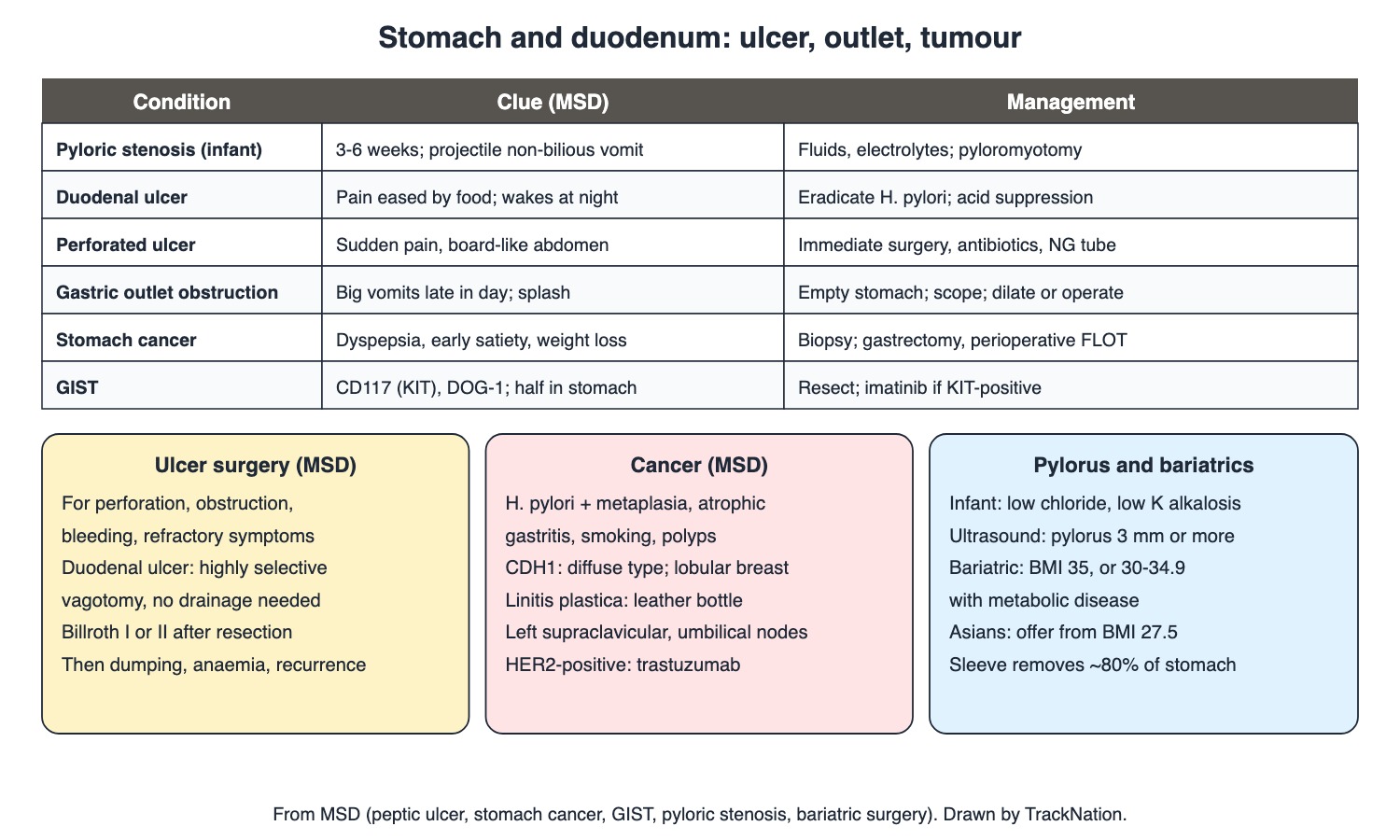
Stomach and duodenal conditions at a glance. Drawn by TrackNation.
Peptic Ulcer and Its Complications (MSD)
Almost all ulcers: H. pylori or NSAIDs; rarely gastrinoma (Zollinger-Ellison). An ulcer goes through the muscularis mucosae; an erosion does not.
Duodenal ulcer: pain absent on waking, mid-morning, relieved by food, back 2–3 h later; night pain strongly suggests it. Gastric ulcer: inconsistent; food may worsen pain. Biopsy gastric ulcers (cancer can mimic, especially >60 years, weight loss); duodenal ulcers are almost never malignant.
Bleeding is the commonest complication. Penetration into lesser sac, pancreas or liver. Free perforation: usually the anterior duodenal wall; sudden epigastric pain spreading over the abdomen, lies still, board-like rigidity; free air (lateral chest film most sensitive) — its absence does not exclude it. Immediate surgery, antibiotics, NG suction.
Gastric outlet obstruction: large vomits late in the day (up to 6 h after food), early fullness, weight loss, dehydration, alkalosis; succussion splash >6 h after a meal or >200 mL residue after an overnight fast. Empty the stomach, endoscopy or CT; balloon dilation; surgery in selected cases.
Recurrence at 3 years: <10% if H. pylori is eradicated, >50% if not.
Surgery (now rare): perforation, obstruction, uncontrolled or recurrent bleeding, refractory symptoms. For duodenal ulcer, highly selective (parietal cell) vagotomy — spares the antrum, so no drainage procedure. Resections (antrectomy, partial gastrectomy) with truncal vagotomy need drainage: Billroth I (gastroduodenostomy) or II (gastrojejunostomy). Up to 30% then have weight loss, anaemia, dumping, bilious vomiting or recurrence.
Stomach Cancer and GIST (MSD)
Adenocarcinoma is 95% of gastric malignancy. Risks: H. pylori with intestinal metaplasia, autoimmune atrophic gastritis, smoking, adenomatous polyps (>2 cm or villous), genetic syndromes. CDH1 (hereditary diffuse gastric cancer): autosomal dominant, young onset, lobular breast cancer in women; prophylactic gastrectomy for carriers aged 18–40.
Gross types include linitis plastica ("leather bottle"); protruding tumours do better than spreading ones.
Early symptoms mimic ulcer dyspepsia; later early satiety, weight loss, anaemia, dysphagia (cardia). Late signs: epigastric mass, umbilical, left supraclavicular or left axillary nodes, liver, ovarian or rectal mass.
Endoscopy with multiple biopsies → CT chest/abdomen → EUS for depth and nodes; CEA before and after surgery; endoscopic screening in high-risk countries such as Japan.
Curative: subtotal or total gastrectomy with nodes plus perioperative FLOT. Palliation: gastroenterostomy for pyloric obstruction. HER2-positive advanced disease: trastuzumab.
GIST: from interstitial cells of Cajal; C-KIT (or PDGFRA) mutation; stomach 51%, small bowel 36%; CD117 and DOG-1 positive; <2 cm low risk. Resect localised tumours; imatinib for unresectable/metastatic or as adjuvant (usually 3 years).
Pyloric Stenosis and Bariatric Surgery (MSD)
Infantile hypertrophic pyloric stenosis: boys 5:1 (firstborn), 3–6 weeks; early erythromycin raises risk. Projectile non-bilious vomiting after feeds, hungry baby, visible peristalsis left to right, olive-like mass in the right epigastrium. Hypochloraemic hypokalaemic metabolic alkalosis. Ultrasound: pylorus ≥3 mm thick and long; contrast shows a string sign. Correct fluids and electrolytes first, then longitudinal pyloromyotomy leaving mucosa intact.
Bariatric surgery (IFSO): BMI ≥35 regardless of disease, or 30–34.9 with metabolic disease; in Asians, offer at BMI ≥27.5. Sleeve gastrectomy removes ~80% of the stomach (less ghrelin); Roux-en-Y bypass is especially good for diabetes. Complications: leak, bleeding, dumping after sugary/fatty food, marginal ulcer (NSAIDs, smoking), internal hernia. Monitor vitamin D, B12, folate, iron.
Traps the Examiner Sets
Biopsy a gastric ulcer, not a duodenal one.
No free air does not rule out perforation.
Pyloric stenosis vomit is non-bilious; electrolytes before pyloromyotomy.
Highly selective vagotomy needs no drainage; truncal vagotomy does.
Memory Hooks & Shortcuts
Shortcuts to lock in this article's numbers and lists. Each one only re-packages facts proven above.
🧠 Duodenal ulcer: 'Dinner Decreases pain'; Gastric: 'Grub Gives pain' — ulcer pain
🧠 'Biopsy the Belly (stomach), spare the Duodenum' — biopsy
🧠 'Anterior = Air': anterior duodenal ulcers perforate freely and give free gas — complications
🧠 Pyloric stenosis: 'First-born boy, Fourth week, Forceful vomit, Fluids first' — infant
🧠 GIST: 'KIT Kat for the Cajal cat' — CD117, imatinib — GIST
Rapid-Revision Cards
Ulcer causes
H. pylori, NSAIDs.
Duodenal ulcer
Eased by food; night pain.
Biopsy
Gastric ulcers, not duodenal.
Commonest complication
Bleeding.
Perforation site
Anterior duodenal wall.
No free air
Does not exclude perforation.
Penetration
Pancreas, liver, lesser sac.
Outlet obstruction
Late vomits; splash > 6 h; alkalosis.
Recurrence
<10% if H. pylori cleared.
DU operation
Highly selective vagotomy.
Billroth I / II
Gastroduodenostomy / gastrojejunostomy.
Dumping
After sugar/fat; sweating, diarrhoea.
Gastric cancer
95% adenocarcinoma.
CDH1
Diffuse gastric + lobular breast.
Linitis plastica
Leather bottle.
Spread nodes
Left supraclavicular, umbilical.
Gastric cancer Rx
Gastrectomy + FLOT.
GIST
CD117, DOG-1; imatinib.
Pyloric stenosis
3–6 wk; projectile non-bilious.
PS electrolytes
Low Cl, low K, alkalosis.
Asian bariatric
BMI ≥ 27.5.
Sources
Facts in this article were checked against these documents.
MSD Manual Professional: Peptic Ulcer Disease; Stomach Cancer; Gastrointestinal Stromal Tumors; Hypertrophic Pyloric Stenosis; Metabolic and Bariatric Surgery — Merck & Co. (MSD Manuals), 2025 (link)
Competency Based Undergraduate Curriculum, Vol III: General Surgery (SU28) — National Medical Commission, 2024
Test Yourself: Practice Questions
Thirty questions in NEET PG style, most of them clinical vignettes.
Practice Questions (NEET PG pattern)
Original questions written in the style of the exam: +4 for a correct answer, −1 for a wrong one. Every answer was checked against the sources listed above. NEET PG papers are not published by NBEMS, so these are not past-paper questions.
Q1. Nearly all peptic ulcers are caused by
(a) H. pylori or NSAIDs
(b) gastrinoma
(c) stress alone
(d) spicy food
Show answer
Answer: (a) — Gastrinoma is rare.
Q2. A patient's epigastric pain is absent on waking, starts mid-morning, eases with food, returns 2–3 hours later and wakes them at night. Likely:
(a) gastric cancer
(b) duodenal ulcer
(c) GERD
(d) gastric ulcer
Show answer
Answer: (b) — Night pain.
Q3. At endoscopy, which ulcer should be biopsied to exclude cancer?
(a) neither
(b) duodenal ulcer
(c) gastric ulcer
(d) both always
Show answer
Answer: (c) — Malignant duodenal ulcers are very rare.
Q4. The commonest complication of peptic ulcer disease is
(a) malignant change
(b) haemorrhage
(c) perforation
(d) gastric outlet obstruction
Show answer
Answer: (b) — Haematemesis or melena.
Q5. Free perforation of a peptic ulcer most often involves the
(a) fundus
(b) greater curve
(c) posterior duodenal wall
(d) anterior wall of the duodenum
Show answer
Answer: (d) — Posterior ulcers penetrate.
Q6. A patient with ulcer history has sudden severe epigastric pain, lies still, and has a board-like abdomen. Upright X-ray shows no free air. Next:
(a) proceed as perforation; absence of free air does not exclude it
(b) barium meal
(c) start PPI and observe at home
(d) discharge
Show answer
Answer: (a) — CT or surgery.
Q7. A chronic ulcer erodes through the duodenal wall into the pancreas, without free leakage into the peritoneum. This is
(a) penetration (confined perforation)
(b) free perforation
(c) outlet obstruction
(d) malignant change
Show answer
Answer: (a) — Pain may be referred elsewhere.
Q8. A man with a long ulcer history vomits large volumes of stale food in the evening; a splash is heard 6 hours after a meal. Diagnosis:
(a) achalasia
(b) gastric outlet obstruction
(c) small-bowel obstruction
(d) gastroparesis from diabetes only
Show answer
Answer: (b) — Retention.
Q9. The acid–base disturbance expected after prolonged vomiting from gastric outlet obstruction is
(a) normal
(b) metabolic alkalosis
(c) respiratory acidosis
(d) metabolic acidosis
Show answer
Answer: (b) — Loss of acid.
Q10. After successful H. pylori eradication, the 3-year ulcer recurrence rate is about
(a) 100%
(b) over 50%
(c) 25%
(d) under 10%
Show answer
Answer: (d) — Over 50% if not eradicated.
Q11. Which is NOT a standard indication for peptic ulcer surgery?
(a) perforation
(b) first uncomplicated duodenal ulcer
(c) recurrent bleeding
(d) outlet obstruction
Show answer
Answer: (b) — Medical treatment first.
Q12. The recommended elective operation for duodenal ulcer that needs no drainage procedure is
(a) total gastrectomy
(b) highly selective (parietal cell) vagotomy
(c) Whipple procedure
(d) truncal vagotomy alone
Show answer
Answer: (b) — Spares antral nerves.
Q13. After partial gastrectomy, reconstruction by gastrojejunostomy is called
(a) Billroth I
(b) Heller
(c) Billroth II
(d) Roux-en-Y hepaticojejunostomy
Show answer
Answer: (c) — Billroth I = gastroduodenostomy.
Q14. Sweating, light-headedness, cramps and diarrhoea soon after a sugary meal following gastric surgery suggest
(a) afferent loop obstruction
(b) anastomotic leak
(c) gastric cancer recurrence
(d) dumping syndrome
Show answer
Answer: (d) — High-sugar, high-fat food.
Q15. The commonest malignant tumour of the stomach is
(a) carcinoid
(b) adenocarcinoma (95%)
(c) lymphoma
(d) GIST
Show answer
Answer: (b) — MSD.
Q16. A risk factor for gastric cancer is
(a) H. pylori with extensive intestinal metaplasia
(b) high-fibre diet
(c) blood group O only
(d) duodenal ulcer
Show answer
Answer: (a) — Also atrophic gastritis, smoking.
Q17. A young woman with a family history of diffuse gastric cancer and lobular breast cancer likely carries a mutation in
(a) APC
(b) RET
(c) CDH1
(d) BRCA2 only
Show answer
Answer: (c) — Offer prophylactic gastrectomy.
Q18. A rigid, non-distensible 'leather bottle' stomach from diffuse infiltration is
(a) bezoar
(b) linitis plastica
(c) Ménétrier disease
(d) gastric volvulus
Show answer
Answer: (b) — Fibrous reaction.
Q19. A left supraclavicular node in a patient with weight loss and early satiety points to
(a) tuberculosis only
(b) stomach cancer
(c) Hodgkin lymphoma always
(d) thyroid cancer
Show answer
Answer: (b) — Also umbilical, left axillary nodes.
Q20. In confirmed gastric cancer with no metastases on CT, the next staging test is
(a) colonoscopy
(b) endoscopic ultrasound
(c) PET alone
(d) barium meal
Show answer
Answer: (b) — Depth and nodes.
Q21. Curative treatment of a resectable gastric adenocarcinoma is
(a) imatinib
(b) gastrectomy with lymphadenectomy and perioperative FLOT
(c) endoscopic stent
(d) radiation alone
Show answer
Answer: (b) — Subtotal or total.
Q22. Advanced HER2-positive gastric cancer may be treated with chemotherapy plus
(a) tamoxifen
(b) rituximab
(c) imatinib
(d) trastuzumab
Show answer
Answer: (d) — Targets HER2.
Q23. A submucosal gastric tumour stains positive for CD117 and DOG-1. It is a
(a) adenocarcinoma
(b) lymphoma
(c) lipoma
(d) GIST
Show answer
Answer: (d) — Cajal cells.
Q24. GISTs arise from
(a) interstitial cells of Cajal
(b) G cells
(c) lymphoid follicles
(d) parietal cells
Show answer
Answer: (a) — Mesenchymal.
Q25. An unresectable KIT-positive GIST is treated with
(a) trastuzumab
(b) imatinib
(c) FLOT
(d) radiation alone
Show answer
Answer: (b) — Also adjuvant for 3 years.
Q26. A 4-week-old firstborn boy has projectile non-bilious vomiting after every feed and is hungry afterwards. Most likely:
(a) duodenal atresia
(b) hypertrophic pyloric stenosis
(c) GERD
(d) malrotation with volvulus
Show answer
Answer: (b) — 3–6 weeks.
Q27. The classical electrolyte picture in infantile pyloric stenosis is
(a) hyperkalaemic acidosis
(b) hyperchloraemic acidosis
(c) hypochloraemic hypokalaemic metabolic alkalosis
(d) normal
Show answer
Answer: (c) — HCl loss.
Q28. The investigation of choice for suspected infantile pyloric stenosis is
(a) CT abdomen
(b) abdominal ultrasound (pylorus ≥3 mm thick)
(c) endoscopy first
(d) barium enema
Show answer
Answer: (b) — Contrast: string sign.
Q29. In an infant with pyloric stenosis and alkalosis, the first step is
(a) gastrojejunostomy
(b) correct fluids and electrolytes, then pyloromyotomy
(c) antacids
(d) immediate pyloromyotomy
Show answer
Answer: (b) — Mucosa left intact.
Q30. Per IFSO guidance cited by MSD, bariatric surgery should be offered to Asian patients from a BMI of
(a) 27.5 kg/m²
(b) 50 kg/m²
(c) 22 kg/m²
(d) 40 kg/m²
Show answer
Answer: (a) — Others: ≥35, or 30–34.9 with metabolic disease.
Active Recall
From memory: contrast duodenal and gastric ulcers, describe bleeding, perforation, penetration and outlet obstruction with management, outline ulcer surgery and its sequelae, summarise stomach cancer risks, spread, staging and treatment, and describe GIST, infantile pyloric stenosis and bariatric surgery criteria.