Hernias for NEET PG Surgery: Indirect vs Direct Inguinal, Femoral, Umbilical, Incisional, Strangulation and Mesh Repair
Start Here
🎯 Exam priority: High. Expect: indirect vs direct inguinal hernia and the inferior epigastric vessels, Hesselbach triangle, femoral hernia in women and its strangulation risk, incarceration vs strangulation, Lichtenstein and laparoscopic mesh repair, watchful waiting, umbilical hernia in infants, incisional hernia mesh rules, and the child with an inguinal hernia.
CBME mapping: SU28.1–28.2. Primary Indian sources: ICMR STWs (2022) on ventral and congenital inguinal hernia.
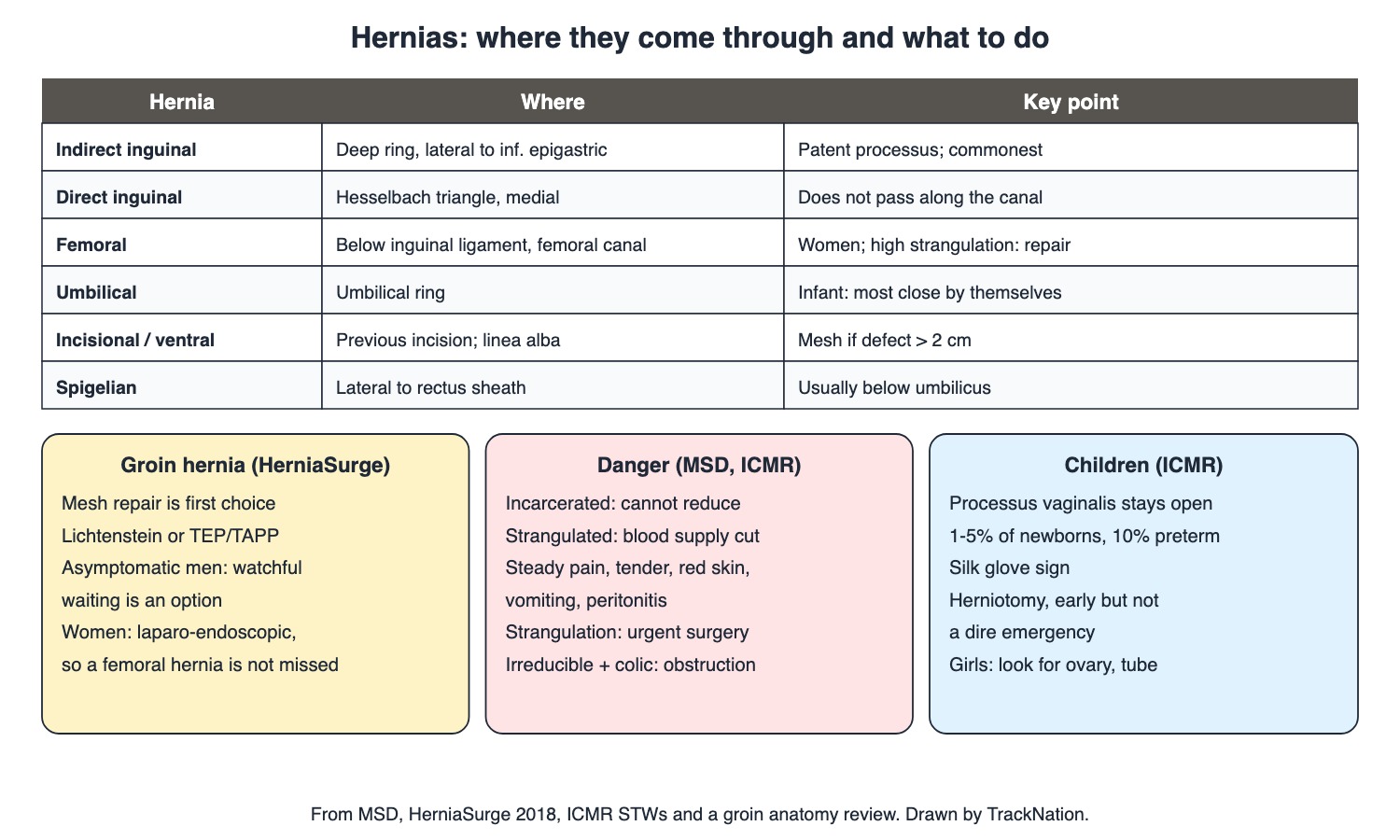
Hernia types, repair, danger signs and children. Drawn by TrackNation.
Types and Anatomy
A hernia is a protrusion of abdominal contents through a weak area or defect. About 75% of abdominal wall hernias are inguinal; incisional and umbilical another 10–15%; femoral and unusual ones the rest (MSD).
Inguinal hernias lie above the inguinal ligament. Indirect: through the deep (internal) ring lateral to the inferior epigastric vessels, along the canal. Direct: forward through Hesselbach triangle (inguinal ligament, rectus border, inferior epigastric vessels), medial to the vessels, not along the canal. Indirect outnumber direct about 2:1. The canal carries the spermatic cord (men) or round ligament (women; canal of Nuck).
Femoral: below the inguinal ligament, into the femoral canal medial to the femoral vein. Epigastric: through the linea alba. Spigelian: lateral to the rectus sheath, usually below the umbilicus. Umbilical: mostly congenital; in adults from obesity, ascites, pregnancy, peritoneal dialysis. A sports hernia is not a true hernia (athletic pubalgia).
Inguinal hernia risk factors (HerniaSurge): family history, previous contralateral hernia, male sex, age, abnormal collagen, prostatectomy, low BMI.
Diagnosis and Complications
Diagnosis is clinical: examine standing; ask the patient to cough or strain; in men a finger in the canal. Cough impulse; reduces on lying down. Ultrasound only if doubtful. Solid, irreducible groin lumps: nodes, ectopic testis, lipoma.
Incarcerated = cannot be reduced (may cause bowel obstruction). Strangulated = blood supply compromised → steady increasing pain, nausea, vomiting, tender hernia, red skin, peritonitis. Irreducible hernia with colicky pain = obstruction; redness, severe pain, fever = strangulation (ICMR) → immediate surgery.
Higher strangulation risk: female sex, femoral hernia, prior hernia-related admission (HerniaSurge).
Treatment
Mesh repair is first choice (hernioplasty): open Lichtenstein (tension-free, 1986) or laparo-endoscopic TEP/TAPP, which recover faster with less chronic pain. Tissue repair (herniorrhaphy): Shouldice first choice. Day surgery for most; no routine antibiotics for open repair in average-risk patients. Chronic pain after repair: 10–12%.
Asymptomatic men: watchful waiting is reasonable. Women: laparo-endoscopic repair, to avoid missing a femoral hernia. Pregnancy: wait — swelling is usually round-ligament varicosity.
Femoral hernia: commoner in women, 2–4% of groin repairs; always repair — watchful waiting is discouraged.
Incisional/ventral (ICMR): repair in general; defects <2 cm may be closed primarily; larger and all incisional hernias need mesh; hold off with untreated ascites and portal hypertension; huge defects need component separation.
Infant umbilical hernia: rarely strangulates; most close by themselves; repair very large ones after 2 years.
Children's Inguinal Hernia (ICMR)
The processus vaginalis fails to close after testicular descent. Seen in 1–5% of newborns, 10% of preterm; up to 20% have a contralateral hernia. Silk glove sign: silky thickening of the cord.
Treatment: herniotomy (or laparoscopic repair) under GA, as early as possible but not a dire emergency; in inborn neonates before discharge. In girls, open the sac and preserve the fallopian tube; consider karyotype to rule out complete androgen insensitivity. Danger signs: irreducible swelling, inconsolable child, distension, bilious vomiting.
Traps the Examiner Sets
Indirect = lateral to inferior epigastric; direct = medial (Hesselbach).
Femoral = below the inguinal ligament, commoner in women, never watch-and-wait.
Incarcerated (irreducible) ≠ strangulated (blood supply cut).
Infant umbilical hernia: wait; infant inguinal hernia: operate early.
Memory Hooks & Shortcuts
Shortcuts to lock in this article's numbers and lists. Each one only re-packages facts proven above.
🧠 'MDs don't LIe': Medial Direct, Lateral Indirect (to the inferior epigastric vessels) — anatomy
🧠 Femoral: 'Females, Fatal if left' — always repair — femoral
🧠 'Stuck vs Starved': incarcerated is stuck, strangulated is starved of blood — complications
🧠 Infant belly button waits, infant groin operates — children
🧠 'Mesh first, Shouldice if no mesh' — repair
Rapid-Revision Cards
Commonest hernia
Inguinal, ~75%.
Indirect
Deep ring; lateral to inf. epigastric.
Direct
Hesselbach; medial; not along canal.
Hesselbach
Inguinal lig., rectus, inf. epigastric.
Femoral
Below lig.; medial to femoral vein.
Femoral rule
Always repair; women.
Incarcerated
Irreducible.
Strangulated
Blood supply cut; urgent surgery.
Strangulation risk
Female, femoral.
Examine
Standing; cough.
First choice
Mesh: Lichtenstein or TEP/TAPP.
Tissue repair
Shouldice.
Lap benefit
Faster recovery, less pain.
Asymptomatic men
Watchful waiting OK.
Women
Laparo-endoscopic repair.
Chronic pain
10–12%.
Incisional
Mesh; <2 cm primary closure.
Infant umbilical
Observe; repair large after 2 y.
Spigelian
Lateral to rectus sheath.
Child inguinal
Patent processus; herniotomy.
Silk glove sign
Child inguinal hernia.
Sources
Facts in this article were checked against these documents.
MSD Manual Professional: Hernias of the Abdominal Wall; Inguinal Hernia — Merck & Co. (MSD Manuals), 2024–26 (link)
International guidelines for groin hernia management (HerniaSurge Group), Hernia 22:1–165 — HerniaSurge Group, 2018 (link)
Fascinating history of groin hernias: anatomy, classic considerations (World J Methodol 11:160) — Hori T, Yasukawa D, et al., 2021 (link)
Standard Treatment Workflows: Incisional/Ventral Hernia; Congenital Inguinal Hernias — ICMR / Department of Health Research, 2022
Competency Based Undergraduate Curriculum, Vol III: General Surgery (SU28) — National Medical Commission, 2024
Test Yourself: Practice Questions
Thirty questions in NEET PG style, most of them clinical vignettes.
Practice Questions (NEET PG pattern)
Original questions written in the style of the exam: +4 for a correct answer, −1 for a wrong one. Every answer was checked against the sources listed above. NEET PG papers are not published by NBEMS, so these are not past-paper questions.
Q1. The commonest type of abdominal wall hernia is
(a) inguinal
(b) Spigelian
(c) femoral
(d) umbilical
Show answer
Answer: (a) — About 75%.
Q2. At laparoscopy a hernia sac is seen entering the deep ring lateral to the inferior epigastric vessels. It is
(a) an indirect inguinal hernia
(b) a femoral hernia
(c) an obturator hernia
(d) a direct inguinal hernia
Show answer
Answer: (a) — Lateral = indirect.
Q3. A direct inguinal hernia protrudes through
(a) Hesselbach triangle, medial to the inferior epigastric vessels
(b) the femoral canal
(c) the linea alba
(d) the deep ring
Show answer
Answer: (a) — Not along the canal.
Q4. Which of these is a boundary of Hesselbach triangle?
(a) deep ring
(b) linea alba
(c) femoral vein
(d) inferior epigastric vessels
Show answer
Answer: (d) — With inguinal ligament and rectus border.
Q5. Unlike an indirect hernia, a direct inguinal hernia
(a) does not pass through the inguinal canal
(b) is congenital
(c) always enters the scrotum
(d) lies below the inguinal ligament
Show answer
Answer: (a) — Extends directly forward.
Q6. A groin swelling below the inguinal ligament, entering the canal medial to the femoral vein, is a
(a) femoral hernia
(b) indirect inguinal hernia
(c) Spigelian hernia
(d) direct inguinal hernia
Show answer
Answer: (a) — Femoral canal.
Q7. A woman has a small, asymptomatic femoral hernia. The best plan is
(a) watchful waiting
(b) reassure; it never strangulates
(c) truss
(d) timely elective repair
Show answer
Answer: (d) — Strangulation risk too high.
Q8. Which groin hernia features carry the highest risk of strangulation?
(a) male sex and direct hernia
(b) female sex and femoral hernia
(c) young age and indirect hernia
(d) bilateral direct hernias
Show answer
Answer: (b) — Also prior hernia admission.
Q9. A hernia that cannot be pushed back but has an intact blood supply is
(a) sliding
(b) incarcerated
(c) strangulated
(d) reducible
Show answer
Answer: (b) — Strangulated = blood supply compromised.
Q10. A patient with a known inguinal hernia develops steady worsening pain, vomiting and a tender, red, irreducible lump. Next step:
(a) urgent surgery
(b) elective repair in 6 weeks
(c) truss
(d) watchful waiting
Show answer
Answer: (a) — Strangulation.
Q11. A man has an irreducible ventral hernia with colicky abdominal pain. ICMR calls this
(a) simple reducible hernia
(b) strangulation always
(c) a sports hernia
(d) intestinal obstruction needing immediate surgery
Show answer
Answer: (d) — Relieve obstruction.
Q12. A suspected groin hernia is best examined with the patient
(a) under anaesthesia
(b) standing, coughing or straining
(c) lying flat only
(d) prone
Show answer
Answer: (b) — Raise intra-abdominal pressure.
Q13. A firm, irreducible groin lump with no cough impulse is least likely to be
(a) a lipoma
(b) a lymph node
(c) an ectopic testis
(d) a simple reducible hernia
Show answer
Answer: (d) — Solid masses are not reducible.
Q14. The first-choice repair for an adult inguinal hernia, per international guidelines, is
(a) mesh repair, open or laparo-endoscopic
(b) herniotomy alone
(c) Bassini repair
(d) truss
Show answer
Answer: (a) — HerniaSurge.
Q15. The tension-free open mesh repair introduced in 1986 is
(a) Shouldice
(b) Lichtenstein
(c) McVay
(d) Bassini
Show answer
Answer: (b) — Hernioplasty.
Q16. When a non-mesh tissue repair is chosen for an inguinal hernia, the preferred technique is
(a) Shouldice
(b) plug
(c) Lichtenstein
(d) TEP
Show answer
Answer: (a) — Herniorrhaphy.
Q17. Compared with Lichtenstein, laparo-endoscopic (TEP/TAPP) repair offers
(a) higher chronic pain
(b) no mesh
(c) no need for anaesthesia
(d) faster recovery and lower chronic pain
Show answer
Answer: (d) — If expertise exists.
Q18. A man with a small, painless inguinal hernia prefers to avoid surgery. Per guidelines
(a) a truss is curative
(b) urgent surgery is mandatory
(c) mesh is contraindicated
(d) watchful waiting is acceptable
Show answer
Answer: (d) — Low emergency risk.
Q19. For a woman with a groin hernia, laparo-endoscopic repair is suggested mainly to
(a) avoid mesh
(b) preserve the spermatic cord
(c) avoid missing a femoral hernia and reduce chronic pain
(d) save cost
Show answer
Answer: (c) — Many 'recurrences' in women are femoral.
Q20. A pregnant woman has a new painful groin lump. Most such swellings are
(a) lymphoma
(b) round ligament varicosities, so watch
(c) femoral hernias
(d) strangulated hernias
Show answer
Answer: (b) — Colour duplex helps.
Q21. The commonest troublesome long-term problem after groin hernia repair, affecting about 10–12%, is
(a) bowel injury
(b) testicular atrophy
(c) mesh infection
(d) chronic pain
Show answer
Answer: (d) — With recurrence.
Q22. A risk factor for inguinal hernia listed by HerniaSurge is
(a) smoking cessation
(b) low body mass index
(c) female sex
(d) high body mass index
Show answer
Answer: (b) — Also prostatectomy, family history.
Q23. Routine antibiotic prophylaxis for open mesh repair in an average-risk patient is
(a) always required
(b) given for 7 days
(c) replaced by mesh soaking
(d) not recommended
Show answer
Answer: (d) — Low-risk setting.
Q24. An incisional hernia with a 5 cm defect should be repaired with
(a) mesh reinforcement
(b) primary suture only
(c) a truss
(d) observation
Show answer
Answer: (a) — All incisional hernias get mesh.
Q25. A small midline primary ventral hernia under 2 cm may be
(a) closed primarily (anatomical repair)
(b) left alone always
(c) treated with Sugarbaker technique
(d) repaired with component separation
Show answer
Answer: (a) — ICMR.
Q26. A 1-year-old has a soft umbilical swelling that reduces easily. Best management:
(a) mesh repair now
(b) observe; most close spontaneously
(c) urgent repair
(d) strapping with a coin
Show answer
Answer: (b) — Repair very large ones after 2 years.
Q27. A hernia through the linea alba is
(a) obturator
(b) Spigelian
(c) femoral
(d) epigastric
Show answer
Answer: (d) — Linea alba.
Q28. A hernia lateral to the rectus sheath, usually below the umbilicus, is
(a) Spigelian
(b) epigastric
(c) umbilical
(d) lumbar
Show answer
Answer: (a) — Transversus defect.
Q29. In a preterm baby with a reducible inguinal swelling, the cause and treatment are
(a) patent processus vaginalis; herniotomy before discharge
(b) observe until 5 years
(c) femoral canal; mesh
(d) weak posterior wall; Lichtenstein
Show answer
Answer: (a) — ICMR.
Q30. Palpable silky thickening of the cord in a child with an intermittent groin swelling is
(a) the blue dot sign
(b) the silk glove sign
(c) Prehn sign
(d) the bag of worms sign
Show answer
Answer: (b) — Inguinal hernia.
Active Recall
From memory: distinguish indirect, direct and femoral hernias by anatomy, define incarceration and strangulation and their management, outline elective repair options and when to watch, and summarise incisional, umbilical and childhood inguinal hernias.