Liver and Spleen for NEET PG Surgery: Amoebic and Pyogenic Liver Abscess, Hydatid Cyst, HCC, Benign Tumours, Portal Hypertension and Splenic Injury
Start Here
🎯 Exam priority: High. Expect: amoebic liver abscess (young man, single right lobe, chocolate pus, metronidazole, when to aspirate), pyogenic abscess, hydatid cyst (dog host, daughter cysts, hydatid sand, anaphylaxis, PAIR rules, albendazole), HCC (HBV, AFP >400, washout, Milan, ablation/TACE/TARE), adenoma on the pill, haemangioma, portal pressures, varices, splenic injury and post-splenectomy vaccines.
CBME mapping: SU28.10–28.11 (liver abscess, hydatid disease, injuries and tumours of the liver; spleen).
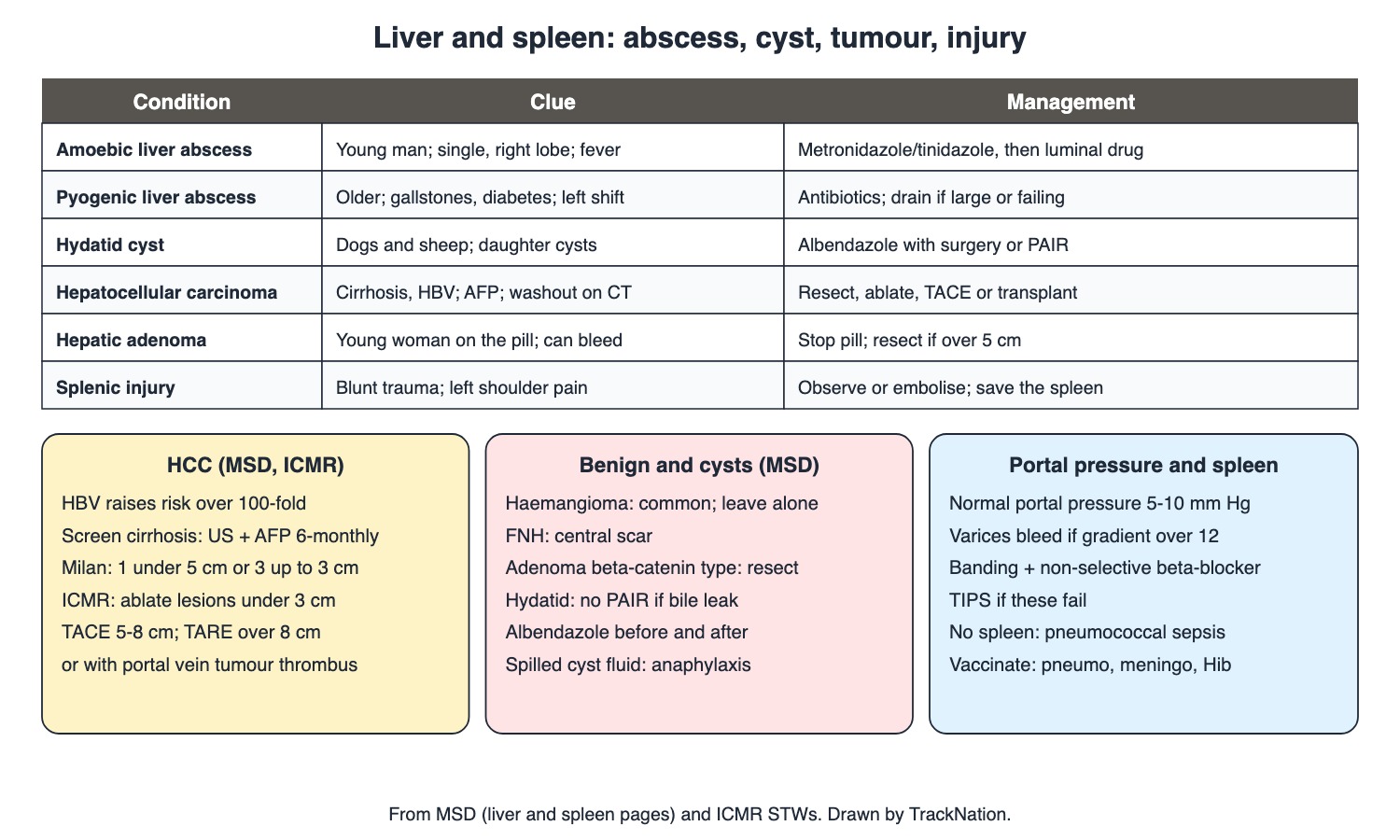
Liver and spleen conditions at a glance. Drawn by TrackNation.
Liver Abscess (MSD, ICMR)
Amoebic: E. histolytica trophozoites reach the liver by the portal vein; liver abscess is the commonest extraintestinal form. Usually single, right lobe; men 7–9:1, younger adults from endemic areas. Pain over the liver (may go to the right shoulder), fever, sweats, weight loss; jaundice unusual. May rupture into subphrenic space, right pleura or lung, pericardium.
Pyogenic: older patients, gallstones, diabetes, left shift, raised bilirubin. Imaging cannot reliably tell the two apart.
Amoebic diagnosis: imaging plus serology or a therapeutic trial; stool microscopy usually negative; pus is thick, yellow to chocolate-brown. Aspirate only if pyogenic/fungal suspected, rupture imminent, or poor response.
Treatment: metronidazole or tinidazole (no alcohol — disulfiram-like), then a luminal agent (paromomycin, diloxanide, iodoquinol) to clear cysts. ICMR: metronidazole + ceftriaxone for liver abscess; image-guided drainage for >100 mL; red flags include a left-lobe abscess and a segment VIII abscess (can rupture into the pleura), sepsis, or failure.
Hydatid Cyst (MSD)
Echinococcus granulosus: dogs are definitive hosts; sheep and humans are intermediate hosts (no adult worms in human gut). Slow-growing unilocular cysts in liver and lung with daughter cysts and protoscolices.
Mass, pain, jaundice if the bile duct is blocked; rupture → fever, urticaria, anaphylaxis. Imaging with daughter cysts and hydatid sand is diagnostic; serology supports.
Surgery for complicated cysts (ruptured, biliary fistula, daughter cysts, >10 cm, superficial). PAIR (aspirate, hypertonic saline, re-aspirate) for small (<5 cm) simple cysts — not if there is biliary communication. Albendazole 1 week before and ≥4 weeks after; alone for inoperable cysts. Calcified inactive cysts can be watched. Avoid spillage.
Liver Tumours (MSD, ICMR)
HCC: usually on cirrhosis; HBV >100-fold risk (India: HBV 33%, alcohol 30%, HCV 21% — ICMR); aflatoxin. Paraneoplastic hypoglycaemia, erythrocytosis, hypercalcaemia. AFP >400 ng/mL in 40–65%. Triple-phase CT/MRI: arterial enhancement with washout (LI-RADS); biopsy only if equivocal. Screen cirrhosis (and long-standing HBV) with ultrasound ± AFP every 6 months.
Treatment: transplant within Milan (one <5 cm or up to three ≤3 cm, no vascular invasion, AFP <500); resection for single tumours without portal hypertension; ICMR image-guided options — ablation for up to 3 lesions <3 cm, TACE ± ablation 3–5 cm, TACE 5–8 cm, TARE >8 cm or with portal-vein tumour thrombus.
Hepatic adenoma: young women on the pill; >5 cm may rupture and bleed; may regress off the pill; resect if persistent, >5 cm, subcapsular, in men or β-catenin type (~10% malignant). FNH: central scar; rarely treated. Haemangioma: up to 20% of adults; peripheral then centripetal fill-in; no biopsy, no treatment usually.
Portal Hypertension and Spleen (MSD)
Portal vein = superior mesenteric + splenic veins; normal 5–10 mm Hg. Causes: prehepatic (portal/splenic vein thrombosis), hepatic (cirrhosis, schistosomiasis), posthepatic (Budd-Chiari, constriction). Varices bleed when the gradient is >12 mm Hg; caput medusae is rare.
After a variceal bleed: banding plus non-selective beta-blocker (carvedilol first-line in compensated cirrhosis); failures → TIPS (or surgical shunt).
Splenic injury: blunt trauma; pain to the left shoulder; enlarged spleen (e.g. infectious mononucleosis) ruptures easily. Graded 1–5. CT if stable; FAST/laparotomy if unstable. Most injuries are managed non-operatively; transfusion alone does not mandate surgery; angioembolisation cuts failure in high grades.
Avoid splenectomy when possible: overwhelming post-splenectomy sepsis, mostly S. pneumoniae. Vaccinate against pneumococcus, meningococcus and Hib. Hypersplenism = cytopenia from splenomegaly.
Traps the Examiner Sets
Amoebic abscess: drugs first, needle only if rupture threatens or no response.
No PAIR if the hydatid cyst communicates with bile ducts.
Do not biopsy a typical haemangioma.
Stable splenic injury: observe, embolise — don't rush to splenectomy.
Memory Hooks & Shortcuts
Shortcuts to lock in this article's numbers and lists. Each one only re-packages facts proven above.
🧠 Amoebic abscess: 'Single, Right, Man, Metronidazole' — abscess
🧠 'Chocolate pus, no amoebae in stool' — amoebic diagnosis
🧠 Hydatid: 'Dog drops eggs, Sheep and Sapiens get cysts' — hosts
🧠 Milan '1-5, 3-3' — transplant
🧠 Spleen gone? 'Pneumo, Meningo, Hib — vaccinate before the knife' — splenectomy
Rapid-Revision Cards
Amoebic abscess
Single, right lobe, young men.
Route
Portal vein.
Pyogenic abscess
Older; gallstones, diabetes.
Pus
Yellow to chocolate-brown.
Diagnosis
Therapeutic trial; stool negative.
Aspirate if
Rupture imminent, no response.
Amoebic Rx
Metronidazole → luminal agent.
Hydatid host
Dog definitive.
Hydatid sand
Diagnostic.
PAIR
<5 cm; not if biliary leak.
Albendazole
1 wk before, ≥4 wk after.
HCC risk
HBV >100×; cirrhosis.
AFP
>400 in 40–65%.
HCC imaging
Arterial + washout.
Milan
1 <5 cm or ≤3 ≤3 cm.
ICMR HCC
Ablate <3; TACE 5–8; TARE >8.
Adenoma
Pill; >5 cm bleeds.
FNH
Central scar.
Varices bleed
Gradient >12 mm Hg.
Splenic injury
Observe; embolise.
Post-splenectomy
Pneumococcus; vaccinate.
Sources
Facts in this article were checked against these documents.
MSD Manual Professional: Amebiasis; Echinococcosis; Hepatocellular Carcinoma; Benign Liver Tumors; Portal Hypertension; Splenic Injury; Hypersplenism — Merck & Co. (MSD Manuals), 2024–26 (link)
Standard Treatment Workflows: Image Guided Therapies for Primary Liver Tumors; Image Guided Drainage of Intra-abdominal Abscess — ICMR / Department of Health Research, 2024
Competency Based Undergraduate Curriculum, Vol III: General Surgery (SU28) — National Medical Commission, 2024
Test Yourself: Practice Questions
Thirty questions in NEET PG style, most of them clinical vignettes.
Practice Questions (NEET PG pattern)
Original questions written in the style of the exam: +4 for a correct answer, −1 for a wrong one. Every answer was checked against the sources listed above. NEET PG papers are not published by NBEMS, so these are not past-paper questions.
Q1. A young man from an endemic area has fever and right upper quadrant pain; ultrasound shows a single right-lobe liver abscess. Most likely:
(a) hydatid cyst
(b) haemangioma
(c) HCC
(d) amoebic liver abscess
Show answer
Answer: (d) — Men 7–9:1.
Q2. Amoebic trophozoites reach the liver through the
(a) portal vein
(b) hepatic artery
(c) bile ducts
(d) lymphatics
Show answer
Answer: (a) — From the colon.
Q3. An older diabetic with gallstones has a liver abscess, neutrophilia with left shift and raised bilirubin. This favours
(a) amoebic liver abscess
(b) pyogenic liver abscess
(c) hydatid cyst
(d) simple cyst
Show answer
Answer: (b) — Amoebic rarely raises bilirubin.
Q4. Aspirated pus from an amoebic liver abscess is classically
(a) thick, yellow to chocolate-brown
(b) foul green
(c) clear with hydatid sand
(d) milky
Show answer
Answer: (a) — Amoebae rarely seen.
Q5. The most helpful diagnostic step for a suspected amoebic liver abscess is often
(a) a therapeutic trial of an amoebicide
(b) liver biopsy
(c) routine aspiration
(d) stool microscopy
Show answer
Answer: (a) — Stool is usually negative.
Q6. In amoebic liver abscess, needle aspiration is indicated when
(a) the abscess is in the right lobe
(b) every case at diagnosis
(c) rupture seems imminent or drugs fail
(d) the patient is a man
Show answer
Answer: (c) — Or pyogenic/fungal suspected.
Q7. After metronidazole for amoebic liver abscess, a second drug such as paromomycin is given to
(a) prevent hydatid spread
(b) eradicate intestinal cysts
(c) reduce pain
(d) treat bacterial infection
Show answer
Answer: (b) — Luminal agent.
Q8. A patient on metronidazole should avoid alcohol because of
(a) a disulfiram-like reaction
(b) hepatotoxicity only
(c) QT prolongation
(d) hypoglycaemia
Show answer
Answer: (a) — Also tinidazole.
Q9. ICMR lists a left-lobe liver abscess as a red flag. Besides pleura and lung, an amoebic liver abscess may rupture into the
(a) gallbladder
(b) pericardium
(c) kidney
(d) colon
Show answer
Answer: (b) — Segment VIII risks the pleura.
Q10. In hydatid disease, the definitive host is the
(a) sheep
(b) dog
(c) human
(d) cow
Show answer
Answer: (b) — Humans are intermediate hosts.
Q11. A shepherd's liver cyst ruptures during an injury and they develop urticaria and hypotension. This is
(a) haemorrhagic shock
(b) septic shock
(c) vasovagal reaction
(d) anaphylaxis from hydatid fluid
Show answer
Answer: (d) — Highly antigenic fluid.
Q12. White sediment of scolices found in aspirated cyst fluid is
(a) anchovy sauce
(b) hydatid sand — diagnostic of echinococcosis
(c) biliary sludge
(d) pus cells
Show answer
Answer: (b) — Diagnostic.
Q13. PAIR must not be used for a hydatid cyst that
(a) is in the liver
(b) is under 5 cm
(c) is unilocular
(d) communicates with the bile ducts
Show answer
Answer: (d) — Risk of cholangitis.
Q14. To prevent secondary hydatidosis, albendazole is given around surgery or PAIR for
(a) 1 week before and at least 4 weeks after
(b) 1 year before
(c) never
(d) 1 day only
Show answer
Answer: (a) — Spillage risk.
Q15. A 12 cm hydatid cyst with daughter cysts is best treated by
(a) albendazole for 1 week only
(b) surgical resection with albendazole cover
(c) observation
(d) PAIR alone
Show answer
Answer: (b) — Complicated cyst.
Q16. The strongest risk factor for HCC listed by MSD is
(a) hydatid cyst
(b) haemangioma
(c) chronic hepatitis B (>100-fold risk)
(d) gallstones
Show answer
Answer: (c) — Also cirrhosis, HCV, aflatoxin.
Q17. In a cirrhotic patient, a liver mass with arterial enhancement and delayed washout on triple-phase CT and AFP of 600 ng/mL is
(a) HCC, diagnosable without biopsy
(b) haemangioma
(c) FNH
(d) metastasis needing biopsy always
Show answer
Answer: (a) — LI-RADS.
Q18. Screening for HCC in cirrhosis is commonly done with
(a) liver biopsy yearly
(b) no screening
(c) CT every month
(d) ultrasound plus AFP every 6 months
Show answer
Answer: (d) — Also long-standing HBV.
Q19. A cirrhotic patient has a single 4 cm HCC without vascular invasion and AFP 200. They meet
(a) criteria for palliation only
(b) TARE only
(c) Milan criteria for liver transplantation
(d) no surgical option
Show answer
Answer: (c) — One <5 cm or up to three ≤3 cm.
Q20. Per ICMR image-guided therapy guidance, a single 2 cm HCC is suited to
(a) systemic chemotherapy first
(b) TARE
(c) image-guided ablation
(d) observation
Show answer
Answer: (c) — Up to three lesions <3 cm.
Q21. Per ICMR, an HCC larger than 8 cm or with portal-vein tumour thrombus may be treated with
(a) ablation
(b) PAIR
(c) sclerotherapy
(d) TARE (radioembolisation)
Show answer
Answer: (d) — TACE for 5–8 cm.
Q22. A 28-year-old woman on oral contraceptives has a 6 cm liver lesion and presents with sudden pain and shock. Likely:
(a) haemangioma
(b) ruptured hepatic adenoma
(c) amoebic abscess
(d) FNH
Show answer
Answer: (b) — Resect if persistent or >5 cm.
Q23. A liver lesion with a central scar on imaging is typical of
(a) hydatid cyst
(b) adenoma
(c) focal nodular hyperplasia
(d) amoebic abscess
Show answer
Answer: (c) — Rarely treated.
Q24. An incidental 2 cm liver lesion with early peripheral and later centripetal enhancement should be
(a) treated with albendazole
(b) resected
(c) biopsied urgently
(d) left alone without biopsy (haemangioma)
Show answer
Answer: (d) — Up to 20% of adults.
Q25. Variceal bleeding rarely occurs unless the portal pressure gradient exceeds
(a) 12 mm Hg
(b) 30 mm Hg
(c) 2 mm Hg
(d) 5 mm Hg
Show answer
Answer: (a) — Normal portal pressure 5–10.
Q26. Portal hypertension from hepatic vein thrombosis is
(a) schistosomiasis
(b) presinusoidal
(c) prehepatic
(d) Budd-Chiari syndrome (posthepatic)
Show answer
Answer: (d) — Posthepatic.
Q27. Secondary prevention after an oesophageal variceal bleed is
(a) surgery first
(b) endoscopic banding plus a non-selective beta-blocker
(c) PPI alone
(d) banding alone forever
Show answer
Answer: (b) — TIPS if this fails.
Q28. A haemodynamically stable patient with a grade 3 splenic laceration on CT and no other injury should usually have
(a) laparoscopy for all
(b) discharge home
(c) immediate splenectomy
(d) non-operative management with monitoring, ± angioembolisation
Show answer
Answer: (d) — Save the spleen.
Q29. The commonest organism in overwhelming post-splenectomy sepsis is
(a) Streptococcus pneumoniae
(b) Pseudomonas
(c) Staphylococcus aureus
(d) E. coli
Show answer
Answer: (a) — Encapsulated.
Q30. Before elective splenectomy, the patient should be vaccinated against
(a) rabies
(b) typhoid only
(c) pneumococcus, meningococcus and Haemophilus influenzae
(d) BCG only
Show answer
Answer: (c) — Plus influenza.
Active Recall
From memory: compare amoebic and pyogenic liver abscess with diagnosis and treatment, describe hydatid cyst and its management, outline HCC risk, diagnosis, screening and treatment, summarise benign liver tumours and portal hypertension, and describe management of splenic injury and splenectomy precautions.