Small and Large Intestine for NEET PG Surgery: Colorectal Cancer, Polyps and FAP, Diverticulitis, Mesenteric Ischaemia, Meckel, Hirschsprung and Malrotation
Start Here
🎯 Exam priority: High. Expect: right- vs left-sided colon cancer, rectal bleeding must exclude cancer, screening age and tests, CEA use, LAR vs APR, adjuvant chemo for node-positive disease, advanced adenoma, FAP and Gardner features, diverticulitis and colovesical fistula, mesenteric ischaemia (embolus, pain out of proportion, splenic flexure watershed), Meckel bleeding and scan, Hirschsprung (48 h meconium, rectal biopsy), bilious vomiting and malrotation, short bowel and carcinoid.
CBME mapping: SU28.13–28.14 (intestine, including neonatal obstruction and short gut syndrome). Appendix and anorectum follow.
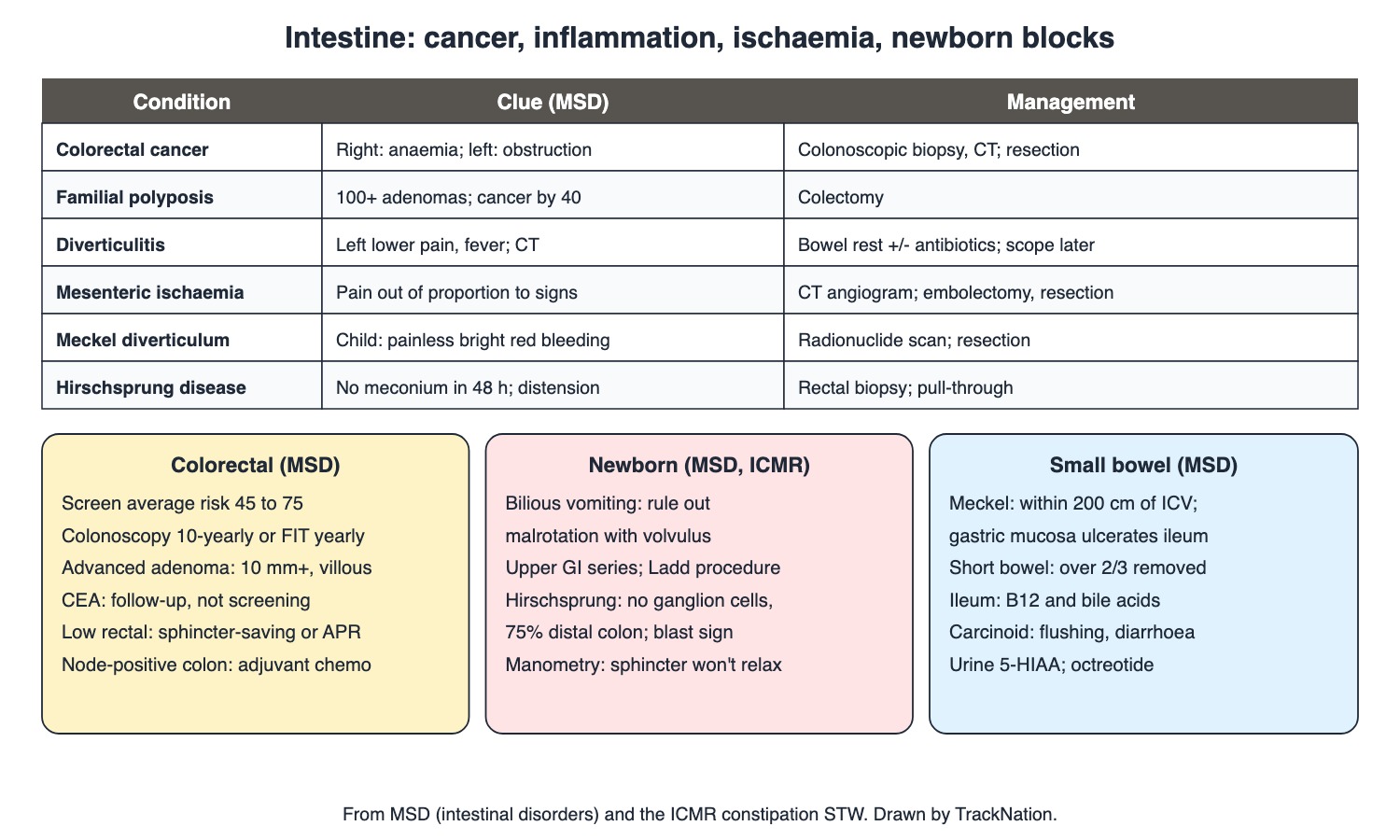
Intestinal conditions at a glance. Drawn by TrackNation.
Colorectal Cancer and Polyps (MSD)
Most arise in adenomatous polyps; 80% sporadic, 20% inherited (FAP, Lynch, Peutz-Jeghers, juvenile, MUTYH); long-standing ulcerative or Crohn colitis; low-fibre, high-fat diets. Advanced adenoma: ≥10 mm, villous or high-grade dysplasia.
Right colon (wide, liquid content): occult bleeding, iron-deficiency anaemia, fatigue, mass; obstruction late. Left colon: colicky pain and obstruction earlier. Rectum: bleeding with defecation, tenesmus. Any rectal bleeding — even with piles — needs cancer excluded.
Diagnosis: colonoscopy with biopsy, CT for spread. CEA: not for screening; useful to detect recurrence after treatment. Screening (average risk): 45–75 years, colonoscopy every 10 years or yearly FIT (also sigmoidoscopy, CT colonography, stool DNA).
Surgery: segment with its lymphatics (aim ~5 cm margin). Low rectal cancer: sphincter-sparing low anterior resection, or abdominoperineal resection with permanent colostomy. Stage III (node-positive) colon cancer → adjuvant chemotherapy; rectal cancer increasingly gets total neoadjuvant therapy. Liver metastases may be resected. Localised disease: ~90% 5-year survival.
FAP: autosomal dominant, ≥100 adenomas, cancer before 40 if untreated → colectomy; extracolonic (Gardner) features: desmoids, osteomas, duodenal cancer.
Diverticulitis and Mesenteric Ischaemia (MSD)
Diverticulitis: left lower quadrant pain, tenderness, palpable sigmoid, fever. CT confirms; colonoscopy after it settles to exclude cancer. Complicated = abscess, fistula, obstruction, perforation. Colovesical fistula → pneumaturia, faecaluria. Mild uncomplicated disease in healthy people may not need antibiotics; abscess → CT-guided drainage; perforation/peritonitis → surgery.
Acute mesenteric ischaemia: SMA supplies distal duodenum to splenic flexure; the splenic flexure is a watershed. Causes: arterial embolus (>40%; AF, heart disease), thrombosis (30%), venous (15%), non-occlusive low flow (15%). Pain out of proportion to signs; lactate rises late. CT angiography; fluids, antibiotics, embolectomy/revascularisation ± resection.
Paediatric and Small-Bowel Conditions (MSD, ICMR)
Meckel diverticulum: true diverticulum from the vitelline duct; commonest GI anomaly; antimesenteric ileum within 200 cm of the ileocaecal valve; ectopic gastric/pancreatic tissue. Children: painless bright red rectal bleeding (acid ulcerates the ileum); also obstruction (intussusception, Littre hernia), diverticulitis. Radionuclide scan for bleeding; resection.
Hirschsprung disease: absent ganglion cells (neural crest migration failure); 75% distal colon. Failure to pass meconium in 48 hours (ICMR red flag), distension, vomiting; blast sign on rectal exam. Rectal biopsy is definitive; manometry: internal sphincter does not relax. Danger: enterocolitis. Treatment: resect aganglionic bowel with pull-through.
Malrotation with midgut volvulus: bilious vomiting in an infant is an emergency; upper GI series (DJ junction right of the spine); Ladd procedure.
Short bowel syndrome: loss of >2/3 of small bowel (Crohn, mesenteric infarction, volvulus, NEC in children); ileal loss → B12 and bile-acid malabsorption; small feeds, antidiarrhoeals, TPN, GLP-2 analogues (teduglutide), transplant.
Carcinoid syndrome (usually with liver metastases): flushing, cramps, diarrhoea, right-heart valve disease; urinary 5-HIAA; octreotide.
Traps the Examiner Sets
Right colon cancer presents as anaemia, not obstruction.
CEA monitors recurrence; it does not screen.
Bilious vomiting in a newborn = malrotation until proven otherwise.
Meckel bleeding is painless; mesenteric ischaemia pain is out of proportion.
Memory Hooks & Shortcuts
Shortcuts to lock in this article's numbers and lists. Each one only re-packages facts proven above.
🧠 'Right Bleeds, Left Blocks' — colon cancer
🧠 Meckel: 'Ileum, 200 cm, gastric tissue, children bleed painlessly' — Meckel
🧠 'Green vomit = Get the contrast' (malrotation) — neonate
🧠 Hirschsprung: 'No Ganglia, No Go — 48 hours, biopsy' — Hirschsprung
🧠 'Pain without signs = gut without blood' — mesenteric ischaemia
Rapid-Revision Cards
CRC origin
Adenomatous polyps.
Right colon cancer
Anaemia, occult bleed.
Left colon cancer
Obstruction, colic.
Rectal bleeding
Exclude cancer even with piles.
CEA
Recurrence, not screening.
Screening
45–75; colonoscopy 10 y / FIT yearly.
Advanced adenoma
≥10 mm, villous, HGD.
FAP
≥100 adenomas; colectomy.
Low rectal cancer
LAR or APR.
Stage III colon
Adjuvant chemo.
Diverticulitis
LLQ pain; CT; scope later.
Colovesical fistula
Pneumaturia, faecaluria.
Mesenteric ischaemia
Embolus >40%; pain > signs.
Watershed
Splenic flexure.
Meckel
Vitelline duct; painless bleed.
Meckel test
Radionuclide scan.
Hirschsprung
No meconium 48 h; rectal biopsy.
Blast sign
Hirschsprung.
Bilious vomit infant
Malrotation; Ladd.
Ileal resection
B12, bile acids.
Carcinoid
5-HIAA; octreotide.
Sources
Facts in this article were checked against these documents.
MSD Manual Professional: Colorectal Cancer; Colorectal Cancer Screening; Polyps of the Colon and Rectum; Familial Adenomatous Polyposis; Colonic Diverticulitis; Acute Mesenteric Ischemia; Meckel Diverticulum; Hirschsprung Disease; Malrotation; Short Bowel Syndrome; Carcinoid Syndrome — Merck & Co. (MSD Manuals), 2025–26 (link)
Standard Treatment Workflow: Constipation (paediatric) — ICMR / Department of Health Research, 2022
Competency Based Undergraduate Curriculum, Vol III: General Surgery (SU28) — National Medical Commission, 2024
Test Yourself: Practice Questions
Thirty questions in NEET PG style, most of them clinical vignettes.
Practice Questions (NEET PG pattern)
Original questions written in the style of the exam: +4 for a correct answer, −1 for a wrong one. Every answer was checked against the sources listed above. NEET PG papers are not published by NBEMS, so these are not past-paper questions.
Q1. Most colorectal cancers arise from
(a) diverticula
(b) adenomatous polyps
(c) hamartomas
(d) hyperplastic polyps
Show answer
Answer: (b) — 80% sporadic.
Q2. A patient has fatigue and iron-deficiency anaemia with no bowel symptoms. The likely colonic lesion site is
(a) anal canal
(b) right colon
(c) sigmoid colon
(d) rectum
Show answer
Answer: (b) — Wide lumen, liquid stool.
Q3. Colicky lower abdominal pain and progressive constipation from a colon cancer suggest a tumour in the
(a) ascending colon
(b) left colon
(c) caecum
(d) appendix
Show answer
Answer: (b) — Narrower lumen.
Q4. A patient with known haemorrhoids has bright red bleeding with defecation and tenesmus. Next step:
(a) stool softeners only
(b) exclude rectal cancer by endoscopy
(c) band the piles only
(d) reassure
Show answer
Answer: (b) — Always.
Q5. The best use of serum CEA in colorectal cancer is
(a) population screening
(b) diagnosis without colonoscopy
(c) staging nodes
(d) detecting recurrence after treatment
Show answer
Answer: (d) — Not for screening.
Q6. Average-risk colorectal cancer screening per MSD begins at age
(a) 55
(b) 30
(c) 45
(d) 60
Show answer
Answer: (c) — Continue to 75.
Q7. A screening colonoscopy finds a 12 mm tubulovillous adenoma. This is
(a) an advanced adenoma with higher cancer risk
(b) normal
(c) a hyperplastic polyp
(d) a hamartoma
Show answer
Answer: (a) — ≥10 mm or villous or HGD.
Q8. An adult has hundreds of colonic adenomas, a jaw osteoma and a desmoid tumour. Diagnosis and treatment:
(a) Lynch syndrome; observe
(b) FAP (Gardner features); colectomy
(c) ulcerative colitis; steroids
(d) Peutz-Jeghers; polypectomy only
Show answer
Answer: (b) — Autosomal dominant.
Q9. Untreated familial adenomatous polyposis leads to colorectal cancer in nearly all patients before age
(a) never
(b) 70
(c) 40
(d) 20
Show answer
Answer: (c) — Prophylactic colectomy.
Q10. Sphincter-sparing low anterior resection is suitable for a low rectal cancer that
(a) has liver metastases only
(b) invades the sphincter
(c) lies near but does not involve the anal sphincter complex
(d) is in the caecum
Show answer
Answer: (c) — Otherwise APR with permanent colostomy.
Q11. After resection, node-positive (stage III) colon cancer needs
(a) adjuvant chemotherapy
(b) repeat surgery
(c) no further treatment
(d) radiotherapy alone
Show answer
Answer: (a) — Also high-risk stage II.
Q12. Five-year survival for localised colorectal cancer is about
(a) 40%
(b) 10%
(c) 90%
(d) 60%
Show answer
Answer: (c) — Falls with nodes and metastases.
Q13. A patient has left lower quadrant pain, fever and a tender palpable sigmoid. The diagnostic test is
(a) barium enema
(b) plain film only
(c) CT abdomen and pelvis
(d) colonoscopy immediately
Show answer
Answer: (c) — Colonoscopy after it settles.
Q14. After an attack of diverticulitis settles, colonoscopy is done to
(a) treat the diverticula
(b) check for Hirschsprung
(c) exclude colorectal cancer
(d) drain an abscess
Show answer
Answer: (c) — Similar symptoms.
Q15. A patient with sigmoid diverticular disease passes gas and faeces in the urine. This is a
(a) enterocutaneous fistula
(b) UTI only
(c) colovaginal fistula
(d) colovesical fistula
Show answer
Answer: (d) — Commonest diverticular fistula.
Q16. A healthy, immunocompetent patient with mild uncomplicated sigmoid diverticulitis and no sepsis
(a) can often be managed without antibiotics
(b) always needs colectomy
(c) needs immediate colonoscopy
(d) needs IV antibiotics for 6 weeks
Show answer
Answer: (a) — MSD.
Q17. The commonest cause of acute mesenteric ischaemia is
(a) vasculitis
(b) venous thrombosis
(c) arterial embolus (e.g. from atrial fibrillation)
(d) volvulus
Show answer
Answer: (c) — >40%.
Q18. The colonic watershed area at particular risk of ischaemia is the
(a) hepatic flexure
(b) splenic flexure
(c) caecum
(d) rectum
Show answer
Answer: (b) — Between SMA and IMA.
Q19. In acute mesenteric ischaemia, serum lactate
(a) is the earliest sensitive marker
(b) is always normal
(c) excludes infarction if normal
(d) rises late and is nonspecific
Show answer
Answer: (d) — Clinical diagnosis matters most.
Q20. Meckel diverticulum results from persistence of the
(a) thyroglossal duct
(b) vitelline duct
(c) urachus
(d) processus vaginalis
Show answer
Answer: (b) — True diverticulum.
Q21. A 2-year-old has repeated painless bright red rectal bleeding. The best test is
(a) barium enema
(b) stool culture
(c) radionuclide (Meckel) scan
(d) colonoscopy first
Show answer
Answer: (c) — Ectopic gastric mucosa.
Q22. Bleeding from a Meckel diverticulum is caused by
(a) polyps
(b) intussusception only
(c) angiodysplasia
(d) acid from ectopic gastric mucosa ulcerating the ileum
Show answer
Answer: (d) — Gastric tissue up to 71%.
Q23. A Meckel diverticulum trapped in a hernia sac is a
(a) Spigelian hernia
(b) Amyand hernia
(c) Richter hernia
(d) Littre hernia
Show answer
Answer: (d) — MSD.
Q24. A term newborn has not passed meconium by 48 hours and has abdominal distension. Suspect
(a) duodenal atresia only
(b) pyloric stenosis
(c) GERD
(d) Hirschsprung disease
Show answer
Answer: (d) — ICMR red flag.
Q25. The definitive test for Hirschsprung disease is
(a) abdominal X-ray
(b) rectal biopsy showing absent ganglion cells
(c) manometry alone
(d) barium enema alone
Show answer
Answer: (b) — Suction or surgical biopsy.
Q26. On rectal examination of a child with Hirschsprung disease, explosive passage of stool on withdrawing the finger is the
(a) target sign
(b) string sign
(c) Rovsing sign
(d) blast sign
Show answer
Answer: (d) — Empty rectum.
Q27. Hirschsprung disease most often involves
(a) the distal colon (75%)
(b) the whole small bowel
(c) the caecum only
(d) the stomach
Show answer
Answer: (a) — Neural crest migration failure.
Q28. A 2-week-old suddenly develops bilious vomiting. The urgent step is
(a) change formula
(b) reassure as reflux
(c) upper GI contrast study for malrotation with volvulus
(d) pyloric ultrasound
Show answer
Answer: (c) — Ladd procedure.
Q29. After extensive ileal resection, a patient is at risk of deficiency of
(a) folate only
(b) vitamin C
(c) vitamin B12 with bile-acid diarrhoea
(d) iron only
Show answer
Answer: (c) — Ileum absorbs B12 and bile acids.
Q30. A patient with liver metastases has flushing, diarrhoea and tricuspid regurgitation. The confirmatory test is
(a) CA 19-9
(b) AFP
(c) serum CEA
(d) urinary 5-HIAA
Show answer
Answer: (d) — Carcinoid syndrome; octreotide.
Active Recall
From memory: describe colorectal cancer risk, presentation by site, diagnosis, screening and treatment, summarise FAP and polyps, diverticulitis and mesenteric ischaemia, and describe Meckel diverticulum, Hirschsprung disease, malrotation, short bowel syndrome and carcinoid syndrome.