Acute Kidney Injury and Chronic Kidney Disease for NEET PG Medicine: KDIGO, Hyperkalaemia, Dialysis, ICMR CKD Care, Nephrotic vs Nephritic
Start Here
🎯 Exam priority: High. Expect: KDIGO AKI numbers, prerenal vs ATN indices, nephrotoxins, hyperkalaemia drug doses, dialysis indications, CKD stages and complications, ICMR targets (BP, salt, Hb, phosphate, bicarbonate), drugs to stop in CKD, and nephrotic vs nephritic vs RPGN.
CBME mapping: GM 10.1–10.24. Glomerular pathology is in Pathology article 21; fluids and electrolytes in article 16; diabetic kidney disease also in article 17.
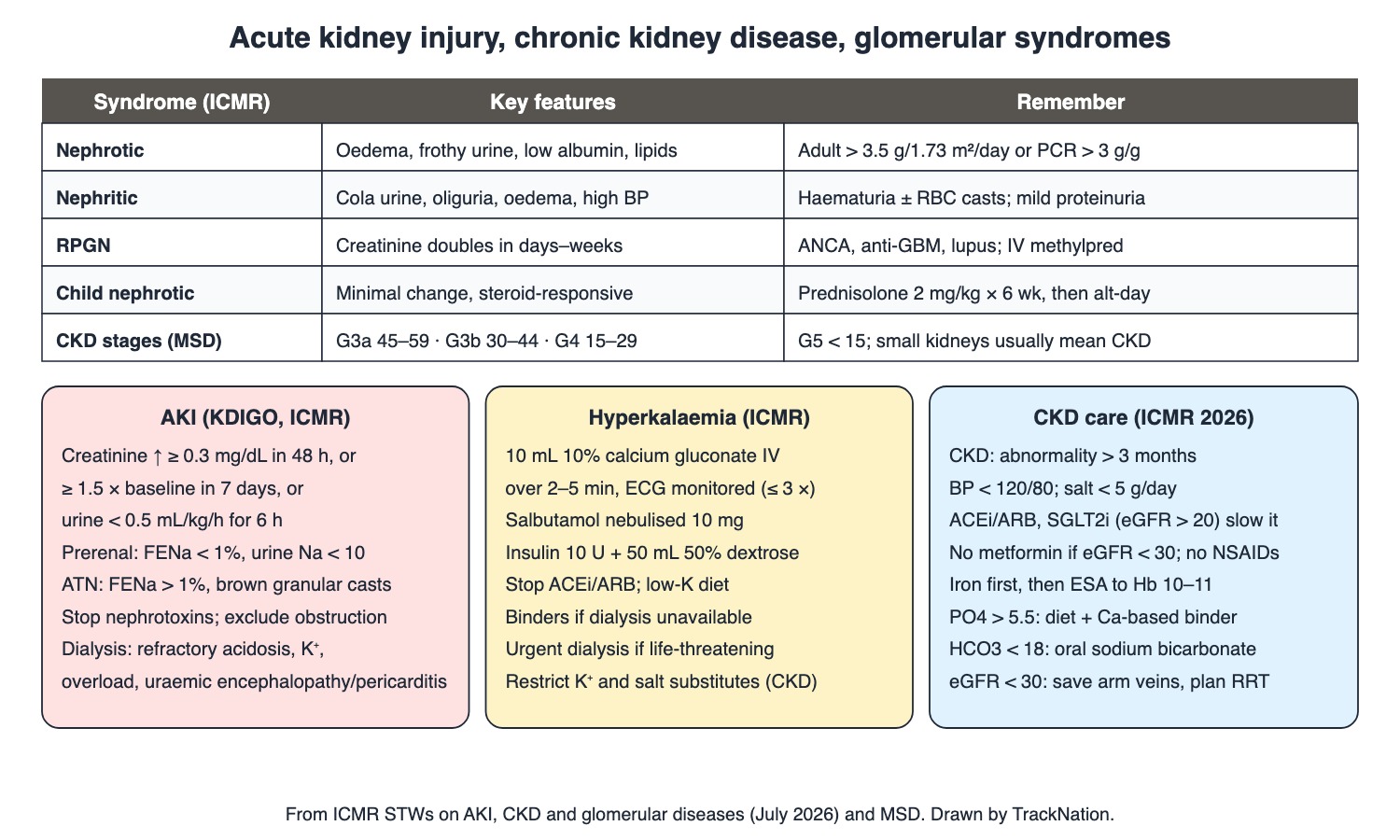
Glomerular syndromes, CKD stages, AKI, hyperkalaemia and ICMR CKD care. Drawn by TrackNation.
Acute Kidney Injury
KDIGO (ICMR STW): creatinine rise ≥ 0.3 mg/dL in 48 h, or ≥ 1.5 × baseline within 7 days, and/or urine output < 0.5 mL/kg/h for 6 h — after excluding obstruction.
Classify as prerenal (poor perfusion — volume loss, heart failure, liver disease), intrinsic (ATN, acute GN, nephrotoxins) or postrenal (obstruction). ATN follows ischaemia or toxins: vancomycin, aminoglycosides, iodinated contrast, myoglobin (rhabdomyolysis — check CPK), haemoglobin (haemolysis); uric acid in tumour lysis.
First steps: monitor urine output and weight, correct hydration, stop nephrotoxins, exclude outflow obstruction, treat infection, assess dialysis need. Indian settings: envenomation (anti-snake venom), poisoning, pregnancy complications, heat stroke.
Urgent dialysis: refractory acidosis, hyperkalaemia, intoxications, refractory overload, uraemic encephalopathy or pericarditis. AKI not resolving in > 2 weeks → CECT for cortical necrosis and biopsy.
Index (MSD) | Prerenal | Intrinsic (ATN) |
Urine sodium (mmol/L) | < 10 | > 40 |
FENa | < 1% | > 1% |
BUN/creatinine ratio | > 20 | < 10 |
Sediment | Bland | Tubular cells, casts, many (brown) granular casts |
Hyperkalaemia (ICMR)
Calcium gluconate 10% 10 mL IV slowly over 2–5 minutes with ECG monitoring (may repeat up to 3 times).
Shift potassium into cells: nebulised salbutamol 10 mg; insulin 10 U in 50 mL of 50% dextrose (or 100 mL of 25%).
Stop drugs that raise potassium (ACEi/ARB), avoid high-potassium diet, potassium binders if dialysis is unavailable, urgent dialysis if life-threatening.
Chronic Kidney Disease
CKD: abnormal kidney structure or function for > 3 months. eGFR by CKD-EPI (adults). Stages: G1 ≥ 90 with albuminuria or structural disease; G2 60–89; G3a 45–59; G3b 30–44; G4 15–29; G5 < 15. Small kidneys on ultrasound usually mean CKD.
Commonest causes: diabetic nephropathy, hypertensive nephrosclerosis, glomerulopathies.
Complications: normocytic anaemia (low erythropoietin), low calcitriol → hypocalcaemia, high phosphate, secondary hyperparathyroidism, renal osteodystrophy; metabolic acidosis (HCO3 15–20); uraemic frost, pruritus, pericarditis, encephalopathy.
ICMR 2026 care: BP < 120/80; salt < 5 g/day; protein 0.8 g/kg/day; ACEi/ARB preferred (care if K⁺ > 5.5); ACEi/ARB, SGLT2i (if eGFR > 20) and non-steroidal MRAs slow progression; no metformin if eGFR < 30; no NSAIDs or unproven herbal products.
Anaemia: make iron-replete first (oral; IV for dialysis patients), then ESA to Hb 10–11 g/dL. Phosphate > 5.5: diet and calcium-based binders. Bicarbonate < 18: oral sodium bicarbonate. Hepatitis B vaccine 20 µg in each deltoid at 0, 1, 2 and 6 months if seronegative. eGFR < 30: preserve non-dominant arm veins for an AV fistula and discuss RRT.
Nephrotic, Nephritic and RPGN
Nephrotic: oedema, frothy urine, hypoalbuminaemia, hyperlipidaemia; adults > 3.5 g/1.73 m²/day or PCR > 3 g/g. Children: minimal change disease, steroid-responsive — prednisolone 2 mg/kg/day (max 60) × 6 weeks, then 1.5 mg/kg alternate days × 6 weeks; screen for TB first. Anti-PLA2R for membranous; thromboprophylaxis if albumin < 2.5 g/dL.
Nephritic: cola-coloured urine, oliguria, oedema, hypertension, haematuria ± RBC casts, little proteinuria. Causes: post-infectious GN (check ASO after sore throat or skin infection), HSP in children, IgA nephropathy, lupus, vasculitis.
RPGN: creatinine doubles within days to weeks — ANCA vasculitis, anti-GBM, lupus, severe IgA; immediate referral, biopsy, IV methylprednisolone, cyclophosphamide/rituximab ± plasmapheresis.
Traps the Examiner Sets
KDIGO: 0.3 in 48 h, 1.5 × in 7 days, < 0.5 mL/kg/h for 6 h.
FENa < 1% = prerenal.
Hyperkalaemia: calcium gluconate (ECG-monitored) first, then insulin–dextrose and salbutamol.
CKD Hb target 10–11 g/dL; ICMR BP target < 120/80.
Metformin stops below eGFR 30; SGLT2i can start above eGFR 20.
Memory Hooks & Shortcuts
Shortcuts to lock in this article's numbers and lists. Each one only re-packages facts proven above.
🧠 KDIGO '0.3-1.5-0.5': 0.3 rise, 1.5 times, 0.5 mL/kg/h — AKI
🧠 Hyperkalaemia 'C BIG K Drop': Calcium, Beta-agonist, Insulin + Glucose, K binder, Dialysis — hyperkalaemia
🧠 Dialysis 'AEIOU': Acidosis, Electrolytes (K), Intoxication, Overload, Uraemia — dialysis indications
🧠 CKD numbers '120-5-10-18-30': BP 120/80, salt 5 g, Hb 10–11, HCO3 18, metformin stops at 30 — ICMR CKD
🧠 FENa under 1 = 'Fluid-Empty' prerenal — prerenal
Rapid-Revision Cards
KDIGO AKI
Cr ↑ 0.3 in 48 h / 1.5 × in 7 d / UO < 0.5 mL/kg/h × 6 h.
Prerenal indices
UNa < 10, FENa < 1%, BUN:Cr > 20.
ATN indices
UNa > 40, FENa > 1%, granular casts.
Tubular toxins
Aminoglycosides, vancomycin, contrast, myoglobin, Hb.
Rhabdomyolysis
Check CPK.
Hyperkalaemia step 1
Calcium gluconate 10% 10 mL over 2–5 min.
Hyperkalaemia shift
Insulin 10 U + 50 mL D50; salbutamol 10 mg neb.
Urgent dialysis
Acidosis, K⁺, overload, toxins, uraemic encephalopathy/pericarditis.
AKI > 2 weeks
CECT (cortical necrosis), biopsy.
CKD definition
> 3 months.
CKD stages
G3a 45–59, G3b 30–44, G4 15–29, G5 < 15.
CKD anaemia
Normocytic; low EPO.
CKD bone
Low calcitriol, high PO4, secondary HPT.
ICMR CKD BP
< 120/80; salt < 5 g.
CKD drugs
ACEi/ARB, SGLT2i (eGFR > 20), ns-MRA.
Metformin
Stop if eGFR < 30.
ESA target
Hb 10–11 after iron repletion.
Phosphate > 5.5
Diet + calcium binder.
Bicarbonate < 18
Oral NaHCO3.
HBV vaccine CKD
20 µg each deltoid, 0-1-2-6 mo.
eGFR < 30
Save non-dominant arm veins; plan RRT.
Nephrotic adult
> 3.5 g/day or PCR > 3.
Child nephrotic Rx
Pred 2 mg/kg × 6 wk → 1.5 alt-day × 6 wk.
RPGN
Cr doubles in days–weeks; ANCA, anti-GBM.
Sources
Facts in this article were checked against these documents.
Standard Treatment Workflows: Acute Kidney Injury; Chronic Kidney Disease; Glomerular Diseases — Indian Council of Medical Research, DHR, July 2026 (link)
MSD Manual Professional: Acute Kidney Injury; Chronic Kidney Disease — Merck & Co. (MSD Manuals), reviewed 2025–26 (link)
Competency Based Undergraduate Curriculum, General Medicine (GM 10) — National Medical Commission, 2024
Test Yourself: Practice Questions
Thirty questions in NEET PG style, most of them clinical vignettes.
Practice Questions (NEET PG pattern)
Original questions written in the style of the exam: +4 for a correct answer, −1 for a wrong one. Every answer was checked against the sources listed above. NEET PG papers are not published by NBEMS, so these are not past-paper questions.
Q1. A hospitalised patient's creatinine rises from 1.0 to 1.4 mg/dL within 36 hours. By KDIGO criteria this is
(a) not AKI unless urine output falls
(b) CKD stage 3
(c) acute kidney injury (rise ≥ 0.3 mg/dL in 48 h)
(d) normal variation
Show answer
Answer: (c) — Or ≥ 1.5 × baseline within 7 days.
Q2. The KDIGO urine-output criterion for AKI is
(a) < 0.5 mL/kg/h for 6 hours
(b) < 1 mL/kg/h for 1 hour
(c) anuria for 24 h
(d) < 400 mL/day only
Show answer
Answer: (a) — Applied after excluding obstruction.
Q3. In a man with low urine output and suspected bladder outlet obstruction, an early step is to
(a) give furosemide
(b) do a kidney biopsy
(c) exclude and relieve urinary outflow obstruction
(d) start dialysis
Show answer
Answer: (c) — Post-renal AKI is reversible.
Q4. A dehydrated patient with AKI has urine sodium 6 mmol/L, FENa 0.4% and BUN/creatinine ratio 28. The likely type is
(a) acute tubular necrosis
(b) prerenal
(c) post-renal
(d) acute interstitial nephritis
Show answer
Answer: (b) — FENa < 1%, urine Na < 10.
Q5. Urine sediment in acute tubular necrosis typically shows
(a) tubular cells and many granular casts, often brown
(b) bland sediment
(c) fatty casts with Maltese crosses
(d) RBC casts
Show answer
Answer: (a) — Muddy brown granular casts.
Q6. Agents that cause ATN by direct tubular toxicity include all EXCEPT
(a) iodinated contrast
(b) amlodipine
(c) myoglobin
(d) aminoglycosides
Show answer
Answer: (b) — Also vancomycin and haemoglobin.
Q7. A man crushed under debris develops dark urine and AKI. Per ICMR, the test to order is
(a) CPK for rhabdomyolysis
(b) serum amylase
(c) anti-GBM
(d) ASO titre
Show answer
Answer: (a) — Myoglobin is a tubular toxin.
Q8. A patient has life-threatening hyperkalaemia. The first drug listed in the ICMR workflow is
(a) furosemide
(b) oral potassium binder
(c) sodium bicarbonate only
(d) 10 mL of 10% calcium gluconate IV over 2–5 minutes with ECG monitoring
Show answer
Answer: (d) — Can be repeated up to 3 times.
Q9. To shift potassium into cells in hyperkalaemia, ICMR advises
(a) IV potassium
(b) ACE inhibitor
(c) insulin 10 units in 50 mL of 50% dextrose and nebulised salbutamol 10 mg
(d) calcium chloride orally
Show answer
Answer: (c) — They shift potassium into cells.
Q10. An indication for urgent dialysis in AKI is
(a) urine output 1.5 L/day
(b) uraemic pericarditis
(c) mild oedema
(d) creatinine 2.0 mg/dL alone
Show answer
Answer: (b) — Also refractory acidosis, hyperkalaemia, overload, intoxications, encephalopathy.
Q11. AKI after a snakebite is managed with supportive care and
(a) immediate transplant
(b) steroids
(c) antibiotics only
(d) anti-snake venom and haemodynamic correction
Show answer
Answer: (d) — Envenomation is an Indian AKI setting.
Q12. AKI that has not resolved after more than 2 weeks should be evaluated with
(a) repeat creatinine only
(b) no tests
(c) IVP
(d) contrast CT to exclude cortical necrosis and kidney biopsy as indicated
Show answer
Answer: (d) — Look for vasculitis, myeloma, TMA.
Q13. Chronic kidney disease is defined by abnormal kidney structure or function lasting more than
(a) 2 weeks
(b) 6 weeks
(c) 3 months
(d) 1 year
Show answer
Answer: (c) — Repeat tests after 3 months to confirm.
Q14. A patient has eGFR 38 mL/min/1.73 m² for 6 months. The CKD stage is
(a) G3b
(b) G3a
(c) G4
(d) G2
Show answer
Answer: (a) — G3a 45–59, G3b 30–44, G4 15–29, G5 < 15.
Q15. Ultrasound showing bilaterally small kidneys in a patient with raised creatinine suggests
(a) chronic kidney disease
(b) obstruction
(c) acute GN
(d) AKI from dehydration
Show answer
Answer: (a) — Normal or large kidneys can occur in diabetic nephropathy.
Q16. Anaemia in CKD is typically
(a) microcytic due to thalassaemia
(b) haemolytic
(c) macrocytic due to B12 deficiency
(d) normocytic normochromic due to low erythropoietin
Show answer
Answer: (d) — Iron deficiency often coexists.
Q17. Hypocalcaemia in CKD is mainly due to
(a) low phosphate
(b) decreased renal production of calcitriol
(c) vitamin C deficiency
(d) excess PTH
Show answer
Answer: (b) — Plus phosphate retention → secondary hyperparathyroidism.
Q18. The ICMR 2026 blood pressure target for adults with CKD is
(a) < 120/80 mm Hg
(b) < 140/90 mm Hg
(c) < 160/100 mm Hg
(d) < 150/90 mm Hg
Show answer
Answer: (a) — With salt < 5 g/day; ACEi/ARB preferred.
Q19. A diabetic patient with CKD has eGFR 26 mL/min. Per ICMR,
(a) double metformin
(b) stop all antidiabetics
(c) stop metformin (not used if eGFR < 30)
(d) start NSAIDs for pain
Show answer
Answer: (c) — SGLT2i can be used if eGFR > 20.
Q20. Drugs that slow CKD progression and reduce cardiovascular events per ICMR include
(a) metformin at any eGFR
(b) NSAIDs
(c) high-dose diuretics
(d) ACEi/ARB, SGLT2 inhibitors and non-steroidal MRAs
Show answer
Answer: (d) — Use with care for potassium.
Q21. A CKD patient with Hb 8.5 g/dL has low transferrin saturation. The first step is
(a) no treatment
(b) start ESA to Hb 14
(c) make the patient iron-replete before starting ESA
(d) transfuse to Hb 12
Show answer
Answer: (c) — Then ESA to Hb 10–11 g/dL.
Q22. When erythropoiesis-stimulating agents are used in CKD, the ICMR Hb target is
(a) 10–11 g/dL
(b) 8 g/dL
(c) > 15 g/dL
(d) 13–15 g/dL
Show answer
Answer: (a) — Avoid overshooting.
Q23. A CKD patient has serum phosphate 6.8 mg/dL and calcium 8.6 mg/dL. Initial management is
(a) no action
(b) phosphate supplements
(c) vitamin C
(d) dietary phosphate restriction and calcium-containing binders
Show answer
Answer: (d) — Non-calcium binders if calcium > 9, vascular calcification or low iPTH.
Q24. Oral sodium bicarbonate is started in CKD when venous bicarbonate falls below
(a) 28 mEq/L
(b) 10 mEq/L
(c) 18 mEq/L
(d) 24 mEq/L
Show answer
Answer: (c) — Moderate acidosis (15–20) is characteristic.
Q25. A newly diagnosed CKD patient is HBsAg- and anti-HBs-negative. Hepatitis B vaccination per ICMR is
(a) single 10 µg dose
(b) 20 µg IM in each deltoid at 0, 1, 2 and 6 months
(c) not needed
(d) oral vaccine
Show answer
Answer: (b) — Double dose, four visits.
Q26. When eGFR falls below 30, the ICMR workflow advises
(a) stopping all follow-up
(b) starting dialysis immediately in all
(c) cannulating both arms freely
(d) preserving veins in the non-dominant arm for an AV fistula and discussing RRT
Show answer
Answer: (d) — Dialysis timing is decided by the nephrologist.
Q27. A child has generalised oedema, frothy urine, low albumin and high cholesterol with normal kidney function. The likely lesion and first treatment are
(a) RPGN — plasmapheresis
(b) IgA nephropathy — ACEi
(c) minimal change disease — prednisolone 2 mg/kg/day for 6 weeks
(d) post-streptococcal GN — penicillin
Show answer
Answer: (c) — Then 1.5 mg/kg on alternate days for 6 weeks; screen for TB first.
Q28. Nephrotic-range proteinuria in adults per ICMR is
(a) > 3.5 g/1.73 m²/day or spot PCR > 3 g/g
(b) > 150 mg/day
(c) > 300 mg/g
(d) > 1 g/day
Show answer
Answer: (a) — Children: > 1000 mg/m²/day or PCR > 2 g/g.
Q29. After a recent sore throat, a child has cola-coloured urine, oedema and hypertension with RBC casts. The test that supports the likely diagnosis is
(a) HbA1c
(b) ASO titre
(c) anti-PLA2R
(d) serum amylase
Show answer
Answer: (b) — Post-infectious GN (nephritic syndrome).
Q30. A patient's creatinine doubles within 10 days with haematuria and RBC casts; ANCA is positive. This is
(a) nephrotic syndrome
(b) prerenal AKI
(c) CKD stage 2
(d) rapidly progressive glomerulonephritis — urgent biopsy and IV methylprednisolone
Show answer
Answer: (d) — Also cyclophosphamide/rituximab ± plasmapheresis.
Active Recall
From memory: define AKI by KDIGO, contrast prerenal with ATN, list nephrotoxins and urgent dialysis indications, give the ICMR hyperkalaemia steps, define and stage CKD, list its complications and the ICMR 2026 targets and drug rules, and distinguish nephrotic, nephritic and RPGN.