Anaemia and Clinical Haematology for NEET PG Medicine: Iron, B12, Haemolysis, Sickle Cell, ITP, TTP, Haemophilia, DIC, Transfusion
Start Here
🎯 Exam priority: High. Expect: iron deficiency work-up and dosing, response timeline, AMB doses, B12 before folate, aplastic anaemia treatment, Coombs test, G6PD triggers, sickle cell crisis triggers and prevention, thalassaemia transfusion and chelation, ITP and TTP treatment, haemophilia vs vWD vs DIC labs, APS anticoagulation and transfusion reactions.
CBME mapping: GM 9.1–9.17. Morphology and lab diagnosis of anaemias are in Pathology articles 9–12; haematinic pharmacology in Pharmacology; AMB in Community Medicine.
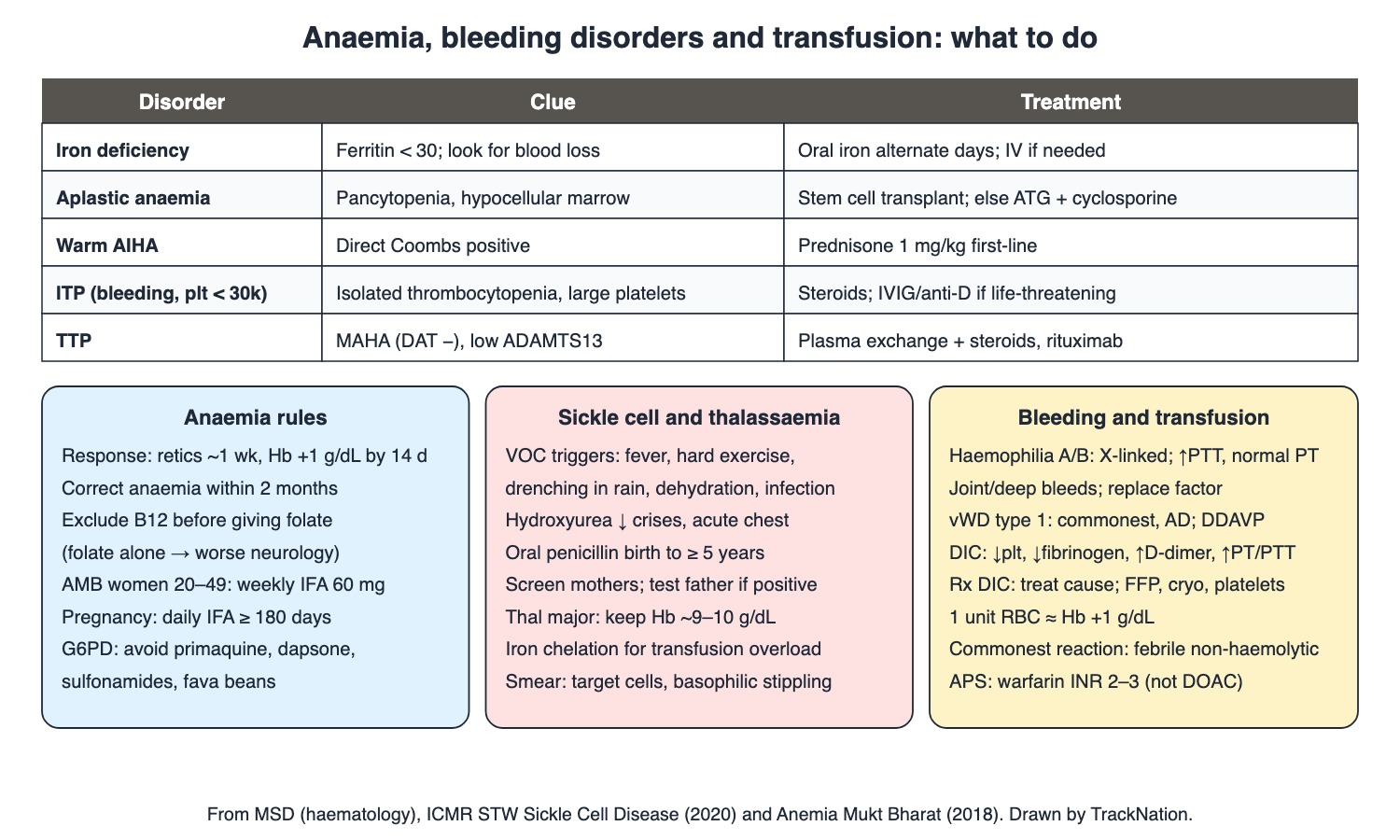
Anaemia treatment, sickle cell and thalassaemia, bleeding disorders and transfusion. Drawn by TrackNation.
Iron, B12 and Folate
Iron deficiency: ferritin < 30 ng/mL; suspect occult blood loss until proven otherwise — always look for the cause.
Oral iron: about 65 mg elemental iron every other day, 30 minutes before meals; bigger or more frequent doses are poorly absorbed (hepcidin) and cause constipation. Reticulocytes rise by 1 week; Hb rises ~1 g/dL by day 14; correct anaemia within 2 months. Parenteral iron works faster but can cause infusion reactions.
Anemia Mukt Bharat: IFA tablet = 60 mg elemental iron + 500 µg folic acid — weekly for adolescents and non-pregnant women of reproductive age; daily for pregnant women from the second trimester (≥ 180 days) and 180 days postpartum.
Megaloblastic anaemia: always exclude B12 deficiency before folate — folate alone can correct the anaemia and let the neurological damage progress.
Marrow Failure and Haemolysis
Aplastic anaemia: pancytopenia with a hypocellular marrow; stem cell transplant, otherwise equine ATG + cyclosporine.
AIHA: direct Coombs test diagnoses it; warm AIHA → prednisone 1 mg/kg first-line; haemolysis mainly extravascular.
G6PD deficiency (X-linked): haemolysis after infection or oxidant drugs — primaquine, dapsone, sulfonamides, nitrofurans, rasburicase, sometimes fava beans; bite cells and Heinz bodies.
Sickle cell disease (ICMR): autosomal recessive; ~88% of Asian homozygous cases are Indian. Crises triggered by fever, strenuous exercise, dehydration, drenching in rain, surgery, infection. Complications: acute chest syndrome, splenic sequestration, priapism, avascular necrosis, CKD, stroke. Screen all pregnant women in the first trimester; if positive, test the father. Hydroxyurea reduces crises and acute chest syndrome; oral penicillin from birth to ≥ 5 years. Diagnosis by Hb electrophoresis/HPLC.
Thalassaemia major: target cells and basophilic stippling; transfuse to keep Hb about 9–10 g/dL and chelate iron; stem cell transplant can cure.
Platelets, Coagulation, Transfusion
Bleeding disorder (MSD) | Lab pattern | Treatment |
Haemophilia A / B | ↑ PTT, normal PT; factor VIII / IX low | Replace factor (start before tests if bleeding); emicizumab prophylaxis |
von Willebrand disease | Type 1 (commonest, AD): mucosal bleeding, bruising | Desmopressin or VWF-containing factor VIII concentrate |
DIC | ↓ platelets, ↑ PT and PTT, ↑ D-dimer, falling fibrinogen | Treat cause; platelets, FFP, cryoprecipitate for bleeding |
ITP | Isolated low platelets, large platelets | Prednisone if bleeding/plt < 30k; IVIG, anti-D for severe bleeding |
TTP | DAT-negative MAHA, schistocytes, low ADAMTS13 | Plasma exchange, steroids, rituximab |
DIC that evolves slowly causes thrombosis (cancer); rapid DIC causes bleeding.
Antiphospholipid syndrome: arterial/venous thrombosis or recurrent miscarriage; indefinite warfarin, INR 2–3 — DOACs have more recurrences.
Transfusion: Hb as low as 7 g/dL may be adequate in healthy patients (higher with heart disease or bleeding); 1 unit raises Hb by ~1 g/dL. Commonest reaction: febrile non-haemolytic. Most serious: ABO-incompatible acute haemolysis, TA-GVHD (prevent with irradiated products), TACO and TRALI. Stop the unit and do not restart it.
Traps the Examiner Sets
Iron every other day absorbs better than several doses a day.
Never give folate alone without excluding B12 deficiency.
Haemophilia: PTT up, PT normal, platelets normal.
TTP: plasma exchange — DAT negative.
APS: warfarin, not DOACs.
Memory Hooks & Shortcuts
Shortcuts to lock in this article's numbers and lists. Each one only re-packages facts proven above.
🧠 Iron: 'Every Other Day keeps hepcidin away' — oral iron
🧠 'B before F' — B12 before folate — megaloblastic
🧠 Sickle crisis 'FEDRIS': Fever, Exercise, Dehydration, Rain, Infection, Surgery — VOC triggers
🧠 TTP 'Plasma Pours in' — exchange, not platelets — TTP
🧠 Haemophilia: 'Joints and PTT; PT is free' — haemophilia
🧠 APS: 'Warfarin Wins over DOACs' — APS
Rapid-Revision Cards
Iron deficiency
Ferritin < 30; find blood loss.
Oral iron
~65 mg elemental, alternate days, before meals.
Iron response
Retics 1 wk; Hb +1 g/dL by 14 d; correct by 2 months.
AMB IFA
60 mg iron + 500 µg FA.
AMB pregnancy
Daily from T2, ≥ 180 d + 180 d postpartum.
Folate rule
Exclude B12 first.
Aplastic anaemia
HSCT; else ATG + cyclosporine.
AIHA
DAT positive; prednisone 1 mg/kg.
G6PD
X-linked; primaquine, dapsone, sulfa, fava.
SCD inheritance
Autosomal recessive.
VOC triggers (ICMR)
Fever, exercise, dehydration, rain, infection, surgery.
SCD prevention
Hydroxyurea; penicillin to ≥ 5 y.
Antenatal SCD screen
All women T1; test father if positive.
Thal major
Hb ~9–10; chelation.
ITP
Pred if plt < 30k/bleeding; IVIG/anti-D severe.
TTP
Low ADAMTS13; plasma exchange.
Haemophilia
X-linked; ↑PTT, normal PT; factor now.
vWD
Type 1 commonest, AD; DDAVP.
DIC labs
↓plt, ↓fibrinogen, ↑PT/PTT, ↑D-dimer.
APS
Warfarin INR 2–3.
1 unit RBC
Hb +1 g/dL.
Commonest transfusion reaction
Febrile non-haemolytic.
TA-GVHD
Irradiated products.
Sources
Facts in this article were checked against these documents.
Standard Treatment Workflow: Sickle Cell Disease — Indian Council of Medical Research, DHR, 2020 (link)
Anemia Mukt Bharat: Intensified National Iron Plus Initiative — Operational Guidelines — Ministry of Health and Family Welfare, 2018 (link)
MSD Manual Professional: haematology and transfusion medicine chapters — Merck & Co. (MSD Manuals), reviewed 2025–26 (link)
Competency Based Undergraduate Curriculum, General Medicine (GM 9) — National Medical Commission, 2024
Test Yourself: Practice Questions
Thirty questions in NEET PG style, most of them clinical vignettes.
Practice Questions (NEET PG pattern)
Original questions written in the style of the exam: +4 for a correct answer, −1 for a wrong one. Every answer was checked against the sources listed above. NEET PG papers are not published by NBEMS, so these are not past-paper questions.
Q1. A man has iron deficiency anaemia with ferritin 8 ng/mL. Besides iron, the essential next step is
(a) search for a source of blood loss
(b) start folate alone
(c) bone marrow biopsy
(d) transfuse to Hb 12
Show answer
Answer: (a) — Occult blood loss until proven otherwise.
Q2. Current evidence favours oral iron given as
(a) once a month
(b) with tea at meals
(c) three large doses daily
(d) about 65 mg elemental iron every other day
Show answer
Answer: (d) — Hepcidin limits absorption of frequent doses.
Q3. After starting oral iron in a responder, reticulocytosis appears and Hb rises by about 1 g/dL by
(a) 1 month and 6 months
(b) 1 day and 3 days
(c) never
(d) 1 week and 14 days respectively
Show answer
Answer: (d) — Correct anaemia within 2 months.
Q4. Compared with oral iron, parenteral iron
(a) never causes reactions
(b) works faster but can cause allergic or infusion reactions
(c) is always first-line
(d) is less effective
Show answer
Answer: (b) — Used when oral iron fails or is not tolerated.
Q5. Under Anemia Mukt Bharat, a pregnant woman receives
(a) IFA only if Hb < 7
(b) one IFA tablet (60 mg iron + 500 µg folic acid) daily from the second trimester for at least 180 days
(c) weekly IFA
(d) folic acid alone
Show answer
Answer: (b) — Continue 180 days after delivery.
Q6. A non-pregnant woman aged 25 under Anemia Mukt Bharat receives
(a) no supplement
(b) one IFA tablet weekly
(c) one IFA tablet daily
(d) IV iron yearly
Show answer
Answer: (b) — Red tablet, 60 mg iron + 500 µg folic acid.
Q7. A patient with macrocytic anaemia and paraesthesia is about to receive folic acid. First,
(a) transfuse
(b) exclude vitamin B12 deficiency
(c) give folic acid alone
(d) start iron
Show answer
Answer: (b) — Folate can mask B12 deficiency and worsen neurology.
Q8. A young adult has pancytopenia and a hypocellular bone marrow without abnormal cells. The definitive treatment, if a donor is available, is
(a) haematopoietic stem cell transplantation
(b) iron
(c) splenectomy
(d) folic acid
Show answer
Answer: (a) — Otherwise ATG + cyclosporine.
Q9. Haemolytic anaemia with a positive direct antiglobulin test is
(a) TTP
(b) autoimmune haemolytic anaemia
(c) hereditary spherocytosis
(d) G6PD deficiency
Show answer
Answer: (b) — Warm AIHA: prednisone first-line.
Q10. First-line treatment of idiopathic warm AIHA is
(a) iron
(b) splenectomy
(c) prednisone 1 mg/kg daily
(d) plasma exchange
Show answer
Answer: (c) — Taper slowly once stable.
Q11. A man develops dark urine and anaemia after starting primaquine for vivax malaria; smear shows bite cells. The likely cause is
(a) G6PD deficiency
(b) AIHA
(c) PNH
(d) sickle cell crisis
Show answer
Answer: (a) — X-linked; oxidant drugs.
Q12. G6PD deficiency is inherited as
(a) autosomal recessive
(b) autosomal dominant
(c) mitochondrial
(d) X-linked
Show answer
Answer: (d) — Mostly affects males.
Q13. Per ICMR, a vaso-occlusive crisis in sickle cell disease is commonly precipitated by
(a) fever, strenuous exercise, dehydration or drenching in rain
(b) high altitude only
(c) iron tablets
(d) vitamin C
Show answer
Answer: (a) — Also surgery and infection.
Q14. Sickle cell disease is inherited as
(a) mitochondrial
(b) autosomal recessive
(c) X-linked recessive
(d) autosomal dominant
Show answer
Answer: (b) — HbAS carriers, HbSS disease.
Q15. A pregnant woman is found to be a sickle cell carrier. Per ICMR the next step is
(a) start hydroxyurea
(b) no further action
(c) test the father; if positive, counsel and offer prenatal testing
(d) terminate the pregnancy
Show answer
Answer: (c) — Screen all women in the first trimester.
Q16. A drug that reduces painful crises and acute chest syndrome in sickle cell disease is
(a) hydroxyurea
(b) iron
(c) methotrexate
(d) warfarin
Show answer
Answer: (a) — Plus penicillin prophylaxis in children.
Q17. Children with sickle cell disease should receive
(a) continuous oral penicillin from birth to at least 5 years
(b) no prophylaxis
(c) penicillin only during fever
(d) monthly IV antibiotics
Show answer
Answer: (a) — Splenic damage raises infection risk.
Q18. In beta-thalassaemia major, transfusions aim to maintain haemoglobin around
(a) 5 g/dL
(b) 7 g/dL without chelation
(c) 9–10 g/dL, with iron chelation
(d) 14 g/dL
Show answer
Answer: (c) — Chelation prevents iron-overload complications.
Q19. An adult with ITP has bleeding and platelets 12,000/µL. Initial treatment is
(a) platelet transfusion alone daily
(b) aspirin
(c) splenectomy immediately
(d) oral glucocorticoid (e.g. prednisone 1 mg/kg)
Show answer
Answer: (d) — Dexamethasone 40 mg × 4 days is an alternative.
Q20. For life-threatening bleeding in ITP, options include
(a) platelet transfusion with IV steroids and IVIG or anti-D
(b) plasma exchange
(c) heparin
(d) warfarin
Show answer
Answer: (a) — Used individually or together.
Q21. A patient has thrombocytopenia and Coombs-negative haemolysis with schistocytes; ADAMTS13 is very low. Treatment is
(a) splenectomy
(b) IV iron
(c) plasma exchange with glucocorticoids (± rituximab)
(d) platelet transfusion
Show answer
Answer: (c) — TTP.
Q22. A boy has recurrent painful joint swellings after minor trauma; PTT is prolonged, PT and platelets normal. The likely diagnosis is
(a) ITP
(b) DIC
(c) haemophilia
(d) von Willebrand disease type 1
Show answer
Answer: (c) — X-linked factor VIII/IX deficiency.
Q23. A haemophilia patient presents with suspected intracranial bleeding. Factor replacement should be given
(a) immediately, even before diagnostic tests
(b) after factor assays
(c) not at all
(d) only after CT
Show answer
Answer: (a) — Do not delay.
Q24. A woman has heavy menstrual bleeding, easy bruising and gum bleeding; her mother has similar symptoms. The commonest inherited cause is
(a) Glanzmann thrombasthenia
(b) haemophilia A
(c) vitamin K deficiency
(d) von Willebrand disease type 1 (autosomal dominant)
Show answer
Answer: (d) — Treat with desmopressin or VWF-containing concentrate.
Q25. A septic patient oozes from all lines; platelets low, PT and PTT high, fibrinogen falling, D-dimer high. Diagnosis and treatment:
(a) DIC — treat the cause and replace platelets, FFP and cryoprecipitate
(b) TTP — plasma exchange
(c) haemophilia — factor VIII
(d) ITP — steroids
Show answer
Answer: (a) — Rapid DIC bleeds; slow DIC clots.
Q26. Slowly evolving DIC, as in cancer, mainly causes
(a) venous thrombosis and embolism
(b) bleeding only
(c) no symptoms
(d) haemarthrosis
Show answer
Answer: (a) — Rapid DIC causes bleeding.
Q27. A woman with recurrent miscarriages and a DVT has persistent antiphospholipid antibodies. Long-term anticoagulation is
(a) aspirin alone
(b) no anticoagulation
(c) warfarin, target INR 2–3
(d) a DOAC preferred
Show answer
Answer: (c) — DOACs have more recurrences.
Q28. One unit of packed red cells in an average adult raises haemoglobin by about
(a) 0.2 g/dL
(b) 3 g/dL
(c) 5 g/dL
(d) 1 g/dL
Show answer
Answer: (d) — Haematocrit by ~3%.
Q29. The most common complication of blood transfusion is
(a) acute haemolytic reaction
(b) febrile non-haemolytic reaction
(c) TRALI
(d) transfusion-associated GVHD
Show answer
Answer: (b) — AHTR, GVHD, TACO and TRALI are the most serious.
Q30. Transfusion-associated graft-versus-host disease is prevented by
(a) giving blood faster
(b) leukocyte filters alone
(c) irradiated blood products
(d) warming blood
Show answer
Answer: (c) — For at-risk patients.
Active Recall
From memory: outline iron deficiency work-up, oral dosing and response, Anemia Mukt Bharat IFA doses, the B12-before-folate rule, treatment of aplastic anaemia and AIHA, G6PD triggers, ICMR sickle cell care, thalassaemia transfusion, ITP and TTP treatment, labs of haemophilia, vWD and DIC, APS anticoagulation and transfusion reactions.