Diabetes Mellitus for NEET PG Medicine: ICMR Diagnosis and Treatment Ladder, DKA Protocol, HHS, Hypoglycaemia, Diabetic Foot
Start Here
🎯 Exam priority: Very high. Expect: diagnostic and prediabetes cut-offs, GDM screening, ICMR HbA1c-based drug ladder and targets, drug adverse effects, DKA severity and protocol (fluids before insulin, potassium rule, dextrose at 250), HHS numbers, euglycaemic DKA, hypoglycaemia definitions, retinopathy stages, albuminuria and diabetic foot care.
CBME mapping: GM 11.1–11.24. Antidiabetic pharmacology is in Pharmacology; diabetic retinopathy in Ophthalmology; GDM in OBG; DKA in children in Paediatrics.
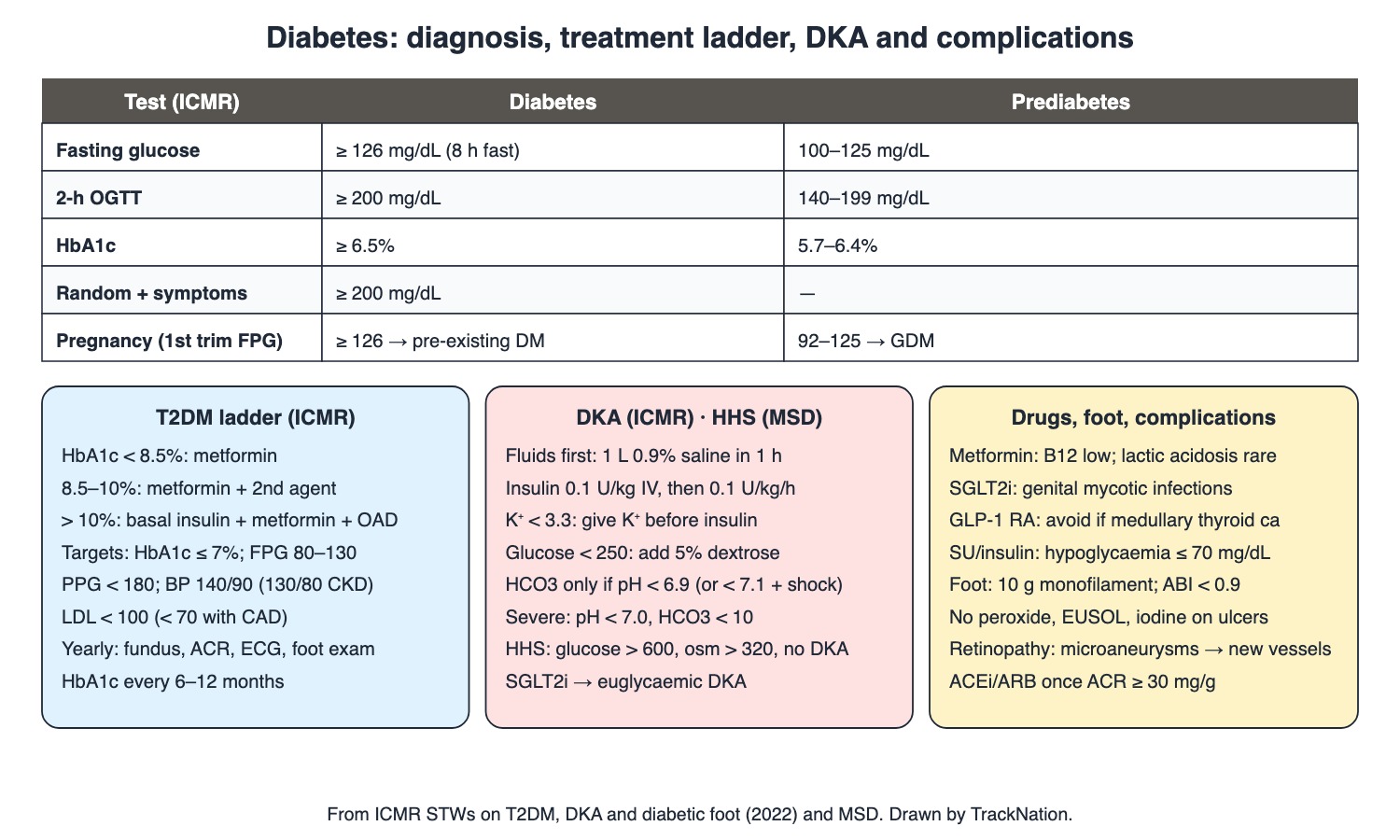
Diabetes thresholds, ICMR treatment ladder, DKA and HHS, drugs, foot and complications. Drawn by TrackNation.
Diagnosis and Treatment
Diabetes (ICMR): FPG ≥ 126 (8-h fast), 2-h OGTT ≥ 200, HbA1c ≥ 6.5%, or random ≥ 200 with symptoms. Prediabetes: FPG 100–125, OGTT 140–199, HbA1c 5.7–6.4%.
Screen overweight/obese adults (BMI ≥ 23; ≥ 27.5 obese) with risk factors, and anyone with osmotic symptoms, weight loss, ACS, recurrent or deep-seated infections (liver abscess, lower-lobe pneumonia, TB, pyelonephritis) or non-healing ulcers. Pregnancy: first-trimester FPG ≥ 126 = pre-existing diabetes; 92–125 = GDM.
Type 1 is autoimmune (antibodies), may present as DKA; LADA is adult-onset autoimmune diabetes that progresses slowly.
ICMR T2DM ladder: HbA1c < 8.5% → metformin; 8.5–10% → metformin + a second agent (SU, TZD, DPP-4i, SGLT2i, AGI, GLP-1 RA); > 10% → basal insulin + metformin + another oral drug. Targets: HbA1c ≤ 7% (relaxed in the elderly), pre-meal 80–130, post-meal < 180, BP 140/90 (130/80 in CKD), LDL < 100 (< 70 with CAD).
Monitoring: HbA1c every 6–12 months (3-monthly if uncontrolled); yearly ECG, urine ACR, dilated fundoscopy, foot examination.
Drug adverse effects: metformin — GI upset, B12 malabsorption, rare lactic acidosis (stop before contrast); SGLT2i — genital mycotic infections, euglycaemic DKA; DPP-4i — slight pancreatitis risk; GLP-1 RA — avoid with medullary thyroid cancer history; sulfonylureas and insulin — hypoglycaemia.
DKA, HHS and Hypoglycaemia
DKA: may be the first presentation of type 1; triggers — missed insulin, infection. Abdominal pain, vomiting, Kussmaul breathing, fruity breath; fever means infection. Pitfalls: insulin before fluids, stopping IV insulin before SC insulin, trusting amylase for pancreatitis, normal K⁺ despite body depletion, cerebral oedema in children.
HHS (type 2): glucose > 600 mg/dL, osmolality > 320, altered consciousness, fluid deficit can exceed 10 L; enough insulin to prevent ketoacidosis. Euglycaemic DKA: SGLT2 inhibitors, alcohol, cirrhosis. Alcoholic ketoacidosis: ketoacidosis without significant hyperglycaemia.
Hypoglycaemia on treatment: glucose ≤ 70 mg/dL (sulfonylureas, insulin). Without diabetes treatment, confirm Whipple's triad (symptoms, glucose < 55, relief with glucose); C-peptide and insulin levels help find the cause.
DKA step (ICMR STW) | What to do |
Severity | Mild pH 7.25–7.3 / HCO3 15–18; moderate 7.0–7.25 / 10–15; severe < 7.0 / < 10 (ICU) |
Fluids first | 1 L 0.9% saline in the first hour, then 250–500 mL/h (children 10–20 mL/kg/h initially) |
Insulin | Regular insulin 0.1 U/kg IV, then 0.1 U/kg/h; double if glucose falls < 10% in an hour |
Potassium | If K⁺ < 3.3 (or ECG changes) give K⁺ before insulin; replace 10–20 mEq/h with insulin if K⁺ < 5.5 |
Dextrose | Add 5% dextrose at 50 mL/h when glucose < 250 mg/dL |
Bicarbonate | Only if pH < 6.9, or < 7.1 with hypotension, or hyperkalaemia |
Stop infusion | Eating, glucose < 250, anion gap normal; give SC insulin ≥ 30 min before stopping the drip |
Complications and Diabetic Foot
Retinopathy: microaneurysms (background) → neovascularisation (proliferative) and macular oedema; no early symptoms — yearly dilated fundoscopy.
Nephropathy: start ACEi/ARB at the first sign of albuminuria (ACR ≥ 30 mg/g) or with hypertension.
Neuropathy: symmetric stocking-glove polyneuropathy (commonest); autonomic — gastroparesis, resting tachycardia, erectile dysfunction; third-nerve palsy with ptosis and diplopia.
Diabetic foot (ICMR): test sensation with a 10 g monofilament; PAD if pulses absent or ABI < 0.9; probe-to-bone or X-ray for osteomyelitis; deformities (claw toes, rocker-bottom Charcot foot). Moist dressings, off-loading, glucose control; do not use hydrogen peroxide, EUSOL, povidone-iodine or chlorhexidine. Uninfected wounds need no antibiotics. Follow-up: low risk yearly, medium 6-monthly, high (previous ulcer/amputation) 3-monthly.
Traps the Examiner Sets
DKA: fluids before insulin; K⁺ < 3.3 → potassium first.
Add dextrose at glucose 250 but keep insulin running until the anion gap closes.
HbA1c > 10% at diagnosis → basal insulin (ICMR).
SGLT2i can cause DKA with near-normal glucose.
GDM by first-trimester FPG 92–125 (ICMR).
Memory Hooks & Shortcuts
Shortcuts to lock in this article's numbers and lists. Each one only re-packages facts proven above.
🧠 '126-200-6.5': fasting, OGTT/random, HbA1c — diagnosis
🧠 ICMR ladder '8.5-10': under 8.5 one drug, up to 10 two, above 10 insulin — treatment ladder
🧠 DKA: 'Fluids, then K check, then Insulin' — FKI — DKA order
🧠 DKA '250 = sweeten the drip' (add dextrose) — dextrose
🧠 HHS '600/320' — HHS
🧠 SGLT2i: 'Sugar Gone, Lethal ketones Too' (euglycaemic DKA) — SGLT2i
Rapid-Revision Cards
Diabetes cut-offs
FPG ≥ 126; OGTT ≥ 200; HbA1c ≥ 6.5; RBS ≥ 200 + symptoms.
Prediabetes
FPG 100–125; OGTT 140–199; HbA1c 5.7–6.4.
GDM (ICMR)
1st-trimester FPG 92–125.
ICMR ladder
< 8.5 metformin; 8.5–10 dual; > 10 basal insulin + 2.
Targets
HbA1c ≤ 7; FPG 80–130; PPG < 180.
BP and LDL in DM
140/90 (130/80 CKD); LDL < 100 (< 70 CAD).
Annual checks
ECG, ACR, fundus, foot.
Metformin
B12 ↓; rare lactic acidosis; stop before contrast.
SGLT2i
Mycotic infections; euglycaemic DKA.
GLP-1 RA
Avoid with medullary thyroid cancer history.
DKA severity
Severe pH < 7.0, HCO3 < 10.
DKA fluids
1 L NS in 1 h, then 250–500 mL/h.
DKA insulin
0.1 U/kg bolus + 0.1 U/kg/h.
DKA potassium
K⁺ < 3.3 → K⁺ first.
DKA dextrose
Glucose < 250 → add D5.
DKA bicarbonate
pH < 6.9 (or < 7.1 + shock).
Stopping infusion
SC insulin 30 min before.
HHS
Glucose > 600, osm > 320, no ketoacidosis.
Euglycaemic DKA
SGLT2i, alcohol, cirrhosis.
Hypoglycaemia on Rx
≤ 70 mg/dL.
Whipple's triad
Symptoms, glucose < 55, relief.
Retinopathy
Microaneurysms → new vessels.
Albuminuria
ACR ≥ 30 → ACEi/ARB.
Diabetic foot
10 g monofilament; ABI < 0.9; moist dressing.
Sources
Facts in this article were checked against these documents.
Standard Treatment Workflows: Diabetes Mellitus Type 2; Diabetic Ketoacidosis; Diabetic Foot — Indian Council of Medical Research, DHR, 2022 (link)
MSD Manual Professional: Diabetes Mellitus; Drug Treatment of Diabetes Mellitus; Diabetic Ketoacidosis (and HHS); Complications of Diabetes Mellitus; Hypoglycemia — Merck & Co. (MSD Manuals), reviewed 2025–26 (link)
Competency Based Undergraduate Curriculum, General Medicine (GM 11) — National Medical Commission, 2024
Test Yourself: Practice Questions
Thirty questions in NEET PG style, most of them clinical vignettes.
Practice Questions (NEET PG pattern)
Original questions written in the style of the exam: +4 for a correct answer, −1 for a wrong one. Every answer was checked against the sources listed above. NEET PG papers are not published by NBEMS, so these are not past-paper questions.
Q1. An adult has fasting plasma glucose 132 mg/dL on two occasions. By ICMR criteria this is
(a) normal
(b) impaired glucose tolerance
(c) diabetes mellitus
(d) impaired fasting glucose
Show answer
Answer: (c) — FPG ≥ 126 after an 8-hour fast.
Q2. HbA1c of 6.1% indicates
(a) diabetes
(b) hypoglycaemia
(c) normal glycaemia
(d) prediabetes
Show answer
Answer: (d) — Prediabetes 5.7–6.4%; diabetes ≥ 6.5%.
Q3. A 2-hour OGTT value of 165 mg/dL is
(a) impaired fasting glucose
(b) normal
(c) diabetes
(d) impaired glucose tolerance
Show answer
Answer: (d) — IGT 140–199.
Q4. A pregnant woman's first-trimester fasting plasma glucose is 104 mg/dL. Per ICMR she has
(a) normal glucose
(b) prediabetes only
(c) pre-existing diabetes
(d) gestational diabetes
Show answer
Answer: (d) — FPG 92–125 = GDM; ≥ 126 = pre-existing diabetes.
Q5. A newly diagnosed type 2 diabetic has HbA1c 7.8%. The ICMR first-line drug is
(a) triple therapy
(b) metformin monotherapy
(c) sulfonylurea plus insulin
(d) basal insulin
Show answer
Answer: (b) — HbA1c < 8.5% → metformin.
Q6. A newly diagnosed type 2 diabetic has HbA1c 11.2%. Per ICMR, start
(a) diet only
(b) basal insulin with metformin and another oral drug
(c) metformin alone
(d) a DPP-4 inhibitor alone
Show answer
Answer: (b) — HbA1c > 10%.
Q7. The ICMR glycaemic target for most adults with type 2 diabetes is
(a) HbA1c ≤ 7%
(b) HbA1c ≤ 9%
(c) HbA1c ≤ 5.5%
(d) HbA1c < 6% for all
Show answer
Answer: (a) — Higher targets acceptable in the elderly or with major comorbidity.
Q8. In a diabetic patient with coronary artery disease, the ICMR LDL target is
(a) < 100 mg/dL
(b) < 130 mg/dL
(c) < 160 mg/dL
(d) < 70 mg/dL
Show answer
Answer: (d) — < 100 otherwise.
Q9. Annual monitoring in type 2 diabetes per ICMR includes all EXCEPT
(a) coronary angiography
(b) dilated fundoscopy
(c) urine albumin–creatinine ratio
(d) foot examination
Show answer
Answer: (a) — Also ECG yearly.
Q10. A long-term metformin user develops a low B12 level. The explanation is
(a) autoimmune gastritis only
(b) lactic acidosis
(c) metformin causes vitamin B12 malabsorption
(d) SGLT2 effect
Show answer
Answer: (c) — Also GI upset; rare lactic acidosis.
Q11. Metformin should be stopped temporarily before
(a) a chest X-ray
(b) eye drops
(c) dental cleaning
(d) radiological procedures using iodinated contrast
Show answer
Answer: (d) — Contraindicated with acidosis, hypoxia, ESRD.
Q12. A woman started on dapagliflozin develops vulvovaginal candidiasis. This adverse effect is typical of
(a) sulfonylureas
(b) SGLT2 inhibitors
(c) DPP-4 inhibitors
(d) metformin
Show answer
Answer: (b) — Genitourinary (mycotic) infections are the commonest.
Q13. A GLP-1 receptor agonist is contraindicated in a patient with
(a) a personal or family history of medullary thyroid cancer
(b) fatty liver
(c) hypertension
(d) obesity
Show answer
Answer: (a) — Based on rodent data.
Q14. A young person presents with vomiting, abdominal pain, deep sighing breathing and fruity breath; glucose 420 mg/dL, pH 6.95, HCO3 8. The severity of DKA per ICMR is
(a) not DKA
(b) severe (HCO3 < 10)
(c) mild
(d) moderate
Show answer
Answer: (b) — Severe: pH < 7.0 and HCO3 < 10 — ICU.
Q15. In DKA, the first therapeutic step is
(a) 1 L of 0.9% saline over the first hour
(b) oral fluids only
(c) sodium bicarbonate
(d) insulin bolus before fluids
Show answer
Answer: (a) — Starting insulin before fluids is a listed error.
Q16. The ICMR insulin regimen in DKA is
(a) 1 U/kg/h
(b) glargine 20 units SC
(c) insulin only after glucose < 250
(d) regular insulin 0.1 U/kg IV bolus then 0.1 U/kg/h
Show answer
Answer: (d) — Double the rate if glucose falls < 10% in the first hour.
Q17. A DKA patient has serum potassium 3.0 mEq/L. Per ICMR,
(a) give potassium before starting insulin
(b) give bicarbonate
(c) stop fluids
(d) start insulin and ignore potassium
Show answer
Answer: (a) — K⁺ < 3.3 → replace before insulin.
Q18. During DKA treatment blood glucose falls to 230 mg/dL but the anion gap is still high. The next step is
(a) stop insulin
(b) switch to SC insulin and discharge
(c) add 5% dextrose and continue insulin
(d) give bicarbonate
Show answer
Answer: (c) — Insulin continues until acidosis resolves.
Q19. Per the ICMR DKA workflow, sodium bicarbonate is indicated when
(a) pH < 6.9, or pH < 7.1 with hypotension, or hyperkalaemia
(b) HCO3 < 18 in all
(c) never
(d) pH < 7.3
Show answer
Answer: (a) — Routine bicarbonate is not used.
Q20. Before stopping the IV insulin infusion in resolved DKA, the patient should receive
(a) a bicarbonate bolus
(b) subcutaneous long/intermediate and short-acting insulin at least 30 minutes earlier
(c) oral metformin only
(d) nothing
Show answer
Answer: (b) — Prevents rebound ketoacidosis.
Q21. In DKA, a normal serum potassium means
(a) hyperkalaemia will follow
(b) no potassium needed ever
(c) total body potassium may still be depleted
(d) the patient is not in DKA
Show answer
Answer: (c) — Acidosis shifts potassium out of cells.
Q22. A type 2 diabetic is drowsy with glucose 900 mg/dL, serum osmolality 360 and no significant ketoacidosis. The diagnosis is
(a) DKA
(b) alcoholic ketoacidosis
(c) hyperosmolar hyperglycaemic state
(d) hypoglycaemia
Show answer
Answer: (c) — Fluid deficit can exceed 10 L.
Q23. A patient on empagliflozin has nausea, vomiting and anion gap acidosis with ketones but glucose of only 190 mg/dL. The likely diagnosis is
(a) lactic acidosis from metformin
(b) HHS
(c) gastroenteritis only
(d) euglycaemic DKA due to SGLT2 inhibitor
Show answer
Answer: (d) — Also with alcohol use or cirrhosis.
Q24. A malnourished heavy drinker has vomiting and high anion gap ketoacidosis with near-normal glucose. The diagnosis is
(a) methanol poisoning
(b) DKA
(c) HHS
(d) alcoholic ketoacidosis
Show answer
Answer: (d) — Alcohol plus starvation.
Q25. In a patient on insulin or sulfonylurea, hypoglycaemia is defined as blood glucose
(a) ≤ 100 mg/dL
(b) ≤ 40 mg/dL only
(c) ≤ 90 mg/dL
(d) ≤ 70 mg/dL
Show answer
Answer: (d) — Without diabetes treatment, use Whipple's triad (< 55).
Q26. The earliest lesion of diabetic retinopathy is
(a) retinal capillary microaneurysms
(b) neovascularisation
(c) vitreous haemorrhage
(d) retinal detachment
Show answer
Answer: (a) — Background → proliferative; macular oedema.
Q27. A normotensive diabetic has urine ACR 60 mg/g on repeat testing. The next drug step is
(a) an ACE inhibitor or ARB
(b) a calcium-channel blocker only
(c) no treatment
(d) a beta-blocker
Show answer
Answer: (a) — Start at the earliest albuminuria (ACR ≥ 30).
Q28. The commonest form of diabetic neuropathy is
(a) autonomic gastroparesis
(b) third-nerve palsy
(c) diabetic amyotrophy
(d) distal symmetric (stocking-glove) polyneuropathy
Show answer
Answer: (d) — Paraesthesia or painless loss of sensation.
Q29. Loss of protective sensation in a diabetic foot is screened with
(a) pinprick on the face
(b) a tuning fork of 512 Hz only
(c) ABI
(d) a 10 g monofilament
Show answer
Answer: (d) — ABI < 0.9 indicates PAD.
Q30. For a clean diabetic foot ulcer without osteomyelitis, the ICMR workflow advises
(a) hyperbaric oxygen first
(b) moist dressings, off-loading and glucose control — not hydrogen peroxide, EUSOL or povidone-iodine
(c) daily hydrogen peroxide
(d) routine antibiotics for all
Show answer
Answer: (b) — Uninfected wounds need no antibiotics.
Active Recall
From memory: give diabetes, prediabetes and GDM thresholds, the ICMR T2DM ladder and targets, key drug adverse effects, the ICMR DKA protocol with potassium, dextrose and bicarbonate rules, HHS and euglycaemic DKA features, hypoglycaemia definitions, and complications with diabetic foot care.