Thyroid, Adrenal, Pituitary and Parathyroid Disorders for NEET PG Medicine: ICMR Hypothyroidism, Graves, Cushing, Addison
Start Here
🎯 Exam priority: High. Expect: overt vs subclinical vs central hypothyroidism, levothyroxine dose and elderly start, titrating central hypothyroidism by FT4, myxoedema coma, Graves features and TSI, PTU vs methimazole, agranulocytosis, thyroid storm triggers, Cushing tests and causes, Addison electrolytes and crisis, Conn and phaeochromocytoma, prolactinoma drug, hypopituitarism order, Sheehan, DI and hyperparathyroidism types.
CBME mapping: GM 12.1–12.14 (thyroid) with adrenal and pituitary topics. Endocrine pathology is in Pathology article 26; drugs in Pharmacology; diabetes in article 17; calcium disorders also in article 16.
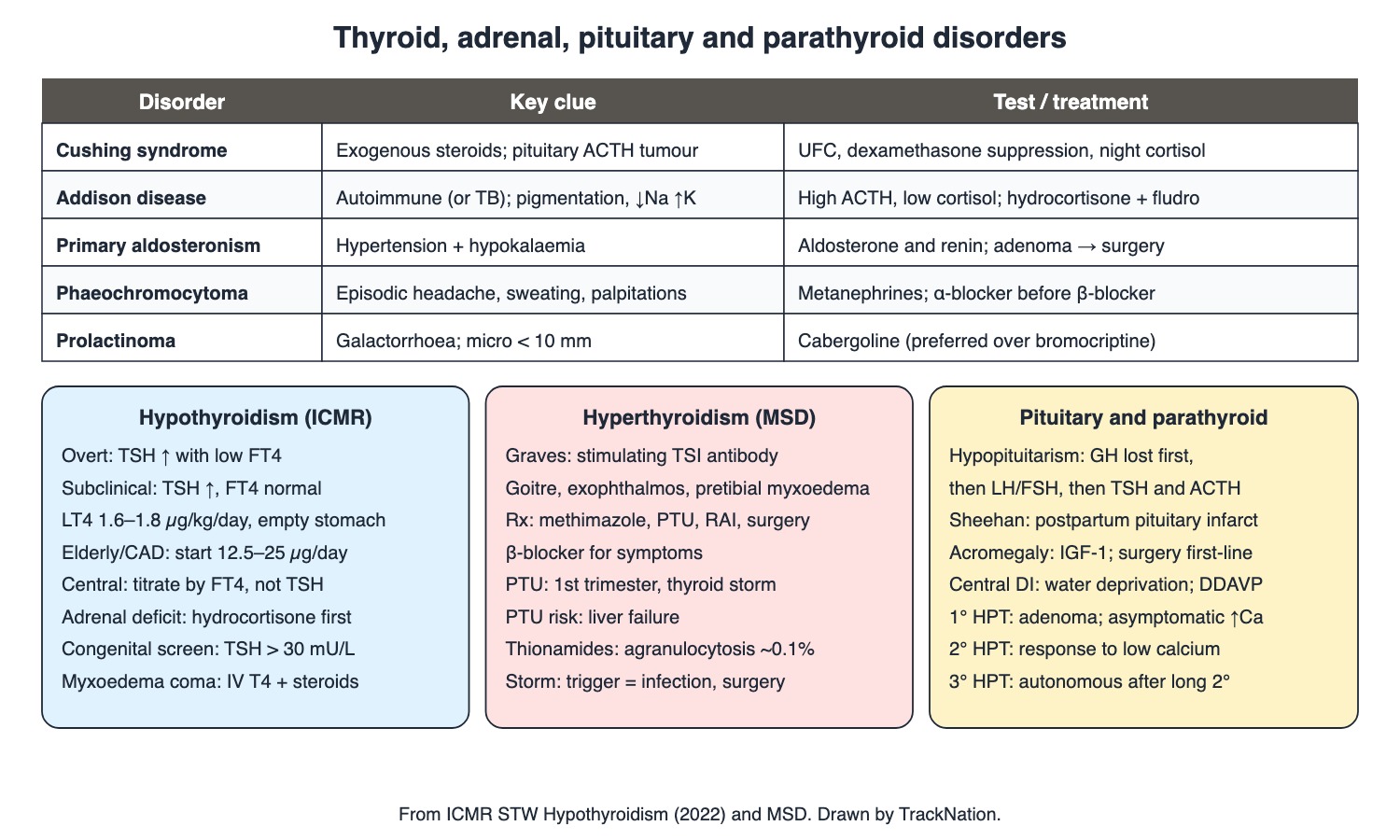
Adrenal and pituitary syndromes, ICMR hypothyroidism, Graves disease and parathyroid. Drawn by TrackNation.
Hypothyroidism
Symptoms: fatigue, weight gain with poor appetite, cold intolerance, dry skin, constipation, hoarseness, menorrhagia, infertility; signs — puffy face, bradycardia, delayed tendon-reflex relaxation, carpal tunnel syndrome, effusions. Billewicz score: ≥ 6 hypothyroid, 3–5 intermediate, ≤ 2 euthyroid.
Commonest cause (MSD): autoimmune — Hashimoto thyroiditis (lymphocytic infiltration, high anti-TPO, painless goitre; rarely thyroid lymphoma). Iodine deficiency causes endemic goitre.
Treat subclinical disease with a large goitre, positive TPO antibodies, ASCVD, heart failure, infertility, dyslipidaemia or TSH > 10 (high progression risk). Target TSH in the young 1–2.5 mU/L, higher with age.
Myxoedema coma: coma with extreme hypothermia in long-standing hypothyroidism — IV T4 plus glucocorticoids and support.
Hypothyroidism (ICMR STW) | Primary | Central (secondary) | Congenital |
Diagnose | TSH ↑ + low FT4 (overt); TSH ↑ + normal FT4 (subclinical) | TSH normal/low + low FT4 | Screen after 72 h: TSH > 30 mU/L |
Start | LT4 1.6–1.8 µg/kg/day, empty stomach; elderly/CAD 12.5–25 µg | LT4 1.3 µg/kg/day — after hydrocortisone if adrenal deficit | LT4 10–15 µg/kg/day |
Titrate by | TSH | FT4 (upper half of normal) | FT4/T4 and TSH |
Hyperthyroidism
Commonest causes: Graves disease, multinodular goitre, toxic nodule, thyroiditis. Graves: a stimulating autoantibody (TSI) to the TSH receptor; goitre, exophthalmos, infiltrative dermopathy (pretibial myxoedema).
Treatment: methimazole or PTU, beta-blockers for symptoms, iodine, radioactive iodine, thyroidectomy. Thionamides: rash, liver injury (liver failure with PTU), agranulocytosis in ~0.1%. PTU only in special situations — first trimester of pregnancy and thyroid storm.
Thyroid storm: life-threatening acute hyperthyroidism in untreated/undertreated Graves or toxic MNG, triggered by infection, trauma, surgery, DKA or pre-eclampsia.
hCG peaks in the first trimester and can lower TSH physiologically. Nodules: ultrasound features decide fine-needle aspiration.
Adrenal Disorders
Cushing syndrome: moon face, buffalo hump, striae, thin limbs. ACTH-dependent — pituitary tumour (Cushing disease) or ectopic ACTH (small cell lung cancer); ACTH-independent — therapeutic glucocorticoids, adrenal adenoma/carcinoma. Tests: urinary free cortisol, dexamethasone suppression, midnight serum/salivary cortisol, then ACTH.
Addison disease: mostly autoimmune; also TB and other granulomas. Hypotension, hyperpigmentation, hyponatraemia, hyperkalaemia. High ACTH with low cortisol. Treat with hydrocortisone + fludrocortisone. Adrenal crisis: give hydrocortisone at once — delay for testing may be fatal.
Primary aldosteronism: hypertension, hypokalaemia, weakness; measure aldosterone and renin; remove an adenoma; spironolactone for hyperplasia.
Phaeochromocytoma: severe headache, sweating, palpitations, paroxysmal hypertension; plasma or urine metanephrines; alpha-blockade first, then beta-blockers, then surgery. Bilateral in 10% (20% in children), malignant in ~10%.
Pituitary and Parathyroid
Prolactinoma: galactorrhoea commonest; most in women are microadenomas (< 10 mm). Cabergoline is preferred over bromocriptine.
Acromegaly: GH drives IGF-1 (measure it); surgery is first-line; octreotide/lanreotide if surgery is not possible.
Hypopituitarism: GH is lost first, then gonadotropins, then TSH and ACTH. Causes include pituitary apoplexy and Sheehan syndrome (postpartum shock).
Central DI: polyuria, polydipsia; water deprivation test fails to concentrate urine; desmopressin. Nephrogenic DI is AVP resistance.
Hyperparathyroidism: primary — usually a single adenoma, often asymptomatic hypercalcaemia, kidney stones; parathyroidectomy cures. Secondary — response to hypocalcaemia (e.g. CKD). Tertiary — autonomous PTH after long secondary disease.
Traps the Examiner Sets
Central hypothyroidism: TSH is unreliable — follow FT4; give hydrocortisone before LT4 if adrenal deficit.
PTU in the first trimester and in thyroid storm; methimazole otherwise.
Phaeochromocytoma: never start a beta-blocker before alpha-blockade.
Suspected adrenal crisis: hydrocortisone first, tests later.
Hypopituitarism: GH first, ACTH last.
Memory Hooks & Shortcuts
Shortcuts to lock in this article's numbers and lists. Each one only re-packages facts proven above.
🧠 Central hypothyroid: 'Follow the Free T4, Forget the TSH' — central hypothyroidism
🧠 'Steroids before thyroid' when the adrenals are weak — replacement order
🧠 PTU = 'Pregnancy (1st trimester) and Thyroid storm Use' — PTU
🧠 Phaeo: 'Alpha before Beta' as in the alphabet — phaeochromocytoma
🧠 Hypopituitarism 'Go Look For The Adenoma': GH, LH/FSH, TSH, ACTH — hormone loss order
🧠 Cabergoline: 'Cab-ride beats the Bromo-bus' — prolactinoma
Rapid-Revision Cards
Overt vs subclinical
TSH ↑ + low FT4 vs TSH ↑ + normal FT4.
Central hypothyroidism
Low FT4 with normal/low TSH; follow FT4.
LT4 dose
1.6–1.8 µg/kg/day; elderly/CAD 12.5–25 µg.
Adrenal + thyroid deficit
Hydrocortisone before LT4.
Congenital screen
After 72 h; TSH > 30.
Billewicz
≥ 6 hypothyroid.
Hashimoto
Anti-TPO; lymphocytes; rarely lymphoma.
Myxoedema coma
IV T4 + steroids.
Graves
Stimulating TSI; exophthalmos; pretibial myxoedema.
PTU uses
1st trimester, thyroid storm.
Thionamide danger
Agranulocytosis ~0.1%; PTU liver failure.
Storm triggers
Infection, trauma, surgery, DKA.
Cushing disease
Pituitary ACTH tumour.
Cushing tests
UFC, dexamethasone suppression, night cortisol.
Addison
Pigmentation, ↓Na ↑K, high ACTH low cortisol.
Adrenal crisis
Hydrocortisone now.
Conn
HTN + low K; aldosterone/renin.
Phaeo
Metanephrines; α then β.
Phaeo 10s
10% bilateral, 10% malignant.
Prolactinoma
Cabergoline.
Acromegaly
IGF-1; surgery first.
Hypopituitarism order
GH → LH/FSH → TSH, ACTH.
Sheehan
Postpartum haemorrhage → pituitary infarct.
Central DI
Water deprivation; desmopressin.
Hyperparathyroidism
1° adenoma; 2° low Ca; 3° autonomous.
Sources
Facts in this article were checked against these documents.
Standard Treatment Workflow: Hypothyroidism — Indian Council of Medical Research, DHR, 2022 (link)
MSD Manual Professional: Hypothyroidism; Hashimoto Thyroiditis; Hyperthyroidism; Thyroid Nodule; Cushing Syndrome; Primary Adrenal Insufficiency; Primary Aldosteronism; Pheochromocytoma; Prolactinoma; Gigantism and Acromegaly; Generalized Hypopituitarism; Central Diabetes Insipidus; Hyperparathyroidism — Merck & Co. (MSD Manuals), reviewed 2025–26 (link)
Competency Based Undergraduate Curriculum, General Medicine (GM 12) — National Medical Commission, 2024
Test Yourself: Practice Questions
Thirty questions in NEET PG style, most of them clinical vignettes.
Practice Questions (NEET PG pattern)
Original questions written in the style of the exam: +4 for a correct answer, −1 for a wrong one. Every answer was checked against the sources listed above. NEET PG papers are not published by NBEMS, so these are not past-paper questions.
Q1. A woman has fatigue, weight gain, cold intolerance and constipation; TSH is high and free T4 low. The diagnosis is
(a) central hypothyroidism
(b) subclinical hypothyroidism
(c) Graves disease
(d) overt primary hypothyroidism
Show answer
Answer: (d) — Subclinical: TSH high, FT4 normal.
Q2. TSH is raised with a normal free T4 in a minimally symptomatic person. This is
(a) central hypothyroidism
(b) subclinical hypothyroidism
(c) overt hypothyroidism
(d) euthyroid sick syndrome
Show answer
Answer: (b) — TSH > 10 carries a high risk of progression.
Q3. A patient with a pituitary macroadenoma has low free T4 with a normal TSH. This indicates
(a) laboratory error
(b) hyperthyroidism
(c) central (secondary) hypothyroidism — titrate levothyroxine by FT4
(d) primary hypothyroidism — titrate by TSH
Show answer
Answer: (c) — TSH is unreliable for monitoring.
Q4. The usual full replacement dose of levothyroxine for a young adult with primary hypothyroidism per ICMR is
(a) 10–15 µg/kg/day
(b) 1.6–1.8 µg/kg/day on an empty stomach
(c) 0.5 µg/kg/day
(d) 200 µg weekly
Show answer
Answer: (b) — Single dose, no food for 1 hour.
Q5. A 74-year-old with coronary artery disease is newly found to have hypothyroidism. Levothyroxine should be started at
(a) 1.8 µg/kg/day at once
(b) only after angiography
(c) 200 µg/day
(d) 12.5–25 µg/day, increased every 3–4 weeks
Show answer
Answer: (d) — Start low, go slow.
Q6. A patient with hypopituitarism has both central hypothyroidism and adrenal insufficiency. Before levothyroxine, give
(a) growth hormone
(b) fludrocortisone alone
(c) nothing
(d) hydrocortisone
Show answer
Answer: (d) — LT4 first can precipitate adrenal crisis.
Q7. On newborn screening for congenital hypothyroidism (ICMR), the screening TSH cut-off is
(a) not done in India
(b) > 100 mU/L only
(c) > 5 mU/L at birth
(d) > 30 mU/L, tested after 72 hours
Show answer
Answer: (d) — Treat with LT4 10–15 µg/kg/day; do not delay.
Q8. The Billewicz score in suspected hypothyroidism classifies as hypothyroid a total of
(a) 6 points or more
(b) 3–5 points
(c) 12 points only
(d) 2 points or less
Show answer
Answer: (a) — 3–5 intermediate; ≤ 2 euthyroid.
Q9. A woman has a painless firm goitre, hypothyroidism and high anti-TPO antibody titres. The diagnosis is
(a) Hashimoto thyroiditis
(b) thyroid cancer
(c) subacute thyroiditis
(d) Graves disease
Show answer
Answer: (a) — Lymphocytic infiltration; rarely thyroid lymphoma.
Q10. A long-standing hypothyroid patient is found comatose with extreme hypothermia. Treatment is
(a) oral levothyroxine 25 µg
(b) propylthiouracil
(c) IV T4 plus glucocorticoids and supportive care
(d) rapid external rewarming only
Show answer
Answer: (c) — Myxoedema coma.
Q11. A woman with hyperthyroidism has goitre, proptosis and non-pitting swelling over the shins. The antibody responsible is
(a) a stimulating antibody against the TSH receptor (TSI)
(b) anti-thyroglobulin inhibiting the gland
(c) anti-TPO causing destruction
(d) anti-GAD
Show answer
Answer: (a) — Graves disease; pretibial myxoedema.
Q12. A woman in the first trimester of pregnancy has Graves hyperthyroidism. The preferred antithyroid drug then is
(a) radioactive iodine
(b) propylthiouracil
(c) lugol iodine alone
(d) methimazole
Show answer
Answer: (b) — PTU is otherwise limited because of liver failure.
Q13. A patient on methimazole develops fever and sore throat. The dangerous adverse effect to exclude is
(a) hypothyroidism
(b) hyperkalaemia
(c) agranulocytosis
(d) lactic acidosis
Show answer
Answer: (c) — ~0.1% of patients; check a blood count.
Q14. Thyroid storm is commonly precipitated by
(a) levothyroxine overdose only
(b) iodine deficiency
(c) infection, trauma or surgery in poorly controlled hyperthyroidism
(d) hypothermia
Show answer
Answer: (c) — Also DKA and pre-eclampsia.
Q15. In early pregnancy a mildly low TSH with slightly high free T4 may be due to
(a) hypopituitarism
(b) high hCG, a weak thyroid stimulator, peaking in the first trimester
(c) Graves disease always
(d) lab error
Show answer
Answer: (b) — Physiological.
Q16. Cushing disease specifically means
(a) Cushing syndrome due to an ACTH-secreting pituitary tumour
(b) any steroid excess
(c) adrenal carcinoma
(d) ectopic ACTH from lung cancer
Show answer
Answer: (a) — Ectopic ACTH: small cell lung cancer.
Q17. A screening test for Cushing syndrome is
(a) glucagon test
(b) ACTH stimulation test
(c) water deprivation test
(d) overnight dexamethasone suppression test
Show answer
Answer: (d) — Also urinary free cortisol and late-night salivary cortisol.
Q18. A patient has weakness, postural hypotension, skin pigmentation, Na 126 and K 5.9 mmol/L. The likely diagnosis is
(a) primary adrenal insufficiency (Addison disease)
(b) Conn syndrome
(c) Cushing syndrome
(d) SIADH
Show answer
Answer: (a) — High ACTH, low cortisol.
Q19. Besides autoimmunity, an important destructive cause of Addison disease is
(a) iodine deficiency
(b) hepatitis A
(c) tuberculosis
(d) thiazides
Show answer
Answer: (c) — Granulomatous destruction.
Q20. A patient arrives in shock with suspected adrenal crisis. The first step is
(a) give hydrocortisone immediately — do not wait for tests
(b) do an ACTH stimulation test first
(c) give insulin
(d) start fludrocortisone only
Show answer
Answer: (a) — Delay may be fatal.
Q21. Long-term replacement in Addison disease is
(a) dexamethasone alone
(b) hydrocortisone plus fludrocortisone
(c) fludrocortisone alone
(d) spironolactone
Show answer
Answer: (b) — Glucocorticoid + mineralocorticoid.
Q22. A patient has hypertension, episodic muscle weakness and low potassium. The screening tests are
(a) TSH
(b) plasma aldosterone and renin activity
(c) metanephrines
(d) serum cortisol
Show answer
Answer: (b) — Primary aldosteronism.
Q23. A patient has episodes of severe headache, sweating and palpitations with very high blood pressure. The first test is
(a) serum aldosterone
(b) plasma free or urinary metanephrines
(c) dexamethasone suppression
(d) ACTH stimulation
Show answer
Answer: (b) — Imaging only if biochemistry is positive.
Q24. Before surgery for phaeochromocytoma, blood pressure is controlled with
(a) alpha-blockers first, then beta-blockers
(b) diuretics
(c) ACE inhibitors alone
(d) beta-blockers first
Show answer
Answer: (a) — Unopposed alpha stimulation is dangerous.
Q25. A woman with galactorrhoea and amenorrhoea has a 6 mm pituitary prolactinoma. The treatment of choice is
(a) bromocriptine always
(b) cabergoline
(c) radiotherapy
(d) surgery first
Show answer
Answer: (b) — Better tolerated and more potent than bromocriptine.
Q26. First-line treatment for most patients with acromegaly is
(a) surgical removal of the pituitary tumour
(b) octreotide for life
(c) cabergoline
(d) radiotherapy
Show answer
Answer: (a) — Somatostatin analogues if surgery is not possible.
Q27. After shock from postpartum haemorrhage, a woman develops features of pituitary hormone deficiency. The diagnosis is
(a) prolactinoma
(b) Sheehan syndrome
(c) Cushing disease
(d) Asherman syndrome
Show answer
Answer: (b) — Postpartum pituitary infarction.
Q28. In hypopituitarism, the hormone most commonly lost first is
(a) vasopressin
(b) ACTH
(c) growth hormone
(d) TSH
Show answer
Answer: (c) — Then gonadotropins, then TSH and ACTH.
Q29. A patient with polyuria and polydipsia cannot concentrate urine on a water deprivation test but responds to vasopressin. Treatment is
(a) insulin
(b) thiazide only (nephrogenic DI)
(c) desmopressin (central DI)
(d) fluid restriction
Show answer
Answer: (c) — Nephrogenic DI = AVP resistance.
Q30. The commonest cause of primary hyperparathyroidism is
(a) CKD
(b) vitamin D deficiency
(c) parathyroid carcinoma
(d) a single parathyroid adenoma
Show answer
Answer: (d) — CKD causes secondary hyperparathyroidism.
Active Recall
From memory: distinguish overt, subclinical and central hypothyroidism and give the ICMR levothyroxine dosing rules, describe Graves disease and antithyroid drug cautions, thyroid storm and myxoedema coma, and outline diagnosis and treatment of Cushing, Addison, Conn, phaeochromocytoma, prolactinoma, acromegaly, hypopituitarism, central DI and hyperparathyroidism.