Diarrhoea, Malabsorption and Pancreatitis for NEET PG Medicine: Coeliac, Tropical Sprue, IBS, Acute and Chronic Pancreatitis
Start Here
🎯 Exam priority: Medium–High. Expect: food-poisoning toxins, enterotoxins, antimotility caution, chronic diarrhoea definitions, steatorrhoea threshold, coeliac serology, biopsy and associations, tropical sprue treatment, Whipple PAS, lactose breath test, Rome criteria and red flags, acute pancreatitis diagnosis, severity and fluids, and tropical chronic pancreatitis.
CBME mapping: GM 16.1–16.17. Childhood diarrhoea and ORS are in Paediatrics; cholera and enteric organisms in Microbiology; pancreatic surgery in Surgery.
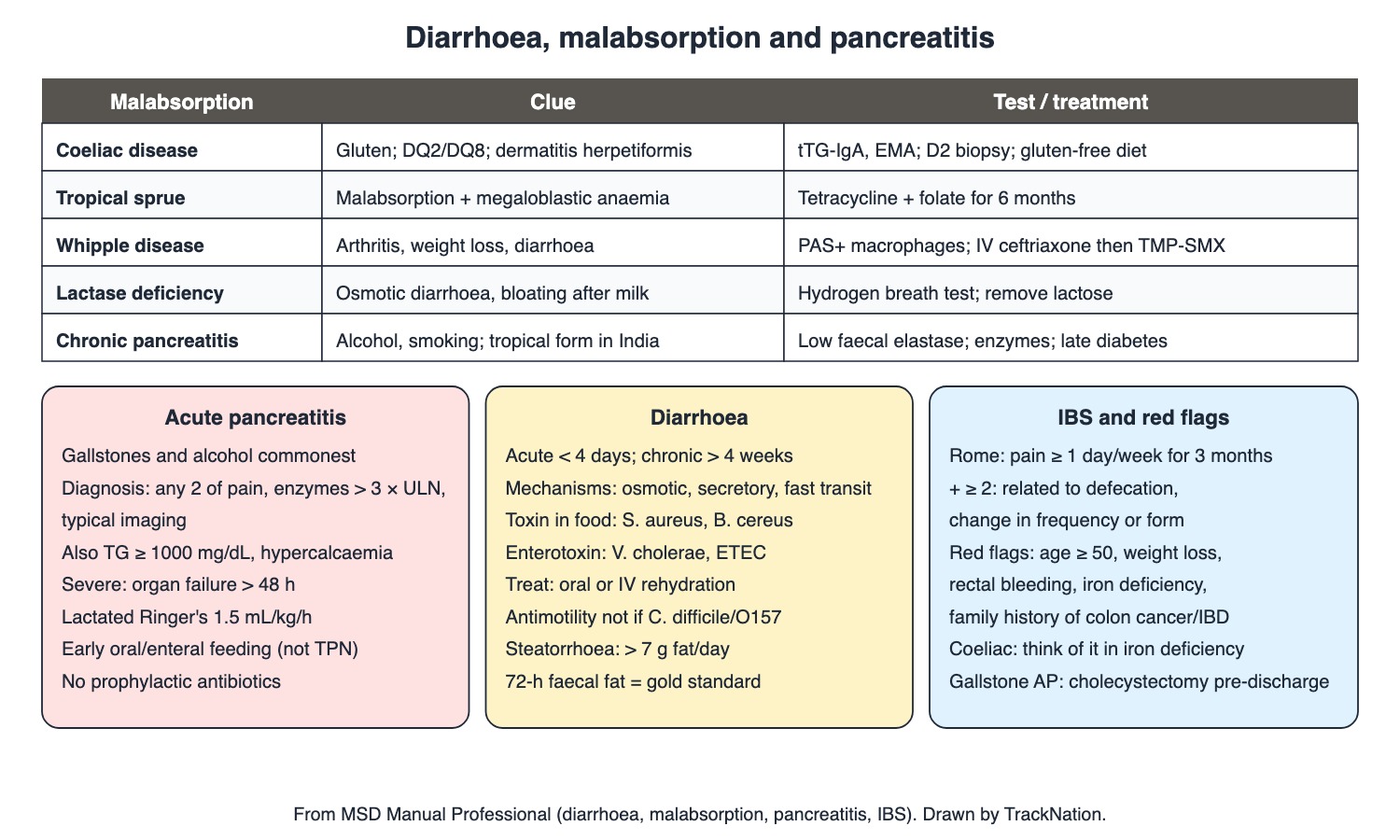
Malabsorption syndromes, acute pancreatitis, diarrhoea and IBS. Drawn by TrackNation.
Diarrhoea
Mechanisms: osmotic load, secretory (infections are the commonest cause), and reduced contact time or surface area. Stool electrolytes give the osmotic gap.
Acute diarrhoea (< 4 days) is mostly infection and food poisoning; chronic > 4 weeks needs evaluation (sooner if immunocompromised or ill).
Pre-formed toxins (S. aureus, B. cereus, C. perfringens) cause acute nausea and vomiting without infection; enterotoxins (V. cholerae, ETEC) cause secretion without invasion.
Treatment: oral or IV rehydration; antimotility drugs only if C. difficile or E. coli O157:H7 is not suspected; antibiotics only in selected cases.
Malabsorption
Steatorrhoea: > 7 g fat/day — pale, bulky, greasy, foul stools; 72-hour faecal fat is the gold standard.
Coeliac disease: gluten intolerance → villous atrophy. > 95% carry HLA-DQ2 or DQ8. Test tTG-IgA and EMA while the patient is eating gluten; confirm with biopsy from the second part of the duodenum (villous atrophy, intraepithelial lymphocytes, crypt hyperplasia). Dermatitis herpetiformis in ~17%. Think of it in iron deficiency without GI bleeding. Treat with a strict gluten-free diet.
Tropical sprue: acquired, probably infective; malabsorption with megaloblastic anaemia; tetracycline + folate for 6 months.
Whipple disease (Tropheryma whipplei): arthritis, weight loss, abdominal pain, diarrhoea; PAS-positive macrophages; IV ceftriaxone or penicillin 2–4 weeks, then long-term TMP-SMX.
Lactase deficiency: osmotic diarrhoea, distension and flatulence; hydrogen breath test; remove the sugar from the diet.
IBS (Rome): abdominal pain ≥ 1 day/week for 3 months with ≥ 2 of: related to defecation, change in frequency, change in form. Red flags: age ≥ 50, weight loss, rectal bleeding, iron deficiency, family history of colon cancer, IBD or coeliac disease.
Pancreatitis
Acute pancreatitis (MSD) | Key point |
Causes | Gallstones and alcohol most common; also ERCP, trauma, triglycerides ≥ 1000 mg/dL, hypercalcaemia, drugs |
Diagnosis (any 2) | Typical pain; amylase and/or lipase > 3 × ULN; characteristic CT/MRI findings |
Severity | Mild: no organ failure; moderately severe: transient (< 48 h); severe: persistent organ failure > 48 h |
Fluids | Lactated Ringer's at 1.5 mL/kg/h (moderate volume) |
Nutrition | Early oral; if not possible, enteral preferred over TPN |
Antibiotics | Not prophylactic — only for infection |
Gallstone pancreatitis | Cholecystectomy before discharge after a mild attack |
Grey Turner (flank) and Cullen (umbilical) ecchymoses mean haemorrhagic exudate; they occur in < 3%. A pseudocyst contains only fluid; walled-off necrosis contains solid debris.
Chronic pancreatitis: heavy alcohol and smoking; tropical pancreatitis is an idiopathic form in children and young adults in India. Pain predominates; calcification and duct stones; steatorrhoea when enzyme output falls below 10%; diabetes comes late. Faecal elastase is low.
Traps the Examiner Sets
Acute vomiting after a shared meal → pre-formed toxin (S. aureus, B. cereus).
Coeliac serology is unreliable once the patient has stopped gluten.
Acute pancreatitis: 2 of 3 criteria; severe = organ failure > 48 h; no prophylactic antibiotics; lactated Ringer's.
Steatorrhoea threshold is 7 g/day.
Memory Hooks & Shortcuts
Shortcuts to lock in this article's numbers and lists. Each one only re-packages facts proven above.
🧠 Fast vomit after food = Formed toxin (Staph, Bacillus) — food poisoning
🧠 Coeliac: 'Duodenum 2 for DQ2' — coeliac biopsy
🧠 Tropical sprue: 'Tetra-Folate for half a year' — tropical sprue
🧠 Pancreatitis '2 of 3, 3 times, 48 hours' — acute pancreatitis
🧠 GreY Turner = Your flanks; Cullen = Centre (umbilicus) — signs
Rapid-Revision Cards
Diarrhoea mechanisms
Osmotic, secretory, reduced contact time.
Acute vs chronic diarrhoea
< 4 days; > 4 weeks.
Pre-formed toxins
S. aureus, B. cereus, C. perfringens.
Enterotoxin, no invasion
V. cholerae, ETEC.
Antimotility caution
Not in C. difficile or O157.
Steatorrhoea
> 7 g fat/day; 72-h collection.
Coeliac serology
tTG-IgA, EMA (on gluten).
Coeliac biopsy
D2: villous atrophy, IELs, crypt hyperplasia.
Coeliac HLA
DQ2/DQ8 in > 95%.
Dermatitis herpetiformis
~17% of coeliac; extensor rash.
Tropical sprue Rx
Tetracycline + folate × 6 months.
Whipple
T. whipplei; PAS+ macrophages; ceftriaxone → TMP-SMX.
Lactase deficiency
Hydrogen breath test.
IBS Rome
Pain ≥ 1 d/wk × 3 mo + 2 of 3.
IBS red flags
≥ 50, weight loss, bleeding, iron deficiency, family history.
AP causes
Gallstones, alcohol; TG ≥ 1000.
AP diagnosis
2 of: pain, enzymes > 3 × ULN, imaging.
Severe AP
Organ failure > 48 h.
AP fluids
Ringer's lactate 1.5 mL/kg/h.
AP antibiotics
No prophylaxis.
Gallstone AP
Cholecystectomy before discharge.
Grey Turner / Cullen
Flank / umbilical; < 3%.
Tropical pancreatitis
Young, India, calcification, diabetes.
Sources
Facts in this article were checked against these documents.
MSD Manual Professional: Diarrhea; Overview of Gastroenteritis; Overview of Malabsorption; Celiac Disease; Tropical Sprue; Whipple Disease; Carbohydrate Intolerance; Irritable Bowel Syndrome; Acute Pancreatitis; Chronic Pancreatitis — Merck & Co. (MSD Manuals), reviewed 2025–26 (link)
Competency Based Undergraduate Curriculum, General Medicine (GM 16) — National Medical Commission, 2024
Test Yourself: Practice Questions
Thirty questions in NEET PG style, most of them clinical vignettes.
Practice Questions (NEET PG pattern)
Original questions written in the style of the exam: +4 for a correct answer, −1 for a wrong one. Every answer was checked against the sources listed above. NEET PG papers are not published by NBEMS, so these are not past-paper questions.
Q1. Several people develop acute nausea and vomiting after eating the same food. The cause is most likely
(a) Shigella invasion
(b) a pre-formed toxin such as from Staphylococcus aureus or Bacillus cereus
(c) rotavirus
(d) amoebiasis
Show answer
Answer: (b) — The exotoxin causes illness without infection.
Q2. Vibrio cholerae causes diarrhoea by
(a) an enterotoxin that causes secretion without invading the mucosa
(b) osmotic load
(c) pre-formed toxin in food
(d) invading and ulcerating the colon
Show answer
Answer: (a) — Like enterotoxigenic E. coli.
Q3. Antimotility drugs should be avoided in acute diarrhoea when
(a) stools are watery
(b) C. difficile or E. coli O157:H7 infection is suspected
(c) it lasts 2 days
(d) the patient is dehydrated
Show answer
Answer: (b) — Rehydration is the mainstay.
Q4. Chronic diarrhoea is defined as diarrhoea lasting more than
(a) 6 months
(b) 4 weeks
(c) 4 days
(d) 1 week
Show answer
Answer: (b) — Acute: < 4 days.
Q5. The most common cause of secretory diarrhoea is
(a) VIPoma
(b) lactase deficiency
(c) laxative abuse
(d) infection (gastroenteritis)
Show answer
Answer: (d) — Enterotoxins block sodium absorption.
Q6. Steatorrhoea is defined as faecal fat excretion of more than
(a) 20 g/day
(b) 50 g/day
(c) 7 g/day
(d) 1 g/day
Show answer
Answer: (c) — 72-hour faecal fat is the gold standard.
Q7. A woman has chronic diarrhoea, iron deficiency anaemia without GI bleeding and an itchy vesicular rash on the elbows and knees. The likely diagnosis is
(a) Crohn disease
(b) Whipple disease
(c) coeliac disease with dermatitis herpetiformis
(d) tropical sprue
Show answer
Answer: (c) — Dermatitis herpetiformis in ~17%.
Q8. The serological test used to screen for coeliac disease is
(a) ASCA
(b) pANCA
(c) tissue transglutaminase IgA (with total IgA)
(d) anti-parietal cell antibody
Show answer
Answer: (c) — Endomysial IgA also used.
Q9. A patient with suspected coeliac disease has been on a gluten-free diet for 6 months. Before serology, the patient should
(a) continue the gluten-free diet
(b) resume a gluten-containing diet
(c) fast for 24 hours
(d) take steroids
Show answer
Answer: (b) — Antibodies fall on a gluten-free diet.
Q10. Coeliac disease is confirmed by biopsy from
(a) the gastric antrum
(b) the rectum
(c) the terminal ileum
(d) the second part of the duodenum
Show answer
Answer: (d) — Villous atrophy, intraepithelial lymphocytes, crypt hyperplasia.
Q11. Duodenal biopsy in coeliac disease shows
(a) normal villi
(b) granulomas
(c) PAS-positive macrophages
(d) villous atrophy, increased intraepithelial lymphocytes and crypt hyperplasia
Show answer
Answer: (d) — Not specific — also in tropical sprue.
Q12. More than 95% of patients with coeliac disease carry
(a) HLA-DQ2 or HLA-DQ8
(b) HLA-B27
(c) HLA-DR3 only
(d) HLA-B5701
Show answer
Answer: (a) — High sensitivity, low specificity.
Q13. A patient living in a tropical region has malabsorption with megaloblastic anaemia. The treatment of tropical sprue is
(a) steroids
(b) gluten-free diet
(c) pancreatic enzymes
(d) tetracycline and folate for 6 months
Show answer
Answer: (d) — Probably infectious.
Q14. A man has arthritis, weight loss, abdominal pain and diarrhoea; small-bowel biopsy shows PAS-positive macrophages. The diagnosis is
(a) coeliac disease
(b) amyloidosis
(c) Whipple disease
(d) intestinal TB
Show answer
Answer: (c) — Tropheryma whipplei.
Q15. Whipple disease is treated initially with
(a) steroids alone
(b) gluten-free diet
(c) IV ceftriaxone or penicillin G for 2–4 weeks, then long-term TMP-SMX
(d) metronidazole 5 days
Show answer
Answer: (c) — Long oral course follows.
Q16. A patient gets bloating, flatulence and loose stools after milk. The diagnostic test for lactase deficiency is
(a) 72-hour faecal fat
(b) D-xylose test
(c) hydrogen breath test
(d) colonoscopy
Show answer
Answer: (c) — Treat by removing the sugar from the diet.
Q17. Undigested disaccharides cause diarrhoea by
(a) an osmotic load
(b) secretion due to toxins
(c) rapid transit only
(d) mucosal invasion
Show answer
Answer: (a) — Also bacterial fermentation and gas.
Q18. Rome criteria for IBS require abdominal pain at least 1 day per week for 3 months plus at least two of
(a) vomiting, jaundice, mass
(b) related to defecation, change in stool frequency, change in stool form
(c) weight loss, fever, bleeding
(d) nocturnal diarrhoea, anaemia, age > 50
Show answer
Answer: (b) — Symptom-based diagnosis.
Q19. A 58-year-old with bowel symptoms suggestive of IBS also has weight loss and iron deficiency. The next step is
(a) antispasmodics only
(b) reassure and start fibre
(c) investigate further — these are red flags
(d) no follow-up
Show answer
Answer: (c) — Age ≥ 50, weight loss, rectal bleeding, iron deficiency, family history.
Q20. The two most common causes of acute pancreatitis are
(a) drugs and scorpion sting
(b) mumps and trauma
(c) gallstones and alcohol
(d) hypercalcaemia and ERCP
Show answer
Answer: (c) — Others: ERCP, triglycerides, hypercalcaemia.
Q21. Acute pancreatitis is diagnosed when at least two of three are present:
(a) pain, vomiting, leucocytosis
(b) typical pain, amylase/lipase > 3 × ULN, characteristic imaging
(c) raised calcium, glucose, LDH
(d) fever, jaundice, pain
Show answer
Answer: (b) — Imaging is not needed if the first two are present.
Q22. Hypertriglyceridaemia can cause acute pancreatitis. The triglyceride level that carries the highest risk is
(a) ≥ 300 mg/dL
(b) ≥ 200 mg/dL
(c) ≥ 1000 mg/dL
(d) ≥ 150 mg/dL
Show answer
Answer: (c) — Hypertriglyceridaemia causes 1–4% of cases.
Q23. Acute pancreatitis is classified as severe when there is
(a) any pseudocyst
(b) amylase > 10 × ULN
(c) pain for more than 3 days
(d) persistent organ failure for more than 48 hours
Show answer
Answer: (d) — Revised Atlanta classification.
Q24. Initial fluid resuscitation in acute pancreatitis per MSD is
(a) albumin infusion
(b) no fluids
(c) lactated Ringer's at 1.5 mL/kg/h
(d) 5% dextrose
Show answer
Answer: (c) — Moderate volume, monitored closely.
Q25. A patient with acute pancreatitis cannot eat by day 3. Nutrition should be
(a) IV dextrose only
(b) TPN routinely
(c) nil by mouth for 2 weeks
(d) enteral (tube) feeding rather than TPN
Show answer
Answer: (d) — TPN increases infection and organ failure.
Q26. In severe acute pancreatitis without evidence of infection, prophylactic antibiotics are
(a) given for 2 weeks
(b) not recommended
(c) given only with alcohol
(d) mandatory (imipenem)
Show answer
Answer: (b) — Start antibiotics only for infection.
Q27. A woman recovers from mild gallstone pancreatitis. The recommended step is
(a) ursodeoxycholic acid only
(b) no surgery
(c) cholecystectomy after 1 year
(d) cholecystectomy before discharge
Show answer
Answer: (d) — Prevents recurrence.
Q28. Ecchymosis of the flanks in acute pancreatitis is
(a) Cullen sign
(b) Murphy sign
(c) Grey Turner sign
(d) Kehr sign
Show answer
Answer: (c) — Cullen = periumbilical; both < 3%.
Q29. A young adult from India with recurrent abdominal pain has pancreatic calcification, steatorrhoea and diabetes, with no alcohol use. The likely diagnosis is
(a) acute pancreatitis
(b) tropical (idiopathic) chronic pancreatitis
(c) coeliac disease
(d) pancreatic cancer
Show answer
Answer: (b) — Occurs in children and young adults in tropical regions such as India.
Q30. In chronic pancreatitis, diabetes mellitus usually
(a) never occurs
(b) is the first symptom
(c) precedes pain by decades
(d) appears late in the course
Show answer
Answer: (d) — Steatorrhoea appears when enzyme output < 10%.
Active Recall
From memory: explain diarrhoea mechanisms and food-poisoning toxins, give the steatorrhoea threshold, describe coeliac disease diagnosis and associations, tropical sprue, Whipple disease and lactase deficiency, state the Rome criteria and red flags, and outline diagnosis, severity and management of acute pancreatitis and features of tropical chronic pancreatitis.