Obesity, Metabolic Syndrome and Dyslipidaemia for NEET PG Medicine: BMI, Bariatric Surgery, Statins, LDL Targets, Familial Hypercholesterolaemia
Start Here
🎯 Exam priority: Medium. Expect: BMI classes, Asian cut-offs, metabolic syndrome components, bariatric surgery criteria and dumping, statin mechanism and adverse effects, LDL goals, ezetimibe and fibrate actions, familial hypercholesterolaemia signs, xanthelasma, lipaemia retinalis, triglycerides and pancreatitis, and secondary causes.
CBME mapping: GM 14.1–14.14. Lipid pharmacology is in Pharmacology; obesity epidemiology and NP-NCD in Community Medicine; atherosclerosis in Pathology; IHD in article 2.
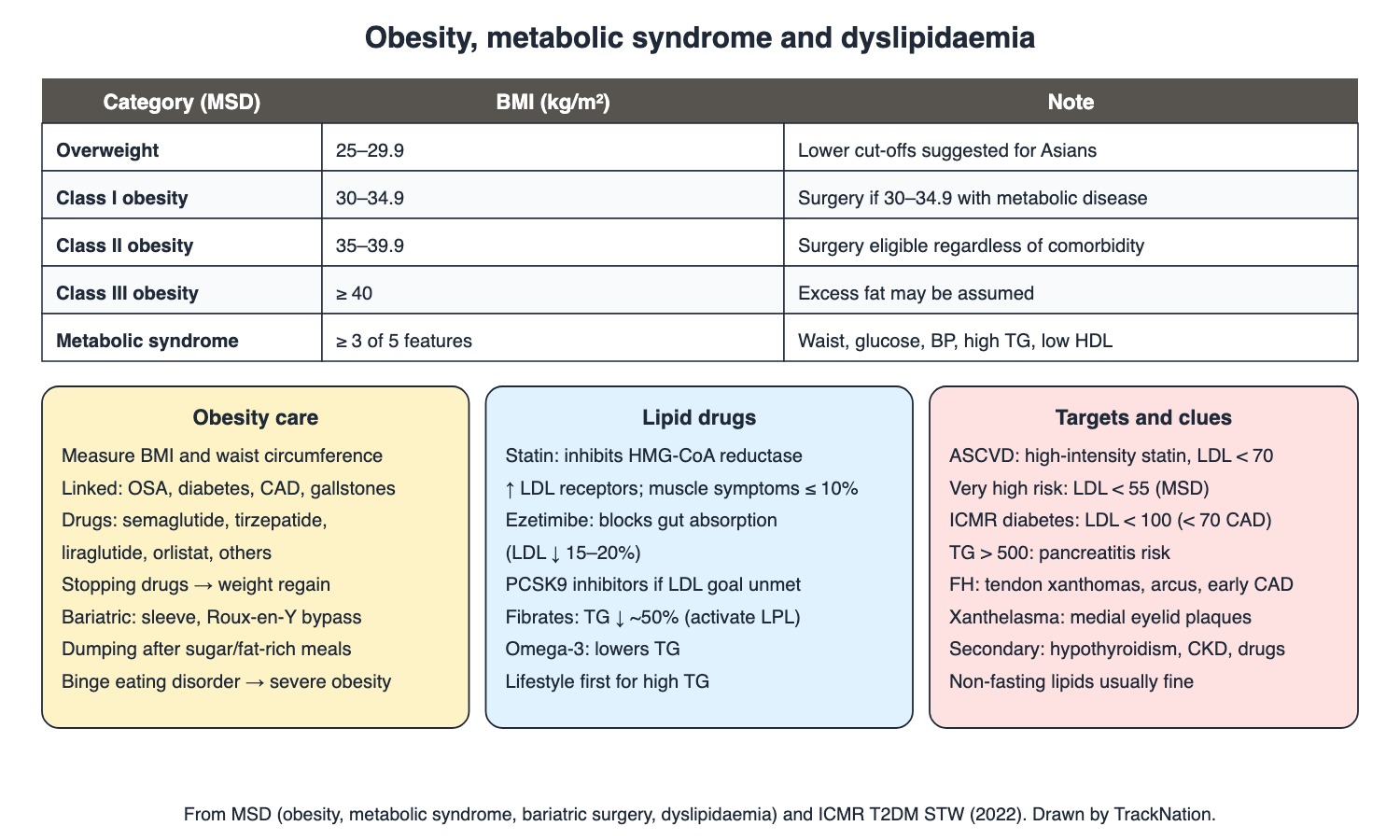
BMI classes, obesity care, lipid drugs and targets. Drawn by TrackNation.
Obesity and Metabolic Syndrome
BMI = weight (kg) / height (m)². Overweight 25–29.9; class I obesity 30–34.9; class II 35–39.9; class III ≥ 40. Lower cut-offs are suggested for people of Asian descent. Add waist circumference and, where possible, body composition.
Complications: cardiovascular disease (especially with abdominal fat), diabetes, certain cancers, gallstones, obstructive sleep apnoea, infertility. Binge eating disorder can drive severe obesity.
Drugs: semaglutide, tirzepatide, liraglutide, phentermine/topiramate, naltrexone/bupropion, orlistat — stopping them often causes weight regain.
Bariatric surgery: BMI ≥ 35 regardless of comorbidity, or 30–34.9 with metabolic disease. Common operations: sleeve gastrectomy, Roux-en-Y gastric bypass. Dumping syndrome after high-sugar or high-fat meals: light-headedness, sweating, nausea, pain, diarrhoea.
Metabolic syndrome: ≥ 3 of large waist (abdominal fat), high fasting glucose, hypertension, high triglycerides, low HDL.
Dyslipidaemia
Secondary causes: diabetes, CKD, cholestatic liver disease (PBC), hypothyroidism, alcohol, drugs (thiazides, beta-blockers, retinoids, antiretrovirals, cyclosporine, tacrolimus); low HDL with smoking, anabolic steroids, HIV, nephrotic syndrome.
Clues: xanthelasma (yellow plaques on the medial eyelids — also in PBC with normal lipids), arcus, tendon xanthomas; triglycerides > 500 risk acute pancreatitis; very high TG gives eruptive xanthomas and lipaemia retinalis.
Familial hypercholesterolaemia (LDL-receptor defect): heterozygotes 1 in 200 — tendon xanthomas, arcus, CAD at 30–50 years (~5% of MIs under 60); homozygotes — CAD before 18, need LDL apheresis or liver transplant.
Goals (MSD): with ASCVD, high-intensity statin to cut LDL > 50% and LDL < 70 mg/dL; very high risk (recent MI, diabetes, CKD ≥ 3) < 55. ICMR diabetes target: LDL < 100 (< 70 with CAD). High TG: lifestyle first (exercise, weight loss, avoid sugar and alcohol).
Non-fasting lipids are usually sufficient; fast if non-fasting TG > 400.
Lipid drug (MSD) | Action | Key point |
Statins | Inhibit HMG-CoA reductase → more LDL receptors | High-intensity cuts LDL > 50%; muscle symptoms in up to 10% |
Ezetimibe | Blocks intestinal cholesterol absorption | LDL ↓ 15–20%; add if goal not met |
PCSK9 inhibitors | Evolocumab, alirocumab | Add when maximal statin fails to reach goal |
Fibrates | Stimulate lipoprotein lipase | TG ↓ ~50% |
Omega-3 (prescription) | EPA ± DHA | Lower TG; may raise LDL |
Traps the Examiner Sets
Statin muscle symptoms can occur with a normal CK.
Xanthelasma does not always mean high lipids (PBC).
Alcohol raises HDL but is not a treatment.
Bariatric surgery at BMI ≥ 35 even without comorbidity.
Omega-3 lowers triglycerides but can raise LDL.
Memory Hooks & Shortcuts
Shortcuts to lock in this article's numbers and lists. Each one only re-packages facts proven above.
🧠 BMI ladder '25-30-35-40' — BMI classes
🧠 Metabolic syndrome '3 of WGBTH': Waist, Glucose, BP, TG, HDL — metabolic syndrome
🧠 Statin = 'Stop the Synthesis'; Ezetimibe = 'Exclude from the gut' — lipid drugs
🧠 Fibrates Fight Fat in blood (TG) — fibrates
🧠 FH: 'Tendons, Arcus, early Attacks' — familial hypercholesterolaemia
Rapid-Revision Cards
BMI
kg / m².
BMI classes
25–29.9 overweight; 30–34.9 I; 35–39.9 II; ≥ 40 III.
Asian BMI
Lower cut-offs suggested.
Obesity drugs
Semaglutide, tirzepatide, liraglutide, orlistat…
Bariatric criteria
BMI ≥ 35; or 30–34.9 + metabolic disease.
Dumping
After sugar/fat: dizziness, sweating, diarrhoea.
Metabolic syndrome
≥ 3 of waist, glucose, BP, TG, low HDL.
Statin action
HMG-CoA reductase ↓ → LDL receptors ↑.
Statin muscle
Up to 10%; CK may be normal; rhabdo rare.
Ezetimibe
Gut cholesterol absorption ↓; LDL ↓ 15–20%.
PCSK9 inhibitors
Evolocumab, alirocumab — when goal unmet.
Fibrates
LPL ↑; TG ↓ ~50%.
Omega-3
TG ↓, LDL may ↑.
LDL goals (MSD)
ASCVD < 70; very high risk < 55.
ICMR DM LDL
< 100; < 70 with CAD.
TG and pancreatitis
> 500 mg/dL.
Heterozygous FH
1/200; tendon xanthomas, arcus, CAD 30–50.
Homozygous FH
CAD < 18; LDL apheresis.
Xanthelasma
Medial eyelids; also PBC.
Lipaemia retinalis
Creamy retinal vessels; very high TG.
Secondary causes
Hypothyroid, CKD, cholestasis, alcohol, drugs.
Non-fasting lipids
Fine; fast if TG > 400.
Sources
Facts in this article were checked against these documents.
MSD Manual Professional: Obesity; Metabolic Syndrome; Metabolic and Bariatric Surgery; Dyslipidemia — Merck & Co. (MSD Manuals), reviewed 2025–26 (link)
Standard Treatment Workflow: Diabetes Mellitus Type 2 — Indian Council of Medical Research, DHR, 2022 (link)
Competency Based Undergraduate Curriculum, General Medicine (GM 14) — National Medical Commission, 2024
Test Yourself: Practice Questions
Thirty questions in NEET PG style, most of them clinical vignettes.
Practice Questions (NEET PG pattern)
Original questions written in the style of the exam: +4 for a correct answer, −1 for a wrong one. Every answer was checked against the sources listed above. NEET PG papers are not published by NBEMS, so these are not past-paper questions.
Q1. A man weighs 96 kg and is 1.70 m tall (BMI ≈ 33). By the standard classification he has
(a) class II obesity
(b) overweight
(c) class III obesity
(d) class I obesity
Show answer
Answer: (d) — Class I 30–34.9.
Q2. BMI is calculated as
(a) waist divided by hip
(b) height divided by weight
(c) weight times height
(d) weight (kg) divided by height (m) squared
Show answer
Answer: (d) — Supplement with waist circumference.
Q3. For people of Asian descent, BMI cut-offs for overweight and obesity are
(a) the same
(b) higher
(c) lower than for other ethnic groups
(d) not applicable
Show answer
Answer: (c) — Suggested by WHO and IDF.
Q4. Class III obesity is BMI of
(a) ≥ 40 kg/m²
(b) ≥ 35 kg/m²
(c) ≥ 50 kg/m² only
(d) ≥ 30 kg/m²
Show answer
Answer: (a) — Excess fat can be assumed above 40.
Q5. A pulmonary complication strongly associated with obesity is
(a) bronchiectasis
(b) sarcoidosis
(c) pneumothorax
(d) obstructive sleep apnoea
Show answer
Answer: (d) — Also diabetes, CAD, gallstones.
Q6. A patient who lost weight on semaglutide stops the drug. The likely outcome is
(a) hypothyroidism
(b) permanent weight loss
(c) no change ever
(d) weight regain
Show answer
Answer: (d) — Long-term therapy is usually needed.
Q7. A person with BMI 37 and no comorbidities asks about bariatric surgery. Current recommendations say
(a) not eligible below BMI 40
(b) eligible only with diabetes
(c) never before age 60
(d) eligible — BMI ≥ 35 regardless of comorbidities
Show answer
Answer: (d) — BMI 30–34.9 qualifies with metabolic disease.
Q8. After a Roux-en-Y gastric bypass, a patient gets light-headedness, sweating, nausea and diarrhoea after sweets. This is
(a) dumping syndrome
(b) anastomotic leak
(c) gallstones
(d) B12 deficiency
Show answer
Answer: (a) — Triggered by high-sugar or high-fat foods.
Q9. Metabolic syndrome is usually diagnosed when how many of its five features are present?
(a) 3 or more
(b) 1
(c) 2
(d) all 5
Show answer
Answer: (a) — Waist, glucose, BP, TG, HDL.
Q10. Which is NOT a component of metabolic syndrome?
(a) large waist circumference
(b) low HDL cholesterol
(c) high triglycerides
(d) high LDL cholesterol
Show answer
Answer: (d) — Plus high fasting glucose and hypertension.
Q11. Statins lower LDL by
(a) activating lipoprotein lipase
(b) binding bile acids
(c) blocking intestinal absorption
(d) inhibiting HMG-CoA reductase, which up-regulates LDL receptors
Show answer
Answer: (d) — Key enzyme of cholesterol synthesis.
Q12. A patient on atorvastatin has muscle aches with a normal CK. The correct statement is
(a) statin muscle symptoms can occur without CK elevation
(b) a normal CK excludes a statin cause
(c) this is always rhabdomyolysis
(d) statins never cause muscle symptoms
Show answer
Answer: (a) — Muscle symptoms in up to 10%.
Q13. A serious but uncommon muscle adverse effect of statins is
(a) muscular dystrophy
(b) dermatomyositis always
(c) myasthenia gravis
(d) rhabdomyolysis
Show answer
Answer: (d) — Serious liver toxicity is extremely rare.
Q14. Ezetimibe acts by
(a) inhibiting PCSK9
(b) activating PPAR-alpha
(c) inhibiting intestinal absorption of cholesterol
(d) inhibiting HMG-CoA reductase
Show answer
Answer: (c) — Lowers LDL by 15–20%.
Q15. A patient with recent MI on a high-intensity statin still has LDL above goal. The next step is
(a) add ezetimibe or a PCSK9 inhibitor
(b) stop the statin
(c) no change
(d) add a fibrate only
Show answer
Answer: (a) — Very high-risk goal LDL < 55.
Q16. For a patient with established ASCVD, the usual LDL goal per MSD is
(a) < 130 mg/dL
(b) < 160 mg/dL
(c) no goal
(d) < 70 mg/dL with > 50% reduction
Show answer
Answer: (d) — < 55 if very high risk.
Q17. Per ICMR, the LDL target for a diabetic patient without coronary disease is
(a) < 160 mg/dL
(b) < 100 mg/dL
(c) < 55 mg/dL
(d) < 70 mg/dL
Show answer
Answer: (b) — < 70 with CAD.
Q18. Fibrates mainly lower
(a) LDL by 60%
(b) Lp(a)
(c) triglycerides (by about 50%) via lipoprotein lipase
(d) HDL
Show answer
Answer: (c) — Stimulate endothelial LPL.
Q19. Prescription omega-3 fatty acids
(a) lower triglycerides but may raise LDL
(b) lower LDL strongly
(c) are statins
(d) raise triglycerides
Show answer
Answer: (a) — EPA ± DHA.
Q20. Acute pancreatitis can be caused by triglyceride levels above
(a) 200 mg/dL
(b) 150 mg/dL
(c) 500 mg/dL
(d) 250 mg/dL
Show answer
Answer: (c) — Very high TG also gives hepatosplenomegaly.
Q21. A 34-year-old man has tendon xanthomas, corneal arcus and a strong family history of early MI. The likely diagnosis is
(a) familial chylomicronaemia
(b) Tangier disease
(c) metabolic syndrome only
(d) heterozygous familial hypercholesterolaemia (LDL-receptor defect)
Show answer
Answer: (d) — Affects 1 in 200; CAD at 30–50.
Q22. A child with homozygous familial hypercholesterolaemia may need
(a) fibrates only
(b) LDL apheresis or liver transplantation
(c) no treatment
(d) omega-3 only
Show answer
Answer: (b) — CAD can occur before 18 years.
Q23. Yellow plaques on the medial eyelids are
(a) lipaemia retinalis
(b) tendon xanthomas
(c) eruptive xanthomas
(d) xanthelasma — may also occur in PBC with normal lipids
Show answer
Answer: (d) — Not always hyperlipidaemia.
Q24. A patient with triglycerides of 2400 mg/dL has creamy-white retinal vessels on fundoscopy. This is
(a) lipaemia retinalis
(b) diabetic retinopathy
(c) hypertensive retinopathy
(d) central retinal vein occlusion
Show answer
Answer: (a) — Also eruptive xanthomas, pancreatitis.
Q25. A secondary cause of hypercholesterolaemia that should be excluded is
(a) hypothyroidism
(b) Addison disease
(c) iron deficiency
(d) hyperthyroidism
Show answer
Answer: (a) — Also CKD, cholestasis, alcohol, drugs.
Q26. Drugs that can worsen lipid levels include
(a) statins
(b) thiazides, beta-blockers, retinoids, antiretrovirals and cyclosporine
(c) ezetimibe
(d) metformin and SGLT2 inhibitors
Show answer
Answer: (b) — Review medications in dyslipidaemia.
Q27. For routine lipid screening, most patients
(a) must fast 24 hours
(b) need fasting lipids always
(c) need no lipid test
(d) can have non-fasting lipids; fast if non-fasting TG > 400
Show answer
Answer: (d) — Fasting needed only in specific situations.
Q28. The first step for a patient with high triglycerides is
(a) lifestyle change — exercise, weight loss, avoid concentrated sugar and alcohol
(b) plasma exchange
(c) statin at maximum dose
(d) PCSK9 inhibitor
Show answer
Answer: (a) — Drugs if very high or pancreatitis risk.
Q29. A patient asks whether drinking alcohol to raise HDL is advisable. The answer is
(a) no — alcohol raises HDL but is not recommended as therapy
(b) yes, if HDL < 40
(c) yes, 2 drinks daily
(d) only red wine
Show answer
Answer: (a) — Harms outweigh benefit.
Q30. Low HDL cholesterol is associated with all EXCEPT
(a) regular aerobic exercise
(b) nephrotic syndrome
(c) anabolic steroids
(d) cigarette smoking
Show answer
Answer: (a) — Exercise raises HDL.
Active Recall
From memory: give BMI classes and the Asian caveat, bariatric surgery criteria and dumping, metabolic syndrome components, statin mechanism and adverse effects, LDL goals, actions of ezetimibe, PCSK9 inhibitors and fibrates, features of familial hypercholesterolaemia, clues of severe dyslipidaemia and secondary causes.