Adrenal and Pancreatic Endocrine Tumours for NEET PG Surgery: Phaeochromocytoma, Aldosteronism, Incidentaloma, Insulinoma, Gastrinoma, MEN
Start Here
🎯 Exam priority: High. Expect: phaeochromocytoma sites and 10% figures, the first test, why alpha before beta, provoking factors, aldosterone/renin ratio and adenoma vs hyperplasia, when to remove an incidentaloma, insulinoma fast and Whipple triad, gastrinoma site and MEN 1 link, and the WDHA and glucagonoma rash clues.
CBME mapping: SU23.1–23.3 (adrenal glands) and SU24.2 (pancreatic endocrine tumours). Thyroid and MEN 2 were covered in article 8.
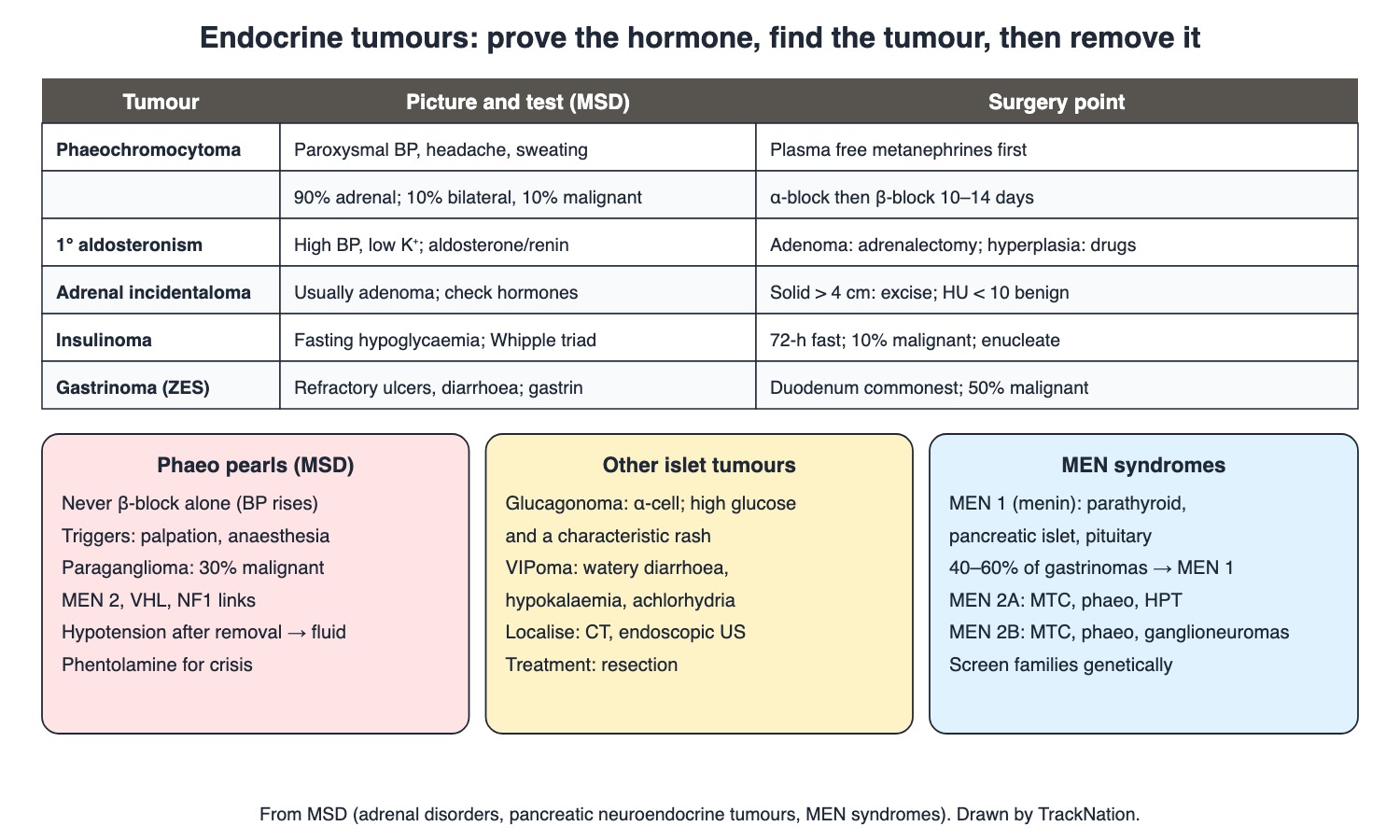
Phaeochromocytoma, aldosteronism, incidentaloma, insulinoma, gastrinoma; phaeo pearls; other islet tumours; MEN. Drawn by TrackNation.
Phaeochromocytoma (MSD)
Catecholamine-secreting chromaffin-cell tumour: ~90% in the adrenal medulla; extra-adrenal ones (paragangliomas, e.g. organ of Zuckerkandl) are malignant in 30%. Adrenal tumours: bilateral 10% (20% in children), malignant ~10%; peak age 20–40; ~half germline — MEN 2A/2B, von Hippel-Lindau, neurofibromatosis.
Hypertension (paroxysmal in 45%) with headache, sweating, palpitations, pallor, a sense of doom; attacks triggered by palpating the tumour, posture, anaesthesia induction, micturition (bladder tumour) and unopposed beta-blockade.
Diagnosis: plasma free metanephrines (up to 99% sensitive) or urinary metanephrines, then CT/MRI; histamine or tyramine provocation is dangerous; keep phentolamine for crises. Catecholamines can cause hyperglycaemia.
Surgery after alpha-blockade (phenoxybenzamine or doxazosin) and then beta-blockade for 10–14 days, BP < 130/80, high-salt diet to expand volume, no atropine. After removal: hypotension (fluids, sometimes noradrenaline) and hypoglycaemia.
Aldosteronism and Incidentaloma (MSD)
Primary aldosteronism (adenoma, hyperplasia or carcinoma): hypertension, hypokalaemia, episodic weakness. Screen with plasma aldosterone and renin (ratio > 20 typical), confirm by saline or salt loading, image, and use adrenal vein sampling to lateralise. Adenoma → adrenalectomy; bilateral hyperplasia → spironolactone (70% stay hypertensive after bilateral adrenalectomy).
Adrenal incidentaloma: usually an adenoma; test hormones (dexamethasone suppression, metanephrines, electrolytes). Solid adrenal mass > 4 cm → excise unless clearly benign; unenhanced CT < 10 HU = benign; 2–4 cm benign- looking, non-functioning → re-image at 6 and 12 months.
Pancreatic Endocrine Tumours and MEN 1 (MSD)
Insulinoma (beta cell): fasting hypoglycaemia with neuroglycopenic and adrenergic symptoms; Whipple triad — symptoms during fasting, low glucose at the time, relief with carbohydrate. 48–72-hour fast (98% symptomatic by 48 h) with insulin levels, then endoscopic ultrasound. 80% single, 10% malignant, ~10% with MEN 1. Exclude surreptitious insulin. Small superficial tumours are enucleated; cure ~90%; diazoxide or octreotide if inoperable.
Gastrinoma (Zollinger-Ellison): refractory, atypical peptic ulcers (25% beyond the duodenal bulb) and diarrhoea (often first); duodenum is the commonest site; ~50% malignant; 40–60% have MEN 1. Best test: serum gastrin.
Glucagonoma (alpha cell): hyperglycaemia and necrolytic migratory erythema. VIPoma: WDHA — watery diarrhoea, hypokalaemia, achlorhydria; more than half malignant.
MEN 1 (menin gene, autosomal dominant): parathyroid, pancreatic islet and pituitary tumours; hyperparathyroidism is common; screen family members.
Traps the Examiner Sets
Beta-blocker alone in phaeochromocytoma raises BP.
Biochemistry before imaging for any functioning tumour.
Bilateral adrenal hyperplasia is treated with drugs, not surgery.
Gastrinoma is commonest in the duodenum, not the pancreas.
Memory Hooks & Shortcuts
Shortcuts to lock in this article's numbers and lists. Each one only re-packages facts proven above.
🧠 Phaeo 'rule of 10s' (adrenal tumours): bilateral 10, malignant 10 — paragangliomas 30 — phaeo
🧠 'Alpha before beta, like the alphabet' — blockade
🧠 MEN 1 'three Ps': Parathyroid, Pancreas, Pituitary — MEN 1
🧠 Whipple triad: 'Starve, Sink, Sugar-saves' — insulinoma
🧠 VIPoma 'WDHA — Water, Down potassium, Hardly acid' — VIPoma
Rapid-Revision Cards
Phaeo first test
Plasma free metanephrines.
Phaeo site
90% adrenal medulla.
Phaeo 10s
10% bilateral, 10% malignant.
Paraganglioma
30% malignant.
Zuckerkandl
Aortic bifurcation.
Phaeo links
MEN 2, VHL, NF1.
Never
β-blocker alone.
Bladder phaeo
Attacks on micturition.
Pre-op
α then β, 10–14 days; salt.
Crisis drug
Phentolamine.
After removal
Hypotension, hypoglycaemia.
Conn picture
High BP, low K⁺.
Conn screen
Aldosterone/renin ratio.
Hyperplasia
Spironolactone, not surgery.
Incidentaloma
Adenoma; > 4 cm excise; < 10 HU benign.
Insulinoma
Fasting hypoglycaemia; 72-h fast.
Whipple triad
Symptoms + low glucose + relief.
Insulinoma Rx
Enucleation; 10% malignant.
Gastrinoma
Duodenum; gastrin; 40–60% MEN 1.
WDHA
VIPoma.
MEN 1
Parathyroid, pancreas, pituitary.
Sources
Facts in this article were checked against these documents.
MSD Manual Professional: Pheochromocytoma; Primary Aldosteronism; Nonfunctional Adrenal Masses; Insulinoma; Gastrinoma; Glucagonoma; Vipoma; MEN 1 — Merck & Co. (MSD Manuals), 2025–26 (link)
Competency Based Undergraduate Curriculum, Vol III: General Surgery (SU23, SU24.2) — National Medical Commission, 2024
Test Yourself: Practice Questions
Thirty questions in NEET PG style, most of them clinical vignettes.
Practice Questions (NEET PG pattern)
Original questions written in the style of the exam: +4 for a correct answer, −1 for a wrong one. Every answer was checked against the sources listed above. NEET PG papers are not published by NBEMS, so these are not past-paper questions.
Q1. A 30-year-old has episodes of severe headache, sweating and palpitations with very high blood pressure. The best first test is
(a) plasma free metanephrines
(b) urinary VMA only
(c) MIBG scan
(d) CT abdomen
Show answer
Answer: (a) — Biochemistry before imaging.
Q2. About what proportion of phaeochromocytomas arise in the adrenal medulla?
(a) 50%
(b) 10%
(c) 100%
(d) 90%
Show answer
Answer: (d) — Rest: paragangliomas.
Q3. Adrenal phaeochromocytomas are bilateral in about
(a) 10% (20% in children)
(b) 50%
(c) 1%
(d) 90%
Show answer
Answer: (a) — Malignant ~10%.
Q4. An extra-adrenal phaeochromocytoma (paraganglioma) is malignant in about
(a) 30%
(b) 90%
(c) 1%
(d) 5%
Show answer
Answer: (a) — Higher than adrenal.
Q5. A paraganglioma at the aortic bifurcation arises in the
(a) carotid body
(b) renal pelvis
(c) organ of Zuckerkandl
(d) adrenal cortex
Show answer
Answer: (c) — Neural crest.
Q6. Syndromes associated with phaeochromocytoma include
(a) MEN 1 and Down syndrome
(b) Marfan only
(c) MEN 2, von Hippel-Lindau and neurofibromatosis
(d) Turner and Klinefelter
Show answer
Answer: (c) — ~50% germline.
Q7. A hypertensive patient given propranolol alone has a sharp rise in blood pressure. This suggests
(a) renal artery stenosis
(b) Conn syndrome
(c) phaeochromocytoma with unopposed alpha effect
(d) beta-blocker allergy
Show answer
Answer: (c) — Alpha first.
Q8. A patient with a bladder phaeochromocytoma typically gets attacks during
(a) eating
(b) sleep
(c) exercise only
(d) micturition
Show answer
Answer: (d) — Also palpation, anaesthesia.
Q9. Preparation for phaeochromocytoma surgery is
(a) no preparation
(b) alpha-blockade (e.g. phenoxybenzamine), then beta-blockade for 10–14 days
(c) beta-blockade first
(d) diuretics
Show answer
Answer: (b) — BP < 130/80; salt.
Q10. During preparation for phaeochromocytoma surgery, a high-salt diet is advised to
(a) expand the contracted blood volume
(b) lower glucose
(c) prevent stones
(d) raise potassium
Show answer
Answer: (a) — Prevents post-op hypotension.
Q11. A hypertensive crisis during phaeochromocytoma surgery is controlled with
(a) adrenaline
(b) atropine
(c) phentolamine
(d) propranolol alone
Show answer
Answer: (c) — Keep it ready.
Q12. After a phaeochromocytoma is removed, a metabolic complication to watch for is
(a) hypernatraemia
(b) hypercalcaemia
(c) hypoglycaemia
(d) hyperkalaemia
Show answer
Answer: (c) — Also hypotension.
Q13. A man with resistant hypertension, low potassium and muscle weakness most likely has
(a) primary aldosteronism
(b) phaeochromocytoma
(c) Cushing syndrome
(d) Addison disease
Show answer
Answer: (a) — Aldosterone/renin.
Q14. The screening test for primary aldosteronism is
(a) plasma aldosterone with plasma renin activity (ratio)
(b) dexamethasone suppression
(c) plasma metanephrines
(d) serum cortisol
Show answer
Answer: (a) — Ratio > 20 typical.
Q15. Primary aldosteronism due to bilateral adrenal hyperplasia is treated with
(a) radiotherapy
(b) spironolactone
(c) bilateral adrenalectomy
(d) unilateral adrenalectomy
Show answer
Answer: (b) — Adenoma → surgery.
Q16. To decide which adrenal is producing excess aldosterone before surgery, the test is
(a) urine VMA
(b) MIBG scan
(c) adrenal vein sampling
(d) plasma metanephrines
Show answer
Answer: (c) — Cortisol and aldosterone levels.
Q17. An adrenal mass found incidentally on CT is most often a(n)
(a) adenoma
(b) phaeochromocytoma
(c) metastasis
(d) carcinoma
Show answer
Answer: (a) — Check hormones.
Q18. A solid non-functioning adrenal mass should usually be excised when it is larger than
(a) 10 cm
(b) 0.5 cm
(c) 4 cm
(d) 1 cm
Show answer
Answer: (c) — Unless clearly benign.
Q19. On unenhanced CT, an adrenal mass is benign regardless of size if its attenuation is below
(a) 50 HU
(b) 0 HU only
(c) 10 Hounsfield units
(d) 100 HU
Show answer
Answer: (c) — Lipid-rich adenoma.
Q20. A woman has recurrent confusion and sweating before breakfast that resolve after eating. During a supervised fast her glucose falls with high insulin. The diagnosis is
(a) glucagonoma
(b) dumping syndrome
(c) Addison disease
(d) insulinoma
Show answer
Answer: (d) — Whipple triad.
Q21. The Whipple triad (for insulinoma) is
(a) diarrhoea, hypokalaemia, achlorhydria
(b) pain, fever, jaundice
(c) jaundice, palpable gallbladder, weight loss
(d) symptoms during fasting, low glucose at the time, relief with carbohydrate
Show answer
Answer: (d) — Not the operation.
Q22. The proportion of insulinomas that are malignant is about
(a) 1%
(b) 90%
(c) 10%
(d) 50%
Show answer
Answer: (c) — 80% single.
Q23. A small insulinoma on the surface of the pancreatic body is treated by
(a) enucleation
(b) total pancreatectomy
(c) radiotherapy
(d) Whipple procedure
Show answer
Answer: (a) — Cure ~90%.
Q24. A patient with easy access to insulin has hypoglycaemia with very high insulin levels. Before diagnosing insulinoma, consider
(a) surreptitious insulin injection
(b) glucagonoma
(c) VIPoma
(d) Conn syndrome
Show answer
Answer: (a) — C-peptide helps.
Q25. Recurrent jejunal ulcers resistant to treatment with diarrhoea suggest
(a) gastrinoma (Zollinger-Ellison syndrome)
(b) H. pylori only
(c) NSAID ulcer
(d) VIPoma
Show answer
Answer: (a) — Measure gastrin.
Q26. The commonest site of gastrinoma is the
(a) ovary
(b) pancreatic tail
(c) duodenum
(d) stomach
Show answer
Answer: (c) — Gastrinoma triangle area.
Q27. What proportion of patients with gastrinoma have MEN 1?
(a) 1%
(b) 10% only
(c) 40–60%
(d) 90%
Show answer
Answer: (c) — Screen for MEN 1.
Q28. A diabetic patient with weight loss develops a migrating necrotic red rash on the legs. The pancreatic tumour is a
(a) glucagonoma
(b) gastrinoma
(c) insulinoma
(d) VIPoma
Show answer
Answer: (a) — Necrolytic migratory erythema.
Q29. Watery diarrhoea, hypokalaemia and achlorhydria (WDHA) indicate a
(a) gastrinoma
(b) VIPoma
(c) carcinoid
(d) insulinoma
Show answer
Answer: (b) — More than half malignant.
Q30. MEN 1 consists of tumours of the
(a) thyroid C cells, adrenal medulla and parathyroid
(b) breast and ovary
(c) parathyroids, pancreatic islets and pituitary
(d) adrenal cortex and kidney
Show answer
Answer: (c) — Menin gene.
Active Recall
From memory: describe phaeochromocytoma with its numbers, triggers, first test and pre-operative preparation; explain how primary aldosteronism is screened and treated; give the rules for an adrenal incidentaloma; and describe insulinoma, gastrinoma, glucagonoma, VIPoma and MEN 1.