Venous Disease and Lymphoedema for NEET PG Surgery: Varicose Veins, Venous Ulcer, DVT, Thrombophlebitis, Lymphoedema and Filariasis
Start Here
🎯 Exam priority: High. Expect: varicose veins and perforator incompetence, venous ulcer site and depth vs arterial ulcer, CVI classes, treatment of varicose veins (endovenous ablation, sclerotherapy), Virchow triad, duplex and D-dimer, phlegmasia, anticoagulation and IVC filters, migratory thrombophlebitis and cancer, and lymphoedema causes and treatment.
CBME mapping: SU27.5–27.8 (venous disease, lymphoedema, lymphangitis). Arteries were article 12.
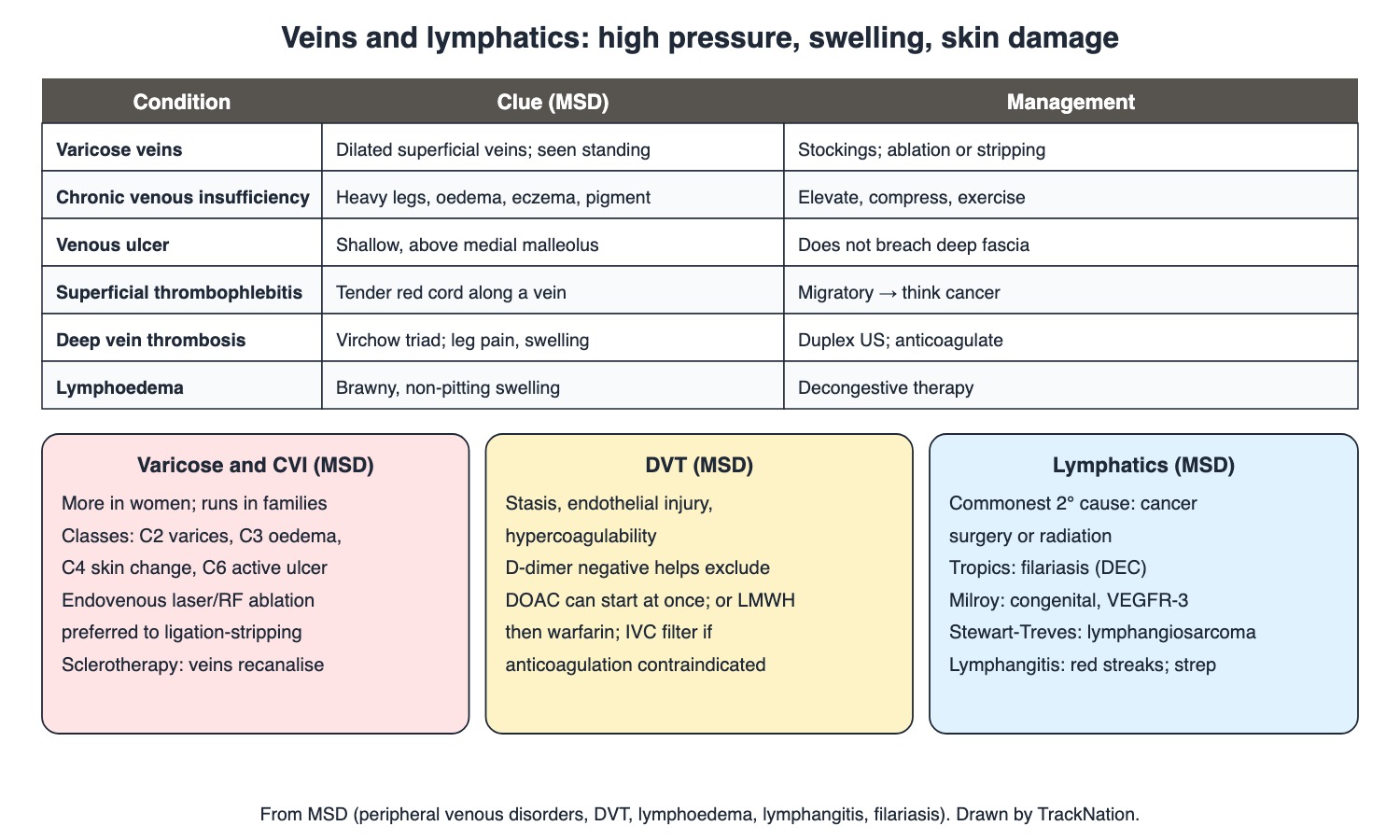
Varicose veins, CVI, venous ulcer, thrombophlebitis, DVT, lymphoedema. Drawn by TrackNation.
Varicose Veins and Venous Insufficiency (MSD)
Varicose veins: dilated superficial leg veins from valve reflux or a weak wall; usually no cause; commoner in women and families; rarely Klippel-Trénaunay-Weber. fullness, pressure, pain; best seen standing; skin changes at the medial malleolus.
Calf muscle pumps drive return; valves keep flow upward. Incompetent perforator valves transmit deep pressure to superficial veins → venous hypertension. Chronic venous insufficiency: heaviness and aching worse on standing, relieved by elevation; oedema, pigmentation, stasis eczema, lipodermatosclerosis, atrophie blanche, ulcers. Classes: C2 varicose veins, C3 oedema, C4 skin change, C5 healed ulcer, C6 active ulcer.
Venous ulcer: shallow, moist, above the medial malleolus, does not breach the deep fascia (arterial ulcers expose tendon or bone). Post-thrombotic syndrome affects up to 50% after DVT, worse with proximal DVT.
Treatment: elevation, compression, exercise, weight loss, wound care. Symptomatic reflux: endovenous laser or radiofrequency ablation (preferred) or ligation and stripping of the saphenous vein; sclerotherapy (sodium tetradecyl sulfate) — veins may recanalise; new varices often appear.
Venous Thrombosis (MSD)
Superficial thrombophlebitis: tender indurated cord along a vein (arm: mostly IV lines; other risks: varicose veins, pregnancy, cancer); near the saphenofemoral junction it can extend into DVT. Chest wall = Mondor disease. Migratory thrombophlebitis (Trousseau) may herald pancreatic or other adenocarcinoma.
DVT: the main source of PE; Virchow triad — stasis, endothelial injury, hypercoagulability; red (fibrin-rich) thrombi from valve cusps; may cause unexplained post-operative fever. Diagnose by duplex ultrasound; a negative D-dimer helps exclude it. Phlegmasia cerulea dolens: massive iliofemoral DVT → blue, painful, ischaemic leg, venous gangrene.
Treat: DOAC (rivaroxaban, apixaban) straight away, or LMWH bridged to warfarin (takes ~5 days). IVC filter when anticoagulation is contraindicated. Prevention: early mobilisation, LMWH, intermittent pneumatic compression when bleeding risk is high.
Lymphoedema and Lymphangitis (MSD)
Lymphoedema: primary (hypoplasia; Milroy disease — congenital, autosomal dominant) or secondary. Commonest secondary cause: cancer treatment (node dissection, radiation); in the tropics, filariasis. Swelling becomes brawny and non-pitting; risks: cellulitis, lymphangitis, rarely lymphangiosarcoma (Stewart-Treves, after mastectomy). Cure is unusual; complete decongestive therapy = manual lymphatic drainage, compression, exercise, skin care.
Lymphangitis: red, warm, tender streaks up a limb, usually streptococcal → antistreptococcal antibiotics; filarial in endemic areas.
Lymphatic filariasis (Wuchereria, Brugia): acute lymphangitis, epididymitis; chronic hydrocele, lymphoedema, elephantiasis; treated with diethylcarbamazine.
Traps the Examiner Sets
Venous symptoms improve with elevation; arterial rest pain worsens.
Venous ulcer: medial malleolus, shallow; arterial ulcer: deep, exposes tendon.
Lymphoedema is non-pitting when chronic.
Migratory thrombophlebitis → look for pancreatic cancer.
Memory Hooks & Shortcuts
Shortcuts to lock in this article's numbers and lists. Each one only re-packages facts proven above.
🧠 'Veins feel better up, arteries feel worse up' — elevation
🧠 Venous ulcer: 'Medial, Moist, Mild depth' — ulcer
🧠 Virchow: 'Slow, Sore, Sticky' — stasis, injury, hypercoagulability — DVT
🧠 'Migrating clots, hunt the pancreas' — Trousseau
🧠 Lymphoedema: 'Press and it won't pit' — lymphoedema
Rapid-Revision Cards
Varicose veins
Dilated superficial; women; families.
Mechanism
Perforator valve incompetence.
CVI symptoms
Worse standing; better elevated.
Venous ulcer
Medial malleolus; shallow.
Arterial ulcer
Deep; exposes tendon/bone.
C6
Active venous ulcer.
Lipodermatosclerosis
Fibrosing panniculitis.
Post-thrombotic
Up to 50% after DVT.
Varicose Rx
Stockings; endovenous ablation.
Sclerotherapy
Sodium tetradecyl sulfate.
Arm phlebitis
IV cannula.
SFJ thrombophlebitis
Can extend to DVT.
Migratory phlebitis
Pancreatic cancer.
Mondor
Chest wall vein.
Virchow triad
Stasis, injury, hypercoagulability.
DVT test
Duplex US; D-dimer excludes.
Phlegmasia cerulea
Blue ischaemic leg.
DVT Rx
DOAC; or LMWH → warfarin.
No anticoagulation
IVC filter.
Lymphoedema cause
Cancer Rx; tropics: filaria.
Stewart-Treves
Lymphangiosarcoma after mastectomy.
Sources
Facts in this article were checked against these documents.
MSD Manual Professional: Varicose Veins; Chronic Venous Insufficiency and Post-thrombotic Syndrome; Superficial Venous Thrombosis; Deep Venous Thrombosis; DVT Prevention; Lymphedema; Lymphangitis; Lymphatic Filariasis — Merck & Co. (MSD Manuals), 2025–26 (link)
Competency Based Undergraduate Curriculum, Vol III: General Surgery (SU27) — National Medical Commission, 2024
Test Yourself: Practice Questions
Thirty questions in NEET PG style, most of them clinical vignettes.
Practice Questions (NEET PG pattern)
Original questions written in the style of the exam: +4 for a correct answer, −1 for a wrong one. Every answer was checked against the sources listed above. NEET PG papers are not published by NBEMS, so these are not past-paper questions.
Q1. A woman whose mother had similar veins has dilated tortuous leg veins most obvious when standing. These are
(a) DVT
(b) varicose veins
(c) lymphoedema
(d) telangiectasia only
Show answer
Answer: (b) — Commoner in women, families.
Q2. Venous pressure is transmitted from deep to superficial veins mainly through incompetent
(a) lymphatics
(b) perforator valves
(c) arterial valves
(d) capillaries
Show answer
Answer: (b) — Venous hypertension.
Q3. Symptoms of chronic venous insufficiency typically
(a) occur only at rest
(b) worsen on standing and improve with elevation
(c) are relieved by walking uphill
(d) worsen on elevation
Show answer
Answer: (b) — Unlike arterial rest pain.
Q4. A shallow, moist ulcer just above the medial malleolus with surrounding pigmentation is most likely a
(a) venous ulcer
(b) neuropathic ulcer
(c) Marjolin ulcer
(d) arterial ulcer
Show answer
Answer: (a) — Does not breach fascia.
Q5. Unlike a venous ulcer, an arterial ulcer
(a) lies above the medial malleolus
(b) is shallow and moist
(c) may expose tendon or bone
(d) heals with elevation
Show answer
Answer: (c) — Ischaemic.
Q6. Hard, indurated, pigmented skin of the lower leg in chronic venous disease is called
(a) lymphangiosarcoma
(b) atrophie blanche
(c) lipodermatosclerosis
(d) corona phlebectatica
Show answer
Answer: (c) — Fibrosing panniculitis.
Q7. In the clinical classification of chronic venous disease, an active venous ulcer is class
(a) C3
(b) C4
(c) C6
(d) C2
Show answer
Answer: (c) — C5 = healed ulcer.
Q8. Post-thrombotic syndrome can affect up to what proportion of patients after DVT?
(a) 50%
(b) 5%
(c) 1%
(d) 90%
Show answer
Answer: (a) — Worse after proximal DVT.
Q9. First-line management of chronic venous insufficiency includes
(a) leg elevation, compression and exercise
(b) diuretics alone
(c) anticoagulation for life
(d) immediate stripping for all
Show answer
Answer: (a) — Plus wound care.
Q10. For symptomatic saphenous reflux not responding to stockings, MSD recommends
(a) amputation
(b) IVC filter
(c) warfarin
(d) endovenous laser or radiofrequency ablation over ligation and stripping
Show answer
Answer: (d) — Similar outcomes.
Q11. A sclerosant used to obliterate varicose veins is
(a) heparin
(b) tranexamic acid
(c) sodium tetradecyl sulfate
(d) potassium chloride
Show answer
Answer: (c) — Veins may recanalise.
Q12. A tender, red, cord-like vein in the arm after an IV cannula is
(a) lymphangitis
(b) cellulitis
(c) DVT
(d) superficial thrombophlebitis
Show answer
Answer: (d) — Commonest arm cause.
Q13. Superficial thrombophlebitis near which site carries the greatest risk of extending to DVT?
(a) the chest wall
(b) the forearm
(c) the dorsum of the foot
(d) the saphenofemoral junction
Show answer
Answer: (d) — Risk of DVT and PE.
Q14. Recurrent migratory superficial thrombophlebitis should prompt a search for
(a) filariasis
(b) pancreatic or other adenocarcinoma
(c) gout
(d) varicose veins only
Show answer
Answer: (b) — Trousseau syndrome.
Q15. Thrombophlebitis of a superficial vein of the chest wall is called
(a) Paget-Schroetter
(b) Mondor disease
(c) Buerger disease
(d) Trousseau syndrome
Show answer
Answer: (b) — Breast or chest.
Q16. The three factors of Virchow triad are
(a) pain, pallor and pulselessness
(b) stasis, endothelial injury and hypercoagulability
(c) fever, rash, arthralgia
(d) hypoxia, hypercapnia, acidosis
Show answer
Answer: (b) — DVT.
Q17. A post-operative patient has a swollen tender calf. The diagnostic test of choice is
(a) duplex ultrasound
(b) D-dimer alone
(c) plain X-ray
(d) venography first
Show answer
Answer: (a) — D-dimer to exclude.
Q18. In a patient with low clinical probability of DVT, a negative D-dimer
(a) helps exclude DVT
(b) requires anticoagulation
(c) is meaningless
(d) confirms DVT
Show answer
Answer: (a) — Pretest probability guides use.
Q19. Fever without an obvious source in a post-operative patient may be due to
(a) thyroid storm
(b) DVT
(c) heat stroke
(d) appendicitis
Show answer
Answer: (b) — Look at the legs.
Q20. A massively swollen, blue, painful, ischaemic leg from iliofemoral DVT is
(a) acute arterial embolism
(b) lymphoedema
(c) phlegmasia cerulea dolens
(d) phlegmasia alba dolens
Show answer
Answer: (c) — Venous gangrene risk.
Q21. A patient with DVT can be started on oral anticoagulation immediately, without heparin, using
(a) aspirin
(b) rivaroxaban or apixaban
(c) clopidogrel
(d) warfarin alone
Show answer
Answer: (b) — Warfarin needs heparin cover.
Q22. Warfarin needs overlap with heparin for DVT because it takes about
(a) 1 month
(b) 1 hour
(c) never acts
(d) 5 days to act
Show answer
Answer: (d) — Warfarin is started within 24 hours of heparin.
Q23. A patient with leg DVT has a contraindication to anticoagulation. To help prevent PE, consider
(a) aspirin
(b) thrombolysis
(c) an IVC filter
(d) compression only
Show answer
Answer: (c) — Placed below the renal veins.
Q24. After major trauma with high bleeding risk, DVT prophylaxis should begin with
(a) intermittent pneumatic compression
(b) nothing
(c) bed rest
(d) full-dose warfarin
Show answer
Answer: (a) — Until bleeding risk falls.
Q25. A woman develops swelling of the arm years after mastectomy with axillary clearance. The swelling is
(a) venous insufficiency
(b) Milroy disease
(c) DVT
(d) secondary lymphoedema
Show answer
Answer: (d) — Cancer treatment commonest cause.
Q26. In tropical regions the commonest cause of secondary lymphoedema is
(a) mastectomy
(b) Milroy disease
(c) venous ulcer
(d) lymphatic filariasis
Show answer
Answer: (d) — Wuchereria, Brugia.
Q27. Chronic lymphoedema characteristically produces
(a) ulcers above the malleolus
(b) pitting oedema that resolves overnight
(c) brawny, non-pitting swelling
(d) warm red streaks
Show answer
Answer: (c) — Fibrosis.
Q28. A rare malignancy arising in long-standing post-mastectomy lymphoedema is
(a) Kaposi sarcoma only
(b) basal cell carcinoma
(c) melanoma
(d) lymphangiosarcoma (Stewart-Treves syndrome)
Show answer
Answer: (d) — Usually after mastectomy.
Q29. The recommended treatment for lymphoedema combines manual lymphatic drainage, compression, exercise and skin care, called
(a) complete decongestive therapy
(b) thrombolysis
(c) stripping
(d) sclerotherapy
Show answer
Answer: (a) — Cure unusual.
Q30. Red, warm, tender streaks spreading up a limb are
(a) erysipelas only
(b) superficial thrombophlebitis
(c) DVT
(d) lymphangitis, treated with antistreptococcal antibiotics
Show answer
Answer: (d) — Usually streptococci.
Active Recall
From memory: explain how varicose veins and chronic venous insufficiency arise and present, contrast venous and arterial ulcers, outline treatment of varicose veins, describe superficial thrombophlebitis and DVT with diagnosis, treatment and prevention, and summarise lymphoedema, lymphangitis and filariasis.