Arterial Disease for NEET PG Surgery: Claudication, ABI, Acute Limb Ischaemia, Buerger Disease, Aortic Aneurysm, Gangrene and Diabetic Foot
Start Here
🎯 Exam priority: High. Expect: claudication level from symptoms, ABI cut-offs, rest pain worse on elevation, dry vs wet gangrene, the Ps of acute ischaemia and the site of block, Buerger disease, AAA definition, risk, growth, rupture and the 5.5-cm repair rule, and the ICMR diabetic foot checks and wound care do's and don'ts.
CBME mapping: SU27.1–27.4 (arterial disease, examination of the vascular system, gangrene and amputation). Veins and lymphatics follow in article 13.
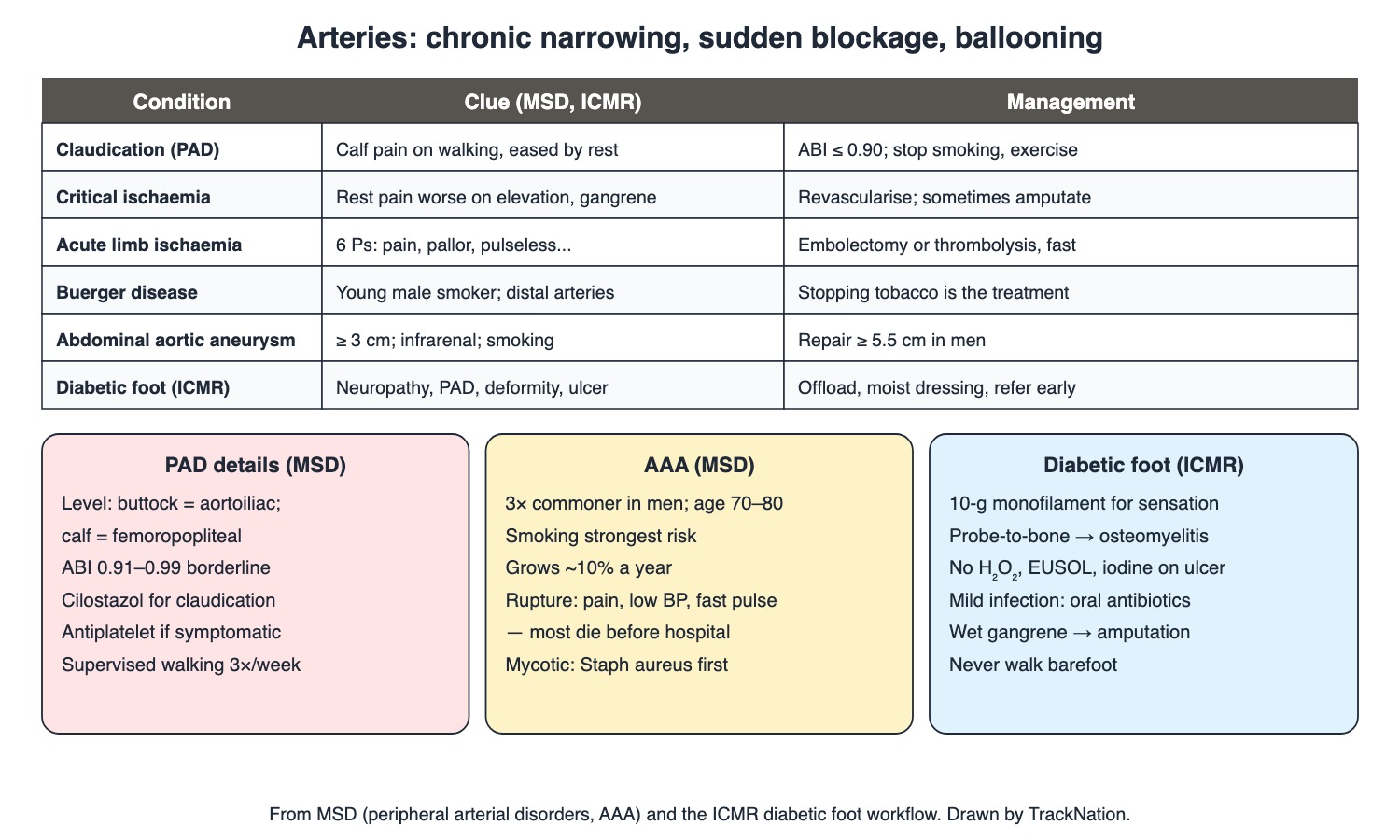
Claudication, critical and acute ischaemia, Buerger disease, AAA, diabetic foot. Drawn by TrackNation.
Peripheral Artery Disease (MSD)
Atherosclerosis of limb arteries. Intermittent claudication: cramping leg pain on walking, relieved by rest, usually in the calf. Level: aortoiliac → buttock/thigh/calf pain, hip pain and erectile dysfunction (Leriche syndrome); femoropopliteal → calf pain.
Chronic limb-threatening ischaemia: rest pain worse on elevation (at night), ulcers with black dry gangrene; infection turns it into wet gangrene with spreading cellulitis.
ABI = highest ankle / highest arm systolic pressure: ≤ 0.90 diagnostic, 0.91–0.99 borderline; a 20% drop after exercise is diagnostic.
Treatment: stop smoking, control diabetes, lipids and BP; supervised walking 30–60 min ≥ 3 times a week; antiplatelet if symptomatic; cilostazol for claudication; endovascular or surgical revascularisation for refractory symptoms or limb threat; some need amputation. Coronary disease drives mortality.
Acute Ischaemia, Buerger and Raynaud (MSD)
Acute limb ischaemia: thrombosis on plaque, embolus from heart or aorta, dissection, compartment syndrome. The Ps — pain (out of proportion), pallor, paraesthesia, poikilothermia, pulselessness, and paralysis in severe cases. The block lies just below the last palpable pulse. Treat fast: embolectomy/thrombectomy, catheter thrombolysis (best < 2 weeks with intact sensation and movement), or bypass.
Thromboangiitis obliterans (Buerger): inflammatory thrombosis of small and medium arteries and superficial veins in young male smokers (30–45); distal ischaemia, ulcers, gangrene, superficial thrombophlebitis, positive Allen test; angiography — corkscrew collaterals, no atherosclerosis. Stopping tobacco is the treatment; continued smoking leads to amputation.
Raynaud phenomenon: cold- or stress-induced digital vasospasm with pallor, cyanosis and redness; avoid cold, stop smoking, nifedipine if needed.
Abdominal Aortic Aneurysm (MSD)
Aortic diameter ≥ 3 cm; usually infrarenal and fusiform; 3 times commoner in men; peak 70–80 years; smoking is the strongest risk, then hypertension, family history, connective tissue disorders. Mycotic aneurysms: Staph aureus, then Salmonella.
Most are silent and grow ~10% a year; diagnose by ultrasound or CT. Rupture: abdominal or back pain, hypotension, tachycardia — most die before reaching hospital. Repair (open or endovascular stent graft) when ≥ 5.5 cm in men if operative risk is lower than rupture risk.
Diabetic Foot (ICMR)
Red flags: sick, drowsy, febrile patient; claudication or rest pain, gangrene, osteomyelitis, acute Charcot foot → refer. Check both feet for ulcer, PAD (pulses, ABI < 0.9), loss of protective sensation (10-g monofilament) and deformity (claw/hammer toes, hallux valgus, rocker-bottom). Probe-to-bone or X-ray for osteomyelitis.
Wound care: moist dressings, offload, good glucose control; do not use hydrogen peroxide, EUSOL, povidone iodine or chlorhexidine; hyperbaric oxygen and antimicrobial dressings lack evidence. Infection: none → no antibiotics; mild → oral antibiotics 1–2 weeks for gram-positive cocci; moderate/severe → refer. Antibiotics fail without wound care. Wet gangrene needs amputation at a higher centre.
Education: inspect feet daily, well-fitting footwear, cut nails straight, never walk barefoot, don't cut corns at home, stop smoking. Review yearly (low risk) to 3-monthly (high risk).
Traps the Examiner Sets
Rest pain worsens on leg elevation, often at night.
ABI ≤ 0.90 is diagnostic of PAD.
The block is just below the last palpable pulse.
No antiseptics like EUSOL or hydrogen peroxide on diabetic ulcers.
Memory Hooks & Shortcuts
Shortcuts to lock in this article's numbers and lists. Each one only re-packages facts proven above.
🧠 'Claudication walks; rest pain sleeps (worse at night)' — PAD
🧠 Acute ischaemia '6 Ps': Pain, Pallor, Paraesthesia, Poikilothermia, Pulselessness, Paralysis — acute
🧠 'Below the last pulse lies the block' — level
🧠 AAA '3 to define, 5.5 to fix' — AAA
🧠 Buerger: 'Burn the cigarette or lose the leg' — Buerger
Rapid-Revision Cards
Claudication
Walk → pain; rest → relief.
Buttock + ED
Aortoiliac (Leriche).
Calf
Femoropopliteal.
Rest pain
Worse on elevation, at night.
Dry vs wet
Infection makes it wet.
ABI
≤ 0.90 diagnostic.
PAD Rx
Stop smoking; walk 3×/week; cilostazol.
Acute ischaemia
5 Ps + paralysis.
Block site
Below last palpable pulse.
Thrombolysis
< 2 weeks, intact limb.
Buerger
Young male smoker; corkscrews.
Buerger Rx
Stop tobacco.
AAA
≥ 3 cm; infrarenal.
AAA risk
Smoking; men 3×.
AAA repair
≥ 5.5 cm (men).
AAA rupture
Back pain, shock.
Mycotic
Staph aureus, then Salmonella.
Raynaud
White-blue-red; nifedipine.
Diabetic foot sensation
10-g monofilament.
Diabetic ulcer
Moist dressing; no EUSOL/H₂O₂.
Wet gangrene
Amputation.
Sources
Facts in this article were checked against these documents.
MSD Manual Professional: Peripheral Artery Disease; Acute Limb Ischemia; Thromboangiitis Obliterans; Abdominal Aortic Aneurysms; Raynaud Phenomenon — Merck & Co. (MSD Manuals), 2025–26 (link)
Standard Treatment Workflow: Diabetic Foot (General Surgery) — Indian Council of Medical Research, DHR, 2022 (link)
Competency Based Undergraduate Curriculum, Vol III: General Surgery (SU27) — National Medical Commission, 2024
Test Yourself: Practice Questions
Thirty questions in NEET PG style, most of them clinical vignettes.
Practice Questions (NEET PG pattern)
Original questions written in the style of the exam: +4 for a correct answer, −1 for a wrong one. Every answer was checked against the sources listed above. NEET PG papers are not published by NBEMS, so these are not past-paper questions.
Q1. A 60-year-old smoker gets cramping calf pain after walking a set distance that goes away when he stops. The diagnosis is
(a) intermittent claudication from PAD
(b) Raynaud phenomenon
(c) DVT
(d) sciatica
Show answer
Answer: (a) — Relieved by rest.
Q2. Buttock and thigh claudication with erectile dysfunction suggests disease at the
(a) tibial level
(b) femoropopliteal level
(c) subclavian level
(d) aortoiliac level (Leriche syndrome)
Show answer
Answer: (d) — Calf = femoropopliteal.
Q3. A diabetic has foot pain at night that worsens when the leg is raised. This is
(a) plantar fasciitis
(b) ischaemic rest pain
(c) neuropathic pain
(d) gout
Show answer
Answer: (b) — Critical ischaemia.
Q4. An ankle-brachial index diagnostic of peripheral artery disease is
(a) ≤ 0.90
(b) 0.91–0.99
(c) 1.0–1.4
(d) > 1.4 always
Show answer
Answer: (a) — 0.91–0.99 borderline.
Q5. A black, dry, necrotic toe that becomes red, swollen and infected has turned into
(a) chilblain
(b) frostbite
(c) dry gangrene
(d) wet gangrene
Show answer
Answer: (d) — Spreading cellulitis.
Q6. The single most essential measure in managing PAD is
(a) anticoagulation for all
(b) smoking cessation
(c) amputation
(d) immediate bypass
Show answer
Answer: (b) — Plus exercise.
Q7. Supervised exercise for claudication is recommended as
(a) 5 minutes daily
(b) 30–60 minutes of walking at least 3 times a week
(c) swimming only
(d) complete rest
Show answer
Answer: (b) — Exercise-rest pattern.
Q8. A drug specifically recommended to improve walking distance in claudication is
(a) propranolol
(b) warfarin
(c) nifedipine
(d) cilostazol
Show answer
Answer: (d) — Plus antiplatelet.
Q9. A woman with a known cardiac source of emboli suddenly develops a painful, pale, cold, pulseless leg. The likely cause is
(a) sciatica
(b) cellulitis
(c) DVT
(d) arterial embolism (acute limb ischaemia)
Show answer
Answer: (d) — Embolus from the heart.
Q10. In acute limb ischaemia, the femoral pulse is palpable but the popliteal is not. The block is at the
(a) aortic bifurcation
(b) tibial arteries only
(c) common femoral bifurcation
(d) popliteal bifurcation
Show answer
Answer: (c) — Just below the last pulse.
Q11. The 'sixth P' of acute limb ischaemia indicating severe ischaemia is
(a) pink skin
(b) polyuria
(c) paralysis
(d) pruritus
Show answer
Answer: (c) — Loss of motor function.
Q12. Catheter-directed thrombolysis works best for arterial occlusions
(a) less than 2 weeks old with intact sensation and movement
(b) with paralysis
(c) in gangrene
(d) older than 3 months
Show answer
Answer: (a) — Salvageable limb.
Q13. A 35-year-old male heavy smoker has digital ulcers, superficial thrombophlebitis and corkscrew collaterals on angiography. The diagnosis is
(a) thromboangiitis obliterans (Buerger disease)
(b) atherosclerotic PAD
(c) Raynaud disease
(d) Takayasu arteritis
Show answer
Answer: (a) — Small and medium arteries.
Q14. The essential treatment of Buerger disease is
(a) statins
(b) complete cessation of tobacco
(c) sympathectomy alone
(d) anticoagulation
Show answer
Answer: (b) — Else amputation.
Q15. An abdominal aortic aneurysm is defined as an aortic diameter of at least
(a) 1.5 cm
(b) 5 cm
(c) 2 cm
(d) 3 cm
Show answer
Answer: (d) — Usually infrarenal.
Q16. The strongest risk factor for abdominal aortic aneurysm is
(a) diabetes
(b) smoking
(c) female sex
(d) obesity
Show answer
Answer: (b) — Men 3×.
Q17. Abdominal aortic aneurysms typically begin
(a) in the thoracic aorta
(b) at the diaphragm
(c) at the coeliac trunk
(d) below the renal arteries
Show answer
Answer: (d) — Infrarenal.
Q18. An asymptomatic AAA in a man should be repaired when it reaches about
(a) 3 cm
(b) 5.5 cm
(c) 8 cm
(d) 4 cm
Show answer
Answer: (b) — If op risk < rupture risk.
Q19. A 72-year-old man collapses with severe back pain, hypotension and tachycardia. He has a known AAA. The likely event is
(a) renal colic
(b) pancreatitis
(c) aneurysm rupture
(d) MI
Show answer
Answer: (c) — Most die before hospital.
Q20. The commonest organism causing a mycotic aortic aneurysm is
(a) Salmonella
(b) Treponema
(c) Staphylococcus aureus
(d) E. coli
Show answer
Answer: (c) — Salmonella second.
Q21. The imaging used to diagnose and follow an AAA is
(a) MRI only
(b) ultrasound or CT
(c) plain X-ray only
(d) angiography only
Show answer
Answer: (b) — Grows ~10%/year.
Q22. A young woman's fingers turn white then blue in the cold. First-line drug if lifestyle measures fail is
(a) propranolol
(b) aspirin only
(c) warfarin
(d) nifedipine
Show answer
Answer: (d) — Raynaud phenomenon.
Q23. To test for loss of protective sensation in a diabetic foot, ICMR recommends
(a) hot water
(b) a pin through the skin
(c) a 10-g monofilament
(d) a tuning fork only
Show answer
Answer: (c) — LOPS.
Q24. A diabetic foot ulcer in which a sterile probe touches bone suggests
(a) Charcot foot
(b) superficial infection only
(c) osteomyelitis
(d) callus
Show answer
Answer: (c) — Probe-to-bone test.
Q25. Which dressing approach does ICMR recommend for diabetic foot ulcers?
(a) EUSOL soaks
(b) moist dressings, avoiding hydrogen peroxide, EUSOL and povidone iodine
(c) dry gauze only
(d) daily hydrogen peroxide
Show answer
Answer: (b) — Offload too.
Q26. A diabetic foot ulcer with mild local infection and no systemic signs needs
(a) amputation
(b) no treatment
(c) IV broad-spectrum antibiotics
(d) oral antibiotics for 1–2 weeks against gram-positive cocci
Show answer
Answer: (d) — Plus wound care.
Q27. A diabetic foot with wet gangrene should be
(a) given oral antibiotics only
(b) observed
(c) referred for amputation at a higher centre
(d) managed with dressings at home
Show answer
Answer: (c) — Source control.
Q28. Advice for a patient at risk of diabetic foot includes
(a) soak feet in hot water
(b) never walk barefoot, even at home
(c) remove corns at home with a blade
(d) cut nails rounded deeply
Show answer
Answer: (b) — Daily inspection.
Q29. ICMR notes that in diabetic foot infection, antibiotics
(a) are not needed even in cellulitis
(b) replace debridement
(c) are insufficient without proper wound care
(d) are always IV
Show answer
Answer: (c) — Debride, dress, offload.
Q30. Patients with PAD most often die from
(a) stroke only
(b) infection only
(c) coexisting coronary artery disease
(d) limb gangrene
Show answer
Answer: (c) — Treat risk factors.
Active Recall
From memory: describe claudication and critical ischaemia with the level of disease and the ABI, outline PAD treatment, list the Ps of acute limb ischaemia and its treatment, describe Buerger disease and Raynaud phenomenon, give the key facts of abdominal aortic aneurysm, and summarise the ICMR diabetic foot assessment and wound care.