Cardiothoracic Surgery and Transplantation for NEET PG: Lung Cancer, Pulmonary Nodule, CABG, Tetralogy, PDA, Kidney and Liver Transplant, Rejection
Start Here
🎯 Exam priority: Medium–High. Expect: SCLC vs NSCLC, Pancoast with Horner, SVC syndrome, paraneoplastic syndromes by type, benign calcification patterns in a nodule, the LIMA-to-LAD graft, tetralogy features and the boot-shaped heart, PDA murmur and drugs, the commonest solid organ transplant, rejection timing and the standard immunosuppressive triple.
CBME mapping: SU26.1–26.4 (cardiothoracic surgery) and SU13.1–13.4 (transplantation). Indian legal aspects of organ donation are not covered here for want of a checkable source.
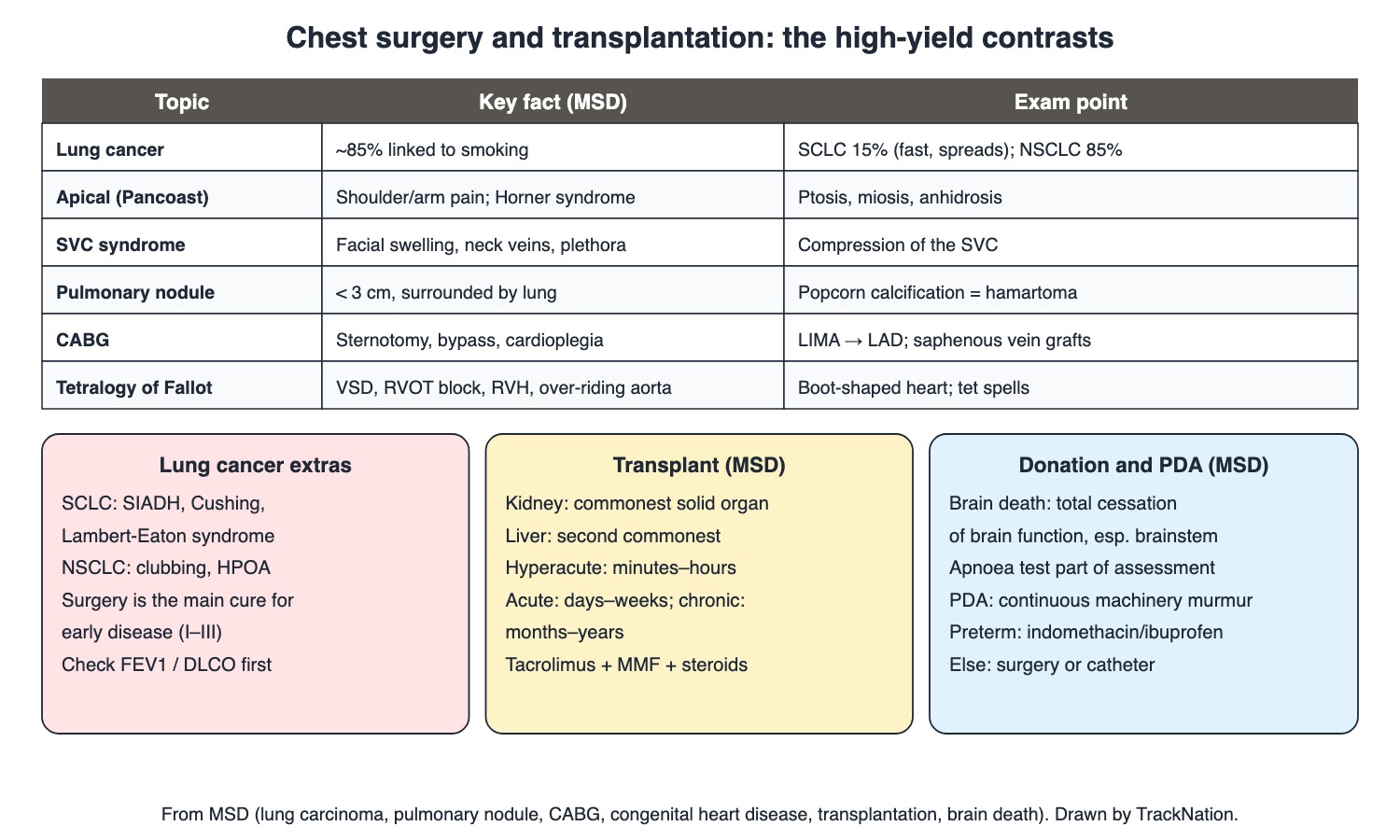
Lung cancer, Pancoast, SVC syndrome, pulmonary nodule, CABG, tetralogy; transplantation; brain death and PDA. Drawn by TrackNation.
Lung Cancer and the Pulmonary Nodule (MSD)
Leading cause of cancer death; ~85% linked to smoking. Small cell (~15%): aggressive, almost only in smokers, 70–80% metastatic at diagnosis (image the brain). Non-small cell (~85%): behaviour varies by type.
Local spread: Pancoast (apical) tumour → shoulder/arm pain and Horner syndrome (ptosis, miosis, anhidrosis); SVC syndrome → head fullness, facial and arm swelling, distended neck veins, plethora; phrenic nerve → raised hemidiaphragm; laryngeal nerve → hoarseness.
Paraneoplastic: SIADH, Cushing, Lambert-Eaton mostly with SCLC; clubbing and hypertrophic osteoarthropathy mostly NSCLC; Trousseau migratory thrombophlebitis.
Tissue diagnosis is required. Surgical resection is the main cure for early (I–III) disease; check FEV1/DLCO first (≥ 80% predicted needs no more testing).
Solitary pulmonary nodule: < 3 cm, surrounded by lung; malignancy < 1% if < 6 mm. Benign calcification: central or concentric (granuloma), popcorn (hamartoma). Cancer clues: spiculated margins, upper lobe, doubling time 21–400 days.
Cardiac Surgery (MSD)
CABG bypasses severe coronary stenoses not suitable for stenting: median sternotomy, cardiopulmonary bypass after high-dose heparin, aortic cross-clamp and cardioplegia. The left internal mammary artery is grafted to the left anterior descending artery; saphenous vein segments for others.
Tetralogy of Fallot: VSD, right ventricular outflow obstruction, RV hypertrophy, over-riding aorta; cyanosis and tet spells; X-ray boot-shaped heart with oligaemic lungs. Palliation: Blalock-Taussig-Thomas shunt (subclavian to pulmonary artery); complete repair mortality < 5%.
PDA: persistent aorta-to-pulmonary-artery channel; continuous machinery murmur; in preterm infants indomethacin or ibuprofen may close it; otherwise surgical or catheter closure.
Transplantation (MSD)
Kidney is the commonest solid-organ transplant (for end-stage kidney failure); liver second (adults: alcohol-related cirrhosis commonest; children: biliary atresia; HCC within Milan criteria).
Rejection: hyperacute — minutes to hours, pre-formed antibodies (HLA/ABO incompatibility), fever, anuria; accelerated — days; acute — days to weeks, T-cell or antibody, usually reversed by pulse steroids or antilymphocyte globulin; chronic — months to years, proteinuria, gradual loss (chronic allograft nephropathy ≥ 3 months).
Maintenance immunosuppression: a calcineurin inhibitor (tacrolimus) + an antimetabolite (mycophenolate) + glucocorticoids; the liver needs the least immunosuppression.
Brain death: total cessation of integrated brain function, especially the brainstem, confirmed by a full neurological examination including apnoea testing — accepted as death and the basis for deceased donation.
Traps the Examiner Sets
Pancoast tumours are usually NSCLC; Horner is ipsilateral.
Popcorn calcification = hamartoma (benign).
Hyperacute rejection happens on the table, not after weeks.
Indomethacin closes PDA only in preterm babies.
Memory Hooks & Shortcuts
Shortcuts to lock in this article's numbers and lists. Each one only re-packages facts proven above.
🧠 'Small cell = Sinister, Smokers, SIADH, Spreads' — SCLC
🧠 Horner 'PMA': Ptosis, Miosis, Anhidrosis — Horner
🧠 'Popcorn is harmless' — hamartoma — nodule
🧠 'LIMA loves the LAD' — CABG
🧠 Rejection clock: 'Hyperacute — on the table; Acute — weeks; Chronic — years' — rejection
Rapid-Revision Cards
Smoking share
~85% of lung cancer.
SCLC
15%; aggressive; scan brain.
NSCLC
85%.
Pancoast
Arm pain + Horner.
Horner
Ptosis, miosis, anhidrosis.
SVC syndrome
Facial swelling, neck veins, plethora.
SCLC paraneoplastic
SIADH, Cushing, Lambert-Eaton.
NSCLC paraneoplastic
Clubbing, HPOA.
Early lung cancer
Resect (I–III).
Nodule
< 3 cm in lung; < 6 mm < 1% risk.
Popcorn calcification
Hamartoma.
Malignant clues
Spiculated, upper lobe.
CABG graft
LIMA → LAD.
Bypass
High-dose heparin; cardioplegia.
Tetralogy
VSD, RVOTO, RVH, over-riding aorta.
Tet X-ray
Boot-shaped heart.
PDA
Machinery murmur; NSAID in preterm.
Commonest transplant
Kidney; then liver.
Hyperacute
Minutes–hours; antibodies.
Acute rejection Rx
Pulse steroids, ALG.
Triple therapy
Tacrolimus + MMF + steroids.
Sources
Facts in this article were checked against these documents.
MSD Manual Professional: Lung Carcinoma; Solitary Pulmonary Nodule; Coronary Artery Bypass Grafting; Tetralogy of Fallot; Patent Ductus Arteriosus; Kidney Transplantation; Liver Transplantation; Brain Death — Merck & Co. (MSD Manuals), 2025–26 (link)
Competency Based Undergraduate Curriculum, Vol III: General Surgery (SU13, SU26) — National Medical Commission, 2024
Test Yourself: Practice Questions
Thirty questions in NEET PG style, most of them clinical vignettes.
Practice Questions (NEET PG pattern)
Original questions written in the style of the exam: +4 for a correct answer, −1 for a wrong one. Every answer was checked against the sources listed above. NEET PG papers are not published by NBEMS, so these are not past-paper questions.
Q1. About what proportion of lung cancers are linked to cigarette smoking?
(a) 15%
(b) 100%
(c) 50%
(d) 85%
Show answer
Answer: (d) — Leading cancer killer.
Q2. Small cell lung cancer differs from NSCLC in that it
(a) never spreads
(b) is the commonest type
(c) is aggressive, almost only in smokers, and usually metastatic at diagnosis
(d) is curable by surgery in most
Show answer
Answer: (c) — 70–80% metastatic.
Q3. A smoker has shoulder and arm pain with ptosis, a small pupil and dry skin on the same side. The tumour is
(a) a central SCLC with SIADH
(b) mesothelioma
(c) an apical (Pancoast) tumour with Horner syndrome
(d) a hamartoma
Show answer
Answer: (c) — Sympathetic chain.
Q4. A man with lung cancer has facial swelling, head fullness, dilated neck veins and plethora. The cause is
(a) superior vena cava syndrome
(b) Horner syndrome
(c) SIADH
(d) Pancoast syndrome
Show answer
Answer: (a) — SVC compression.
Q5. Hoarseness in lung cancer suggests involvement of the
(a) vagus to the heart
(b) sympathetic chain
(c) laryngeal nerve
(d) phrenic nerve
Show answer
Answer: (c) — Phrenic → raised hemidiaphragm.
Q6. Hyponatraemia from SIADH in a lung cancer patient points to
(a) adenocarcinoma
(b) squamous cell carcinoma
(c) carcinoid
(d) small cell lung cancer
Show answer
Answer: (d) — Also Cushing, Lambert-Eaton.
Q7. Myasthenia-like weakness in a smoker with a lung mass suggests Lambert-Eaton syndrome, most often seen with
(a) small cell lung cancer
(b) NSCLC
(c) hamartoma
(d) mesothelioma
Show answer
Answer: (a) — Paraneoplastic.
Q8. Clubbing with hypertrophic pulmonary osteoarthropathy is most common in
(a) tuberculoma
(b) small cell lung cancer
(c) non-small cell lung cancer
(d) hamartoma
Show answer
Answer: (c) — Paraneoplastic.
Q9. After a diagnosis of small cell lung cancer, routine staging should include
(a) brain imaging even without neurological symptoms
(b) no imaging
(c) bone marrow only
(d) colonoscopy
Show answer
Answer: (a) — High metastatic rate.
Q10. The primary curative treatment for stage I–III lung cancer is
(a) radiotherapy alone always
(b) observation
(c) surgical resection
(d) chemotherapy alone
Show answer
Answer: (c) — Check lung function first.
Q11. Before lung resection, a patient whose predicted FEV1 and DLCO are ≥ 80% needs
(a) no further lung function testing
(b) bronchoscopy only
(c) cardiopulmonary bypass
(d) a stair-climb test
Show answer
Answer: (a) — 30–60% needs exercise testing.
Q12. A solitary pulmonary nodule is defined as a lesion
(a) < 3 cm completely surrounded by lung
(b) with effusion
(c) in the mediastinum
(d) > 5 cm touching the pleura
Show answer
Answer: (a) — No atelectasis.
Q13. A lung nodule with 'popcorn' calcification is most likely a
(a) adenocarcinoma
(b) hamartoma
(c) mesothelioma
(d) metastasis
Show answer
Answer: (b) — Benign pattern.
Q14. A nodule feature favouring malignancy is
(a) size < 6 mm
(b) concentric calcification
(c) spiculated margins in an upper lobe
(d) central calcification
Show answer
Answer: (c) — Doubling 21–400 days.
Q15. Malignancy probability for lung nodules smaller than 6 mm is
(a) over 90%
(b) less than 1%
(c) about 25%
(d) about 50%
Show answer
Answer: (b) — Size matters.
Q16. In standard CABG, the left anterior descending artery is usually grafted with the
(a) splenic artery
(b) left internal mammary artery
(c) radial vein
(d) great saphenous vein only
Show answer
Answer: (b) — Pedicled graft.
Q17. Before starting cardiopulmonary bypass, the patient is given
(a) very high-dose heparin
(b) protamine
(c) tranexamic acid only
(d) warfarin
Show answer
Answer: (a) — Prevents circuit clotting.
Q18. During CABG the heart is stopped by
(a) cardioplegic solution after aortic cross-clamping
(b) electric shock
(c) beta-blockers
(d) adenosine
Show answer
Answer: (a) — Reduces oxygen demand.
Q19. A cyanotic infant has a VSD, RV outflow obstruction, RV hypertrophy and an over-riding aorta. The chest X-ray shows
(a) figure-of-3 sign
(b) egg on a string
(c) snowman heart
(d) a boot-shaped heart with oligaemic lungs
Show answer
Answer: (d) — Tetralogy of Fallot.
Q20. A palliative operation for tetralogy of Fallot joining the subclavian artery to the pulmonary artery is the
(a) Blalock-Taussig-Thomas shunt
(b) Fontan operation
(c) Ross procedure
(d) Glenn shunt
Show answer
Answer: (a) — Before complete repair.
Q21. A preterm baby has a continuous machinery murmur and a significant shunt through a PDA. Initial treatment can be
(a) indomethacin or ibuprofen
(b) digoxin only
(c) prostaglandin E1
(d) immediate thoracotomy always
Show answer
Answer: (a) — Not effective in term infants.
Q22. The commonest solid organ transplanted is the
(a) liver
(b) lung
(c) heart
(d) kidney
Show answer
Answer: (d) — Liver second.
Q23. Within minutes to hours of a kidney transplant the recipient becomes febrile and anuric. This is
(a) hyperacute rejection from pre-formed antibodies
(b) acute T-cell rejection
(c) chronic rejection
(d) drug toxicity
Show answer
Answer: (a) — HLA incompatibility.
Q24. Acute rejection a week after kidney transplant is usually reversed by
(a) pulse glucocorticoids or antilymphocyte globulin
(b) antibiotics
(c) graft removal
(d) stopping all drugs
Show answer
Answer: (a) — Intensified immunosuppression.
Q25. Gradual proteinuria and graft decline years after kidney transplant suggest
(a) acute rejection
(b) surgical leak
(c) hyperacute rejection
(d) chronic rejection / chronic allograft nephropathy
Show answer
Answer: (d) — Months to years.
Q26. Standard maintenance immunosuppression after kidney transplant combines
(a) methotrexate and aspirin
(b) tacrolimus, mycophenolate and glucocorticoids
(c) cyclophosphamide alone
(d) antibiotics only
Show answer
Answer: (b) — CNI + antimetabolite + steroid.
Q27. The second commonest solid organ transplant is the
(a) liver
(b) kidney
(c) intestine
(d) pancreas
Show answer
Answer: (a) — After kidney.
Q28. The commonest indication for liver transplantation in children is
(a) HCC
(b) alcohol-related cirrhosis
(c) hepatitis C
(d) biliary atresia
Show answer
Answer: (d) — Adults: alcohol.
Q29. Suitability for liver transplant in cirrhosis with hepatocellular carcinoma is judged by the
(a) Milan criteria
(b) Child criteria alone
(c) Glasgow criteria
(d) Ranson criteria
Show answer
Answer: (a) — Downstaging possible.
Q30. Brain death is defined as
(a) a persistent vegetative state
(b) total cessation of integrated brain function, especially brainstem
(c) deep coma with some reflexes
(d) absent EEG only
Show answer
Answer: (b) — Apnoea test.
Active Recall
From memory: contrast small cell and non-small cell lung cancer with their local and paraneoplastic features, describe the evaluation of a pulmonary nodule, outline CABG, tetralogy of Fallot and PDA, and summarise transplant types, rejection timing, immunosuppression and brain death.