Breast for NEET PG Surgery: Breast Lump Work-up, Fibroadenoma, Nipple Discharge, Mastitis, Breast Cancer Types, Receptors, Surgery and Screening
Start Here
🎯 Exam priority: Very high. Expect: fibroadenoma vs fibrocystic change vs cancer from a description, cyst aspiration rules, the investigation for a solid lump, the commonest cause of bloody discharge, Paget disease and inflammatory cancer, receptor subtype shares, BRCA risks, sentinel node biopsy, tamoxifen vs aromatase inhibitors, phyllodes tumour, lactational mastitis care and gynaecomastia.
CBME mapping: SU25.1–25.5 (breast: anatomy, investigations, benign and malignant disease, counselling).
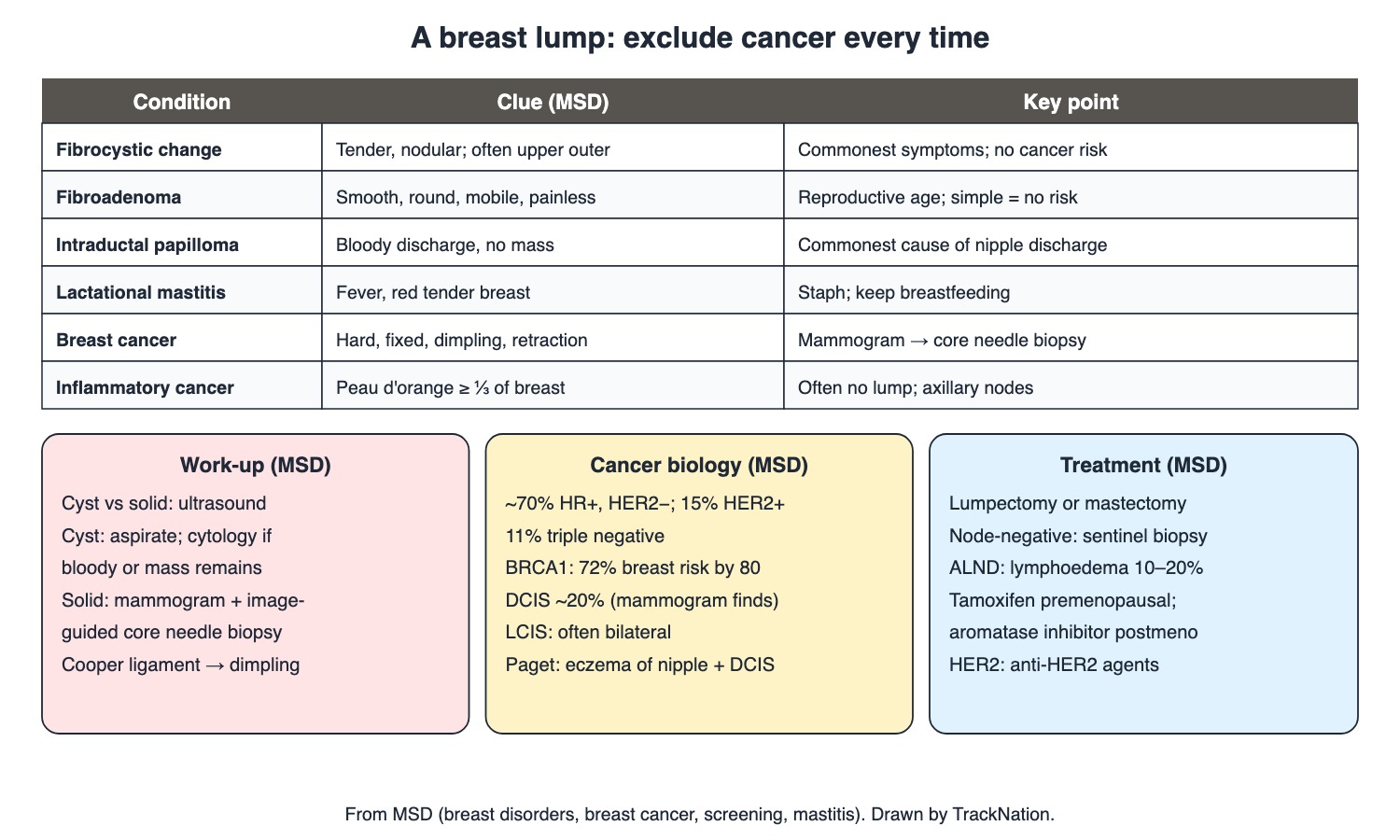
Benign breast conditions and cancer clues; work-up of a lump; cancer biology; treatment. Drawn by TrackNation.
Benign Breast Disease (MSD)
Every lump must be evaluated to exclude cancer, but most are benign. Fibrocystic change: nodular, tender, heavy breasts, cysts (often upper outer); the commonest cause of breast symptoms; settles after menopause; no added cancer risk.
Fibroadenoma: smooth, round, mobile, painless lump in reproductive years; simple ones carry no extra risk, complex ones slightly more; juvenile fibroadenomas in teenagers keep growing. Phyllodes tumour: non-epithelial, often 4–5 cm, 10–25% malignant, recurs locally — wide excision.
Nipple discharge: always abnormal in men; spontaneous unilateral discharge is abnormal. Cancer causes < 15%. Intraductal papilloma is the commonest cause and the commonest cause of bloody discharge without a lump.
Lactational mastitis: fever weeks into breastfeeding, red tender breast; staphylococci; antibiotics and continue breastfeeding to empty the breast; abscess → ultrasound and needle aspiration or incision. Non-lactational infection links to smoking, obesity, diabetes. Galactocele = milk cyst after lactation.
Gynaecomastia = glandular enlargement in men (vs fat in pseudogynaecomastia); pubertal gynaecomastia settles in 6 months–2 years; drugs (spironolactone, anabolic steroids, antiandrogens).
Working Up a Lump (MSD)
History: duration, change, pain, discharge, prior chest irradiation < 30, family history and BRCA. Examine in several positions; skin dimpling appears when tumour tethers a Cooper ligament; a size difference alone is normal.
Red flags: stony hard irregular lump, fixed to skin or chest wall, dimpling, nipple retraction, thick red skin (peau d'orange), bloody or spontaneous discharge, matted axillary nodes.
Ultrasound separates cyst from solid. Cyst: aspirate; send fluid for cytology if bloody or turbid, little fluid, or a mass remains; recheck in 4–8 weeks; a third recurrence needs biopsy. Solid lump: mammography then image-guided core needle biopsy.
Breast Cancer (MSD)
Risks: BRCA1 (~72% breast cancer by 80, ~44% ovarian) and BRCA2 (~69%); a first-degree relative doubles risk; early menarche, late menopause, late first pregnancy, combined HRT. Men with BRCA: 1–2% lifetime risk.
DCIS (~20% of cancers) is confined to ducts and is found mainly on mammography. LCIS is often multifocal and bilateral (20–60%) and raises the risk in both breasts. Paget disease of the nipple: unilateral eczema-like nipple-areola plaque from underlying ductal carcinoma (a lump in 50–60%) — biopsy. Inflammatory cancer: rapid redness, oedema, peau d'orange over ≥ ⅓ of the breast, often no lump, axillary nodes.
Subtypes: ~70% hormone-receptor positive, HER2 negative; ~15% HER2 overexpressing (poorer prognosis); ~11% triple negative.
Treatment (stage I–III): breast-conserving surgery or mastectomy with node surgery; sentinel node biopsy for clinically node-negative disease (less lymphoedema; ALND lymphoedema 10–20%); radiation and chemotherapy as indicated. Endocrine: tamoxifen for premenopausal, aromatase inhibitors (anastrozole, letrozole, exemestane) for postmenopausal women; anti-HER2 drugs for HER2+; PARP inhibitors for BRCA carriers.
Screening: mammography (two views, oblique and craniocaudal) is the mainstay; MRI for high-risk women; Gail model 5-year risk > 1.67% = high risk.
Traps the Examiner Sets
Fibrocystic change does not raise cancer risk.
A bloody aspirate or a residual lump after aspiration needs further work-up.
Inflammatory cancer often has no lump.
Keep breastfeeding in mastitis.
Memory Hooks & Shortcuts
Shortcuts to lock in this article's numbers and lists. Each one only re-packages facts proven above.
🧠 Fibroadenoma = 'breast mouse' — smooth, slippery, runs away — fibroadenoma
🧠 'Bloody nipple, no lump — think papilloma first' — discharge
🧠 'Tamoxifen for the young, AI for the old' — endocrine
🧠 'Peau d'orange, no lump — inflammatory cancer' — inflammatory
🧠 Cyst rules: 'Blood, Bit of fluid, or Bump left — biopsy' — aspiration
Rapid-Revision Cards
Fibroadenoma
Smooth, mobile, painless; young.
Fibrocystic
Tender, nodular; no cancer risk.
Phyllodes
Large; 10–25% malignant; recurs.
Cyst vs solid
Ultrasound.
Aspirate red flags
Bloody, little fluid, residual lump.
Solid lump
Mammogram + core biopsy.
Dimpling
Cooper ligament.
Bloody discharge, no lump
Intraductal papilloma.
Male discharge
Always abnormal.
Mastitis
Staph; keep breastfeeding.
Abscess
Aspirate or incise.
BRCA1
Breast 72%, ovary 44%.
1st-degree relative
2× risk.
DCIS
~20%; mammogram.
LCIS
Multifocal, bilateral.
Paget nipple
Eczema-like plaque; DCIS.
Inflammatory BC
Peau d'orange ≥ ⅓; no lump.
Subtypes
HR+ 70%; HER2 15%; TN 11%.
Axilla
SLNB if node-negative.
Endocrine
Tamoxifen pre; AI post.
Screening
Mammogram; MRI if high risk.
Sources
Facts in this article were checked against these documents.
MSD Manual Professional: Breast Masses; Evaluation of Breast Disorders; Nipple Discharge; Breast Cancer; Breast Cancer Screening and Prevention; Paget Disease of the Nipple; Phyllodes Tumor; Mastitis; Gynecomastia — Merck & Co. (MSD Manuals), 2025–26 (link)
Competency Based Undergraduate Curriculum, Vol III: General Surgery (SU25) — National Medical Commission, 2024
Test Yourself: Practice Questions
Thirty questions in NEET PG style, most of them clinical vignettes.
Practice Questions (NEET PG pattern)
Original questions written in the style of the exam: +4 for a correct answer, −1 for a wrong one. Every answer was checked against the sources listed above. NEET PG papers are not published by NBEMS, so these are not past-paper questions.
Q1. A 22-year-old has a smooth, round, very mobile, painless breast lump. The likely diagnosis is
(a) fibroadenoma
(b) fibrocystic change
(c) fat necrosis
(d) carcinoma
Show answer
Answer: (a) — Reproductive age.
Q2. A woman has tender, nodular breasts with cysts in the upper outer quadrants. Regarding cancer risk, these fibrocystic changes
(a) are pre-malignant
(b) do not increase it
(c) require mastectomy
(d) double it
Show answer
Answer: (b) — Commonest symptoms.
Q3. A simple fibroadenoma
(a) is a sarcoma
(b) does not appear to increase breast cancer risk
(c) requires mastectomy
(d) always becomes malignant
Show answer
Answer: (b) — Complex: slight risk.
Q4. The first imaging step to tell a cystic from a solid breast lump is
(a) MRI
(b) CT
(c) ultrasound
(d) PET
Show answer
Answer: (c) — Cysts rarely cancerous.
Q5. A cyst is aspirated and yields bloody fluid with a lump remaining. The next step is
(a) start antibiotics
(b) reassure
(c) repeat aspiration in a year
(d) cytology, mammography and image-guided core biopsy
Show answer
Answer: (d) — Red flags.
Q6. A 50-year-old woman has a solid, irregular breast lump. The standard work-up is
(a) observation
(b) excision without imaging
(c) FNAC of axilla only
(d) mammography followed by image-guided core needle biopsy
Show answer
Answer: (d) — Surgical biopsy if needle impossible.
Q7. Skin dimpling over a breast cancer is due to tumour tethering of
(a) the nipple
(b) lactiferous ducts
(c) pectoralis major
(d) Cooper (suspensory) ligaments
Show answer
Answer: (d) — Seen with pectoral contraction.
Q8. Which finding is a red flag for breast cancer?
(a) a lump fixed to the chest wall with nipple retraction
(b) bilateral milky discharge with pressure
(c) cyclical tenderness
(d) a mobile lump in a 20-year-old
Show answer
Answer: (a) — Also peau d'orange.
Q9. A woman has spontaneous bloody discharge from one nipple duct with no palpable lump. The commonest cause is
(a) prolactinoma
(b) intraductal papilloma
(c) duct ectasia
(d) ductal carcinoma
Show answer
Answer: (b) — Cancer < 15% of discharge.
Q10. Nipple discharge in a man is
(a) never due to cancer
(b) normal
(c) abnormal only if bloody
(d) always abnormal
Show answer
Answer: (d) — Investigate.
Q11. A breastfeeding mother develops fever and a red, tender breast three weeks after delivery. Advice includes antibiotics and
(a) continuing breastfeeding or pumping
(b) mastectomy
(c) stopping breastfeeding
(d) immediate incision
Show answer
Answer: (a) — Staphylococci.
Q12. A lactating woman has a fluctuant tender breast swelling on ultrasound. Treatment is
(a) mastectomy
(b) radiotherapy
(c) stop lactation only
(d) needle aspiration or incision and drainage with antibiotics
Show answer
Answer: (d) — Abscess.
Q13. A 5-cm breast tumour is reported as a non-epithelial phyllodes tumour. Its key feature is
(a) local recurrence and malignancy in 10–25%
(b) it never recurs
(c) it is always bilateral
(d) it is a lymphoma
Show answer
Answer: (a) — Wide excision.
Q14. Lifetime ovarian cancer risk with a BRCA1 mutation is approximately
(a) 4%
(b) 44%
(c) 90%
(d) 17%
Show answer
Answer: (b) — BRCA2 ~17%.
Q15. Having one first-degree relative with breast cancer increases a woman's risk about
(a) 10-fold
(b) not at all
(c) 2-fold
(d) 100-fold
Show answer
Answer: (c) — ≥ 2 relatives: 3–4×.
Q16. Ductal carcinoma in situ is usually detected by
(a) nipple discharge
(b) mammography
(c) palpation
(d) CT
Show answer
Answer: (b) — ~20% of breast cancers.
Q17. Lobular carcinoma in situ is characteristically
(a) a palpable hard lump
(b) multifocal and often bilateral
(c) a benign lesion with no risk
(d) always unilateral
Show answer
Answer: (b) — 20–60% bilateral.
Q18. A woman has a scaly, eczema-like plaque on one nipple and areola. The diagnosis to exclude is
(a) fungal infection
(b) duct ectasia
(c) atopic eczema
(d) Paget disease of the nipple (underlying ductal carcinoma)
Show answer
Answer: (d) — Biopsy.
Q19. A woman develops rapid redness and oedema with peau d'orange over half of one breast without a palpable lump. The diagnosis is
(a) fibroadenoma
(b) inflammatory breast cancer
(c) Paget disease
(d) mastitis
Show answer
Answer: (b) — ≥ ⅓ of breast.
Q20. The commonest breast cancer receptor profile is
(a) triple negative
(b) receptor-negative HER2 positive
(c) hormone-receptor positive, HER2 negative (~70%)
(d) HER2 positive only
Show answer
Answer: (c) — TNBC ~11%.
Q21. HER2 overexpression is found in about what proportion of breast cancers?
(a) 15%
(b) 50%
(c) 1%
(d) 70%
Show answer
Answer: (a) — Poorer prognosis.
Q22. For early breast cancer with clinically negative axillary nodes, axillary staging is by
(a) radiotherapy only
(b) full axillary dissection always
(c) sentinel lymph node biopsy
(d) no axillary assessment
Show answer
Answer: (c) — Less lymphoedema.
Q23. The lifetime risk of arm lymphoedema after axillary lymph node dissection is about
(a) 50–60%
(b) 1%
(c) 10–20%
(d) 90%
Show answer
Answer: (c) — Lower with SLNB.
Q24. A premenopausal woman with ER-positive breast cancer is usually given which endocrine drug?
(a) anastrozole alone
(b) tamoxifen
(c) letrozole alone
(d) no endocrine therapy
Show answer
Answer: (b) — AIs for postmenopausal.
Q25. Aromatase inhibitors work in postmenopausal women by
(a) stopping ovulation
(b) blocking HER2
(c) blocking ER in the nucleus
(d) blocking peripheral conversion of androgens to oestrogen
Show answer
Answer: (d) — Anastrozole, letrozole.
Q26. A breast cancer patient with a germline BRCA mutation may benefit from
(a) tamoxifen only
(b) an ACE inhibitor
(c) a statin
(d) a PARP inhibitor (olaparib)
Show answer
Answer: (d) — Targeted therapy.
Q27. The mainstay of breast cancer screening is
(a) tumour markers
(b) mammography
(c) ultrasound for all
(d) self-examination alone
Show answer
Answer: (b) — MRI for high risk.
Q28. A BRCA1 carrier should be screened with
(a) chest X-ray
(b) CA 15-3 only
(c) ultrasound only
(d) mammography plus MRI
Show answer
Answer: (d) — High-risk women.
Q29. A 14-year-old boy has a tender disc of tissue under both areolae. Most likely it
(a) is physiological pubertal gynaecomastia that resolves in 6 months to 2 years
(b) needs mastectomy
(c) is breast cancer
(d) is a lipoma
Show answer
Answer: (a) — Reassure.
Q30. A drug commonly causing gynaecomastia is
(a) spironolactone
(b) paracetamol
(c) amlodipine
(d) metformin
Show answer
Answer: (a) — Also anabolic steroids, antiandrogens.
Active Recall
From memory: contrast fibroadenoma, fibrocystic change and cancer, outline the work-up of a cyst and a solid lump, give the causes of nipple discharge, describe mastitis care, and summarise breast cancer risks, special forms, receptor subtypes, axillary surgery, endocrine therapy and screening.