Thyroid and Parathyroid Surgery for NEET PG: Thyroid Nodule Work-up, Thyroid Cancers, Thyroidectomy Complications, Hyperparathyroidism
Start Here
🎯 Exam priority: Very high. Expect: first test for a nodule (TSH), hot vs cold, ultrasound red flags and FNA thresholds, the commonest thyroid cancer and how each spreads, medullary cancer with calcitonin, RET and MEN, anaplastic behaviour, extent of thyroidectomy, radioiodine use, pre-op preparation in Graves, post-thyroidectomy hypocalcaemia and nerve palsy, and parathyroidectomy criteria.
CBME mapping: SU22.1–22.6 (thyroid and parathyroid). Adrenal and pancreatic endocrine tumours follow in article 9.
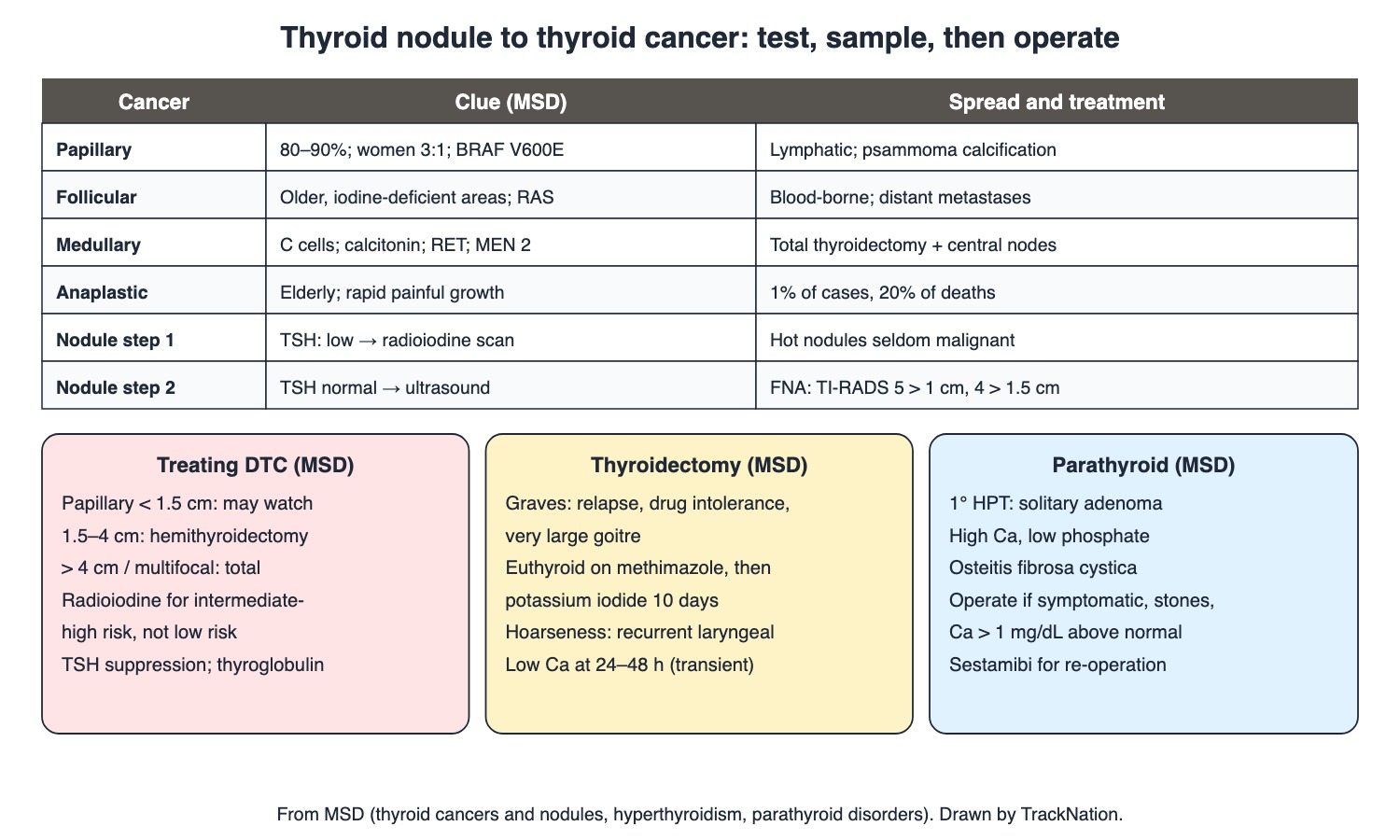
Thyroid cancer types; nodule work-up; treatment of differentiated cancer; thyroidectomy; hyperparathyroidism. Drawn by TrackNation.
Thyroid Nodule (MSD)
Palpable in ~5% of middle-aged and older people, on ultrasound in ~50% of older adults; most are benign (colloid goitre, cysts, thyroiditis, adenoma). Pain suggests thyroiditis or bleeding into a cyst.
Cancer risk: neck irradiation in childhood, age > 55, female sex, family history or MEN 2, rapid growth, dysphagia, hoarseness; men have more aggressive disease. Signs: stony hard, fixed, lymph nodes, vocal cord palsy.
First test: TSH. Low TSH → radioiodine scan; hot nodules are seldom malignant. Normal TSH → ultrasound: hypoechoic, very vascular, irregular, taller than wide, microcalcifications (papillary). US-guided FNA for TI-RADS 5 > 1 cm or TI-RADS 4 > 1.5 cm (not for < 1 cm or purely cystic nodules); report by Bethesda system.
Thyroid Cancers (MSD)
Papillary (80–90%): women 3:1, age 30–60, BRAF V600E; spreads by lymphatics (nodes in a third); psammoma microcalcification on ultrasound; 5-year survival ~98%. Treatment: selected tumours < 1.5 cm may be watched; 1.5–4 cm hemithyroidectomy; > 4 cm or multifocal → total thyroidectomy. Radioiodine for intermediate/high risk (not low risk); TSH-suppressive levothyroxine; follow with thyroglobulin and ultrasound.
Follicular: older patients, iodine-deficient areas, RAS; spreads by blood → distant metastases, which respond well to radioiodine. Small encapsulated tumours → lobectomy; extensive vascular invasion → total thyroidectomy + radioiodine.
Medullary: from parafollicular C cells making calcitonin (best test; calcium stays normal); amyloid on Congo red; 25% familial with RET mutation — MEN 2A (MTC, hyperparathyroidism, phaeochromocytoma), MEN 2B (MTC, phaeochromocytoma, ganglioneuromas). Test all for RET; total thyroidectomy with central neck dissection; exclude and remove a phaeochromocytoma first.
Anaplastic: elderly, rapid painful enlargement; ~1% of cases but 20% of thyroid cancer deaths; BRAF in ~45%. Rapid growth with Hashimoto thyroiditis also suggests thyroid lymphoma.
Thyroidectomy and Goitre (MSD)
Graves disease is the commonest cause of hyperthyroidism. Surgery for Graves when it relapses after antithyroid drugs and the patient refuses radioiodine, drug intolerance, or very large goitres. Preparation: make the patient euthyroid with methimazole first, then potassium iodide for 10 days to reduce gland vascularity.
Complications: hypothyroidism (depends on extent), recurrent laryngeal nerve palsy (hoarseness) and hypoparathyroidism. Transient hypocalcaemia is common, starting 24–48 h after surgery — perioral and finger tingling, cramps, tetany; permanent in ~0.3% with experienced surgeons; treat with calcium and vitamin D.
Iodine deficiency is the commonest cause of goitre worldwide (endemic goitre); very large goitres may need partial removal.
Parathyroid (MSD)
Primary hyperparathyroidism: usually a solitary adenoma (older women), sometimes hyperplasia or MEN. High calcium, low phosphate, bone loss; osteitis fibrosa cystica from osteoclast activity. Secondary hyperparathyroidism follows hypocalcaemic states such as kidney disease.
Operate when symptomatic or progressive; in asymptomatic patients when calcium is > 1 mg/dL above normal, there are kidney stones or hypercalciuria, creatinine clearance < 60 mL/min, or osteoporosis. An experienced surgeon's neck exploration cures most; sestamibi is the most sensitive scan, mainly for re-operation.
Traps the Examiner Sets
Order TSH before ultrasound or FNA.
Papillary goes to nodes; follicular goes by blood.
In medullary cancer, rule out phaeochromocytoma before the neck.
Iodide only after the patient is euthyroid.
Memory Hooks & Shortcuts
Shortcuts to lock in this article's numbers and lists. Each one only re-packages facts proven above.
🧠 Nodule order 'TSH → Scan or Sono → Sample' — work-up
🧠 'Papillary Prefers Pipes (lymph); Follicular Flows in blood' — spread
🧠 'Medullary Makes calcitonin; MEN 2 — check the Pheo first' — medullary
🧠 'Euthyroid first, then iodide' — Graves surgery
🧠 'Stones, bones, groans' — and a calcium 1 above normal for surgery — hyperparathyroidism
Rapid-Revision Cards
Nodule first test
TSH.
Low TSH
Radioiodine scan; hot = rarely cancer.
Normal TSH
Ultrasound → FNA by TI-RADS.
Suspicious US
Hypoechoic, taller-than-wide, microcalcification.
FNA threshold
TI-RADS 5 > 1 cm; 4 > 1.5 cm.
Commonest cancer
Papillary (80–90%).
Papillary
BRAF; lymphatic; psammoma.
Follicular
RAS; iodine deficiency; blood spread.
Medullary
C cells; calcitonin; RET.
MEN 2A
MTC + phaeo + HPT.
MEN 2B
MTC + phaeo + ganglioneuromas.
Before MTC surgery
Exclude phaeochromocytoma.
Anaplastic
Elderly, rapid painful; 20% of deaths.
Papillary 1.5–4 cm
Hemithyroidectomy.
> 4 cm/multifocal
Total thyroidectomy.
Low-risk RAI
Not recommended.
Follow-up marker
Thyroglobulin.
Graves pre-op
Methimazole, then iodide 10 days.
Post-op day 1–2 tingling
Hypocalcaemia.
1° HPT cause
Solitary adenoma.
Parathyroidectomy
Ca > 1 above normal, stones, CrCl < 60.
Sources
Facts in this article were checked against these documents.
MSD Manual Professional: Approach to the Patient With a Thyroid Nodule; Thyroid Cancers; Hyperthyroidism; Simple Nontoxic Goiter; Hyperparathyroidism; Hypoparathyroidism; Parathyroid Tumors — Merck & Co. (MSD Manuals), 2025–26 (link)
Competency Based Undergraduate Curriculum, Vol III: General Surgery (SU22) — National Medical Commission, 2024
Test Yourself: Practice Questions
Thirty questions in NEET PG style, most of them clinical vignettes.
Practice Questions (NEET PG pattern)
Original questions written in the style of the exam: +4 for a correct answer, −1 for a wrong one. Every answer was checked against the sources listed above. NEET PG papers are not published by NBEMS, so these are not past-paper questions.
Q1. A 40-year-old woman has a 2-cm thyroid nodule. The first investigation is
(a) CT neck
(b) serum TSH
(c) radioiodine ablation
(d) FNA biopsy
Show answer
Answer: (b) — Low TSH → scan.
Q2. A thyroid nodule with low TSH is 'hot' on radioiodine scan. This nodule is
(a) usually malignant
(b) seldom malignant
(c) an indication for total thyroidectomy
(d) always medullary
Show answer
Answer: (b) — Hyperfunctioning.
Q3. With a normal TSH, the next step in evaluating a thyroid nodule is
(a) observation without imaging
(b) radioiodine scan
(c) PET scan
(d) thyroid ultrasound
Show answer
Answer: (d) — Then FNA by features.
Q4. An ultrasound feature that raises suspicion of thyroid cancer is
(a) a purely cystic nodule
(b) a hyperechoic halo-free colloid nodule
(c) a hot nodule
(d) a nodule taller than it is wide
Show answer
Answer: (d) — Also microcalcification, hypoechoic.
Q5. Fine, stippled microcalcifications in a thyroid nodule suggest
(a) follicular adenoma
(b) Graves disease
(c) colloid goitre
(d) papillary carcinoma
Show answer
Answer: (d) — Psammoma bodies.
Q6. Ultrasound-guided FNA is indicated for a TI-RADS 5 nodule larger than
(a) 4 cm
(b) 5 cm
(c) 1 cm
(d) 0.3 cm
Show answer
Answer: (c) — TI-RADS 4: > 1.5 cm.
Q7. A thyroid nodule is stony hard and fixed and the patient has new hoarseness. Hoarseness suggests
(a) recurrent laryngeal nerve involvement by cancer
(b) colloid goitre
(c) a hot nodule
(d) thyroiditis
Show answer
Answer: (a) — Sign of malignancy.
Q8. The strongest historical risk factor for thyroid cancer in a nodule is
(a) neck irradiation in childhood
(b) smoking
(c) iodine supplementation
(d) pregnancy
Show answer
Answer: (a) — Also age > 55, family history.
Q9. The commonest thyroid cancer is
(a) follicular carcinoma
(b) anaplastic carcinoma
(c) papillary carcinoma
(d) medullary carcinoma
Show answer
Answer: (c) — 80–90%.
Q10. The commonest mutation in papillary thyroid carcinoma is
(a) BRAF V600E
(b) RET
(c) p53 only
(d) RAS
Show answer
Answer: (a) — RAS in follicular.
Q11. Papillary thyroid carcinoma typically spreads by
(a) blood to bone first
(b) perineural spread
(c) transcoelomic spread
(d) lymphatics to regional nodes
Show answer
Answer: (d) — Nodes in a third.
Q12. A 3-cm unifocal papillary carcinoma without other risk features is appropriately treated by
(a) hemithyroidectomy
(b) radioiodine alone
(c) total thyroidectomy with radical neck dissection always
(d) observation only
Show answer
Answer: (a) — 1.5–4 cm.
Q13. A papillary carcinoma 5 cm across or multifocal requires
(a) total or near-total thyroidectomy
(b) isthmusectomy
(c) surveillance
(d) hemithyroidectomy
Show answer
Answer: (a) — > 4 cm.
Q14. After thyroidectomy for low-risk papillary cancer, routine radioiodine is
(a) given at double dose
(b) replaced by chemotherapy
(c) mandatory
(d) not recommended
Show answer
Answer: (d) — Used for intermediate/high risk.
Q15. The marker used to follow patients after total thyroidectomy for differentiated thyroid cancer is
(a) AFP
(b) serum thyroglobulin (with antibodies)
(c) calcitonin
(d) CEA only
Show answer
Answer: (b) — Plus neck ultrasound.
Q16. A thyroid cancer common in iodine-deficient regions that spreads through the bloodstream is
(a) follicular carcinoma
(b) medullary carcinoma
(c) lymphoma
(d) papillary carcinoma
Show answer
Answer: (a) — RAS mutation.
Q17. An elderly woman has a thyroid mass that has grown rapidly and painfully over weeks. The most aggressive likely cancer is
(a) anaplastic carcinoma
(b) follicular adenoma
(c) papillary microcarcinoma
(d) colloid nodule
Show answer
Answer: (a) — 1% of cases, 20% of deaths.
Q18. Rapid thyroid enlargement in a patient with long-standing Hashimoto thyroiditis should raise suspicion of
(a) papillary microcarcinoma
(b) thyroid lymphoma
(c) Graves disease
(d) colloid cyst
Show answer
Answer: (b) — Also anaplastic.
Q19. Medullary thyroid carcinoma arises from
(a) follicular cells secreting thyroglobulin
(b) lymphocytes
(c) parafollicular C cells secreting calcitonin
(d) parathyroid chief cells
Show answer
Answer: (c) — Amyloid stroma.
Q20. The best tumour marker for medullary thyroid carcinoma is
(a) PTH
(b) thyroglobulin
(c) serum calcitonin
(d) TSH
Show answer
Answer: (c) — Calcium stays normal.
Q21. MEN 2A comprises medullary thyroid carcinoma with
(a) pituitary and pancreatic tumours
(b) adrenal carcinoma and lymphoma
(c) ganglioneuromas only
(d) phaeochromocytoma and primary hyperparathyroidism
Show answer
Answer: (d) — MEN 2B: ganglioneuromas.
Q22. Every patient with medullary thyroid carcinoma should have
(a) HLA typing
(b) no genetic test
(c) BRAF testing only
(d) germline RET testing
Show answer
Answer: (d) — Screen relatives.
Q23. Before thyroidectomy for medullary carcinoma in MEN 2, you must first
(a) give radioiodine
(b) exclude (and remove) a phaeochromocytoma with plasma metanephrines
(c) start levothyroxine
(d) do a sestamibi scan
Show answer
Answer: (b) — Avoid hypertensive crisis.
Q24. The operation for medullary thyroid carcinoma is
(a) isthmusectomy
(b) radioiodine only
(c) hemithyroidectomy
(d) total thyroidectomy with bilateral central compartment node dissection
Show answer
Answer: (d) — Even without obvious bilateral disease.
Q25. Before surgery for Graves disease, potassium iodide is given for about 10 days mainly to
(a) shrink the eyes
(b) reduce gland vascularity, after the patient is made euthyroid with methimazole
(c) increase TSH
(d) make the patient hypothyroid
Show answer
Answer: (b) — Iodide only after euthyroid.
Q26. On the second day after total thyroidectomy, a woman has tingling around the mouth and fingers and cramps. The cause is
(a) hypocalcaemia from hypoparathyroidism
(b) thyroid storm
(c) recurrent laryngeal nerve injury
(d) hypokalaemia
Show answer
Answer: (a) — Usually transient.
Q27. Permanent hypoparathyroidism after thyroidectomy by experienced surgeons occurs in about
(a) 10%
(b) 50%
(c) 30%
(d) 0.3%
Show answer
Answer: (d) — Transient is common.
Q28. The commonest cause of goitre worldwide is
(a) Hashimoto thyroiditis
(b) iodine deficiency
(c) Graves disease
(d) thyroid cancer
Show answer
Answer: (b) — Endemic goitre.
Q29. The commonest cause of primary hyperparathyroidism is
(a) chronic kidney disease
(b) vitamin D deficiency
(c) parathyroid carcinoma
(d) a solitary parathyroid adenoma
Show answer
Answer: (d) — CKD causes secondary.
Q30. An asymptomatic patient with primary hyperparathyroidism should be offered parathyroidectomy if
(a) PTH is low
(b) serum calcium is more than 1 mg/dL above the upper limit or there are kidney stones
(c) calcium is normal
(d) phosphate is high
Show answer
Answer: (b) — Also CrCl < 60, osteoporosis.
Active Recall
From memory: outline the work-up of a thyroid nodule, contrast the four main thyroid cancers with their markers, spread and surgery, explain radioiodine and follow-up, describe preparation and complications of thyroidectomy, and state the cause and surgical criteria of primary hyperparathyroidism.