Opioids, Alcohol and Drug Dependence for NEET PG Pharmacology: Naloxone, Withdrawal, Buprenorphine, Delirium Tremens, Disulfiram
Start Here
🎯 Exam priority: High. Expect an unconscious patient with pinpoint pupils, a methadone overdose that relapses after naloxone, a withdrawal picture, delirium tremens on day 3 after admission, or a disulfiram question.
CBME mapping: PH 2.7 (opioids) and PH 3.7–3.9 (alcohol and drug dependence).
Opioid Toxicity and Withdrawal
Opioid toxicity | Opioid withdrawal | |
Pupils | Miotic (pinpoint) | Mydriasis |
Key signs | Respiratory depression → apnoea; drowsiness | Piloerection, lacrimation, rhinorrhoea, yawning |
Treatment | Naloxone + respiratory support; watch for recurrence with long-acting opioids | Methadone or buprenorphine; clonidine as support |
Death in overdose is mainly from hypoxia due to respiratory depression.
Naloxone's half-life is shorter than that of long-acting opioids (methadone, extended-release morphine), so breathing can fail again within hours — keep observing and repeat doses as needed.
Complete reversal in a dependent patient can precipitate acute withdrawal.
Morphine commonly causes flushing and itching (mast-cell effects).
Opioid Analgesic Warnings
Tramadol: life-threatening breathing depression and death in children, some after tonsillectomy, including ultra-rapid metabolisers; serotonin syndrome (even alone); seizures at recommended doses.
Fentanyl patch: only for opioid-tolerant patients (for example, ≥ 60 mg morphine a day for a week or more). External heat (heating pads, hot baths, saunas) increases absorption and has caused fatal overdose.
Extended-release morphine carries a boxed warning for addiction, abuse and misuse.
Treating Dependence
For opioid use disorder, maintenance treatment (buprenorphine, methadone or long-acting naltrexone) is the standard of care, better than supervised withdrawal alone.
Drug | Use | Must know (source) |
Methadone | Opioid use disorder (full agonist) | QT prolongation and torsades (boxed) |
Buprenorphine (± naloxone) | Opioid use disorder (partial agonist) | First line with methadone (MSD) |
Naltrexone | Opioid or alcohol dependence (antagonist) | Needs opioid-free 7–10 days, else precipitates withdrawal |
Disulfiram | Alcohol dependence (ICMR: 250 mg daily) | Never when intoxicated or without the patient's knowledge; motivated, consenting patient, family supervision; reaction: flushing, headache, vomiting, low BP, arrhythmias |
Acamprosate | Alcohol dependence | Contraindicated if creatinine clearance ≤ 30 mL/min |
Fomepizole | Methanol or ethylene glycol poisoning | Competitive inhibitor of alcohol dehydrogenase; methanol → formic acid (acidosis, visual loss, blindness); ethylene glycol → glycolate and oxalate (acidosis, kidney damage) |
Alcohol: Dependence and Withdrawal (ICMR)
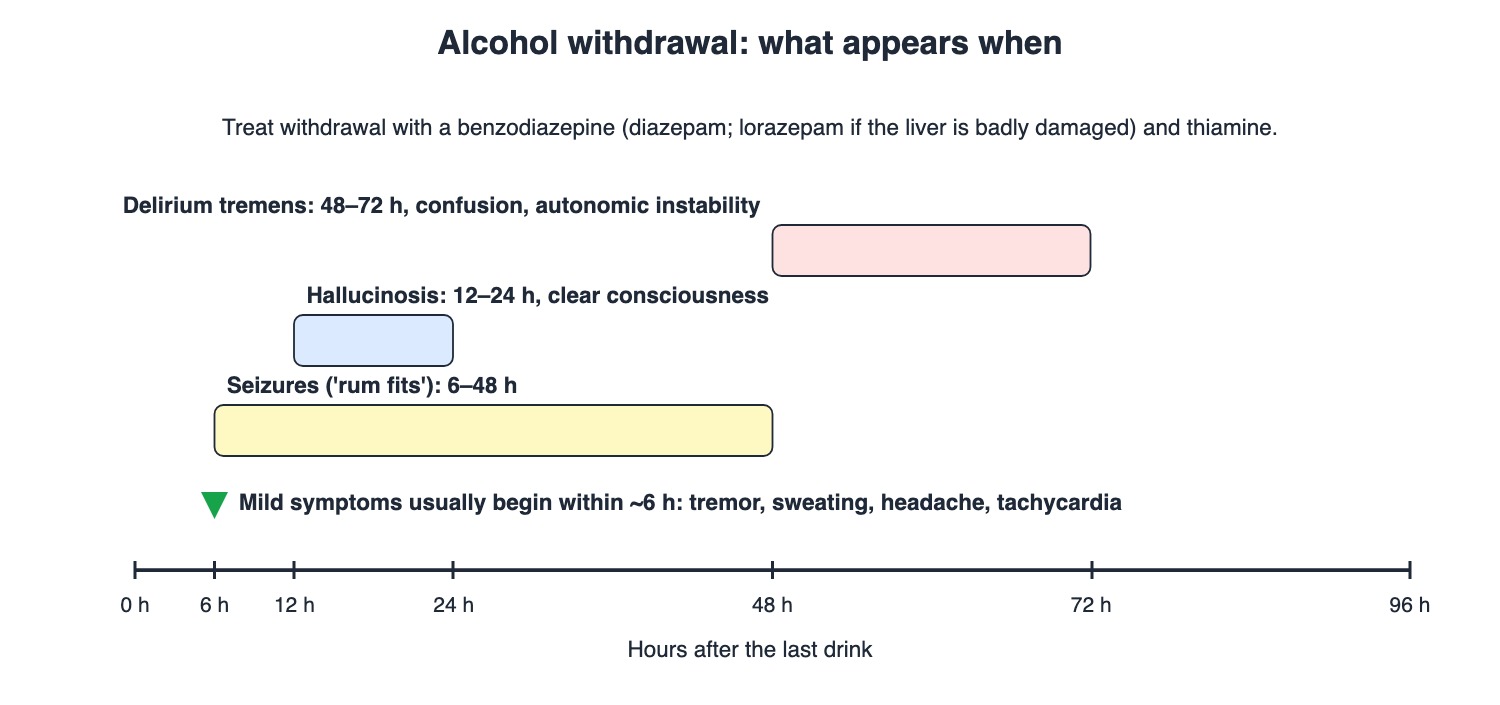
Alcohol withdrawal timeline from the MSD Manual: mild symptoms from about 6 h, seizures 6–48 h, hallucinosis 12–24 h, delirium tremens 48–72 h. Drawn by TrackNation.
Dependence (ICMR): at least 3 of 6 criteria for at least a month — compulsion, poor control, withdrawal, tolerance, preoccupation, use despite harm. Binge: 5 drinks in 2 hours (men), 4 (women).
Withdrawal treatment: diazepam 20–40 mg a day in divided doses, titrated, then reduced by 10–20% a day over 7–10 days; thiamine 100 mg daily. With significant liver damage use lorazepam (2 mg ≈ diazepam 5 mg). Withdrawal seizures, hallucinations or delirium tremens need inpatient care.
Long-term harm includes Wernicke encephalopathy and Korsakoff psychosis.
Relapse prevention: disulfiram 250 mg daily in a motivated patient with written consent and family supervision.
Traps the Examiner Sets
Pinpoint pupils = opioid toxicity; dilated pupils + yawning + piloerection = withdrawal.
Naloxone wears off before methadone — observe and repeat.
Naltrexone needs 7–10 opioid-free days; buprenorphine is a partial agonist.
Methadone: QT prolongation.
Delirium tremens peaks at 48–72 hours, not on day 1; hallucinosis (clear consciousness) comes earlier.
Liver disease: lorazepam rather than diazepam for withdrawal.
Disulfiram never without the patient's knowledge; fomepizole for methanol.
Memory Hooks & Shortcuts
Shortcuts to lock in this article's numbers and lists. Each one only re-packages facts proven above.
🧠 Pinpoint = Poisoned, Pupils wide = Withdrawal — miosis in opioid toxicity; mydriasis in withdrawal
🧠 Naloxone Nips out early — short half-life: repeat after long-acting opioid overdose
🧠 6 – 12 – 48 – 72 — mild withdrawal ~6 h, hallucinosis 12–24 h, seizures to 48 h, DTs 48–72 h
🧠 Liver bad? Lorazepam — use lorazepam rather than diazepam in significant liver disease
🧠 Naltrexone needs a Clean ten — 7–10 opioid-free days before naltrexone
🧠 Disulfiram: Disclose, never Disguise — never given without the patient's knowledge
🧠 Fomepizole Fights methanol — alcohol dehydrogenase inhibitor for methanol and ethylene glycol
Rapid-Revision Cards
Opioid overdose
Miosis + respiratory depression; naloxone + ventilation.
Naloxone pitfall
Shorter than methadone/ER morphine: recurrence; repeat.
Opioid withdrawal signs
Mydriasis, piloerection, lacrimation/rhinorrhoea, yawning.
Naloxone in dependence
Can precipitate withdrawal.
Morphine itch
Mast-cell flushing and itching.
Tramadol
Child deaths (ultra-rapid metabolisers, post-tonsillectomy); serotonin syndrome; seizures.
Fentanyl patch
Opioid-tolerant only; heat ↑ absorption.
Methadone
Full agonist; QT prolongation.
Buprenorphine
Partial agonist; first line for OUD.
Naltrexone
Antagonist; 7–10 opioid-free days first.
OUD standard of care
Maintenance therapy, not withdrawal alone.
Alcohol: mild withdrawal
From ~6 h: tremor, sweating, headache.
Withdrawal seizures
6–48 h.
Alcoholic hallucinosis
12–24 h; clear consciousness.
Delirium tremens
48–72 h; confusion, autonomic instability.
ICMR withdrawal regimen
Diazepam 20–40 mg/day, taper 10–20%/day over 7–10 days + thiamine 100 mg.
Liver disease
Lorazepam (2 mg ≈ diazepam 5 mg).
Dependence (ICMR)
≥ 3 of 6 criteria for ≥ 1 month.
Binge
5 drinks/2 h (men); 4 (women).
Disulfiram
250 mg OD; never secretly or when intoxicated.
Disulfiram reaction
Flushing, headache, vomiting, hypotension, arrhythmia.
Acamprosate
Avoid if CrCl ≤ 30.
Fomepizole
ADH inhibitor; methanol, ethylene glycol.
Sources
Facts in this article were checked against these documents.
MSD Manual Professional Edition: Opioid Toxicity and Withdrawal; Opioid Use Disorder; Alcohol Toxicity and Withdrawal — Merck & Co. (MSD Manuals), 2025–2026 (link)
Standard Treatment Workflow: Management of Alcohol Use Disorders — Indian Council of Medical Research / Department of Health Research, MoHFW, October 2019 (link)
Prescribing labels: morphine sulfate ER, tramadol, fentanyl transdermal, naloxone injection, naltrexone, buprenorphine and naloxone sublingual, methadone, disulfiram, acamprosate, fomepizole — DailyMed, US National Library of Medicine, current labels, accessed November 2026 (link)
Competency Based Undergraduate Curriculum, Pharmacology (PH 2.7, PH 3.7–3.9) — National Medical Commission, 2024
Test Yourself: Practice Questions
Twenty-three questions in NEET PG style, most of them clinical vignettes.
Practice Questions (NEET PG pattern)
Original questions written in the style of the exam: +4 for a correct answer, −1 for a wrong one. Every answer was checked against the sources listed above. NEET PG papers are not published by NBEMS, so these are not past-paper questions.
Q1. A young man is brought unconscious with slow shallow breathing and pinpoint pupils. The first drug to give is
(a) flumazenil
(b) naloxone, with respiratory support
(c) physostigmine
(d) atropine
Show answer
Answer: (b) — Opioid overdose: miotic pupils and respiratory depression; treat with naloxone and ventilatory support.
Q2. A woman who took a large methadone overdose wakes after naloxone, then becomes apnoeic again 2 hours later. The reason is
(a) an allergic reaction to naloxone
(b) naloxone is a partial agonist
(c) naloxone's half-life is shorter than methadone's
(d) methadone induces naloxone metabolism
Show answer
Answer: (c) — Respiratory depression can recur within hours after a long-acting opioid; observe and repeat naloxone.
Q3. A heroin user is given a large IV dose of naloxone and develops yawning, rhinorrhoea, piloerection and agitation. This is
(a) anaphylaxis
(b) naloxone toxicity
(c) precipitated opioid withdrawal
(d) serotonin syndrome
Show answer
Answer: (c) — Complete reversal in a dependent patient can precipitate acute withdrawal.
Q4. Which sign distinguishes opioid withdrawal from opioid toxicity?
(a) Respiratory depression
(b) Constipation
(c) Mydriasis
(d) Drowsiness
Show answer
Answer: (c) — Withdrawal: mydriasis, piloerection, lacrimation/rhinorrhoea, yawning; toxicity: miosis and respiratory depression.
Q5. A 5-year-old given tramadol after tonsillectomy dies of respiratory depression. A recognised risk factor is
(a) ultra-rapid metabolism of tramadol
(b) pseudocholinesterase deficiency
(c) slow acetylation
(d) G6PD deficiency
Show answer
Answer: (a) — Tramadol label: deaths in children, some after tonsillectomy, including an ultra-rapid metaboliser.
Q6. A patient on an SSRI is prescribed tramadol for pain. The labelled risks include
(a) serotonin syndrome and seizures
(b) hyperkalaemia
(c) agranulocytosis
(d) hypoglycaemia only
Show answer
Answer: (a) — Tramadol can cause serotonin syndrome (even alone, more with serotonergic drugs) and seizures at recommended doses.
Q7. A fentanyl patch is prescribed to an opioid-naive patient after surgery. This is wrong because the patch is
(a) only for children
(b) only for opioid-tolerant patients with severe persistent pain
(c) too weak for post-operative pain
(d) contraindicated with paracetamol
Show answer
Answer: (b) — Fentanyl transdermal is for opioid-tolerant patients (e.g. ≥ 60 mg oral morphine/day for ≥ 1 week).
Q8. A cancer patient on a fentanyl patch uses a heating pad over it and becomes deeply sedated. The mechanism is
(a) tolerance
(b) enzyme induction
(c) heat increased fentanyl absorption
(d) heat inactivated fentanyl
Show answer
Answer: (c) — External heat increases fentanyl absorption and has caused fatal overdose.
Q9. A man on methadone maintenance has a prolonged QTc. The relevant boxed warning is
(a) SJS
(b) hepatic failure
(c) agranulocytosis
(d) life-threatening QT prolongation
Show answer
Answer: (d) — Methadone: QTc prolongation and torsades de pointes.
Q10. Buprenorphine differs from methadone because buprenorphine is
(a) a full opioid agonist
(b) a benzodiazepine
(c) a partial opioid agonist
(d) an opioid antagonist
Show answer
Answer: (c) — Buprenorphine (partial agonist) and methadone (full agonist) are both first-line for opioid use disorder.
Q11. A patient dependent on heroin wants naltrexone to prevent relapse. Before starting, he must be
(a) opioid-free for at least 7–10 days
(b) started on disulfiram
(c) on methadone at full dose
(d) given naloxone daily
Show answer
Answer: (a) — An opioid-free interval of 7–10 days (short-acting opioids) is needed, or naltrexone precipitates withdrawal.
Q12. For a patient with opioid use disorder, MSD describes the standard of care as
(a) supervised withdrawal alone
(b) naloxone daily
(c) benzodiazepines
(d) maintenance treatment with buprenorphine, methadone or long-acting naltrexone
Show answer
Answer: (d) — Maintenance drug treatment is the standard of care over supervised withdrawal alone.
Q13. A man admitted for surgery becomes confused, sweaty and tremulous with fluctuating BP on his third hospital day; he drank heavily until admission. The likely diagnosis is
(a) delirium tremens
(b) opioid withdrawal
(c) Wernicke encephalopathy only
(d) alcoholic hallucinosis
Show answer
Answer: (a) — Delirium tremens usually begins 48–72 hours after the last drink, with confusion and autonomic instability.
Q14. Twenty hours after stopping drinking, a man hears accusing voices but is fully oriented with stable vital signs. This is
(a) delirium tremens
(b) Korsakoff psychosis
(c) schizophrenia
(d) alcoholic hallucinosis
Show answer
Answer: (d) — Hallucinosis: hallucinations without impaired consciousness, usually within 12–24 hours.
Q15. Alcohol withdrawal seizures generally occur
(a) only with delirium tremens
(b) within 1 hour
(c) 6–48 hours after the last drink
(d) after 1 week
Show answer
Answer: (c) — Seizures generally occur 6–48 hours after cessation.
Q16. Under the ICMR workflow, uncomplicated alcohol withdrawal is treated with
(a) disulfiram
(b) naltrexone
(c) haloperidol alone
(d) diazepam 20–40 mg a day in divided doses, tapered over 7–10 days, plus thiamine 100 mg daily
Show answer
Answer: (d) — Diazepam titrated to severity, reduced 10–20% a day over 7–10 days, with thiamine 100 mg OD.
Q17. A man in alcohol withdrawal has significant liver dysfunction. The ICMR choice of benzodiazepine is
(a) diazepam
(b) no benzodiazepine
(c) chlordiazepoxide only
(d) lorazepam
Show answer
Answer: (d) — Significant liver dysfunction: lorazepam (2 mg ≈ diazepam 5 mg).
Q18. Alcohol dependence (ICMR) requires
(a) a raised GGT
(b) at least 3 of 6 criteria present for at least a month
(c) any drinking above 2 units a day
(d) one episode of intoxication
Show answer
Answer: (b) — Three of six criteria for at least one month.
Q19. A wife asks the doctor to give her husband disulfiram secretly in his food. The correct response is
(a) agree if he is intoxicated
(b) give naltrexone secretly instead
(c) refuse: disulfiram must never be given without the patient's full knowledge
(d) agree, at a low dose
Show answer
Answer: (c) — Boxed warning: never when intoxicated or without the patient's full knowledge; ICMR requires a motivated patient's written consent.
Q20. A patient on disulfiram drinks a small amount of alcohol. Expect
(a) no reaction
(b) sedation only
(c) hypertensive crisis with bradycardia
(d) flushing, headache, vomiting, fall in BP and arrhythmias
Show answer
Answer: (d) — ICMR warns of an unpleasant, potentially serious reaction even with small amounts.
Q21. Acamprosate is contraindicated when
(a) creatinine clearance is ≤ 30 mL/min
(b) the patient has hypertension
(c) liver enzymes are mildly raised
(d) the patient smokes
Show answer
Answer: (a) — Contraindicated in severe renal impairment.
Q22. A man drinks illicit liquor and develops visual disturbance and metabolic acidosis; methanol is suspected. A specific antidote is
(a) naloxone
(b) fomepizole
(c) flumazenil
(d) N-acetylcysteine
Show answer
Answer: (b) — Methanol is converted by alcohol dehydrogenase to formic acid, which causes the acidosis and visual damage; fomepizole blocks alcohol dehydrogenase.
Q23. A supportive drug used for opioid withdrawal symptoms (besides methadone or buprenorphine) is
(a) clonidine
(b) disulfiram
(c) naloxone
(d) flumazenil
Show answer
Answer: (a) — MSD lists clonidine among supportive medications for withdrawal.
Active Recall
From memory: contrast opioid toxicity and withdrawal and explain naloxone's pitfalls; give the warnings for tramadol, fentanyl patches and methadone; compare buprenorphine, methadone and naltrexone; draw the alcohol withdrawal timeline and give the ICMR treatment; and state the rules for disulfiram and the antidote for methanol.