Antihypertensives, Heart Failure and Angina Drugs for NEET PG Pharmacology: ICMR 2026 Protocols, ACE Inhibitors, ARNI, Nitrates
Start Here
🎯 Exam priority: High. Cardiovascular drugs are the biggest block in Pharmacology. Expect: first-line choice for a new hypertensive, a cough on enalapril, a pregnant woman on an ARB, a man on sildenafil with chest pain, and the heart-failure drug that saves lives.
CBME mapping: PH 4.1–4.5. Protocols follow India's ICMR Standard Treatment Workflows (2026).
Hypertension: Diagnosis and Targets (ICMR 2026)
Category (ICMR 2026) | Systolic | Diastolic | Action |
Normal | < 120 | and < 80 | Healthy lifestyle |
Elevated | 120–139 | and/or 80–89 | Lifestyle change |
Grade 1 | 140–159 | and/or 90–99 | Drugs + lifestyle |
Grade 2 | 160–179 | and/or 100–109 | Drugs + lifestyle |
Grade 3 | ≥ 180 | and/or ≥ 110 | Drugs + lifestyle |
Diagnosis: ≥ 140/90 on two different visits; a single visit is enough if ≥ 160/100.
Targets: < 140/90 for all adults; < 130/80 with diabetes, CKD or established CVD if tolerated; < 150/90 at age ≥ 80.
Lifestyle: salt < 5 g a day, no tobacco or alcohol, 30 minutes of activity daily, BMI < 23.
Hypertension: Drug Choice
Two drugs from two classes can be the default first step for most adults, preferably as a single pill. Monotherapy only for low-risk grade 1, age ≥ 80 or frailty.
Pair a CCB or thiazide-like diuretic with a RAAS blocker (ACE inhibitor or ARB). Never combine two RAAS blockers (kidney injury).
Beta-blockers are for hypertension with angina, after MI or with heart failure.
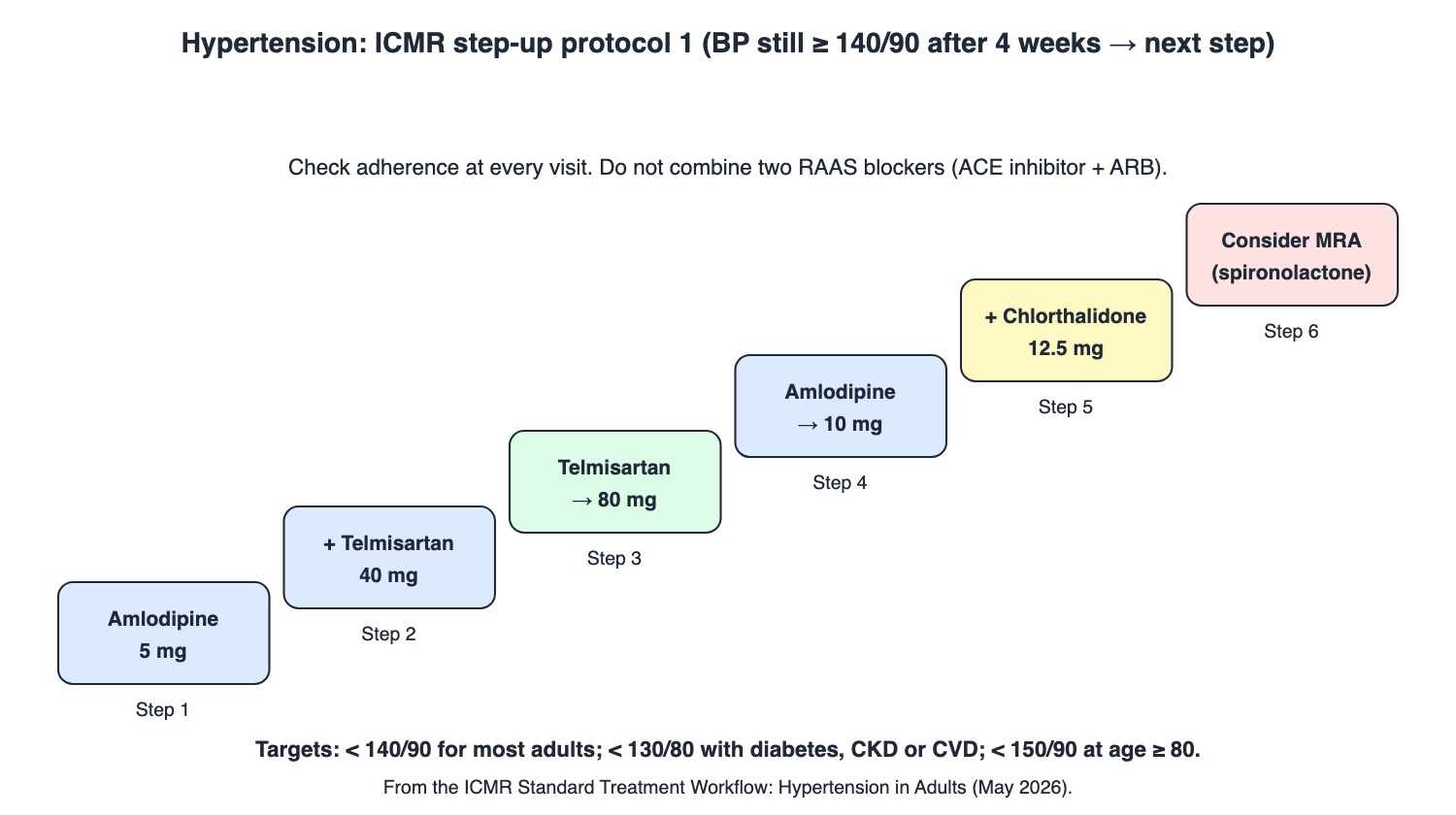
ICMR hypertension step-up protocol 1: amlodipine 5 mg, add telmisartan 40 mg, raise telmisartan to 80 mg, raise amlodipine to 10 mg, add chlorthalidone 12.5 mg, then consider spironolactone, each step after 4 weeks. Drawn by TrackNation.
Class (ICMR doses) | Contraindications | Side effects | Label points |
CCB: amlodipine 2.5–10 mg | Heart failure | Pedal oedema (dose-related), constipation | — |
ACE inhibitor: enalapril 5–40 mg, ramipril 2.5–10 mg | Pregnancy, planning pregnancy, prior ACE-inhibitor angioedema, bilateral renal artery stenosis | Dry cough, angioedema, hyperkalaemia, rise in creatinine | Cough from bradykinin; boxed fetal toxicity |
ARB: losartan 50–100 mg, telmisartan 40–80 mg | Pregnancy, bilateral renal artery stenosis | Hyperkalaemia, hypotension, acute renal failure | Boxed fetal toxicity |
Thiazide-like: chlorthalidone 12.5–25 mg | Pregnancy, gout | Glucose intolerance, low sodium and potassium, high calcium | — |
Beta-blockers: metoprolol, carvedilol, labetalol, nebivolol | Asthma, severe bradycardia, 2nd/3rd-degree AV block, uncontrolled HF | Fatigue, hyperglycaemia, sexual dysfunction | For angina, post-MI, heart failure |
MRA: spironolactone 25 mg | Hyperkalaemia | Gynaecomastia, mastalgia | — |
Hypertensive urgency (≥ 180/120 without acute organ damage): start oral drugs, lower BP gradually over 24–48 hours, no IV drugs; review within a week. With red-flag symptoms, stabilise and refer.
Other Antihypertensives: Label Warnings
Hydralazine: a lupus-like syndrome (including glomerulonephritis).
Methyldopa: positive Coombs test, haemolytic anaemia, liver disorders.
Sodium nitroprusside: releases cyanide; never run at the maximum rate for more than 10 minutes.
Verapamil: avoid in 2nd/3rd-degree AV block; with beta-blockers ventricular function can deteriorate.
Furosemide: ototoxicity (tinnitus, deafness), especially with rapid injection, renal failure, high doses or aminoglycosides.
Heart Failure (ICMR 2026)
Decongest first with IV furosemide (and oxygen if saturation < 90%).
Then start an ARNI (sacubitril-valsartan) and spironolactone; add a beta-blocker after decongestion (carvedilol 3.125–25 mg twice daily, metoprolol or bisoprolol, started low and uptitrated every 1–2 weeks); add an SGLT2 inhibitor (dapagliflozin reduces CV death and heart-failure hospitalisation). Consider ivabradine, vericiguat and digoxin at tertiary level.
HFrEF = ejection fraction < 35% (ICMR). Give pneumococcal and influenza vaccines.
ARNI: allow a 36-hour washout when switching from or to an ACE inhibitor (angioedema risk).
Spironolactone: hyperkalaemia (watch potassium and creatinine), gynaecomastia. Ivabradine: blocks the HCN channel (the pacemaker If current) and slows the heart.
Stable Angina (ICMR 2026)
Stable angina: effort-related pain relieved by rest or nitroglycerin within 1–2 minutes.
Control symptoms: metoprolol with or without a dihydropyridine CCB; add nitrates if needed; then trimetazidine, nicorandil or ranolazine.
Prevent events: aspirin 75 mg (clopidogrel 75 mg if aspirin is not tolerated) and high-intensity statins (atorvastatin 40–80 mg or rosuvastatin 20–40 mg); ACE inhibitor. Prefer CABG over PCI in diabetes with multivessel or left-main disease.
Sublingual nitroglycerin: one tablet every 5 minutes, no more than three in 15 minutes; then seek help. Never with PDE-5 inhibitors (sildenafil, tadalafil): severe hypotension, syncope, ischaemia.
Nitrate tolerance: efficacy returns only after nitrates have been absent for several hours (nitrate-free interval).
Traps the Examiner Sets
ACE-inhibitor cough is from bradykinin and resolves when the drug is stopped.
ACE inhibitors and ARBs are contraindicated in pregnancy and in bilateral renal artery stenosis.
Amlodipine is contraindicated in heart failure (ICMR) and causes ankle oedema.
Never ACE inhibitor + ARB; ARNI needs 36 hours off an ACE inhibitor.
Beta-blockers in heart failure only after decongestion, started low.
Nitrates + sildenafil = dangerous hypotension.
Hypertensive urgency: oral drugs, slow lowering, no IV.
Memory Hooks & Shortcuts
Shortcuts to lock in this article's numbers and lists. Each one only re-packages facts proven above.
🧠 140/90 twice, 160/100 once — ICMR diagnosis of hypertension
🧠 A + T, then T↑, A↑, add C, then S — ICMR protocol: amlodipine, telmisartan, chlorthalidone, spironolactone
🧠 Two RAAS = Renal disaster — never combine ACE inhibitor and ARB
🧠 ACE = Always Coughs Eventually — bradykinin cough with ACE inhibitors
🧠 Pregnant? Pull the pril and sartan — RAAS drugs are fetotoxic
🧠 Drain, then Defend — heart failure: decongest with furosemide, then ARNI, spironolactone, beta-blocker, SGLT2 inhibitor
🧠 Nitrate + Viagra = Floor — PDE-5 inhibitors with nitrates cause severe hypotension
Rapid-Revision Cards
HTN grades (ICMR)
G1 140–159/90–99 · G2 160–179/100–109 · G3 ≥ 180/110.
HTN diagnosis
≥ 140/90 on 2 visits, or ≥ 160/100 at one.
BP targets
< 140/90; < 130/80 DM/CKD/CVD; < 150/90 at ≥ 80.
First step (ICMR)
Two classes, single pill: CCB or thiazide-like + ACEi/ARB.
ICMR protocol 1
Amlo 5 → +Telmi 40 → Telmi 80 → Amlo 10 → +Chlorthalidone 12.5 → MRA; 4-weekly.
Never
ACEi + ARB together.
Amlodipine
Avoid in heart failure; pedal oedema.
ACEi
Dry cough (bradykinin), angioedema, hyperkalaemia; not in pregnancy or bilateral RAS.
RAAS + pregnancy
Boxed fetal toxicity: stop when pregnancy found.
Thiazide-like
Avoid in gout, pregnancy; low K and Na, high Ca and glucose.
HTN urgency
≥ 180/120, no organ damage: oral drugs, lower over 24–48 h, no IV.
Hydralazine
Drug-induced lupus.
Methyldopa
Coombs-positive haemolytic anaemia.
Nitroprusside
Cyanide; max rate ≤ 10 min.
HF first step (ICMR)
IV furosemide to decongest.
HF drugs (ICMR)
ARNI + spironolactone; beta-blocker after decongestion; SGLT2 inhibitor.
ARNI switch
36-hour gap from ACEi.
Spironolactone
Hyperkalaemia, gynaecomastia.
Ivabradine
Blocks HCN (If) current.
Angina symptom control (ICMR)
Metoprolol ± DHP CCB; add nitrates.
Angina prevention (ICMR)
Aspirin 75 (clopidogrel if intolerant) + high-intensity statin + ACEi.
SL nitroglycerin
Every 5 min, max 3 in 15 min.
Nitrates + PDE-5
Contraindicated: severe hypotension.
Nitrate tolerance
Needs a nitrate-free interval.
Verapamil + beta-blocker
Ventricular depression, AV block.
Furosemide
Ototoxicity, worse with aminoglycosides.
Sources
Facts in this article were checked against these documents.
Standard Treatment Workflow: Hypertension in Adults — Indian Council of Medical Research / Department of Health Research, MoHFW, May 2026
Standard Treatment Workflows: Heart Failure; Stable Angina — Indian Council of Medical Research / Department of Health Research, MoHFW, January 2026
Prescribing labels: Vasotec, Cozaar, Entresto, Aldactone, Farxiga, Nitrostat, isosorbide mononitrate ER, Corlanor, hydralazine, methyldopa, sodium nitroprusside, verapamil ER, amlodipine, furosemide — DailyMed, US National Library of Medicine, current labels, accessed November 2026 (link)
Competency Based Undergraduate Curriculum, Pharmacology (PH 4.1–4.5) — National Medical Commission, 2024
Test Yourself: Practice Questions
Twenty-five questions in NEET PG style, most of them clinical vignettes.
Practice Questions (NEET PG pattern)
Original questions written in the style of the exam: +4 for a correct answer, −1 for a wrong one. Every answer was checked against the sources listed above. NEET PG papers are not published by NBEMS, so these are not past-paper questions.
Q1. A 45-year-old has BP 150/95 on two visits; no other illness. Under ICMR 2026, the usual starting treatment is
(a) clonidine
(b) furosemide
(c) two drugs from different classes (e.g. amlodipine with an ARB), preferably as a single pill
(d) a beta-blocker alone
Show answer
Answer: (c) — Two-drug combination can be the default for most adults; a CCB or thiazide-like diuretic is paired with an ACE inhibitor or ARB.
Q2. Hypertension can be diagnosed at a single clinic visit (ICMR) when BP is at least
(a) 180/120 only
(b) 130/80
(c) 160/100
(d) 140/90
Show answer
Answer: (c) — ≥ 140/90 on two visits, or ≥ 160/100 at one visit.
Q3. The ICMR BP target for a 60-year-old with diabetes is
(a) below 120/70 at any cost
(b) below 160/100
(c) below 150/90
(d) below 130/80 if tolerated
Show answer
Answer: (d) — Diabetes, CKD or established CVD: < 130/80 (optimal, if tolerated); ≥ 80 years: < 150/90.
Q4. A woman on enalapril develops a persistent dry cough. The mechanism and best switch are
(a) bradykinin accumulation; it resolves when the ACE inhibitor is stopped
(b) histamine release; add an antihistamine
(c) beta-blockade; it is permanent
(d) fluid overload; add furosemide
Show answer
Answer: (a) — ACE inhibitors block bradykinin degradation; the cough always resolved after stopping therapy (label).
Q5. A hypertensive woman on losartan finds she is 8 weeks pregnant. The right action is to
(a) add enalapril
(b) double the dose
(c) continue losartan
(d) stop losartan as soon as possible (fetal toxicity)
Show answer
Answer: (d) — Boxed warning: RAAS drugs injure and can kill the fetus; discontinue when pregnancy is detected.
Q6. ACE inhibitors and ARBs are contraindicated in
(a) heart failure
(b) type 2 diabetes
(c) bilateral renal artery stenosis
(d) post-MI patients
Show answer
Answer: (c) — ICMR lists bilateral renal artery stenosis (and pregnancy, prior ACE-inhibitor angioedema) as contraindications.
Q7. A man with heart failure is started on amlodipine for hypertension. Under ICMR this is
(a) inappropriate: heart failure is listed as a contraindication to the CCB
(b) required with every ARNI
(c) safe only with digoxin
(d) the best choice
Show answer
Answer: (a) — ICMR table: amlodipine — contraindication heart failure; side effects pedal oedema, constipation.
Q8. A patient's BP stays high on amlodipine and telmisartan. Under ICMR, a doctor should never add
(a) chlorthalidone
(b) spironolactone later
(c) a lifestyle plan
(d) an ACE inhibitor, because combining two RAAS blockers raises kidney-injury risk
Show answer
Answer: (d) — Do not combine two RAAS blockers (AKI risk). Next steps are chlorthalidone, then an MRA.
Q9. A man with gout needs a third antihypertensive. ICMR advises against
(a) telmisartan
(b) amlodipine
(c) metoprolol
(d) chlorthalidone (thiazide-like diuretic)
Show answer
Answer: (d) — Thiazide-like diuretics: contraindicated in pregnancy and gout; cause glucose intolerance, hypokalaemia, hyponatraemia, hypercalcaemia.
Q10. BP is 190/122 in an asymptomatic man with no signs of organ damage (hypertensive urgency). ICMR advises
(a) IV labetalol bolus
(b) no treatment
(c) oral antihypertensives, lowering BP gradually over 24–48 hours, no IV drugs
(d) IV nitroprusside at once
Show answer
Answer: (c) — Urgency: start oral drugs, reduce gradually, do not use IV medicines; follow up within a week.
Q11. A woman on hydralazine develops arthralgia, rash and a positive ANA. The likely cause is
(a) rheumatoid arthritis
(b) drug-induced lupus from hydralazine
(c) ACE-inhibitor angioedema
(d) methyldopa haemolysis
Show answer
Answer: (b) — Hydralazine can cause a syndrome simulating SLE, including glomerulonephritis.
Q12. Long-term methyldopa can cause
(a) lupus
(b) a positive Coombs test and haemolytic anaemia
(c) gynaecomastia
(d) cough
Show answer
Answer: (b) — Methyldopa label: positive Coombs test, haemolytic anaemia and liver disorders.
Q13. A patient on a high-dose nitroprusside infusion for 2 days develops metabolic acidosis and confusion. Suspect
(a) cyanide toxicity
(b) beta-blocker overdose
(c) thiazide hyponatraemia
(d) digoxin toxicity
Show answer
Answer: (a) — Nitroprusside releases cyanide; maximum-rate infusion should never exceed 10 minutes.
Q14. In acute decompensated heart failure, ICMR's first step is to
(a) decongest with IV furosemide
(b) start ivabradine
(c) give verapamil
(d) start a beta-blocker at full dose
Show answer
Answer: (a) — Decongest with IV furosemide; beta-blockers only after decongestion.
Q15. In heart failure with reduced EF, a beta-blocker should be started
(a) never
(b) at full dose during acute pulmonary oedema
(c) after decongestion, at a low dose, titrated every 1–2 weeks
(d) only with verapamil
Show answer
Answer: (c) — Consider beta-blockers after decongestion; start low and uptitrate 1–2 weekly.
Q16. A patient on enalapril is to switch to sacubitril-valsartan. The required gap is
(a) 7 days
(b) no gap
(c) 36 hours
(d) 2 hours
Show answer
Answer: (c) — Entresto: 36-hour washout between ACE inhibitor and ARNI (angioedema risk).
Q17. Which drug, originally for diabetes, reduces CV death and heart-failure hospitalisation in heart failure?
(a) Pioglitazone
(b) Insulin
(c) Dapagliflozin (SGLT2 inhibitor)
(d) Glibenclamide
Show answer
Answer: (c) — Farxiga is indicated to reduce CV death, HF hospitalisation and urgent HF visits; ICMR includes SGLT2 inhibitors.
Q18. A man on spironolactone for heart failure develops painful breast enlargement and a potassium of 6.0. Both are
(a) unrelated
(b) signs of digoxin toxicity
(c) known adverse effects of spironolactone
(d) due to furosemide
Show answer
Answer: (c) — Aldactone causes gynaecomastia and hyperkalaemia; ICMR advises watching potassium and creatinine.
Q19. Ivabradine lowers heart rate by blocking
(a) the HCN channel carrying the pacemaker If current
(b) L-type calcium channels
(c) Na-K ATPase
(d) beta-1 receptors
Show answer
Answer: (a) — Corlanor blocks the hyperpolarization-activated cyclic nucleotide-gated channel (If).
Q20. A man with stable angina took sildenafil last night and now has chest pain. Sublingual nitroglycerin is
(a) first-line
(b) safe at half dose
(c) safe with aspirin
(d) contraindicated: severe hypotension, syncope or ischaemia
Show answer
Answer: (d) — Nitrostat is contraindicated with PDE-5 inhibitors.
Q21. During an angina attack, sublingual nitroglycerin may be taken
(a) only after aspirin fails
(b) every hour without limit
(c) every 5 minutes, up to 3 tablets in 15 minutes, then seek help
(d) once a day only
Show answer
Answer: (c) — One tablet every 5 minutes until relief; no more than three in 15 minutes.
Q22. A patient on round-the-clock isosorbide mononitrate finds it stops working. The remedy is
(a) switching to IV nitrates continuously
(b) adding sildenafil
(c) a daily nitrate-free interval
(d) doubling the dose repeatedly
Show answer
Answer: (c) — Tolerance: efficacy is restored only after nitrates have been absent for several hours; dose escalation fails.
Q23. For symptom control in stable angina, ICMR starts with
(a) ranolazine alone
(b) digoxin
(c) metoprolol with or without a dihydropyridine CCB
(d) furosemide
Show answer
Answer: (c) — Metoprolol ± DHP CCB, add nitrates; then trimetazidine, nicorandil or ranolazine.
Q24. A man with stable angina cannot tolerate aspirin. ICMR's alternative antiplatelet is
(a) warfarin
(b) heparin
(c) no antiplatelet
(d) clopidogrel 75 mg daily
Show answer
Answer: (d) — Clopidogrel 75 mg OD if intolerant to aspirin; plus high-intensity statin.
Q25. A patient on metoprolol for angina is given verapamil. The risk is
(a) hypertension
(b) cough
(c) hyperkalaemia
(d) worsening ventricular function and AV block
Show answer
Answer: (d) — Verapamil with beta-blockers can depress ventricular function; avoid in 2nd/3rd-degree AV block.
Active Recall
From memory: give the ICMR 2026 hypertension grades, diagnosis rule, targets, first-line strategy and step-up protocol; list each class with its contraindications and side effects; outline heart-failure and stable-angina treatment under ICMR; and recall the label warnings for ACE inhibitors, ARNI, nitrates, hydralazine, methyldopa and nitroprusside.