Amyloidosis for NEET PG Pathology: Congo Red, AL vs AA vs ATTR, Kidney and Heart Involvement, Diagnosis
Start Here
🎯 Exam priority: Moderate. Expect: the Congo red finding, which protein makes AL vs AA, the inflammatory diseases that cause AA, dialysis amyloid, organs involved, and the best biopsy site.
CBME mapping: PA 9.1–9.2.
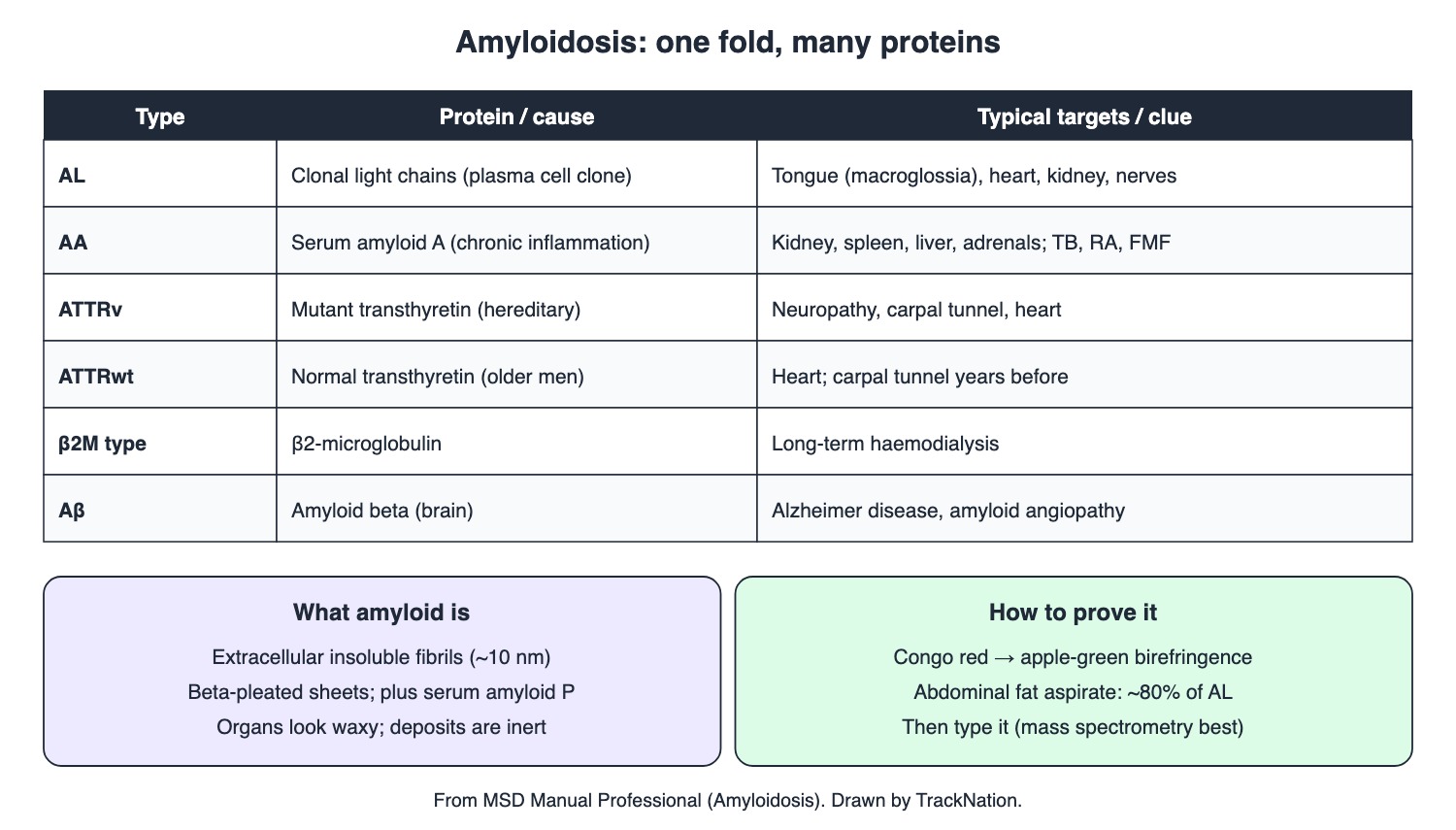
Types of amyloidosis and how amyloid is identified. Drawn by TrackNation.
What Amyloid Is
Extracellular deposits of insoluble ~10 nm fibrils made of misfolded proteins arranged as beta-pleated sheets, with serum amyloid P component and glycosaminoglycans. Deposits are inert but crowd organs; some prefibrillar oligomers are directly toxic.
Stains: pink on H&E; PAS and Alcian blue positive; most characteristic is apple-green birefringence under polarised light after Congo red. Electron microscopy shows non-branching 10 nm fibrils. Organs look waxy at autopsy.
Types
AL: clonal immunoglobulin light chains from a plasma cell or B-cell clone; 10–20% of myeloma patients develop it. Targets skin, nerves, heart, gut and tongue (macroglossia), kidney, liver, spleen, vessels.
AA: serum amyloid A, an acute-phase reactant raised by IL-1, TNF and IL-6 in chronic infection (TB, bronchiectasis, osteomyelitis, leprosy) or inflammation (rheumatoid and juvenile arthritis, Crohn disease, familial Mediterranean fever). Prefers kidneys, spleen, liver, adrenals and lymph nodes.
Hereditary ATTRv: mutant transthyretin — the commonest hereditary type; neuropathy (carpal tunnel first), kidney and heart disease; liver transplant can remove the source. ATTRwt: normal transthyretin in the hearts of older men. Typing matters: chemotherapy is for AL, not ATTR.
β2-microglobulin amyloid in long-term haemodialysis. Localised: amyloid beta in the brain (Alzheimer disease, amyloid angiopathy); light chains elsewhere.
Organs and Diagnosis
Kidney: glomerular deposits → proteinuria → nephrotic syndrome or end-stage disease. Heart: restrictive (infiltrative) cardiomyopathy, diastolic failure, low ECG voltage despite a thick wall. Liver: painless, sometimes massive, hepatomegaly. Peripheral neuropathy; bruising around the eyes ("raccoon eyes") from fragile vessels.
Diagnosis: show fibrils in tissue. Abdominal fat aspirate finds amyloid in ~80% of AL (under 25% of ATTRwt); kidney or heart biopsy is nearly 100% sensitive when involved. Then type it — mass spectrometry is the most sensitive and specific.
Traps the Examiner Sets
Apple-green birefringence needs Congo red and polarised light.
AL = light chains (myeloma, macroglossia); AA = serum amyloid A (TB, RA, FMF).
Dialysis amyloid = β2-microglobulin; brain = amyloid beta.
Thick heart wall but low ECG voltage = infiltrative (amyloid).
Memory Hooks & Shortcuts
Shortcuts to lock in this article's numbers and lists. Each one only re-packages facts proven above.
🧠 Congo goes Green in Polarised light — Congo red apple-green birefringence
🧠 AL = Light chains; AA = Acute-phase (SAA) — AL vs AA
🧠 Dialysis Delivers β2M — dialysis amyloid
🧠 Thick wall, Tiny voltage = amyloid — cardiac amyloid ECG
🧠 Fat first, then the organ — biopsy order
Rapid-Revision Cards
Amyloid
Extracellular insoluble ~10 nm fibrils, beta-pleated sheets.
Constant components
Serum amyloid P + glycosaminoglycans.
Stains
H&E pink; PAS/Alcian blue +; Congo red → apple-green under polarised light.
EM
Non-branching 10 nm fibrils.
AL
Light chains; myeloma (10–20%); macroglossia.
AA
Serum amyloid A; TB, bronchiectasis, RA, Crohn, FMF.
AA targets
Kidney, spleen, liver, adrenals, nodes.
ATTRv
Commonest hereditary; carpal tunnel first.
ATTRwt
Older men's hearts; no chemotherapy.
Dialysis amyloid
β2-microglobulin.
Brain amyloid
Amyloid beta — Alzheimer, angiopathy.
Kidney
Glomerular → proteinuria → nephrotic.
Heart
Restrictive; thick wall, low ECG voltage.
Raccoon eyes
Fragile amyloid vessels.
First biopsy
Abdominal fat (~80% AL).
Typing
Mass spectrometry best.
Sources
Facts in this article were checked against these documents.
Test Yourself: Practice Questions
Twenty-two questions in NEET PG style, most of them clinical vignettes.
Practice Questions (NEET PG pattern)
Original questions written in the style of the exam: +4 for a correct answer, −1 for a wrong one. Every answer was checked against the sources listed above. NEET PG papers are not published by NBEMS, so these are not past-paper questions.
Q1. A kidney biopsy stained with Congo red and viewed under polarised light shows apple-green birefringence. The deposit is
(a) amyloid
(b) fibrin
(c) collagen
(d) immune complexes
Show answer
Answer: (a) — Most characteristic amyloid stain finding.
Q2. Amyloid fibrils are arranged as
(a) beta-pleated sheets
(b) random coils
(c) alpha helices only
(d) triple helices
Show answer
Answer: (a) — Approximately 10 nm insoluble fibrils.
Q3. Besides the fibrillar protein, all amyloid deposits contain
(a) haemosiderin
(b) serum amyloid P component and glycosaminoglycans
(c) calcium phosphate
(d) immunoglobulin heavy chains only
Show answer
Answer: (b) — MSD.
Q4. On routine H&E, amyloid appears
(a) black
(b) blue and intracellular
(c) pink, amorphous and extracellular
(d) unstained
Show answer
Answer: (c) — Also PAS and Alcian blue positive.
Q5. Electron microscopy of an amyloid-laden heart biopsy shows
(a) viral particles
(b) non-branching fibrils about 10 nm wide
(c) branching fibrils 100 nm wide
(d) dense deposits on the basement membrane
Show answer
Answer: (b) — MSD.
Q6. A patient with multiple myeloma develops an enlarged tongue, heavy proteinuria and heart failure. The amyloid protein is
(a) transthyretin
(b) immunoglobulin light chain (AL)
(c) serum amyloid A (AA)
(d) β2-microglobulin
Show answer
Answer: (b) — Macroglossia is common in AL; 10–20% of myeloma patients develop AL.
Q7. A man with long-standing untreated tuberculosis develops nephrotic syndrome. Renal biopsy shows amyloid. The precursor protein is
(a) serum amyloid A (acute-phase reactant)
(b) amyloid beta
(c) light chain
(d) transthyretin
Show answer
Answer: (a) — AA follows chronic infection or inflammation.
Q8. Which condition is a recognised cause of AA amyloidosis?
(a) familial Mediterranean fever
(b) multiple myeloma
(c) long-term haemodialysis
(d) Alzheimer disease
Show answer
Answer: (a) — Also TB, bronchiectasis, osteomyelitis, leprosy, RA, Crohn disease.
Q9. In AA amyloidosis, serum amyloid A rises because
(a) plasma cells make it
(b) the kidney fails to clear it
(c) inflammatory cytokines (IL-1, TNF, IL-6) increase its hepatic synthesis
(d) it is inherited
Show answer
Answer: (c) — An acute-phase reactant.
Q10. AA amyloidosis typically targets the
(a) brain only
(b) skin only
(c) kidneys, spleen, liver, adrenals and lymph nodes
(d) tongue only
Show answer
Answer: (c) — Heart and nerves late.
Q11. A patient on haemodialysis for many years develops amyloid deposits. The protein is
(a) light chain
(b) serum amyloid A
(c) transthyretin
(d) β2-microglobulin
Show answer
Answer: (d) — Less common with high-flow membranes.
Q12. The commonest type of hereditary amyloidosis is caused by mutant
(a) transthyretin (ATTRv)
(b) immunoglobulin
(c) amyloid beta
(d) serum amyloid A
Show answer
Answer: (a) — Neuropathy, kidney disease, cardiomyopathy.
Q13. In hereditary transthyretin amyloidosis, the neurological feature that commonly comes first is
(a) seizures
(b) carpal tunnel syndrome
(c) dementia
(d) optic neuritis
Show answer
Answer: (b) — Then sensorimotor and autonomic neuropathy.
Q14. An elderly man has heart failure with a thick-walled heart; amyloid is made of normal (wild-type) transthyretin. Why must it be typed carefully?
(a) chemotherapy is for AL amyloidosis and would be wrong for ATTRwt
(b) it is always fatal
(c) it is infectious
(d) it needs dialysis
Show answer
Answer: (a) — ATTRwt mainly affects the heart of older men.
Q15. Amyloid deposits in the brain in Alzheimer disease are made of
(a) light chains
(b) serum amyloid A
(c) transthyretin
(d) amyloid beta protein
Show answer
Answer: (d) — Also cerebral amyloid angiopathy.
Q16. In renal amyloidosis, deposits typically start in the
(a) ureter
(b) renal artery only
(c) glomerular membrane, causing proteinuria and nephrotic syndrome
(d) renal pelvis
Show answer
Answer: (c) — About 15% affect tubules instead.
Q17. Cardiac amyloidosis causes which type of cardiomyopathy?
(a) dilated
(b) arrhythmogenic right ventricular
(c) restrictive (infiltrative), with diastolic dysfunction
(d) hypertrophic obstructive
Show answer
Answer: (c) — Also sarcoidosis among infiltrative causes.
Q18. Echocardiography shows a thick ventricular wall, but the ECG shows low voltage. This combination suggests
(a) amyloid infiltration
(b) pericardial effusion only
(c) athlete's heart
(d) hypertensive hypertrophy only
Show answer
Answer: (a) — MSD.
Q19. A patient with AL amyloidosis bruises around the eyes after coughing. The cause is
(a) trauma only
(b) low platelets
(c) amyloid weakening small blood vessels
(d) vitamin K deficiency
Show answer
Answer: (c) — 'Raccoon eyes'.
Q20. The simplest first biopsy to look for systemic AL amyloidosis is
(a) bone marrow only
(b) skin of the scalp
(c) aspiration of subcutaneous abdominal fat (~80% positive in AL)
(d) brain biopsy
Show answer
Answer: (c) — If negative, biopsy an involved organ (kidney/heart nearly 100%).
Q21. The most sensitive and specific way to identify which protein forms the amyloid is
(a) mass spectrometry
(b) H&E staining
(c) serum protein electrophoresis
(d) Congo red alone
Show answer
Answer: (a) — Immunohistochemistry can give false positives.
Q22. At autopsy, organs heavily infiltrated by amyloid look
(a) haemorrhagic
(b) black
(c) cystic
(d) waxy
Show answer
Answer: (d) — MSD.
Active Recall
From memory: describe what amyloid is and how it stains; name the protein and causes of AL, AA, ATTRv, ATTRwt, dialysis and brain amyloid; list the organs involved and their signs; and outline how amyloidosis is diagnosed and typed.