Macrocytic and Aplastic Anaemia for NEET PG Pathology: Vitamin B12, Folate, Pernicious Anaemia, Pancytopenia, Parvovirus B19
Start Here
🎯 Exam priority: Very high. Expect: hypersegmented neutrophils, pernicious anaemia with paraesthesia, MMA vs homocysteine, a vegan or metformin user with low B12, alcohol and folate, and pancytopenia with an empty marrow.
CBME mapping: PA 15.1–15.3, 17.1.
Megaloblastic Anaemia
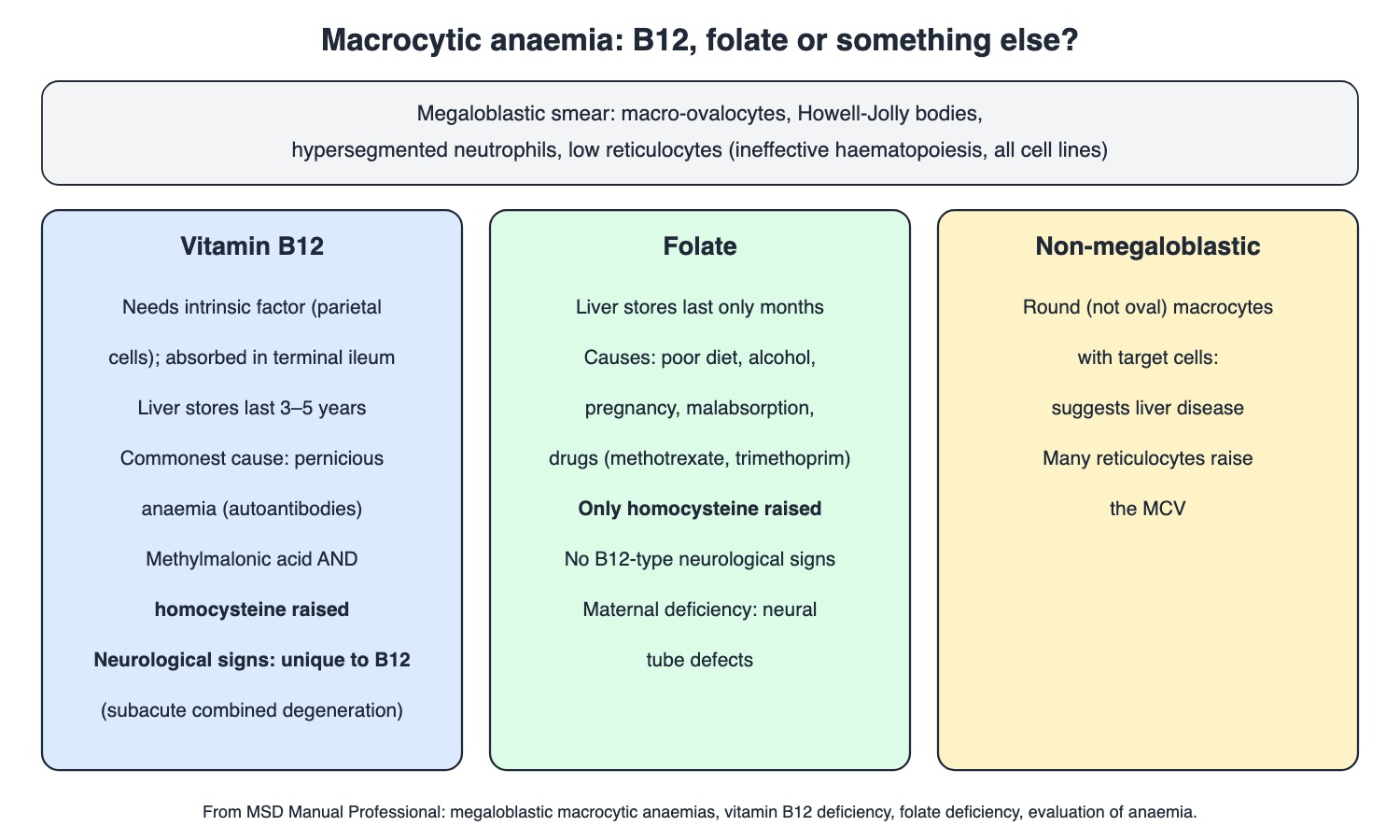
Vitamin B12 versus folate deficiency, and non-megaloblastic macrocytosis. Drawn by TrackNation.
Most often from B12 or folate deficiency. Ineffective haematopoiesis affects all cell lines, especially red cells.
Smear: macro-ovalocytes, Howell-Jolly bodies, hypersegmented neutrophils, low reticulocytes. Neutrophil hypersegmentation is a sensitive, readily available test.
Vitamin B12
Binds intrinsic factor from gastric parietal cells; absorbed in the terminal ileum. Liver stores last 3–5 years — so deficiency appears late in new vegans.
Commonest cause: pernicious anaemia (autoantibodies impair intrinsic factor secretion), which can occur in young women. Other causes include vegans without supplements and drugs such as metformin.
Labs: both methylmalonic acid and homocysteine are raised (only homocysteine in folate deficiency).
Nerves: neurological signs (neuropathy, unsteady gait) are unique to B12 deficiency and can become permanent; paraesthesia may come before anaemia. Subacute combined degeneration affects mainly brain and spinal-cord white matter.
Folate and Other Macrocytosis
Folate stores last only a few months. Causes: poor or restrictive diet, alcohol, anorexia, pregnancy and lactation, malabsorption (coeliac disease, tropical sprue, short bowel) and drugs (methotrexate, triamterene, trimethoprim).
Maternal folate deficiency raises the risk of neural tube defects.
Non-megaloblastic: round (not oval) macrocytes with target cells suggest liver disease; many reticulocytes also raise the MCV.
Aplastic Anaemia and Red-Cell Aplasia
Diagnosis: peripheral pancytopenia plus a hypocellular marrow on biopsy. Marrow testing includes cytogenetics, and flow cytometry for PNH is part of the work-up.
Causes: chemicals (benzene, arsenic), drugs (anticancer drugs, antibiotics, NSAIDs, antiseizure drugs and others), seronegative hepatitis, pregnancy, radiation, EBV and CMV, inherited marrow failure (Fanconi anaemia); about half are idiopathic.
Spleen is not enlarged (unless from transfusion iron overload).
Treatment: equine antithymocyte globulin plus cyclosporine, or bone marrow transplantation.
Pure red-cell aplasia: parvovirus B19 binds the P antigen on red-cell precursors (dangerous in HIV or chronic haemolysis); also linked to thymoma.
Traps the Examiner Sets
MMA raised = B12; homocysteine alone = folate.
Neurological signs point to B12, not folate.
Pancytopenia with splenomegaly is not typical aplastic anaemia.
Aplastic crisis in a child with chronic haemolysis: think parvovirus B19.
Memory Hooks & Shortcuts
Shortcuts to lock in this article's numbers and lists. Each one only re-packages facts proven above.
🧠 B12 = Both (MMA and homocysteine) — folate raises homocysteine only
🧠 B12 for Brain and Back (nerves) — neurology only in B12 deficiency
🧠 B12 lasts Years, folate lasts Months — stores
🧠 Pernicious = Parietal cells lose intrinsic factor — commonest B12 cause
🧠 Aplastic: Empty marrow, Empty blood, No spleen — pancytopenia, hypocellular marrow, no splenomegaly
🧠 Parvo Picks the P antigen — red-cell aplasia
Rapid-Revision Cards
Megaloblastic smear
Macro-ovalocytes, Howell-Jolly bodies, hypersegmented neutrophils, low retics.
Megaloblastic cause
B12 or folate; ineffective haematopoiesis, all lines.
B12 absorption
Intrinsic factor (parietal cells); terminal ileum.
B12 stores
3–5 years.
Commonest B12 cause
Pernicious anaemia (autoantibodies).
Other B12 causes
Vegan diet, metformin.
MMA + homocysteine
Both high in B12; only homocysteine in folate.
B12 nerves
Neuropathy, gait; unique to B12; can be permanent.
SCD
Brain and spinal-cord white matter.
Folate stores
A few months.
Folate causes
Diet, alcohol, pregnancy, coeliac, methotrexate/trimethoprim.
Folate in pregnancy
Deficiency → neural tube defects.
Liver-disease macrocytes
Round, with target cells.
Aplastic anaemia
Pancytopenia + hypocellular marrow.
Aplastic causes
Benzene, drugs, seronegative hepatitis, viruses, Fanconi.
Aplastic spleen
Not enlarged.
Aplastic treatment
ATG + cyclosporine, or BMT.
Parvovirus B19
P antigen; red-cell aplasia in chronic haemolysis/HIV.
PRCA association
Thymoma.
Sources
Facts in this article were checked against these documents.
MSD Manual Professional: Megaloblastic Macrocytic Anemias; Vitamin B12 Deficiency; Folate Deficiency; Aplastic Anemia; Pure Red Blood Cell Aplasia; Evaluation of Anemia — Merck & Co. (MSD Manuals), reviewed 2025–2026 (link)
Competency Based Undergraduate Curriculum, Pathology (PA 15, 17) — National Medical Commission, 2024
Test Yourself: Practice Questions
Twenty-four questions in NEET PG style, most of them clinical vignettes.
Practice Questions (NEET PG pattern)
Original questions written in the style of the exam: +4 for a correct answer, −1 for a wrong one. Every answer was checked against the sources listed above. NEET PG papers are not published by NBEMS, so these are not past-paper questions.
Q1. A 55-year-old woman has macrocytic anaemia; the smear shows oval macrocytes and hypersegmented neutrophils. The process is
(a) megaloblastic anaemia
(b) thalassaemia trait
(c) iron deficiency
(d) anaemia of chronic disease
Show answer
Answer: (a) — Macro-ovalocytes, Howell-Jolly bodies, hypersegmented neutrophils, low reticulocytes.
Q2. The commonest cause of vitamin B12 deficiency is
(a) pernicious anaemia (autoantibodies impair intrinsic factor)
(b) vegan diet
(c) tapeworm
(d) metformin
Show answer
Answer: (a) — MSD.
Q3. Vitamin B12 bound to intrinsic factor is absorbed in the
(a) stomach
(b) colon
(c) terminal ileum
(d) duodenum
Show answer
Answer: (c) — Intrinsic factor comes from gastric parietal cells.
Q4. A man who became vegan 1 year ago has a normal B12 level. Deficiency may take years because
(a) B12 is not needed by adults
(b) liver B12 stores last 3–5 years
(c) plants contain enough B12
(d) B12 is made in the colon and absorbed
Show answer
Answer: (b) — MSD.
Q5. A patient has macrocytic anaemia with raised serum methylmalonic acid and homocysteine. The deficiency is
(a) iron
(b) folate
(c) vitamin C
(d) vitamin B12
Show answer
Answer: (d) — Only homocysteine is raised in folate deficiency.
Q6. Raised homocysteine with normal methylmalonic acid in a macrocytic anaemia indicates
(a) B12 deficiency
(b) folate deficiency
(c) iron deficiency
(d) aplastic anaemia
Show answer
Answer: (b) — MSD.
Q7. A 60-year-old with megaloblastic anaemia has a peripheral neuropathy and an unsteady gait. These features point to
(a) alcohol only
(b) folate deficiency
(c) vitamin B12 deficiency
(d) iron deficiency
Show answer
Answer: (c) — Neurological manifestations are unique to B12 deficiency and can be permanent.
Q8. Subacute combined degeneration in B12 deficiency mainly affects
(a) the retina
(b) brain and spinal-cord white matter
(c) the cerebellar cortex only
(d) skeletal muscle
Show answer
Answer: (b) — MSD.
Q9. A diabetic on long-term metformin has a low B12. This is because
(a) metformin is a recognised cause of B12 deficiency
(b) metformin causes folate excess
(c) it is unrelated
(d) metformin raises B12
Show answer
Answer: (a) — MSD lists metformin among causes.
Q10. A man with heavy alcohol use and poor diet has macrocytic anaemia with normal B12. The likely deficiency is
(a) B12
(b) copper
(c) iron
(d) folate
Show answer
Answer: (d) — Folate stores last only months; alcohol and poor diet are causes.
Q11. Folate deficiency appears faster than B12 deficiency because
(a) folate is stored for years
(b) folate is not absorbed
(c) folate needs intrinsic factor
(d) liver folate stores last only a few months
Show answer
Answer: (d) — MSD.
Q12. Maternal folate deficiency increases the risk of
(a) cleft lip only
(b) neural tube defects
(c) congenital heart block
(d) hypospadias
Show answer
Answer: (b) — MSD.
Q13. A patient on long-term trimethoprim and methotrexate develops megaloblastic anaemia. The mechanism is
(a) drug-induced folate deficiency
(b) B12 malabsorption
(c) iron loss
(d) haemolysis
Show answer
Answer: (a) — MSD lists methotrexate, triamterene, trimethoprim.
Q14. A woman with coeliac disease has macrocytic anaemia. A likely cause is
(a) aplastic anaemia
(b) lead poisoning
(c) excess iron
(d) folate malabsorption
Show answer
Answer: (d) — Coeliac disease, tropical sprue and short bowel cause folate deficiency.
Q15. A man with cirrhosis has a raised MCV; the smear shows round macrocytes and target cells. This is
(a) non-megaloblastic macrocytosis of liver disease
(b) pernicious anaemia
(c) thalassaemia
(d) folate deficiency
Show answer
Answer: (a) — Round rather than oval macrocytes suggest liver disease.
Q16. A young man has pancytopenia, recurrent infections and bleeding; marrow biopsy is markedly hypocellular. The diagnosis is
(a) hypersplenism
(b) aplastic anaemia
(c) megaloblastic anaemia
(d) leukaemia
Show answer
Answer: (b) — Pancytopenia plus hypocellular marrow.
Q17. A worker exposed for years to benzene develops pancytopenia. The likely diagnosis is
(a) thalassaemia
(b) aplastic anaemia
(c) iron deficiency
(d) B12 deficiency
Show answer
Answer: (b) — Benzene and inorganic arsenic are recognised causes.
Q18. Splenomegaly in a patient with suspected aplastic anaemia (never transfused) suggests
(a) classic aplastic anaemia
(b) good prognosis
(c) iron deficiency
(d) another diagnosis, because the spleen is not enlarged in aplastic anaemia
Show answer
Answer: (d) — Splenomegaly is absent unless from transfusion haemosiderosis.
Q19. A teenager develops pancytopenia after a hepatitis that tested negative for all hepatitis viruses. The marrow is empty. This is
(a) aplastic anaemia after seronegative hepatitis
(b) hepatitis B
(c) iron deficiency
(d) megaloblastic anaemia
Show answer
Answer: (a) — MSD lists seronegative hepatitis as a cause.
Q20. Which inherited disorder of marrow failure is a recognised cause of aplastic anaemia?
(a) iron deficiency
(b) thalassaemia trait
(c) pernicious anaemia
(d) Fanconi anaemia
Show answer
Answer: (d) — Inherited marrow failure syndromes cause aplastic anaemia.
Q21. Standard immunosuppressive treatment of aplastic anaemia is
(a) iron and folate
(b) vitamin B12 injections
(c) equine antithymocyte globulin plus cyclosporine
(d) splenectomy
Show answer
Answer: (c) — Or bone marrow transplantation.
Q22. A child with hereditary spherocytosis develops sudden severe anaemia with very low reticulocytes after a febrile illness. The virus is
(a) influenza
(b) CMV
(c) parvovirus B19
(d) EBV
Show answer
Answer: (c) — Parvovirus B19 binds the P antigen on erythroid precursors; dangerous in chronic haemolysis.
Q23. Pure red-cell aplasia in an adult should prompt a search for
(a) kidney stones
(b) thymoma
(c) gallstones
(d) pancreatitis
Show answer
Answer: (b) — MSD lists thymomas among causes.
Q24. In megaloblastic anaemia, ineffective haematopoiesis affects
(a) no cells
(b) only platelets
(c) all cell lines, especially red cells
(d) only neutrophils
Show answer
Answer: (c) — Hence pancytopenia can occur.
Active Recall
From memory: describe the megaloblastic smear, compare B12 and folate deficiency (absorption, stores, causes, MMA and homocysteine, nerves), name the clue to non-megaloblastic macrocytosis, and give the diagnosis, causes and treatment of aplastic anaemia and the cause of pure red-cell aplasia.