Immunopathology for NEET PG Pathology: Hypersensitivity Types, HLA, Transplant Rejection, SLE, Complement, HIV/AIDS
Start Here
🎯 Exam priority: Very high. Expect: classify a disease by hypersensitivity type, HLA–disease pairs, rejection by timing, SLE antibodies, complement deficiencies, and HIV entry and CD4 thresholds.
CBME mapping: PA 8.1–8.6.
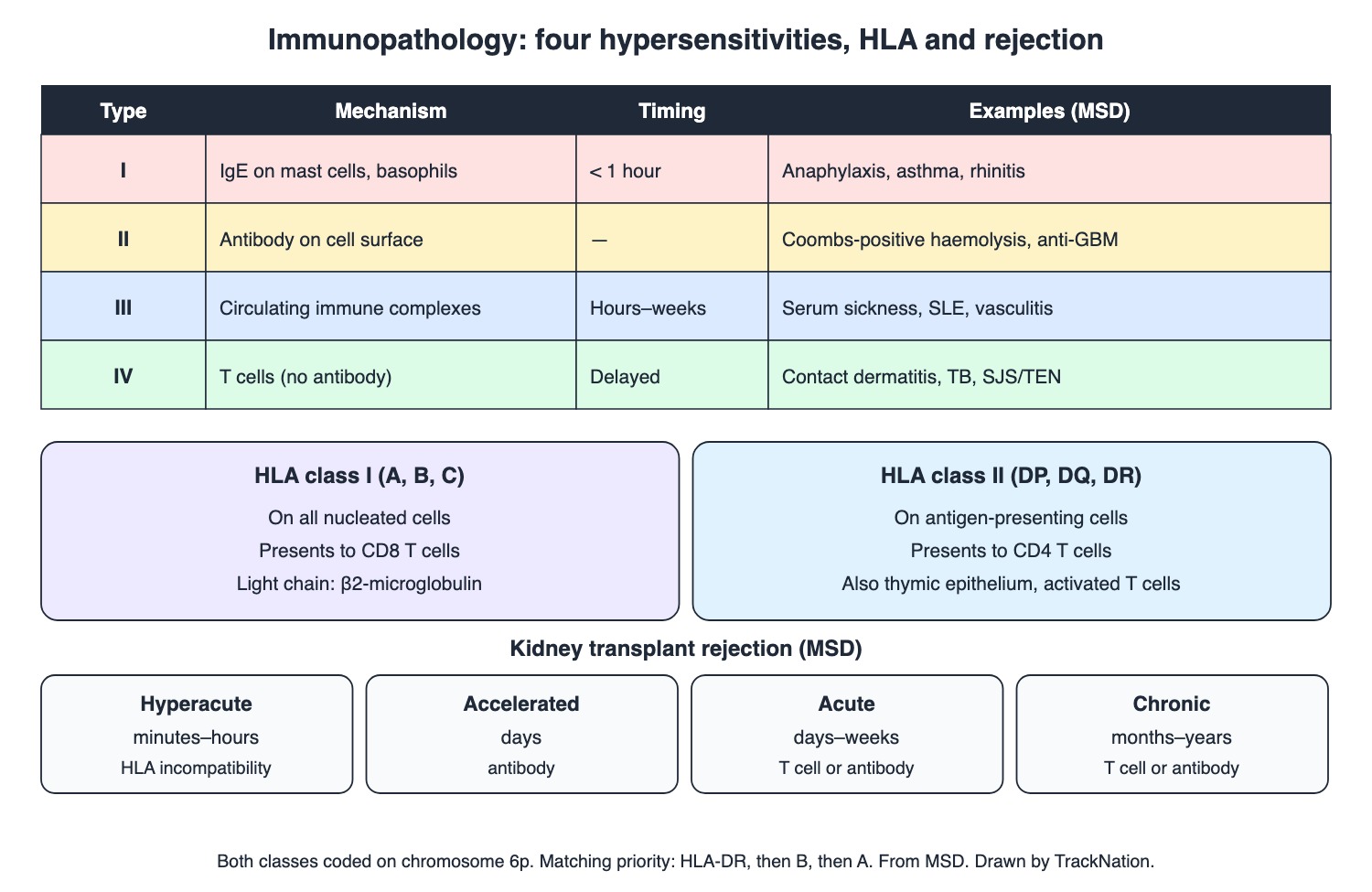
Gell and Coombs hypersensitivity types, HLA classes and kidney transplant rejection. Drawn by TrackNation.
The Four Hypersensitivities
Type I (immediate): antigen cross-links IgE on mast cells and basophils, releasing histamine, leukotrienes and other mediators within an hour. All atopic disorders, anaphylaxis, urticaria. Anaphylaxis is confirmed by serum tryptase, ideally within 2 hours.
Type II (antibody against cells): antibody bound to a cell-surface antigen triggers complement or ADCC — hyperacute graft rejection, Coombs-positive haemolytic anaemia, Hashimoto thyroiditis, anti-GBM disease.
Type III (immune complex): circulating antigen–antibody complexes deposit in vessels and tissues — serum sickness, SLE, rheumatoid arthritis, leukocytoclastic vasculitis, cryoglobulinaemia, several glomerulonephritides.
Type IV (delayed, T cell): no antibody — contact dermatitis, SJS/TEN, DRESS, the response to tuberculosis, acute and chronic allograft rejection.
Autoimmunity and HLA
Autoimmune diseases use types II, III and IV — never type I. Females are affected more often. Mechanisms: altered self-antigens, molecular mimicry (streptococcal M-protein antibodies cross-react with heart muscle) and sequestered antigens released by injury (sympathetic ophthalmia after eye trauma). HLA variants nearly always contribute.
HLA genes sit on the short arm of chromosome 6. Class I (A, B, C) is on all nucleated cells and presents to CD8 T cells; its light chain, β2-microglobulin, is coded on chromosome 15. Class II (DP, DQ, DR) is on antigen-presenting cells, thymic epithelium and activated T cells, and presents to CD4 T cells. Class III region codes C2, C4, factor B and TNF-α. HLA-G in the placenta protects the fetus.
For transplant matching, HLA-DR matters most, then B, then A.
HLA allele (MSD) | Disease |
HLA-B27 | Ankylosing spondylitis, reactive arthritis |
HLA-DR4 | Rheumatoid arthritis |
HLA-DQ2 and DQ8 | Type 1 diabetes, coeliac disease |
HLA-DR3 | SLE, Graves disease, Sjögren |
HLA-B51 | Behçet syndrome |
HLA-DR2 | Multiple sclerosis, narcolepsy |
Transplant Rejection
Hyperacute (minutes to hours; HLA incompatibility; antibody-mediated, type II): fever, anuria; usually means graft failure. Accelerated (days; antibody). Acute (days to weeks; T cell or antibody): rising creatinine, graft swelling — usually reversible with pulse steroids. Chronic (months to years): proteinuria, hypertension, graft loss.
SLE and Complement
SLE mainly affects young women. ANA is very sensitive but not specific; anti-dsDNA is highly specific. Hydralazine, procainamide and TNF inhibitors cause drug-induced lupus. Pericarditis is the commonest cardiac lesion; Libman-Sacks endocarditis is rare. Mothers with anti-Ro (SSA) can have babies with congenital heart block. Antiphospholipid antibodies raise the risk of late miscarriage.
Complement: deficiency of C5–C9, factor B, factor D or properdin → recurrent Neisseria infection; defects in C1, C4 or C5 → SLE. C3a and C5a are anaphylatoxins.
Hereditary angioedema (C1 inhibitor deficiency, autosomal dominant): swelling without itching, urticaria or bronchospasm, but laryngeal oedema can kill.
HIV and AIDS
Entry: gp120 binds CD4, then a co-receptor (CCR5 or CXCR4); gp41 fuses the envelope. Reverse transcriptase turns the RNA genome into DNA.
Advanced disease: CD4 < 200/µL (or < 14%) or an AIDS-defining infection or cancer. Below 200: Pneumocystis, toxoplasma, Cryptococcus. Below 50: CMV and Mycobacterium avium complex.
India (NACO): Strategy III uses three rapid tests in sequence — negative if the first is non-reactive, positive only if all three are reactive. ART is started for everyone regardless of CD4 count or stage ("Treat All", since 2017).
Traps the Examiner Sets
Hyperacute rejection = type II; acute and chronic rejection = type IV (MSD).
Hashimoto and anti-GBM = type II; SLE and serum sickness = type III; TB and contact dermatitis = type IV.
ANA = sensitive; anti-dsDNA = specific.
C5–C9 deficiency = Neisseria; HAE = no urticaria.
Memory Hooks & Shortcuts
Shortcuts to lock in this article's numbers and lists. Each one only re-packages facts proven above.
🧠 ACID: Anaphylactic, Cytotoxic, Immune complex, Delayed — types I to IV in order
🧠 Hyperacute is Hurried antibody (II); later rejection is T-cell (IV) — rejection types
🧠 DR before B before A — 'Doctors Before Assistants' — HLA matching priority
🧠 B27 bends the Back — HLA-B27, ankylosing spondylitis
🧠 ANA = Any lupus? dsDNA = Definitely SLE — sensitive vs specific
🧠 Terminal complement gone, Neisseria comes — C5–C9 deficiency
🧠 Two hundred: Pneumocystis; fifty: CMV and MAC — CD4 thresholds
Rapid-Revision Cards
Type I
IgE, mast cells; < 1 h; atopy, anaphylaxis.
Confirm anaphylaxis
Serum tryptase within 2 h.
Type II
Antibody on cells: hyperacute rejection, Coombs+ haemolysis, Hashimoto, anti-GBM.
Type III
Immune complexes: serum sickness, SLE, RA, vasculitis.
Type IV
T cells: contact dermatitis, TB, SJS/TEN, DRESS, acute/chronic rejection.
Autoimmunity never uses
Type I.
Molecular mimicry
Streptococcal M protein vs heart.
Sequestered antigen
Sympathetic ophthalmia.
HLA genes
Chromosome 6p; β2m on 15.
Class I vs II
All nucleated cells/CD8 vs APCs/CD4.
Class III region
C2, C4, factor B, TNF-α.
Matching priority
DR > B > A.
HLA-B27
Ankylosing spondylitis, reactive arthritis.
HLA-DQ2/DQ8
Coeliac, type 1 diabetes.
HLA-DR4
Rheumatoid arthritis.
Hyperacute rejection
Minutes–hours; HLA antibody; graft lost.
SLE antibodies
ANA sensitive; anti-dsDNA specific.
Drug-induced lupus
Hydralazine, procainamide, TNF inhibitors.
Anti-Ro mother
Congenital heart block.
C5–C9 deficiency
Neisseria.
Hereditary angioedema
C1-INH; AD; no urticaria; larynx.
HIV entry
gp120–CD4 + CCR5/CXCR4; gp41 fusion.
CD4 thresholds
< 200 PCP, toxo, crypto; < 50 CMV, MAC.
NACO
Strategy III: 3 tests all reactive; Treat All since 2017.
Sources
Facts in this article were checked against these documents.
MSD Manual Professional: Overview of Allergic and Atopic Disorders; Anaphylaxis; Autoimmune Disorders; HLA System; Complement System; C1 Inhibitor Deficiency — Merck & Co. (MSD Manuals), reviewed 2025–26 (link)
MSD Manual Professional: Kidney Transplantation; Systemic Lupus Erythematosus; HIV Infection — Merck & Co. (MSD Manuals), reviewed 2025–26 (link)
National Guidelines for HIV Counselling and Testing Services — National AIDS Control Organisation, MoHFW, 2024 (link)
National Guidelines for HIV Care and Treatment — National AIDS Control Organisation, MoHFW, 2021 (link)
Competency Based Undergraduate Curriculum, Pathology (PA 8) — National Medical Commission, 2024
Test Yourself: Practice Questions
Thirty-three questions in NEET PG style, most of them clinical vignettes.
Practice Questions (NEET PG pattern)
Original questions written in the style of the exam: +4 for a correct answer, −1 for a wrong one. Every answer was checked against the sources listed above. NEET PG papers are not published by NBEMS, so these are not past-paper questions.
Q1. Within minutes of a bee sting, a man develops hives, wheeze and hypotension. The mechanism is
(a) immune complexes (type III)
(b) IgE on mast cells and basophils (type I)
(c) antibody against red cells (type II)
(d) T cells (type IV)
Show answer
Answer: (b) — Type I reactions develop within an hour.
Q2. Hours after a suspected anaphylactic reaction, the test that best confirms it is
(a) ANA
(b) serum IgG
(c) serum tryptase (ideally within 2 hours)
(d) complement C3
Show answer
Answer: (c) — Diagnosis is mainly clinical.
Q3. All atopic disorders, such as allergic asthma and allergic rhinitis, are
(a) type III
(b) type IV
(c) type II
(d) type I hypersensitivity
Show answer
Answer: (d) — Atopy = exaggerated IgE response.
Q4. Anti-glomerular basement membrane disease is classified by MSD as
(a) type III
(b) type I
(c) type IV
(d) type II hypersensitivity
Show answer
Answer: (d) — Antibody against a fixed tissue antigen.
Q5. A woman has warm autoimmune haemolytic anaemia with a positive direct Coombs test. The hypersensitivity type is
(a) type I
(b) type II
(c) type III
(d) type IV
Show answer
Answer: (b) — Antibody on the cell surface.
Q6. A patient develops serum sickness after receiving a foreign protein. The mechanism is
(a) immune-complex deposition (type III, serum sickness)
(b) antibody against red cells (type II)
(c) IgE (type I)
(d) T cells (type IV)
Show answer
Answer: (a) — Type III can develop hours to weeks after exposure.
Q7. In MSD's classification, SLE and rheumatoid arthritis are
(a) not hypersensitivity disorders
(b) type III (immune complex) disorders
(c) type IV
(d) type I
Show answer
Answer: (b) — Also leukocytoclastic vasculitis, cryoglobulinaemia.
Q8. A gardener develops contact dermatitis from a plant such as poison ivy. The mechanism is
(a) IgE (type I)
(b) T-cell mediated (type IV)
(c) complement deficiency
(d) immune complex (type III)
Show answer
Answer: (b) — Contact dermatitis (e.g. poison ivy).
Q9. A patient develops Stevens-Johnson syndrome after starting a new drug. The hypersensitivity type is
(a) type I
(b) type II
(c) type III
(d) type IV
Show answer
Answer: (d) — Also TEN and DRESS.
Q10. The tuberculin reaction and the granulomatous response to tuberculosis are examples of
(a) type II
(b) type I
(c) type III
(d) type IV hypersensitivity
Show answer
Answer: (d) — Delayed, T-cell mediated, no antibody.
Q11. Which hypersensitivity type is NOT involved in autoimmune disease?
(a) type I
(b) type III
(c) type IV
(d) type II
Show answer
Answer: (a) — Autoimmunity uses types II, III and IV.
Q12. After a streptococcal throat infection, antibodies against streptococcal M protein attack the heart. The mechanism is
(a) sequestered antigen release
(b) complement deficiency
(c) IgE release
(d) molecular mimicry (cross-reaction)
Show answer
Answer: (d) — Antibodies to a foreign antigen cross-react with self.
Q13. After an injury to one eye, a patient develops sympathetic ophthalmia. The mechanism is
(a) complement consumption
(b) molecular mimicry
(c) IgE
(d) release of a sequestered antigen (sympathetic ophthalmia)
Show answer
Answer: (d) — Melanin-containing uveal cells released after trauma.
Q14. HLA class I molecules are found on
(a) only B cells
(b) all nucleated cells, presenting to CD8 T cells
(c) red cells only
(d) only antigen-presenting cells
Show answer
Answer: (b) — Class II is on APCs and presents to CD4 T cells.
Q15. The light chain of HLA class I (β2-microglobulin) is coded on chromosome
(a) 17
(b) 15
(c) 11
(d) 6
Show answer
Answer: (b) — The HLA genes themselves are on 6p.
Q16. HLA class II (DP, DQ, DR) molecules present antigen to
(a) CD4 helper T cells
(b) red cells
(c) NK cells only
(d) CD8 cytotoxic T cells
Show answer
Answer: (a) — On B cells, macrophages, dendritic cells, thymic epithelium, activated T cells.
Q17. Which genes lie in the HLA class III region?
(a) complement C2, C4, factor B and TNF-α
(b) the T-cell receptor
(c) β2-microglobulin
(d) immunoglobulin heavy chains
Show answer
Answer: (a) — MSD.
Q18. For a kidney transplant, the HLA locus that matters most for matching is
(a) HLA-A
(b) HLA-C
(c) HLA-G
(d) HLA-DR
Show answer
Answer: (d) — Then HLA-B, then HLA-A.
Q19. A young man is diagnosed with ankylosing spondylitis. The HLA allele most associated is
(a) HLA-DQ2
(b) HLA-B27
(c) HLA-B51
(d) HLA-DR4
Show answer
Answer: (b) — Ankylosing spondylitis and reactive arthritis.
Q20. Coeliac disease and type 1 diabetes are both associated with
(a) HLA-B27
(b) HLA-B51
(c) HLA-DR2
(d) HLA-DQ2 and DQ8
Show answer
Answer: (d) — RA: DR4; Behçet: B51.
Q21. Minutes after a kidney transplant is connected, the patient becomes febrile and anuric. This is
(a) chronic rejection
(b) hyperacute rejection from HLA incompatibility
(c) calcineurin toxicity
(d) acute T-cell rejection
Show answer
Answer: (b) — Usually means graft failure; MSD classes it as type II.
Q22. Years after a kidney transplant, a patient has slowly rising proteinuria and hypertension. This is
(a) chronic rejection (T cell or antibody)
(b) type I hypersensitivity
(c) hyperacute rejection
(d) accelerated rejection
Show answer
Answer: (a) — May end in graft loss.
Q23. A young woman has arthritis, a facial rash and a positive ANA. The test that is highly specific for SLE is
(a) ESR
(b) rheumatoid factor
(c) anti-dsDNA
(d) ANA titre
Show answer
Answer: (c) — ANA is very sensitive but not specific.
Q24. A man on long-term hydralazine develops arthralgia and a positive ANA. This is
(a) rheumatoid arthritis
(b) serum sickness
(c) drug-induced lupus (resolves when the drug is stopped)
(d) primary SLE needing lifelong steroids
Show answer
Answer: (c) — Also procainamide and TNF inhibitors.
Q25. A newborn has congenital complete heart block. The mother's blood should be tested for
(a) anti-CCP
(b) anti-GBM
(c) anti-dsDNA
(d) anti-Ro (SSA) antibodies
Show answer
Answer: (d) — Neonatal lupus.
Q26. The commonest cardiac complication of SLE is
(a) pericarditis
(b) Libman-Sacks endocarditis
(c) aortic stenosis
(d) coronary vasculitis
Show answer
Answer: (a) — Libman-Sacks is rare.
Q27. A young adult has a second episode of meningococcal meningitis. A defect to look for is deficiency of
(a) IgE
(b) C1 inhibitor
(c) CD4 cells
(d) a terminal complement component (C5–C9)
Show answer
Answer: (d) — Also factor B, factor D, properdin.
Q28. Defects in early classical-pathway components (C1, C4) predispose to
(a) hereditary angioedema
(b) systemic lupus erythematosus
(c) asthma
(d) Neisseria infection only
Show answer
Answer: (b) — MSD complement table.
Q29. A teenager has recurrent episodes of painful swelling and abdominal colic, never with itching or hives; her father has the same. The defect is
(a) mast cell disease
(b) C1 inhibitor deficiency (hereditary angioedema, autosomal dominant)
(c) IgE-mediated food allergy
(d) C5 deficiency
Show answer
Answer: (b) — Laryngeal oedema can be fatal.
Q30. HIV enters a CD4 T cell when gp120 binds CD4 and then a co-receptor, which is
(a) CCR5 or CXCR4
(b) CD8
(c) HLA class I
(d) the IgE receptor
Show answer
Answer: (a) — gp41 then mediates fusion.
Q31. A person with HIV has a CD4 count of 150/µL and develops pneumonia. The infection that becomes likely below 200 cells/µL is
(a) CMV retinitis only
(b) Mycobacterium avium complex only
(c) Pneumocystis jirovecii pneumonia
(d) influenza only
Show answer
Answer: (c) — Below 50: CMV and MAC.
Q32. Under NACO Strategy III for the general population, a person is reported HIV-positive when
(a) any two tests are reactive
(b) all three rapid tests are reactive
(c) a single ELISA is reactive
(d) the first test is reactive
Show answer
Answer: (b) — Negative if the first test is non-reactive.
Q33. Under India's national programme, a newly diagnosed adult with HIV and a CD4 count of 700/µL should
(a) wait until CD4 < 200
(b) start ART now — Treat All, regardless of CD4 or stage
(c) wait until CD4 < 350
(d) start only if symptomatic
Show answer
Answer: (b) — Treat All since 2017; same-day start offered.
Active Recall
From memory: give the mechanism and two examples of each hypersensitivity type; explain molecular mimicry and sequestered antigens; compare HLA class I and II and name four HLA–disease links; describe the rejection categories; list SLE antibodies and complement deficiencies; and outline HIV entry, CD4 thresholds and NACO testing and treatment policy.