Genetic, Paediatric and Nutritional Disorders for NEET PG Pathology: Down, Turner, Klinefelter, Storage Diseases, PEU, Vitamins
Start Here
🎯 Exam priority: Moderate. Expect: a dysmorphology vignette (Down, Edwards, Patau, Turner, Klinefelter), the enzyme behind a storage disease, the cherry-red spot, fragile X repeats, the classic Wilms presentation, marasmus vs kwashiorkor and the vitamin behind a deficiency picture.
CBME mapping: PA 11.1–11.3, 12.1–12.3. Retinoblastoma and neuroblastoma genetics are in article 4.
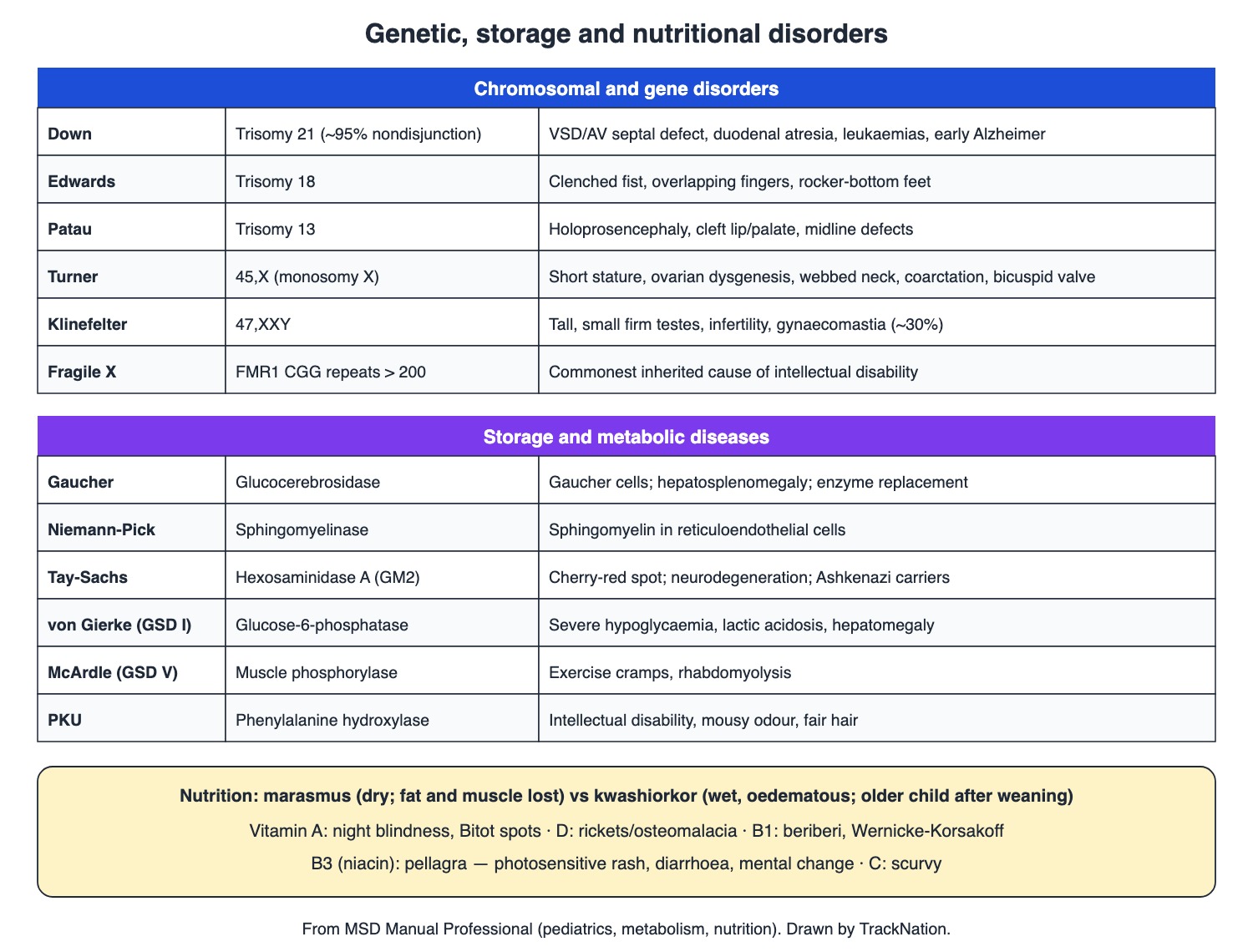
Chromosomal disorders, storage diseases and nutritional deficiencies. Drawn by TrackNation.
Chromosomal and Gene Disorders
Down syndrome: about 95% from nondisjunction (extra, usually maternal, chromosome 21); about 4% from translocation. Risk rises with maternal age (about 1/1476 at 20, 1/352 at 35, 1/85 at 40). Heart disease (VSD, atrioventricular septal defect), duodenal atresia, Hirschsprung disease, coeliac disease, hypothyroidism, leukaemias (ALL, acute megakaryoblastic), atlantoaxial instability and early Alzheimer disease.
Edwards (trisomy 18): clenched fist with the index finger over the third and fourth, rocker-bottom feet. Patau (trisomy 13): midline defects — holoprosencephaly, cleft lip and palate.
Turner (45,X): short stature, ovarian dysgenesis with high gonadotropins and infertility, neonatal lymphoedema, webbed neck, coarctation and bicuspid aortic valve.
Klinefelter (47,XXY): the commonest sex-chromosome disorder — tall, small testes, infertility, high gonadotropins; about 30% get gynaecomastia.
Fragile X: unstable CGG repeat in FMR1 (normal < 54, premutation 55–200, full > 200) — the commonest inherited cause of intellectual disability and autism.
Childhood tumours: Wilms tumour presents as a painless abdominal mass; WT1 deletion; WAGR = Wilms, aniridia, genitourinary anomalies. Retinoblastoma presents with leukocoria.
Storage and Metabolic Diseases
Gaucher: glucocerebrosidase deficiency → glucocerebroside in macrophages (Gaucher cells) → hepatosplenomegaly or CNS disease; treated with enzyme replacement. Niemann-Pick: sphingomyelinase deficiency → sphingomyelin in reticuloendothelial cells. Tay-Sachs: hexosaminidase deficiency → neurodegeneration, cherry-red macular spot, death by about 5; autosomal recessive, carriers 1 in 27 Ashkenazi Jews.
Mucopolysaccharidoses (e.g. Hurler) are autosomal recessive except MPS II.
Glycogen storage: von Gierke (GSD I) — severe hypoglycaemia, lactic acidosis, hepatomegaly before age 1; Pompe (GSD II); McArdle (GSD V, muscle phosphorylase) — exercise cramps and rhabdomyolysis.
Phenylketonuria: phenylalanine hydroxylase deficiency → intellectual disability, mousy odour, lighter skin and hair; lifelong low-phenylalanine diet.
Nutritional Disease
Marasmus (dry form): severe lack of calories and protein in infants — fat and muscle wasting. Kwashiorkor (wet, oedematous form): older children, often after early weaning when a sibling is born.
Vitamin A: early night blindness, Bitot spots, xerophthalmia. Vitamin D: rickets (children) and osteomalacia; low calcium drives secondary hyperparathyroidism. Thiamine (B1): beriberi — dry (symmetric stocking-glove neuropathy) and heart failure; Wernicke-Korsakoff in alcohol use. Niacin (B3): pellagra — symmetric photosensitive rash, glossitis, diarrhoea, mental change. Vitamin C: scurvy (article 2).
Metabolic syndrome: large waist (abdominal fat), hypertension, abnormal fasting glucose or insulin resistance, and dyslipidaemia.
Traps the Examiner Sets
Most Down syndrome = nondisjunction; translocation in about 4%.
Turner: coarctation and bicuspid valve; Klinefelter: gynaecomastia and small testes.
Cherry-red spot = Tay-Sachs (hexosaminidase A).
Gaucher = glucocerebrosidase; Niemann-Pick = sphingomyelinase.
Kwashiorkor = oedema, older child; marasmus = wasting, infant.
Memory Hooks & Shortcuts
Shortcuts to lock in this article's numbers and lists. Each one only re-packages facts proven above.
🧠 Edwards Elects (18) with a clenched fist; Patau Puts holes in the midline (13) — trisomy 18 vs 13
🧠 Turner: Two heart Troubles — coarctation, bicuspid — Turner cardiac
🧠 Klinefelter: Kinda tall, Kinda breasts, tiny testes — Klinefelter
🧠 Cherry on the Tay — Tay-Sachs cherry-red spot
🧠 Kwashiorkor = Kwashi-water (oedema) — kwashiorkor vs marasmus
🧠 Pellagra's 3 Ds: Dermatitis, Diarrhoea, Dementia — niacin deficiency
Rapid-Revision Cards
Down mechanism
~95% nondisjunction (maternal); ~4% translocation.
Down risk by age
1/1476 at 20; 1/352 at 35; 1/85 at 40.
Down associations
VSD/AVSD, duodenal atresia, Hirschsprung, leukaemia, early Alzheimer.
Edwards (18)
Clenched overlapping fingers, rocker-bottom feet.
Patau (13)
Holoprosencephaly, cleft lip/palate.
Turner (45,X)
Short, ovarian dysgenesis, webbed neck, coarctation, bicuspid valve.
Klinefelter (47,XXY)
Tall, small testes, infertility, gynaecomastia ~30%.
Fragile X
FMR1 CGG > 200; commonest inherited ID.
Wilms
Painless abdominal mass; WT1; WAGR.
Gaucher
Glucocerebrosidase; Gaucher cells; hepatosplenomegaly.
Niemann-Pick
Sphingomyelinase.
Tay-Sachs
Hexosaminidase; cherry-red spot; AR; death by ~5.
MPS inheritance
AR except MPS II.
von Gierke
G6Pase; hypoglycaemia, lactic acidosis, hepatomegaly.
McArdle
Muscle phosphorylase; exercise cramps.
PKU
PAH deficiency; mousy odour; diet.
Marasmus vs kwashiorkor
Dry wasting infant vs oedematous older child.
Vitamin A
Night blindness, Bitot spots.
Vitamin D
Rickets/osteomalacia; ↑ PTH.
Thiamine
Beriberi, Wernicke-Korsakoff.
Niacin
Pellagra: photosensitive rash, diarrhoea, mental change.
Metabolic syndrome
Waist, BP, glucose, lipids.
Sources
Facts in this article were checked against these documents.
MSD Manual Professional: Down Syndrome; Trisomy 18; Trisomy 13; Turner Syndrome; Klinefelter Syndrome; Fragile X Syndrome; Wilms Tumor — Merck & Co. (MSD Manuals), reviewed 2024–26 (link)
MSD Manual Professional: Gaucher; Niemann-Pick; Tay-Sachs; Lysosomal Storage Disorders; Glycogen Storage Diseases; Phenylketonuria — Merck & Co. (MSD Manuals), reviewed 2024–26 (link)
MSD Manual Professional: Protein-Energy Undernutrition; Vitamin A, D, Thiamine and Niacin Deficiency; Metabolic Syndrome — Merck & Co. (MSD Manuals), reviewed 2025–26 (link)
Competency Based Undergraduate Curriculum, Pathology (PA 11–12) — National Medical Commission, 2024
Test Yourself: Practice Questions
Thirty-two questions in NEET PG style, most of them clinical vignettes.
Practice Questions (NEET PG pattern)
Original questions written in the style of the exam: +4 for a correct answer, −1 for a wrong one. Every answer was checked against the sources listed above. NEET PG papers are not published by NBEMS, so these are not past-paper questions.
Q1. Most cases of Down syndrome are caused by
(a) mosaicism
(b) maternal nondisjunction giving an extra chromosome 21
(c) a Robertsonian translocation
(d) a paternal deletion
Show answer
Answer: (b) — About 95% nondisjunction; about 4% translocation.
Q2. A couple's first child has Down syndrome due to an unbalanced translocation. What share of Down syndrome cases does this mechanism cause?
(a) about 95%
(b) none
(c) about 4%
(d) about 50%
Show answer
Answer: (c) — Parental karyotyping matters for translocation cases.
Q3. The risk of a Down syndrome birth at maternal age 40, compared with 20, is
(a) slightly lower
(b) much higher (about 1/85 vs 1/1476)
(c) lower
(d) the same
Show answer
Answer: (b) — About 1/352 at 35.
Q4. A newborn with Down syndrome has a congenital obstruction of the upper small bowel. A typical associated anomaly is
(a) malrotation always
(b) pyloric stenosis only
(c) intussusception
(d) duodenal atresia
Show answer
Answer: (d) — Also Hirschsprung and coeliac disease.
Q5. The commonest congenital heart lesions in Down syndrome are
(a) transposition
(b) tetralogy only
(c) coarctation and bicuspid valve
(d) ventricular and atrioventricular septal defects
Show answer
Answer: (d) — Coarctation and bicuspid valve are Turner lesions.
Q6. Adults with Down syndrome have an increased risk of
(a) multiple sclerosis
(b) Parkinson disease
(c) Huntington disease
(d) early-onset Alzheimer disease
Show answer
Answer: (d) — Also leukaemias and hypothyroidism.
Q7. A newborn has a clenched fist with the index finger overlapping the third and fourth fingers and rocker-bottom feet. The karyotype is likely
(a) 45,X
(b) trisomy 13 (Patau)
(c) trisomy 18 (Edwards)
(d) trisomy 21
Show answer
Answer: (c) — Severe heart disease is common.
Q8. A newborn has holoprosencephaly and cleft lip and palate. The likely diagnosis is
(a) trisomy 18
(b) trisomy 13 (Patau)
(c) fragile X
(d) Turner syndrome
Show answer
Answer: (b) — Midline anomalies.
Q9. A short girl has high FSH and LH, had puffy hands and feet at birth and has a webbed neck. The karyotype is
(a) trisomy 21
(b) 47,XXY
(c) 45,X (Turner syndrome)
(d) 46,XY
Show answer
Answer: (c) — Ovarian dysgenesis with hypergonadotropic hypogonadism.
Q10. The cardiac lesions typical of Turner syndrome are
(a) VSD and AV canal
(b) coarctation of the aorta and bicuspid aortic valve
(c) pulmonary stenosis only
(d) transposition
Show answer
Answer: (b) — Also aortic dilatation.
Q11. A tall infertile man has small firm testes, gynaecomastia and high gonadotropins. The karyotype is
(a) 47,XXY (Klinefelter)
(b) trisomy 21
(c) 45,X
(d) 46,XX male only
Show answer
Answer: (a) — The commonest sex-chromosome disorder; about 30% have gynaecomastia.
Q12. The commonest sex-chromosome disorder is
(a) XYY syndrome
(b) Turner syndrome
(c) fragile X
(d) Klinefelter syndrome
Show answer
Answer: (d) — MSD.
Q13. A boy with intellectual disability and autism has more than 200 CGG repeats in FMR1. The diagnosis is
(a) fragile X syndrome
(b) Huntington disease
(c) Down syndrome
(d) myotonic dystrophy
Show answer
Answer: (a) — Normal < 54; premutation 55–200.
Q14. The commonest inherited cause of intellectual disability is
(a) Down syndrome (usually not inherited)
(b) PKU
(c) Tay-Sachs
(d) fragile X syndrome
Show answer
Answer: (d) — Down syndrome is commoner but mostly sporadic.
Q15. A young child has a painless abdominal mass, aniridia and genitourinary anomalies. The syndrome is
(a) Li-Fraumeni
(b) WAGR (Wilms tumour with WT1 deletion)
(c) MEN 2
(d) neurofibromatosis
Show answer
Answer: (b) — Painless palpable mass is the commonest Wilms finding.
Q16. A child has hepatosplenomegaly; marrow shows macrophages laden with glucocerebroside. The enzyme deficient is
(a) hexosaminidase A
(b) alpha-L-iduronidase
(c) glucocerebrosidase (Gaucher disease)
(d) sphingomyelinase
Show answer
Answer: (c) — Treated with enzyme replacement.
Q17. Niemann-Pick disease results from deficiency of
(a) glucocerebrosidase
(b) sphingomyelinase
(c) hexosaminidase
(d) glucose-6-phosphatase
Show answer
Answer: (b) — Sphingomyelin accumulates in reticuloendothelial cells.
Q18. An infant loses milestones after 6 months, develops seizures, and has a cherry-red macular spot. The enzyme deficient is
(a) hexosaminidase (Tay-Sachs disease)
(b) glucocerebrosidase
(c) phenylalanine hydroxylase
(d) muscle phosphorylase
Show answer
Answer: (a) — Death by about age 5; carriers 1/27 Ashkenazi Jews.
Q19. Tay-Sachs disease is inherited as
(a) autosomal dominant
(b) autosomal recessive
(c) X-linked recessive
(d) mitochondrial
Show answer
Answer: (b) — 25% risk when both parents are carriers.
Q20. Which mucopolysaccharidosis is the exception to autosomal recessive inheritance?
(a) Gaucher
(b) Tay-Sachs
(c) MPS I (Hurler)
(d) MPS II
Show answer
Answer: (d) — MSD.
Q21. An infant has severe fasting hypoglycaemia, lactic acidosis and a big liver. The likely glycogen storage disease and enzyme are
(a) von Gierke (GSD I) — glucose-6-phosphatase
(b) Pompe — acid alpha-glucosidase
(c) McArdle — muscle phosphorylase
(d) Gaucher — glucocerebrosidase
Show answer
Answer: (a) — Onset before age 1.
Q22. A young adult gets muscle cramps and dark urine from rhabdomyolysis after exercise. The likely glycogen storage disease is
(a) Pompe
(b) von Gierke
(c) McArdle disease (GSD V, muscle phosphorylase)
(d) Tay-Sachs
Show answer
Answer: (c) — Onset in adolescence or early adulthood.
Q23. An untreated child with intellectual disability, hyperactivity, fair skin and hair and a mousy body odour most likely has
(a) hypothyroidism
(b) phenylketonuria (phenylalanine hydroxylase deficiency)
(c) Tay-Sachs
(d) Down syndrome
Show answer
Answer: (b) — Treated by lifelong phenylalanine restriction.
Q24. An infant has severe loss of subcutaneous fat and muscle without oedema. This is
(a) obesity
(b) kwashiorkor
(c) marasmus (dry form)
(d) rickets
Show answer
Answer: (c) — Severe lack of calories and protein.
Q25. A 2-year-old weaned early when a sibling was born now has generalised oedema. The form of undernutrition is
(a) marasmus
(b) kwashiorkor (wet, oedematous form)
(c) beriberi
(d) scurvy
Show answer
Answer: (b) — Kwashiorkor children tend to be older than marasmic ones.
Q26. A child has difficulty seeing in dim light and keratinised patches on the conjunctiva. The deficient vitamin is
(a) vitamin B1
(b) vitamin D
(c) vitamin A
(d) vitamin C
Show answer
Answer: (c) — Night blindness is an early sign; Bitot spots.
Q27. Vitamin D deficiency lowers calcium, which leads to
(a) hypercalcaemia
(b) low PTH
(c) high phosphate
(d) secondary hyperparathyroidism (raised PTH)
Show answer
Answer: (d) — Causes rickets in children and osteomalacia in adults.
Q28. A man with alcohol use disorder develops Wernicke-Korsakoff syndrome. The deficient vitamin is
(a) vitamin B12
(b) vitamin A
(c) niacin (B3)
(d) thiamine (B1)
Show answer
Answer: (d) — Wernicke-Korsakoff syndrome; also polyneuropathy and heart failure (beriberi).
Q29. Symmetric burning and numbness of the feet in a stocking-glove pattern from thiamine deficiency is called
(a) scurvy
(b) dry beriberi
(c) wet beriberi
(d) pellagra
Show answer
Answer: (b) — Peripheral neurologic deficit.
Q30. A patient has a symmetric photosensitive rash on sun-exposed skin, glossitis, diarrhoea and confusion. The deficiency is
(a) zinc only
(b) vitamin C
(c) niacin (pellagra)
(d) riboflavin
Show answer
Answer: (c) — Advanced pellagra.
Q31. The components of metabolic syndrome are
(a) obesity alone
(b) large waist, hypertension, abnormal fasting glucose or insulin resistance, and dyslipidaemia
(c) hypertension and gout only
(d) diabetes and anaemia
Show answer
Answer: (b) — Abdominal adipose tissue drives it.
Q32. A woman with Turner syndrome had puffy hands and feet at birth. The cause was
(a) hypothyroidism
(b) heart failure
(c) nephrotic syndrome
(d) lymphoedema
Show answer
Answer: (d) — Also loose skin folds at the neck → webbed neck.
Active Recall
From memory: give the mechanism, risk with maternal age and associations of Down syndrome; distinguish trisomy 18, 13, Turner and Klinefelter; explain fragile X repeats; name the enzyme in Gaucher, Niemann-Pick, Tay-Sachs, von Gierke, McArdle and PKU; contrast marasmus and kwashiorkor; and match vitamins A, D, B1 and B3 to their deficiency diseases.