Infections for NEET PG Pathology: Malaria, Leprosy, Tuberculosis, Typhoid, Amoebiasis, Cysticercosis, Hydatid, COVID-19
Start Here
🎯 Exam priority: Moderate–High. Expect: why falciparum is deadly, hypnozoites and relapse, protective red-cell traits, the gold-standard malaria test, tuberculoid vs lepromatous leprosy and the two reactions, Ghon/Ranke complexes, typhoid carriers, amoebic liver abscess, neurocysticercosis and COVID-19 labs.
CBME mapping: PA 10.1–10.5. Granulomas and caseous necrosis are in articles 1–2.
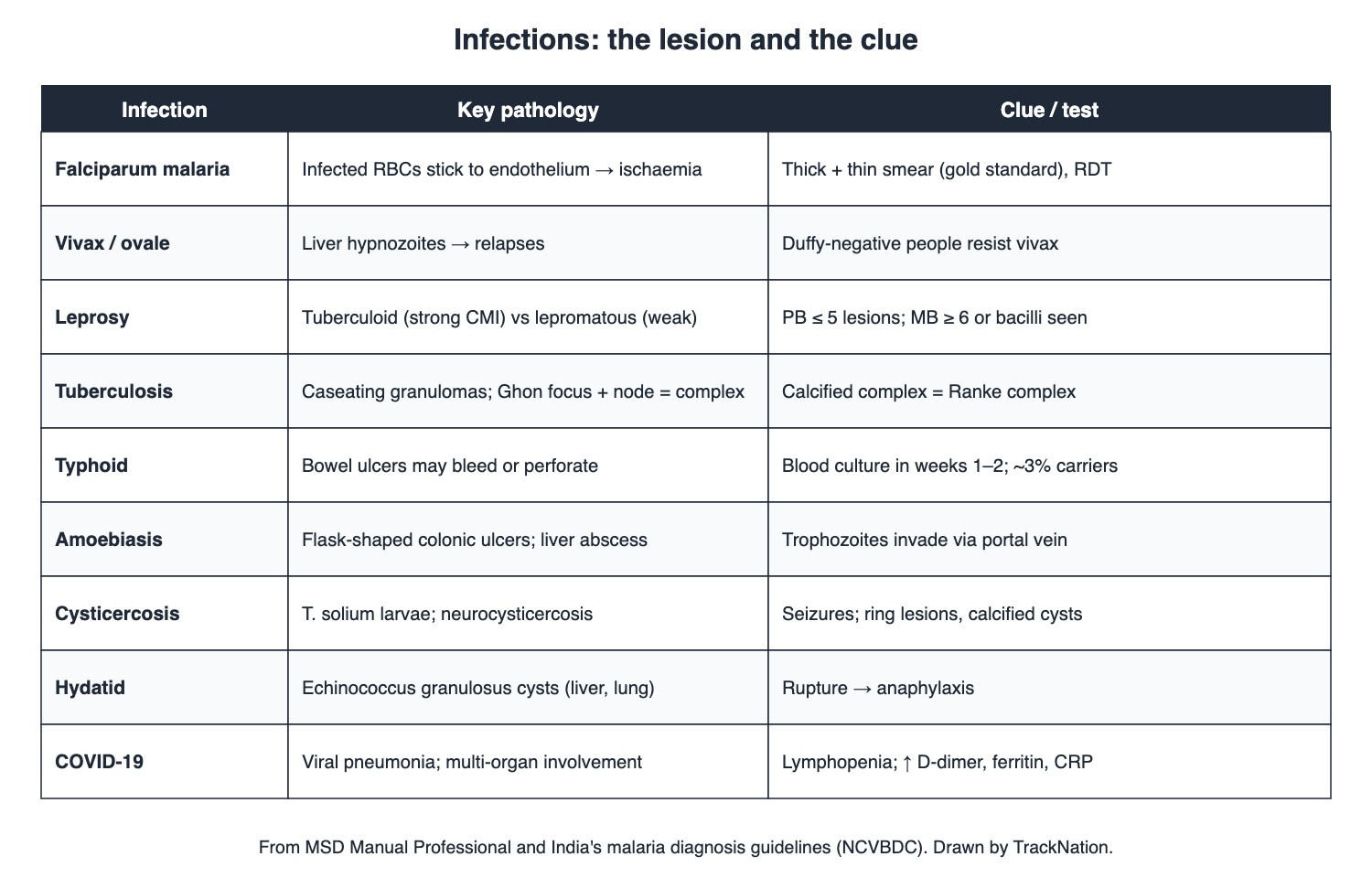
Key pathology and clues for the major infections. Drawn by TrackNation.
Malaria
Spread by the female Anopheles mosquito (rarely by transfusion, transplant, needles or congenitally). Mosquito stages: gametocyte, oocyst, sporozoite; human stages: schizont, merozoite, trophozoite.
P. falciparum: infected red cells stick to endothelium → microvascular obstruction and ischaemia of brain, kidneys, lungs and gut. Cerebral malaria: irritability to seizures and coma. Intravascular haemolysis → haemoglobinuria → blackwater fever. Hypoglycaemia is common (worse with quinine). Fever can become tertian (every 48 h).
P. vivax and P. ovale leave liver hypnozoites that cause relapses years later. People lacking the Duffy blood group resist vivax. Parasite growth is slowed in HbS, HbC, thalassaemia, G6PD deficiency and elliptocytosis.
Diagnosis in India: test every suspected case at once by microscopy and/or RDT; stained thick and thin smears are the gold standard (thin smear for species and parasite density). Repeat smears 12–24-hourly until three are negative.
Leprosy
Mycobacterium leprae (acid-fast) prefers peripheral nerves, skin and upper airway mucosa: anaesthetic skin lesions and neuropathy. Type 1 (reversal) reactions come from a rise in cell-mediated immunity; type 2 (erythema nodosum leprosum) is a systemic vasculitis/panniculitis. Treatment: dapsone, rifampicin and clofazimine.
Leprosy (MSD) | Tuberculoid | Lepromatous |
Cell-mediated immunity | Strong | Poor |
Lesions | Few (paucibacillary) | Widespread infiltration of skin, nerves, organs |
WHO count | PB: ≤ 5 lesions, no bacilli | MB: ≥ 6 lesions or bacilli seen |
Contagious | Less | More |
Tuberculosis, Typhoid and Others
TB: a Ghon focus plus involved node = Ghon complex; calcified = Ranke complex; apical scars from seeding = Simon foci. 5–15% of latent infections progress. Lymphadenitis (scrofula) is the commonest extrapulmonary form.
Typhoid (Salmonella Typhi; humans are the only reservoir): intestinal ulceration, haemorrhage and perforation in severe cases; rose spots in week 2; relative bradycardia. Blood culture is positive in the first 2 weeks, stool culture in weeks 3–5. About 3% of untreated patients become gallbladder carriers.
Amoebiasis (Entamoeba histolytica): cysts infect, trophozoites invade — flask-shaped colonic ulcers; spread via the portal vein causes liver abscess.
Cysticercosis: eating T. solium eggs from human faeces → larvae in tissues; in the brain (neurocysticercosis) they cause seizures; scans show cysts, ring-enhancing or calcified lesions. Eating undercooked pork gives the adult tapeworm.
Hydatid disease (Echinococcus granulosus, sheep-raising areas): cysts in liver or lung; rupture can cause anaphylaxis.
COVID-19: viral pneumonia with ground-glass opacities; can involve heart, kidney, brain and clotting. Severe disease: lymphopenia with raised AST/ALT, LDH, D-dimer, ferritin and CRP. Diagnosis by antigen test or PCR.
Traps the Examiner Sets
Only vivax and ovale relapse (hypnozoites); falciparum is the one that blocks capillaries.
Tuberculoid = strong immunity, few lesions; lepromatous = weak immunity, widespread.
Reversal reaction = type 1 (CMI up); ENL = type 2.
Ghon complex calcified = Ranke complex.
Pork meat → tapeworm; eggs from faeces → cysticercosis.
Memory Hooks & Shortcuts
Shortcuts to lock in this article's numbers and lists. Each one only re-packages facts proven above.
🧠 Falciparum is Fatal: it Fastens to endothelium — falciparum cytoadherence
🧠 Vivax and Ovale come back in Volleys (hypnozoites) — relapse
🧠 Tuberculoid = Tough immunity; Lepromatous = Lax immunity — leprosy spectrum
🧠 Ghon goes Rigid (calcified) = Ranke — Ghon vs Ranke
🧠 Blood first, Stool later (typhoid) — culture timing
🧠 Pork = worm; Poo eggs = cysts in the brain — taeniasis vs cysticercosis
Rapid-Revision Cards
Malaria vector
Female Anopheles; also transfusion, transplant, needles, congenital.
Falciparum danger
RBCs stick to endothelium → ischaemia (brain, kidney).
Blackwater fever
Intravascular haemolysis → dark urine.
Hypnozoites
Vivax, ovale → relapse.
Duffy-negative
Resist vivax.
Protective RBC traits
HbS, HbC, thalassaemia, G6PD, elliptocytosis.
Malaria test (India)
Thick + thin smear = gold standard; RDT also.
Negative smear
Repeat 12–24 h until 3 negative.
Tuberculoid vs lepromatous
Strong vs poor CMI.
PB vs MB
≤ 5 lesions, no bacilli vs ≥ 6 or bacilli.
Type 1 reaction
Reversal — CMI rises.
Type 2 reaction
ENL — vasculitis/panniculitis.
Ghon / Ranke
Focus + node / calcified complex.
Latent TB
5–15% progress.
Typhoid cultures
Blood weeks 1–2; stool weeks 3–5.
Typhoid carrier
Gallbladder, ~3%.
Amoebic ulcer
Flask-shaped; liver abscess via portal vein.
Neurocysticercosis
T. solium eggs; seizures; ring/calcified lesions.
Hydatid
E. granulosus; rupture → anaphylaxis.
Severe COVID-19 labs
Lymphopenia; ↑ D-dimer, ferritin, LDH, CRP.
Sources
Facts in this article were checked against these documents.
MSD Manual Professional: Malaria; Leprosy; Tuberculosis; Typhoid Fever — Merck & Co. (MSD Manuals), reviewed 2024–26 (link)
MSD Manual Professional: Amebiasis; Taenia solium Infection and Cysticercosis; Echinococcosis; COVID-19 — Merck & Co. (MSD Manuals), reviewed 2024–26 (link)
Guidelines for Diagnosis and Treatment of Malaria in India — National Vector Borne Disease Control Programme, 2014 (link)
Competency Based Undergraduate Curriculum, Pathology (PA 10) — National Medical Commission, 2024
Test Yourself: Practice Questions
Thirty questions in NEET PG style, most of them clinical vignettes.
Practice Questions (NEET PG pattern)
Original questions written in the style of the exam: +4 for a correct answer, −1 for a wrong one. Every answer was checked against the sources listed above. NEET PG papers are not published by NBEMS, so these are not past-paper questions.
Q1. Malaria is transmitted to humans mainly by the bite of
(a) the Culex mosquito
(b) the female Aedes mosquito
(c) the sandfly
(d) the female Anopheles mosquito
Show answer
Answer: (d) — Rarely by transfusion, transplant, needles or congenitally.
Q2. A patient develops malaria weeks after a blood transfusion, with no travel. This shows that malaria can spread by
(a) blood transfusion
(b) food
(c) skin contact
(d) droplets
Show answer
Answer: (a) — Also organ transplant, shared needles and congenitally.
Q3. Falciparum malaria causes coma and kidney failure mainly because
(a) of immune complexes only
(b) of hypnozoites
(c) infected red cells stick to vascular endothelium and block microvessels
(d) the parasite invades neurons
Show answer
Answer: (c) — Ischaemia of brain, kidneys, lungs and gut.
Q4. A patient with falciparum malaria passes very dark urine from intravascular haemolysis. This is
(a) rhabdomyolysis
(b) cerebral malaria
(c) blackwater fever
(d) porphyria
Show answer
Answer: (c) — Can occur spontaneously or after quinine.
Q5. A man treated for vivax malaria a year ago has another attack without travelling. The cause is
(a) re-infection only
(b) liver hypnozoites
(c) falciparum resistance
(d) persistent gametocytes
Show answer
Answer: (b) — Vivax and ovale, not falciparum or malariae.
Q6. Most sub-Saharan Africans are completely resistant to P. vivax because they lack
(a) the Duffy blood group
(b) the Rh antigen
(c) G6PD
(d) HbS
Show answer
Answer: (a) — Duffy antigen is used by vivax to attach to red cells.
Q7. Which red-cell condition delays the development of Plasmodium inside red cells?
(a) iron overload
(b) polycythaemia vera
(c) thalassaemia or G6PD deficiency
(d) spherocytosis only
Show answer
Answer: (c) — Also HbS, HbC and elliptocytosis.
Q8. A child in a malaria-endemic area develops fever, seizures and coma. The likely complication is
(a) blackwater fever
(b) meningitis always
(c) simple febrile seizure only
(d) cerebral malaria
Show answer
Answer: (d) — Symptoms range from irritability to seizures and coma.
Q9. A patient with falciparum malaria is being treated with quinine. A common complication to monitor for is
(a) hyperkalaemia
(b) polycythaemia
(c) hypoglycaemia
(d) hypercalcaemia
Show answer
Answer: (c) — Common in falciparum and aggravated by quinine.
Q10. Under India's malaria guidelines, the gold standard to confirm malaria is
(a) serology
(b) a clinical score
(c) microscopy of stained thick and thin blood smears
(d) a single RDT
Show answer
Answer: (c) — All suspected cases are tested at once by microscopy and/or RDT.
Q11. The first blood smear of a febrile traveller is negative but malaria is still suspected. MSD advises
(a) repeat smears every 12–24 hours until three are negative
(b) start treatment without testing
(c) test only after 1 week
(d) stop testing
Show answer
Answer: (a) — Thin smears give species and parasite density.
Q12. A man has a few anaesthetic skin lesions; no bacilli are seen in samples. Immunity and classification are
(a) poor cell-mediated immunity — lepromatous
(b) strong cell-mediated immunity — tuberculoid, paucibacillary
(c) multibacillary
(d) humoral immunity only
Show answer
Answer: (b) — PB: ≤ 5 lesions, no bacilli.
Q13. A patient has many skin lesions with acid-fast bacilli in skin samples. The WHO category is
(a) paucibacillary
(b) multibacillary
(c) indeterminate only
(d) tuberculoid
Show answer
Answer: (b) — MB: ≥ 6 lesions, bacilli seen, or both.
Q14. Lepromatous leprosy reflects
(a) no infection of nerves
(b) a localised single lesion
(c) strong cell-mediated immunity
(d) poor cell-mediated immunity with widespread bacterial infiltration
Show answer
Answer: (d) — Skin, nerves and other organs are infiltrated.
Q15. During treatment, existing leprosy lesions and nerves suddenly become inflamed and tender because cell-mediated immunity rises. This is
(a) drug allergy
(b) erythema nodosum leprosum
(c) relapse
(d) a type 1 (reversal) reaction
Show answer
Answer: (d) — Called reversal despite clinical worsening.
Q16. A patient with lepromatous leprosy develops a systemic inflammatory reaction that behaves like a vasculitis or panniculitis. This is
(a) erythema nodosum leprosum (type 2 reaction)
(b) TB co-infection
(c) type 1 reversal reaction
(d) tuberculoid conversion
Show answer
Answer: (a) — Immune-complex or T-helper mediated.
Q17. Mycobacterium leprae has a special tropism for
(a) lung alveoli only
(b) bone marrow
(c) the liver
(d) peripheral nerves, skin and upper airway mucosa
Show answer
Answer: (d) — Hence anaesthetic skin lesions and neuropathy.
Q18. A chest X-ray shows a calcified peripheral lung nodule with a calcified hilar node from old primary TB. This is
(a) a Ghon focus only
(b) a tuberculoma
(c) a Ranke complex
(d) a Simon focus
Show answer
Answer: (c) — Ghon focus + node = Ghon complex; calcified = Ranke.
Q19. Of people with latent TB infection, the proportion who eventually develop active disease is about
(a) 90%
(b) 50%
(c) 5–15%
(d) less than 0.1%
Show answer
Answer: (c) — MSD.
Q20. A serious intestinal complication that can occur in severe typhoid fever is
(a) pancreatitis
(b) intestinal perforation
(c) appendicitis
(d) cholecystitis
Show answer
Answer: (b) — Ulceration, haemorrhage and perforation in severe cases.
Q21. A patient has had typhoid fever for 4 days. The culture most likely to be positive is
(a) stool culture
(b) blood culture
(c) urine culture
(d) bone marrow only after week 4
Show answer
Answer: (b) — Blood: first 2 weeks; stool: weeks 3–5.
Q22. A food handler sheds Salmonella Typhi for a year after untreated typhoid. The organisms usually persist in the
(a) lungs
(b) kidneys
(c) gallbladder (about 3% become carriers)
(d) spleen
Show answer
Answer: (c) — Humans are the only reservoir.
Q23. Colonic biopsy in a patient with diarrhoea shows flask-shaped mucosal lesions with trophozoites. The organism and a feared complication are
(a) Shigella — HUS
(b) Entamoeba histolytica — liver abscess via the portal vein
(c) Giardia — malabsorption
(d) Salmonella — perforation
Show answer
Answer: (b) — Cysts infect; trophozoites invade.
Q24. The infective form of Entamoeba histolytica is the
(a) trophozoite
(b) cyst
(c) egg
(d) larva
Show answer
Answer: (b) — Trophozoites cause invasive disease.
Q25. A young adult presents with new seizures; CT shows ring-enhancing and calcified cystic brain lesions. The infection is acquired by
(a) drinking unboiled milk
(b) eating undercooked beef
(c) a mosquito bite
(d) swallowing Taenia solium eggs from human faeces
Show answer
Answer: (d) — Neurocysticercosis; eating undercooked pork gives the adult worm instead.
Q26. A man eats undercooked pork containing cysticerci. The result is
(a) neurocysticercosis directly
(b) an adult Taenia solium tapeworm in the intestine
(c) hydatid cysts
(d) trichinosis only
Show answer
Answer: (b) — Eggs from faeces cause cysticercosis.
Q27. A man from a sheep-raising area has a liver cyst; the cyst ruptures and he develops urticaria and shock. The parasite is
(a) Fasciola
(b) Entamoeba histolytica
(c) Echinococcus granulosus (hydatid cyst)
(d) Taenia solium
Show answer
Answer: (c) — Cyst rupture can cause anaphylaxis.
Q28. Laboratory findings typical of severe COVID-19 include
(a) a low D-dimer
(b) neutropenia with low ferritin
(c) eosinophilia
(d) lymphopenia with raised D-dimer, ferritin, LDH and CRP
Show answer
Answer: (d) — Imaging: ground-glass opacities and consolidation.
Q29. COVID-19 is diagnosed by
(a) chest X-ray alone
(b) antibody testing in the first week
(c) blood culture
(d) antigen or nucleic acid (PCR) testing of respiratory secretions
Show answer
Answer: (d) — MSD.
Q30. In typhoid, the fever is often accompanied by
(a) relative bradycardia
(b) marked tachycardia always
(c) no splenomegaly ever
(d) hypothermia
Show answer
Answer: (a) — Rose spots appear in the second week.
Active Recall
From memory: explain why falciparum malaria is severe and why vivax relapses; list traits protecting against malaria and how India confirms it; compare tuberculoid and lepromatous leprosy with the two reactions; define Ghon and Ranke complexes; give typhoid culture timing and carriage; and describe amoebic, cysticercal and hydatid lesions and COVID-19 labs.