Haemolytic Anaemias for NEET PG Pathology: Sickle Cell (ICMR), Thalassaemia, Spherocytosis, G6PD, Autoimmune Haemolysis, PNH
Start Here
🎯 Exam priority: Very high. Expect: the haemolysis panel, a child with a sickle crisis, thalassaemia major with Hb F, spherocytes with negative Coombs, bite cells after a drug, warm IgG vs cold IgM, and PNH with odd-site clots.
CBME mapping: PA 16.1–16.3. Indian protocol: ICMR Sickle Cell Disease workflow (July 2020).
Recognising Haemolysis
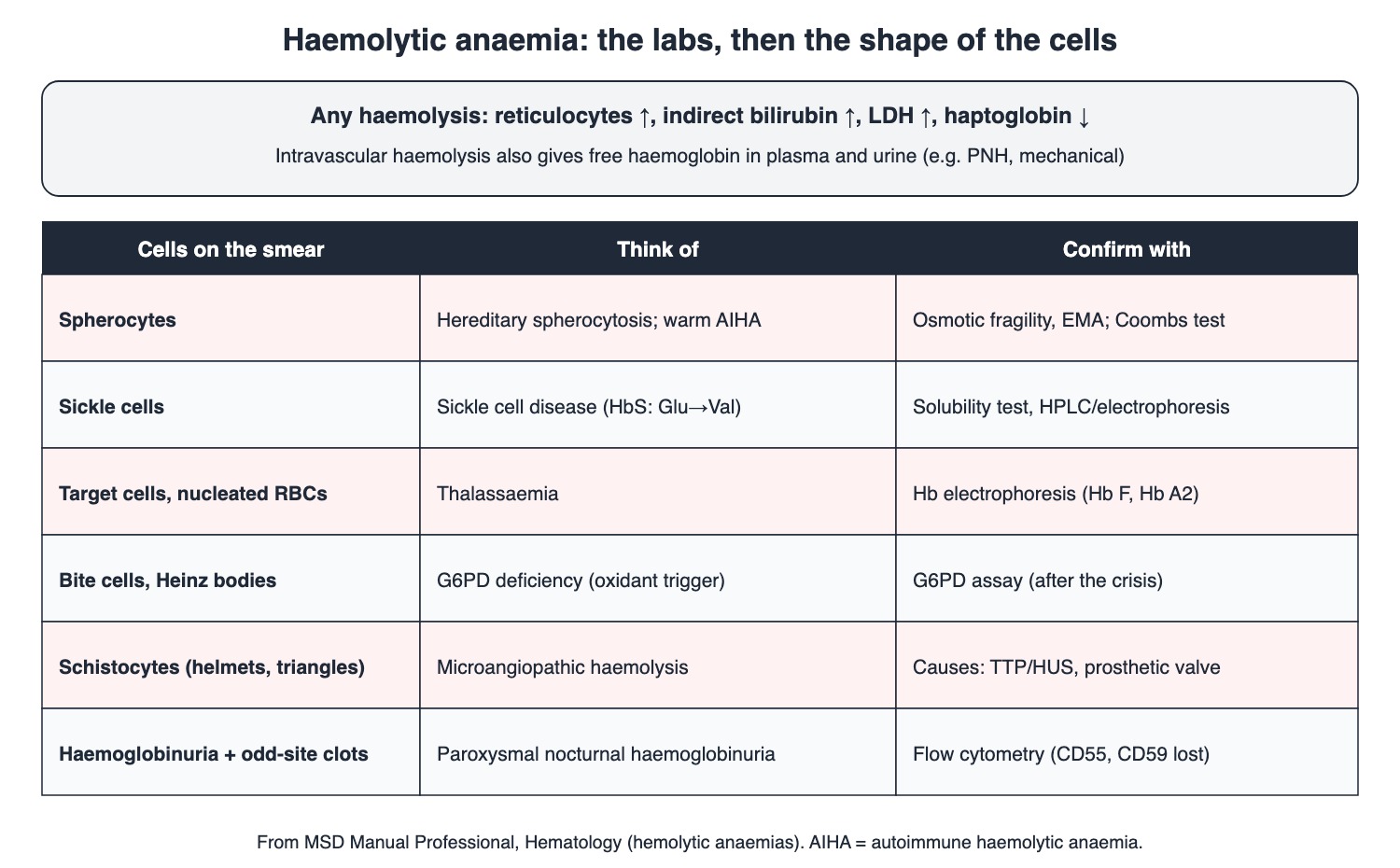
Haemolysis labs and red-cell shapes linked to the likely disorder. Drawn by TrackNation.
Suspect haemolysis in anaemia with reticulocytosis. Test indirect bilirubin, LDH and haptoglobin (low in intravascular haemolysis); unconjugated jaundice appears when bilirubin production exceeds the liver's capacity.
Mechanical intravascular causes: thrombotic microangiopathies, prosthetic heart valves, march haemoglobinuria — giving schistocytes.
Sickle Cell Disease (ICMR)
Molecule: valine replaces glutamic acid at position 6 of the beta chain; deoxygenated HbS polymerises.
India: autosomal recessive; about 88% of homozygous cases in Asia are Indian (ICMR). Crises are precipitated by fever, strenuous exercise, dehydration, drenching in rain, surgery and infection.
Spleen: repeated infarcts shrink it (autosplenectomy) → pneumococcal and Salmonella infections (including osteomyelitis). ICMR: penicillin prophylaxis until 5 years; pneumococcal vaccine.
Diagnosis: solubility test, HPLC or electrophoresis. ICMR screens all pregnant women with a CBC in the first trimester; if the mother is a carrier, testing the father is mandatory. Carriers usually need no treatment.
Hydroxyurea reduces crises and acute chest syndrome.
Thalassaemias
Beta-thalassaemia major: Hb F up to 90%, Hb A2 > 3%; smear shows target cells, small pale cells, nucleated red cells and basophilic stippling; skull shows a widened diploic space and sun-ray trabeculae; iron overload in the liver. Treatment: transfusion, chelation, splenectomy, stem cell transplant.
Alpha-thalassaemia with no alpha genes is lethal in utero (hydrops fetalis): haemoglobin without alpha chains cannot carry oxygen.
Membrane, Enzyme, Immune and PNH
Hereditary spherocytosis: autosomal dominant (spectrin, ankyrin, band 3, protein 4.2); anaemia, jaundice, splenomegaly, pigment gallstones; raised MCHC; increased osmotic fragility, reduced EMA binding and a negative Coombs test.
G6PD deficiency: X-linked; haemolysis after illness or oxidant drugs (e.g. salicylates, sulfonamides); bite cells and Heinz bodies; the assay can be falsely normal during the crisis (reticulocytes are G6PD-rich).
Autoimmune: diagnosed by the direct Coombs test. Warm type is mostly IgG (linked to SLE, lymphoma, CLL; microspherocytes); cold agglutinin disease is IgM (after Mycoplasma pneumonia or infectious mononucleosis). Paroxysmal cold haemoglobinuria = Donath-Landsteiner.
PNH: acquired PIGA mutation → loss of GPI-anchored CD55 and CD59 → complement-mediated intravascular haemolysis and thrombosis at unusual sites (portal vein, cerebral sinuses). Diagnosed by flow cytometry.
Traps the Examiner Sets
Spherocytes + negative Coombs = hereditary spherocytosis; positive Coombs = warm AIHA.
G6PD assay may read normal during haemolysis — repeat later.
Warm = IgG, cold = IgM.
Sickle cell adults have small spleens; children with HS have big ones.
Memory Hooks & Shortcuts
Shortcuts to lock in this article's numbers and lists. Each one only re-packages facts proven above.
🧠 Sickle: Six, Valine Victory over Glutamate — β6 Glu→Val
🧠 HS: Spheres, Spleen, Stones, Sensitive to salt (osmotic fragility) — hereditary spherocytosis
🧠 G6PD: Bites and Heinz after Oxidants — bite cells, Heinz bodies
🧠 Warm = G (IgG), cold = M (IgM): 'Warm Gs, Cold Ms' — AIHA antibodies
🧠 PNH: PIGA Pulls the anchor (CD55, CD59) — GPI anchor loss
🧠 Thal major: F for Fetal, up to 90 — Hb F
Rapid-Revision Cards
Haemolysis panel
Retics ↑, indirect bilirubin ↑, LDH ↑, haptoglobin ↓.
Beta-thalassaemia major
Hb F up to 90%, Hb A2 > 3%; target cells; widened diploic space, sun-ray skull.
Alpha-thalassaemia, all 4 genes deleted
Hydrops fetalis — lethal in utero.
Intravascular causes
TMA, prosthetic valve, march haemoglobinuria; PNH.
HbS
Glu→Val at β6; polymerises when deoxygenated.
SCD in India (ICMR)
AR; ~88% of Asian homozygous cases are Indian.
Sickle crisis triggers
Fever, exercise, dehydration, rain, surgery, infection.
Sickle spleen
Autosplenectomy; pneumococcus, Salmonella osteomyelitis.
ICMR prophylaxis
Penicillin till 5 y; pneumococcal vaccine.
ICMR antenatal
CBC in 1st trimester; carrier mother → test father.
Hydroxyurea
Fewer crises and acute chest syndrome.
Thal major
Hb F up to 90%, A2 > 3%; target cells; sun-ray skull.
Hydrops fetalis
No alpha genes; lethal in utero.
HS
AD; spherocytes, MCHC ↑, osmotic fragility ↑, EMA ↓, Coombs −.
G6PD
X-linked; oxidant drugs; bite cells, Heinz bodies.
G6PD test pitfall
False normal during crisis.
Warm AIHA
IgG; SLE, lymphoma, CLL; Coombs +.
Cold agglutinin
IgM; Mycoplasma, EBV.
PCH
Donath-Landsteiner.
PNH
PIGA; CD55/59 lost; odd-site clots; flow cytometry.
Schistocytes
Helmets, triangles; MAHA.
Sources
Facts in this article were checked against these documents.
Standard Treatment Workflow: Sickle Cell Disease — Indian Council of Medical Research / Department of Health Research, MoHFW, July 2020
MSD Manual Professional: Overview of Hemolytic Anemia; Sickle Cell Disease; Thalassemias; Hereditary Spherocytosis and Elliptocytosis; G6PD Deficiency; Autoimmune Hemolytic Anemia; Paroxysmal Nocturnal Hemoglobinuria; Microangiopathic Hemolytic Anemia — Merck & Co. (MSD Manuals), reviewed 2025–2026 (link)
Competency Based Undergraduate Curriculum, Pathology (PA 16) — National Medical Commission, 2024
Test Yourself: Practice Questions
Twenty-four questions in NEET PG style, most of them clinical vignettes.
Practice Questions (NEET PG pattern)
Original questions written in the style of the exam: +4 for a correct answer, −1 for a wrong one. Every answer was checked against the sources listed above. NEET PG papers are not published by NBEMS, so these are not past-paper questions.
Q1. A jaundiced woman has anaemia with reticulocytosis. To confirm haemolysis, the first panel is
(a) indirect bilirubin, LDH and haptoglobin
(b) ferritin and TIBC
(c) bone marrow biopsy
(d) B12 and folate
Show answer
Answer: (a) — MSD: suspect haemolysis with anaemia and reticulocytosis.
Q2. In intravascular haemolysis, plasma haptoglobin
(a) rises
(b) doubles
(c) falls
(d) is unchanged
Show answer
Answer: (c) — Free haemoglobin binds and consumes haptoglobin.
Q3. In haemoglobin S, the change in the beta chain is
(a) lysine replacing glutamic acid
(b) deletion of the beta gene
(c) valine replacing glutamic acid at position 6
(d) an extra alpha chain
Show answer
Answer: (c) — Deoxygenated HbS polymerises.
Q4. A boy with sickle cell disease develops a painful crisis. Which of these does the ICMR sickle cell workflow list as a crisis trigger?
(a) getting drenched in rain
(b) taking folic acid
(c) drinking plenty of water
(d) routine vaccination
Show answer
Answer: (a) — ICMR triggers: fever, strenuous exercise, dehydration, drenching in rain, surgery, infection.
Q5. An adult with sickle cell disease has a small, shrunken spleen on ultrasound. This is due to
(a) repeated infarction and fibrosis (autosplenectomy)
(b) splenic sequestration
(c) lymphoma
(d) thalassaemia
Show answer
Answer: (a) — MSD.
Q6. A child with sickle cell disease has fever and bone pain; blood culture grows Salmonella. The predisposition is
(a) functional asplenia (pneumococcal and Salmonella infections)
(b) B12 deficiency
(c) hydroxyurea
(d) iron overload
Show answer
Answer: (a) — Salmonella osteomyelitis is classic.
Q7. Per ICMR, a newborn with HbSS should receive
(a) iron supplements
(b) no prophylaxis
(c) penicillin prophylaxis up to 5 years, plus pneumococcal vaccine
(d) hydroxyurea from birth
Show answer
Answer: (c) — ICMR sickle cell workflow.
Q8. A pregnant woman is found to be a sickle cell carrier. ICMR's next step is
(a) start hydroxyurea
(b) no further action
(c) terminate the pregnancy
(d) test the father (mandatory)
Show answer
Answer: (d) — If he is positive, counsel and offer prenatal testing.
Q9. A drug shown to reduce sickle crises and acute chest syndrome is
(a) hydroxyurea
(b) folic acid alone
(c) aspirin
(d) iron
Show answer
Answer: (a) — MSD.
Q10. A child with severe anaemia from infancy has Hb F of 85%, Hb A2 4% and target cells. The diagnosis is
(a) sickle cell trait
(b) hereditary spherocytosis
(c) beta-thalassaemia major
(d) iron deficiency
Show answer
Answer: (c) — Hb F up to 90%, Hb A2 > 3%.
Q11. A skull X-ray of a transfusion-dependent child shows a widened diploic space and 'sun-ray' trabeculae. The cause is
(a) rickets
(b) marrow expansion in thalassaemia major
(c) multiple myeloma
(d) hyperparathyroidism
Show answer
Answer: (b) — Chronic marrow hyperactivity.
Q12. A fetus with deletion of all four alpha-globin genes develops
(a) mild anaemia
(b) hydrops fetalis (lethal in utero)
(c) sickle crises
(d) no disease
Show answer
Answer: (b) — Hb without alpha chains cannot carry oxygen.
Q13. A 12-year-old with jaundice, splenomegaly and gallstones has spherocytes, raised MCHC and a negative direct Coombs test. The diagnosis is
(a) hereditary spherocytosis
(b) warm autoimmune haemolysis
(c) thalassaemia
(d) G6PD deficiency
Show answer
Answer: (a) — Increased osmotic fragility, negative DAT.
Q14. Hereditary spherocytosis is usually inherited as
(a) mitochondrial
(b) autosomal recessive always
(c) autosomal dominant (spectrin, ankyrin, band 3, protein 4.2)
(d) X-linked recessive
Show answer
Answer: (c) — About 25% sporadic or recessive.
Q15. A modern flow-cytometric test supporting hereditary spherocytosis is
(a) reduced eosin-5-maleimide (EMA) binding
(b) Ham test
(c) CD55/CD59 loss
(d) Hb electrophoresis
Show answer
Answer: (a) — MSD.
Q16. A young man develops acute haemolysis after taking a sulfonamide; the smear shows bite cells. The diagnosis is
(a) PNH
(b) G6PD deficiency
(c) sickle cell disease
(d) hereditary spherocytosis
Show answer
Answer: (b) — X-linked; oxidant drugs; Heinz bodies with special stains.
Q17. During that acute haemolytic episode, his G6PD assay is normal. The reason is
(a) reticulocytes are rich in G6PD, giving a false normal
(b) he does not have G6PD deficiency
(c) the drug raised G6PD
(d) lab error always
Show answer
Answer: (a) — Repeat the test after recovery.
Q18. Heinz bodies in G6PD deficiency are
(a) denatured haemoglobin seen only with special stains
(b) iron granules
(c) nuclear remnants
(d) parasites
Show answer
Answer: (a) — MSD.
Q19. A woman with SLE has haemolytic anaemia with microspherocytes. The test that establishes the diagnosis is
(a) osmotic fragility
(b) Hb electrophoresis
(c) direct antiglobulin (Coombs) test
(d) G6PD assay
Show answer
Answer: (c) — Warm AIHA, mostly IgG.
Q20. Two weeks after Mycoplasma pneumonia, a student has haemolysis worse in the cold. The antibody is
(a) IgM (cold agglutinin)
(b) IgG (warm)
(c) IgE
(d) IgA
Show answer
Answer: (a) — Cold agglutinins are almost always clonal IgM.
Q21. Most autoantibodies in warm autoimmune haemolytic anaemia are
(a) IgE
(b) IgG
(c) IgM
(d) IgA
Show answer
Answer: (b) — MSD.
Q22. A man with haemolysis and dark urine develops a portal vein thrombosis. Flow cytometry shows loss of CD55 and CD59. The diagnosis is
(a) sickle cell disease
(b) G6PD deficiency
(c) warm AIHA
(d) paroxysmal nocturnal haemoglobinuria
Show answer
Answer: (d) — Acquired PIGA mutation; GPI-anchored proteins lost.
Q23. PNH results from
(a) an inherited spectrin defect
(b) an X-linked enzyme defect
(c) an acquired PIGA mutation in haematopoietic stem cells
(d) an autoantibody
Show answer
Answer: (c) — MSD.
Q24. A patient with a prosthetic heart valve has anaemia; the smear shows helmet cells and triangles. These are
(a) spherocytes
(b) schistocytes from mechanical haemolysis
(c) target cells
(d) bite cells
Show answer
Answer: (b) — Microangiopathic/mechanical intravascular haemolysis.
Active Recall
From memory: list the haemolysis lab panel; explain sickle cell disease (mutation, triggers, spleen, ICMR prophylaxis and antenatal testing); describe thalassaemia major and hydrops fetalis; and distinguish hereditary spherocytosis, G6PD deficiency, warm and cold autoimmune haemolysis, PNH and microangiopathic haemolysis.