Stroke for NEET PG Medicine: BE-FAST, CT First, Thrombolysis and Thrombectomy, TIA, Intracerebral and Subarachnoid Haemorrhage
Start Here
🎯 Exam priority: Very high. Expect: BE-FAST, first steps, CT before anything, tPA window, dose and BP limits, thrombectomy window, aspirin and DAPT, BP thresholds with and without lysis, AF anticoagulation, TIA duration and ABCD2, amaurosis fugax, ICH site and BP target, anticoagulant reversal, SAH presentation, CT then LP, xanthochromia, nimodipine.
CBME mapping: GM 18.1–18.16. Neuroanatomy of stroke syndromes is in Anatomy; cerebral infarct pathology in Pathology; antiplatelet and anticoagulant drugs in Pharmacology; neurosurgery in Surgery.
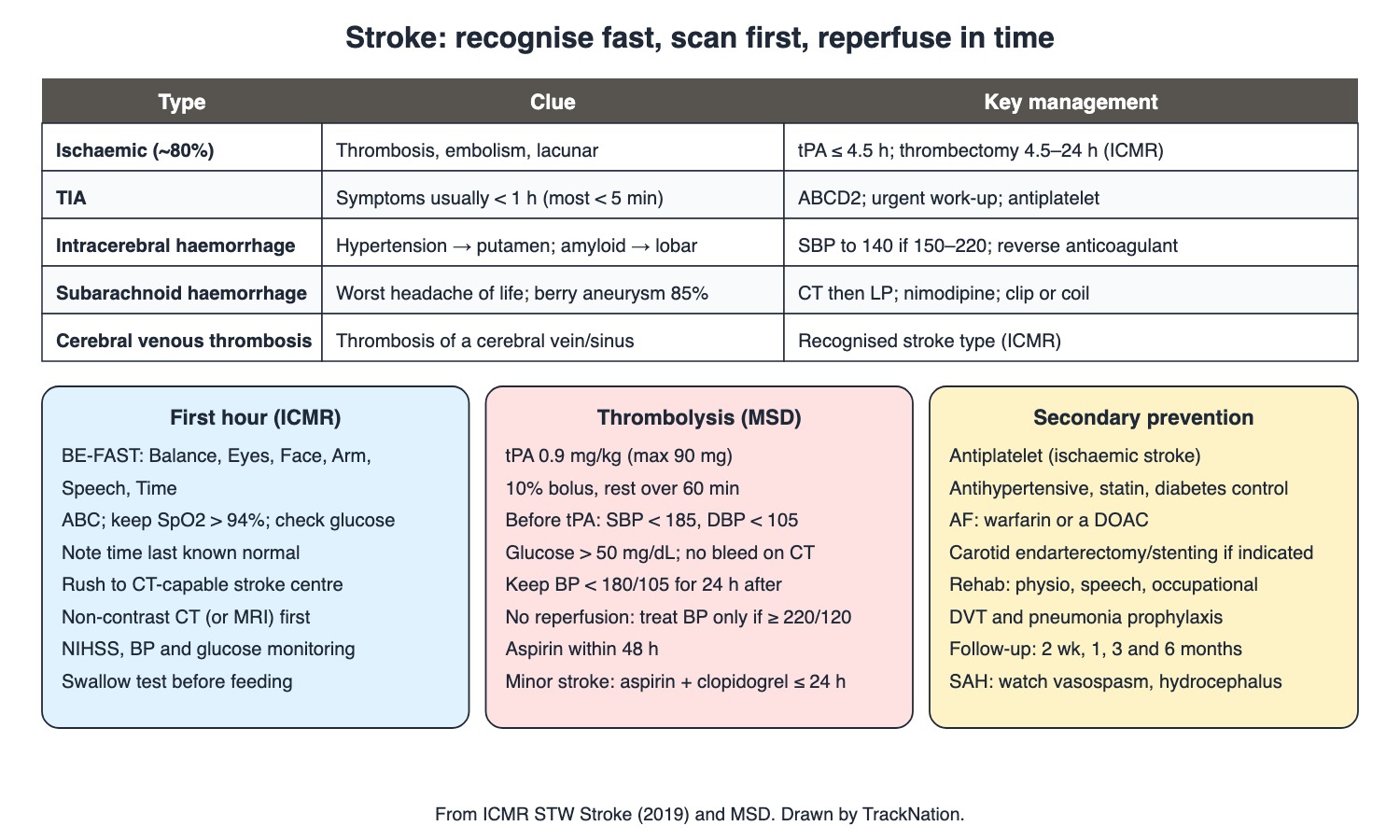
Stroke types, ICMR first hour, thrombolysis and secondary prevention. Drawn by TrackNation.
Recognition and the First Hour
Stroke: sudden persistent focal neurological deficit from cerebral, spinal or retinal infarction or haemorrhage. Types (ICMR): ischaemic, intracerebral haemorrhage, SAH, cerebral venous thrombosis; TIA is transient ischaemia without infarction. About 80% are ischaemic.
BE-FAST: Balance, Eyes, Face droop, Arm drift, Speech, Time. Headache, vomiting and reduced consciousness favour haemorrhage.
ICMR first steps: ABCs, cardiac monitoring, SpO2 > 94%, IV access, check and treat glucose (hypoglycaemia mimics stroke), record time last known normal, rapid transfer to a CT-capable centre. Non-contrast CT (or MRI), ECG, glucose; NIHSS.
Occlusion is most often in the middle cerebral artery; small deep perforator occlusion gives lacunar infarcts.
Thrombolysis (MSD + ICMR) | Rule |
Window | Within 4.5 h of onset — time from when last seen well (ICMR: tPA 0–4.5 h; thrombectomy 4.5–24 h if eligible) |
Before tPA | CT excludes haemorrhage; SBP < 185 and DBP < 105; glucose > 50 mg/dL (the only blood test needed in all) |
Dose | Alteplase 0.9 mg/kg (max 90 mg): 10% IV bolus over 1 min, rest over 60 min |
After tPA | BP < 180/105 for at least 24 h; close monitoring |
No reperfusion | Lower BP by 15% only if ≥ 220/120 on two readings |
Antiplatelet | Aspirin within 48 h; aspirin + clopidogrel within 24 h for minor stroke or high-risk TIA (ABCD2 ≥ 4) |
Secondary Prevention and Stroke Unit
Aspirin for ischaemic stroke; antihypertensives, lipid-lowering and antidiabetic drugs; AF → warfarin or a DOAC (dabigatran, apixaban, rivaroxaban, edoxaban); carotid endarterectomy or stenting when indicated.
Stroke unit: BP and glucose control, swallow assessment, DVT prophylaxis, pneumonia prevention. Rehabilitation: physiotherapy, speech and occupational therapy. ICMR follow-up at 2 weeks, 1, 3 and 6 months.
TIA: symptoms usually < 1 h (most < 5 min). ABCD2 score estimates stroke risk (Age ≥ 60, BP ≥ 140/90, Clinical features — weakness 2, speech 1, Duration ≥ 60 min 2, Diabetes 1). Amaurosis fugax = transient monocular blindness (ophthalmic artery).
Haemorrhagic Stroke
Intracerebral haemorrhage: basal ganglia, lobes, cerebellum, pons. Hypertension → putamen; cerebral amyloid angiopathy → lobar bleeds in older adults. Lower SBP to 140 if it is 150–220. Reverse anticoagulation (FFP, PCC, vitamin K, platelets; idarucizumab for dabigatran, andexanet for factor Xa inhibitors). Cerebellar haematomas can block the 4th ventricle (hydrocephalus).
Subarachnoid haemorrhage: sudden "worst headache of life", often with loss of consciousness; berry (saccular) aneurysm in ~85%. Non-contrast CT; if negative, lumbar puncture for xanthochromia. Complications: vasospasm, seizures, hydrocephalus. Treat with nimodipine to prevent vasospasm and secure the aneurysm by clipping or coiling.
Traps the Examiner Sets
Check glucose before calling it a stroke — and it is the only blood test needed before tPA.
Unknown onset: time starts when last seen well.
Do not lower BP in ischaemic stroke without lysis unless ≥ 220/120.
CT-negative thunderclap headache → LP for xanthochromia.
Nimodipine prevents vasospasm in SAH.
Memory Hooks & Shortcuts
Shortcuts to lock in this article's numbers and lists. Each one only re-packages facts proven above.
🧠 BE-FAST — Balance and Eyes before FAST — warning signs
🧠 tPA '0.9-90-10-60': 0.9 mg/kg, max 90, 10% bolus, 60-min infusion — tPA dose
🧠 Lysis BP '185 to give, 180 to live' (before < 185, after < 180) — BP limits
🧠 No lysis: 'Leave it till 220' — permissive hypertension
🧠 SAH: 'CT, then Tap for yellow' (xanthochromia) — SAH work-up
🧠 Nimodipine — 'Nimo for the spasm' — vasospasm
Rapid-Revision Cards
BE-FAST
Balance, Eyes, Face, Arm, Speech, Time.
Stroke types
~80% ischaemic, 20% haemorrhagic.
First steps (ICMR)
ABC, SpO2 > 94%, glucose, last-known-normal time, CT centre.
Imaging
Non-contrast CT/MRI first.
tPA window
≤ 4.5 h (from last seen well).
Thrombectomy (ICMR)
4.5–24 h if eligible.
tPA dose
0.9 mg/kg, max 90; 10% bolus, rest 60 min.
Pre-tPA BP
SBP < 185, DBP < 105 (MSD).
Only blood test pre-tPA
Glucose.
Post-tPA BP
< 180/105 × 24 h.
No lysis BP
Treat only if ≥ 220/120.
Aspirin
Within 48 h.
DAPT
Minor stroke/ABCD2 ≥ 4, within 24 h.
AF stroke
Warfarin or DOAC.
Lacunar
Small deep perforators.
TIA
< 1 h (most < 5 min); ABCD2.
Amaurosis fugax
Transient monocular blindness.
Hypertensive ICH
Putamen.
Lobar ICH elderly
Amyloid angiopathy.
ICH BP
SBP → 140 if 150–220.
DOAC reversal
Idarucizumab (dabigatran); andexanet (Xa).
SAH
Worst headache; berry aneurysm 85%.
SAH work-up
CT → LP (xanthochromia).
SAH drug
Nimodipine.
Sources
Facts in this article were checked against these documents.
Standard Treatment Workflow: Management of Stroke — Indian Council of Medical Research, DHR, 2019 (link)
MSD Manual Professional: Overview of Stroke; Ischemic Stroke; Transient Ischemic Attack; Intracerebral Hemorrhage; Subarachnoid Hemorrhage — Merck & Co. (MSD Manuals), reviewed 2025–26 (link)
Competency Based Undergraduate Curriculum, General Medicine (GM 18) — National Medical Commission, 2024
Test Yourself: Practice Questions
Thirty questions in NEET PG style, most of them clinical vignettes.
Practice Questions (NEET PG pattern)
Original questions written in the style of the exam: +4 for a correct answer, −1 for a wrong one. Every answer was checked against the sources listed above. NEET PG papers are not published by NBEMS, so these are not past-paper questions.
Q1. The ICMR stroke warning-sign mnemonic is
(a) MONA
(b) AVPU
(c) BE-FAST: Balance, Eyes, Face, Arm, Speech, Time
(d) SAMPLE
Show answer
Answer: (c) — Act fast.
Q2. A man develops sudden right arm weakness and slurred speech. Per ICMR, oxygen saturation should be kept above
(a) 88%
(b) 85%
(c) 94%
(d) 99%
Show answer
Answer: (c) — Plus IV access, cardiac monitoring and glucose.
Q3. A patient with sudden hemiparesis has capillary glucose 38 mg/dL. The first action is
(a) do MRI first
(b) give tPA
(c) give aspirin
(d) treat the hypoglycaemia — it can mimic stroke
Show answer
Answer: (d) — Determine and treat blood glucose.
Q4. A patient woke up with a hemiparesis; he was last seen well at 11 pm. For thrombolysis decisions, onset time is taken as
(a) the time he woke up
(b) the time he reached hospital
(c) the time he was last seen well
(d) irrelevant
Show answer
Answer: (c) — Record time last known normal.
Q5. The first imaging study in suspected acute stroke is
(a) EEG
(b) contrast CT abdomen
(c) carotid Doppler
(d) non-contrast CT (or MRI) of the brain
Show answer
Answer: (d) — Excludes haemorrhage before tPA.
Q6. Per the ICMR workflow, IV thrombolysis for ischaemic stroke is given within
(a) 4.5 hours of onset
(b) 1 week
(c) 24 hours
(d) 12 hours
Show answer
Answer: (a) — Thrombectomy 4.5–24 h if eligible.
Q7. A patient with large-vessel occlusion arrives 9 hours after onset. Per ICMR, the reperfusion option is
(a) no option
(b) IV tPA
(c) heparin infusion
(d) mechanical thrombectomy with a stent retriever if eligible
Show answer
Answer: (d) — Window 4.5–24 hours.
Q8. The dose of IV alteplase in acute ischaemic stroke is
(a) 0.1 mg/kg
(b) 0.9 mg/kg (max 90 mg), 10% as bolus and the rest over 60 minutes
(c) 100 mg fixed over 2 hours
(d) 1.5 mg/kg bolus
Show answer
Answer: (b) — Monitor 24 hours.
Q9. Before tPA, the patient's blood pressure must be below
(a) 220/120
(b) 140/90
(c) 160/100
(d) systolic 185 and diastolic 105 mm Hg (per MSD)
Show answer
Answer: (d) — Treat with IV labetalol or nicardipine if higher.
Q10. The only blood test required in all patients before thrombolysis is
(a) platelet count
(b) troponin
(c) INR
(d) blood glucose
Show answer
Answer: (d) — Others if anticoagulants or bleeding disorders suspected.
Q11. After thrombolysis, blood pressure is kept below
(a) 120/80
(b) 180/105 mm Hg for at least 24 hours
(c) 200/110
(d) 220/120
Show answer
Answer: (b) — Close neurological monitoring.
Q12. In ischaemic stroke not receiving reperfusion therapy, BP is lowered (by about 15%) only when it is
(a) always
(b) ≥ 160/100
(c) ≥ 140/90
(d) ≥ 220/120 mm Hg on two readings
Show answer
Answer: (d) — Permissive hypertension preserves perfusion.
Q13. A patient with an ischaemic stroke not eligible for thrombolysis should receive
(a) no antithrombotic
(b) heparin infusion
(c) warfarin immediately
(d) aspirin within 48 hours
Show answer
Answer: (d) — 81–325 mg.
Q14. Dual antiplatelet therapy (aspirin + clopidogrel) within 24 hours is indicated for
(a) minor stroke or high-risk TIA (ABCD2 ≥ 4)
(b) all haemorrhagic strokes
(c) SAH
(d) large completed stroke
Show answer
Answer: (a) — Short-term.
Q15. Secondary prevention after a cardioembolic stroke due to non-valvular AF includes
(a) no therapy
(b) anticoagulation with warfarin or a DOAC
(c) clopidogrel alone
(d) aspirin alone
Show answer
Answer: (b) — Dabigatran, apixaban, rivaroxaban, edoxaban.
Q16. Thrombotic occlusion in ischaemic stroke most often involves
(a) the vertebral artery only
(b) the posterior communicating artery only
(c) the anterior spinal artery
(d) the main trunk of the middle cerebral artery and its branches
Show answer
Answer: (d) — Also large arteries at the base and perforators.
Q17. Occlusion of small, deep perforating arteries produces
(a) lacunar infarcts
(b) watershed infarcts
(c) cardioembolic infarcts
(d) venous infarcts
Show answer
Answer: (a) — Often with hypertension.
Q18. Which features favour haemorrhagic over ischaemic stroke?
(a) gradual onset over weeks
(b) normal BP
(c) isolated facial droop
(d) headache, vomiting and reduced consciousness
Show answer
Answer: (d) — CT confirms.
Q19. A transient ischaemic attack usually lasts
(a) exactly 24 hours
(b) more than 24 hours
(c) several days
(d) less than 1 hour (most under 5 minutes)
Show answer
Answer: (d) — Infarction unlikely if resolved within 1 hour.
Q20. Sudden loss of vision in one eye for 3 minutes that fully recovers is
(a) optic neuritis
(b) migraine aura in both eyes
(c) amaurosis fugax (ophthalmic artery)
(d) retinal detachment
Show answer
Answer: (c) — A TIA equivalent.
Q21. The ABCD2 score is used to
(a) score coma
(b) estimate stroke risk after a TIA
(c) decide tPA dose
(d) grade SAH
Show answer
Answer: (b) — Age, BP, Clinical features, Duration, Diabetes.
Q22. The commonest site of hypertensive intracerebral haemorrhage is the
(a) occipital lobe
(b) corpus callosum
(c) putamen
(d) medulla
Show answer
Answer: (c) — Also thalamus, pons, cerebellum.
Q23. Recurrent lobar haemorrhages in an older adult suggest
(a) AV malformation in all
(b) hypertensive bleed
(c) cerebral amyloid angiopathy
(d) berry aneurysm
Show answer
Answer: (c) — Amyloid in cerebral arteries.
Q24. In acute intracerebral haemorrhage with systolic BP 190 mm Hg, the guideline target is
(a) systolic 220
(b) systolic below 100
(c) systolic about 140 mm Hg
(d) no lowering
Show answer
Answer: (c) — If SBP is 150–220.
Q25. A patient on dabigatran has an intracerebral haemorrhage. The specific reversal agent is
(a) idarucizumab
(b) vitamin K
(c) protamine
(d) andexanet alfa
Show answer
Answer: (a) — Andexanet for apixaban/rivaroxaban.
Q26. A cerebellar haematoma is dangerous because it can
(a) cause aphasia
(b) cause hemiplegia only
(c) never expand
(d) block the 4th ventricle causing hydrocephalus
Show answer
Answer: (d) — Or compress the brainstem.
Q27. A woman has sudden 'worst headache of my life' and neck stiffness; non-contrast CT is normal. The next investigation is
(a) EEG
(b) lumbar puncture for xanthochromia and red cells
(c) MRI after 1 week
(d) discharge with analgesia
Show answer
Answer: (b) — SAH can be missed on CT.
Q28. Non-traumatic subarachnoid haemorrhage is most commonly due to
(a) amyloid angiopathy
(b) hypertension
(c) AV fistula
(d) a ruptured saccular (berry) aneurysm (~85%)
Show answer
Answer: (d) — Secure by clipping or coiling.
Q29. A drug given in SAH to prevent delayed ischaemia from vasospasm is
(a) nimodipine
(b) heparin
(c) tPA
(d) nifedipine sublingual
Show answer
Answer: (a) — Oral nimodipine.
Q30. Per ICMR, rehabilitation after stroke includes
(a) bed rest for 3 months
(b) physiotherapy, speech therapy and occupational therapy
(c) no rehabilitation until 6 months
(d) only drug therapy
Show answer
Answer: (b) — Follow-up at 2 weeks, 1, 3 and 6 months.
Active Recall
From memory: list BE-FAST and the ICMR first-hour steps, give the tPA window, dose and BP and glucose limits, the thrombectomy window, BP thresholds with and without lysis, antiplatelet and AF rules, TIA definition and ABCD2, and the features and management of intracerebral and subarachnoid haemorrhage.