Rheumatology for NEET PG Medicine: Rheumatoid Arthritis, Spondyloarthritis, Gout, SLE, Systemic Sclerosis, Vasculitis
Start Here
🎯 Exam priority: High. Expect: RA vs OA vs psoriatic patterns, morning stiffness, deformities, atlantoaxial risk, methotrexate dose and TB screening before biologics, HLA-B27 and sacroiliitis, reactive arthritis triad, gout crystals and urate target, septic arthritis organism, SLE antibodies, anti-Ro and heart block, scleroderma renal crisis and ACE inhibitor, GCA urgency, Takayasu, PAN–hepatitis B, GPA c-ANCA, IgA vasculitis.
CBME mapping: GM 7.1–7.22. Immunopathology is in Pathology; DMARD pharmacology in Pharmacology; orthopaedic joint surgery in Orthopaedics.
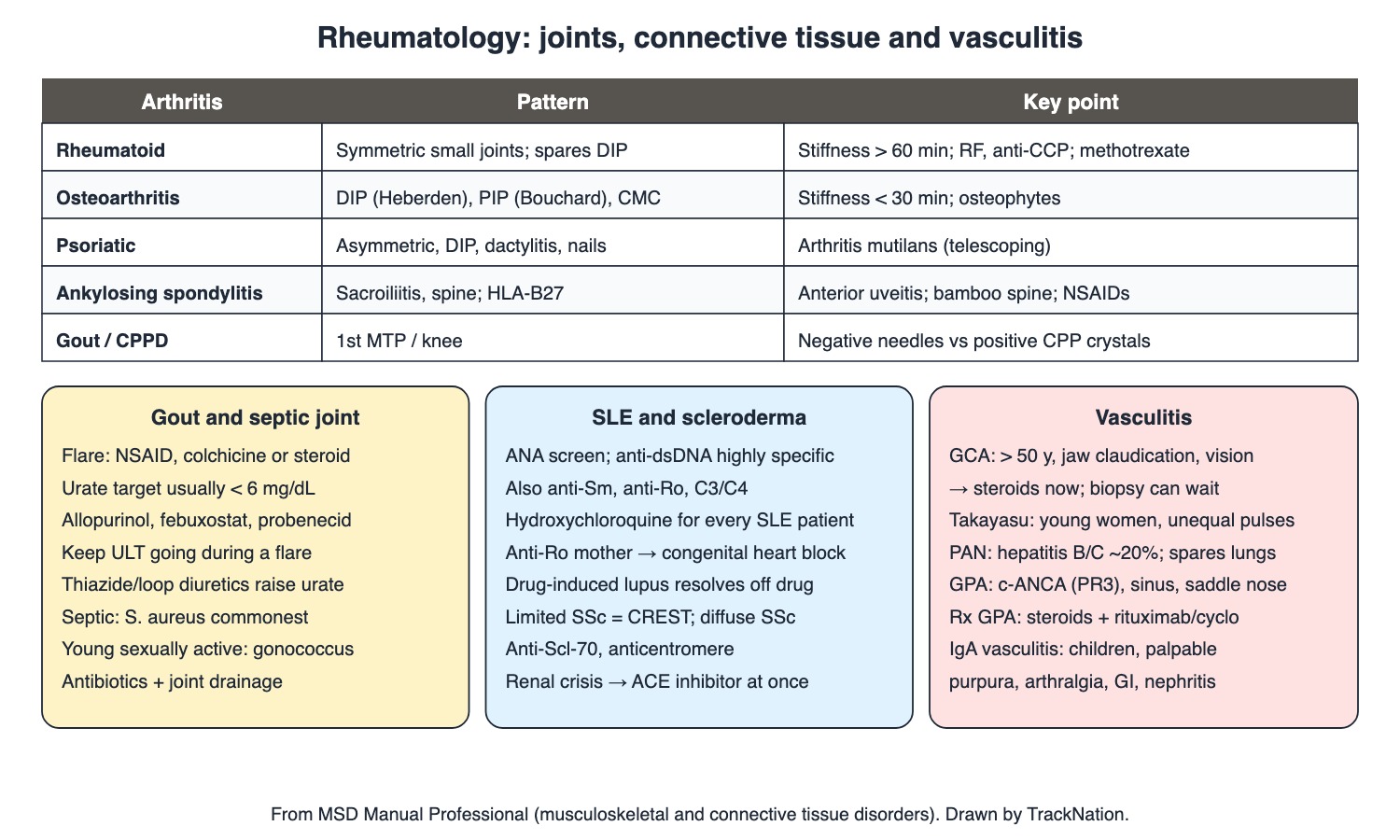
Arthritis patterns, gout, SLE and scleroderma, vasculitis. Drawn by TrackNation.
Rheumatoid and Osteoarthritis
RA: symmetric inflammation of peripheral joints (wrists, MCPs) — almost any joint except the DIPs; morning stiffness > 60 minutes; swan-neck and boutonnière deformities; carpal tunnel; cervical atlantoaxial subluxation. Extra-articular: nodules, ILD, pericarditis, Felty syndrome, Sjögren, episcleritis; subcutaneous nodules in up to 30%. RF and anti-CCP (RF is also low-titre positive in 3% of people and 20% of the elderly).
Treatment: methotrexate 10–15 mg once weekly with daily folic acid, increased to 25 mg; benefit within ~6 weeks. Add a biologic if inadequate, or use triple therapy (methotrexate + hydroxychloroquine + sulfasalazine). Screen for TB (PPD or IGRA) and hepatitis B/C before biologics.
Osteoarthritis: activity-related pain, stiffness < 30 minutes; Heberden (DIP) and Bouchard (PIP) nodes; thumb CMC; osteophytes and sclerosis on X-ray. Education, weight loss, joint protection, topical/oral NSAIDs.
Spondyloarthritis, Crystals and Septic Joints
Ankylosing spondylitis: HLA-B27 in 90% (of White patients; also up to 10% of the population); sacroiliitis on imaging; anterior uveitis, aortitis, conduction defects; late bamboo spine. NSAIDs, TNF or IL-17 inhibitors, exercise.
Reactive arthritis: after Chlamydia (genital) or Shigella/Salmonella (enteric) infection; urethritis or cervicitis, conjunctivitis, keratoderma blennorrhagicum.
Psoriatic arthritis: asymmetric, DIP joints, dactylitis, nail disease, arthritis mutilans (telescoping digits).
Gout: first MTP flare; needle-shaped, negatively birefringent urate crystals; tophi. Flares: NSAIDs, colchicine or glucocorticoids. Long term: allopurinol, febuxostat or probenecid to urate < 6 mg/dL. Continue urate-lowering therapy during a flare — MSD states there is no contraindication to starting it during a flare. Thiazide and loop diuretics raise urate.
CPPD: positively birefringent crystals; chondrocalcinosis of the knee.
Septic arthritis: S. aureus commonest; gonococcus in sexually active young people; antibiotics plus joint drainage.
SLE, Systemic Sclerosis, Vasculitis
SLE: arthritis, Raynaud, malar rash, serositis, nephritis, CNS disease, cytopenias. ANA screen; anti-dsDNA is highly specific; anti-Sm, anti-Ro/La, C3/C4. Hydroxychloroquine for all patients. Anti-Ro in a mother → congenital heart block. Drug-induced lupus resolves when the drug stops.
Systemic sclerosis: Raynaud, dysphagia, heartburn, finger skin thickening. Limited (CREST) vs diffuse. Anti-Scl-70, anticentromere. ILD and renal crisis are the major complications — renal crisis needs an ACE inhibitor promptly.
Vasculitis (MSD) | Who / what | Clue | Treatment |
Giant cell arteritis | Age 50 to > 90 (mean ~70) | Headache, scalp tenderness, jaw claudication, visual loss; PMR in 40–60% | Steroids at once; biopsy may follow |
Takayasu | Women 15–30 | Asymmetric pulses/BP, limb claudication | — |
Polyarteritis nodosa | ~20% have hepatitis B or C | Kidney, skin, nerves, gut; lungs spared | — |
GPA | c-ANCA (anti-PR3) | Sinusitis, epistaxis, saddle nose, lungs, kidneys | Steroids + rituximab or cyclophosphamide |
IgA vasculitis | Mostly children | Palpable purpura, arthralgia, GI symptoms, nephritis | — |
Traps the Examiner Sets
RA spares DIPs; OA and psoriatic arthritis involve them.
Methotrexate is weekly, not daily.
Gout: negative needles; CPPD: positive rhomboid-type crystals.
Suspected GCA: steroids first — do not wait for biopsy.
Scleroderma renal crisis: ACE inhibitor.
Memory Hooks & Shortcuts
Shortcuts to lock in this article's numbers and lists. Each one only re-packages facts proven above.
🧠 RA 'Rarely At DIP'; OA and Psoriatic 'Down In the DIP' — DIP involvement
🧠 Methotrexate: 'Monday only' — once weekly — methotrexate
🧠 Gout 'Negative Needles'; CPPD 'Positive Pyrophosphate' — crystals
🧠 Reactive arthritis: 'Can't see, can't pee, can't climb a tree' — reactive arthritis
🧠 GCA: 'Steroids before scalpel' — GCA
🧠 Scleroderma kidney: 'ACE saves the kidney' — renal crisis
Rapid-Revision Cards
RA pattern
Symmetric wrists/MCPs; spares DIP; stiffness > 60 min.
RA deformities
Swan-neck, boutonnière; atlantoaxial subluxation.
RA antibodies
RF, anti-CCP.
Methotrexate
10–15 mg weekly + folic acid; max 25 mg.
Before biologics
Screen TB (PPD/IGRA), hepatitis B/C.
Felty
RA + splenomegaly + neutropenia.
OA
Stiffness < 30 min; Heberden DIP, Bouchard PIP.
AS
HLA-B27; sacroiliitis; uveitis; NSAIDs.
Reactive arthritis
Chlamydia/Shigella; urethritis, conjunctivitis.
Psoriatic
DIP, dactylitis, nails, mutilans.
Gout crystals
Needle, negative birefringence.
Gout flare Rx
NSAID, colchicine, steroid.
Urate target
< 6 mg/dL.
ULT in flare
Continue.
CPPD
Positive birefringence; chondrocalcinosis.
Septic arthritis
S. aureus; drain.
SLE antibody
Anti-dsDNA highly specific.
SLE drug
Hydroxychloroquine for all.
Anti-Ro
Congenital heart block.
SSc renal crisis
ACE inhibitor.
GCA
> 50; jaw claudication; steroids now.
Takayasu
Women 15–30; unequal pulses.
PAN
Hep B/C ~20%; lungs spared.
GPA
c-ANCA/PR3; saddle nose.
IgA vasculitis
Children; palpable purpura.
Sources
Facts in this article were checked against these documents.
MSD Manual Professional: Rheumatoid Arthritis; Osteoarthritis; Ankylosing Spondylitis; Reactive Arthritis; Psoriatic Arthritis; Gout; CPPD; Acute Infectious Arthritis; SLE; Systemic Sclerosis; Giant Cell Arteritis; Takayasu Arteritis; Polyarteritis Nodosa; GPA; IgA Vasculitis — Merck & Co. (MSD Manuals), reviewed 2025–26 (link)
Competency Based Undergraduate Curriculum, General Medicine (GM 7) — National Medical Commission, 2024
Test Yourself: Practice Questions
Thirty questions in NEET PG style, most of them clinical vignettes.
Practice Questions (NEET PG pattern)
Original questions written in the style of the exam: +4 for a correct answer, −1 for a wrong one. Every answer was checked against the sources listed above. NEET PG papers are not published by NBEMS, so these are not past-paper questions.
Q1. A woman has symmetric pain and swelling of wrists and MCP joints with morning stiffness lasting over an hour; DIP joints are normal. The likely diagnosis is
(a) gout
(b) rheumatoid arthritis
(c) psoriatic arthritis
(d) osteoarthritis
Show answer
Answer: (b) — RA spares DIPs; stiffness > 60 minutes.
Q2. The joints typically spared in rheumatoid arthritis are the
(a) knees
(b) wrists
(c) distal interphalangeal joints
(d) MCP joints
Show answer
Answer: (c) — OA and psoriatic arthritis involve DIPs.
Q3. A patient with long-standing destructive RA develops occipital headache and hyperreflexia. The cervical complication to look for is
(a) lumbar disc prolapse
(b) atlantoaxial subluxation
(c) temporomandibular ankylosis only
(d) sacroiliitis
Show answer
Answer: (b) — Flexion–extension cervical radiographs.
Q4. The usual starting dose of methotrexate in rheumatoid arthritis is
(a) 2.5 mg monthly
(b) 50 mg weekly
(c) 10 mg daily
(d) 10–15 mg once a week with daily folic acid
Show answer
Answer: (d) — Increase to 25 mg weekly if needed.
Q5. Before starting a TNF inhibitor for RA, the patient must be screened for
(a) G6PD
(b) latent tuberculosis (PPD or IGRA) and hepatitis B/C
(c) HLA-B27
(d) anti-dsDNA
Show answer
Answer: (b) — Reactivated TB is the main risk.
Q6. An extra-articular manifestation of rheumatoid arthritis is
(a) tophi
(b) Felty syndrome
(c) dactylitis
(d) keratoderma blennorrhagicum
Show answer
Answer: (b) — Others: nodules (up to 30%), ILD, pericarditis, Sjögren, episcleritis.
Q7. Bony swellings of the DIP joints in a patient with activity-related hand pain and brief morning stiffness are
(a) Bouchard nodes
(b) rheumatoid nodules
(c) tophi
(d) Heberden nodes of osteoarthritis
Show answer
Answer: (d) — Bouchard nodes are at PIPs.
Q8. Morning stiffness in osteoarthritis typically lasts
(a) more than 2 hours
(b) over 60 minutes
(c) all day
(d) less than 30 minutes
Show answer
Answer: (d) — RA: > 60 minutes.
Q9. A young man has inflammatory low back pain and an episode of anterior uveitis; MRI shows sacroiliitis. The associated HLA is
(a) HLA-DR4
(b) HLA-B5701
(c) HLA-B27
(d) HLA-DQ2
Show answer
Answer: (c) — Present in 90% of White patients with AS.
Q10. First-line drug treatment of ankylosing spondylitis is
(a) methotrexate
(b) hydroxychloroquine
(c) allopurinol
(d) NSAIDs (then TNF or IL-17 inhibitors)
Show answer
Answer: (d) — Plus exercise and posture.
Q11. After a sexually acquired infection, a man develops arthritis, urethritis, conjunctivitis and hyperkeratotic crusted skin lesions. The diagnosis is
(a) psoriatic arthritis
(b) gonococcal arthritis
(c) reactive arthritis (keratoderma blennorrhagicum)
(d) gout
Show answer
Answer: (c) — Chlamydia is most often implicated.
Q12. A patient with psoriasis has a 'sausage' swollen finger and DIP joint arthritis with nail changes. This is
(a) septic arthritis
(b) rheumatoid arthritis
(c) psoriatic arthritis
(d) osteoarthritis
Show answer
Answer: (c) — Dactylitis is not typical of RA.
Q13. A man wakes with an exquisitely painful, red, swollen first MTP joint. Synovial fluid shows needle-shaped, negatively birefringent crystals. The diagnosis is
(a) pseudogout (CPPD)
(b) gout
(c) septic arthritis
(d) reactive arthritis
Show answer
Answer: (b) — Monosodium urate.
Q14. Drugs used to treat an acute gout flare include
(a) aspirin
(b) allopurinol alone at high dose
(c) NSAIDs, colchicine or glucocorticoids
(d) probenecid only
Show answer
Answer: (c) — IL-1 inhibitors occasionally.
Q15. A patient already on allopurinol develops a gout flare. The allopurinol should be
(a) switched to probenecid
(b) continued at the same dose
(c) stopped
(d) doubled
Show answer
Answer: (b) — Adjust only after the flare settles.
Q16. The usual serum urate target on long-term urate-lowering therapy is
(a) < 2 mg/dL
(b) < 8.5 mg/dL
(c) < 6 mg/dL
(d) < 10 mg/dL
Show answer
Answer: (c) — Below the saturation point dissolves deposits.
Q17. A drug class that raises serum urate and can provoke gout is
(a) thiazide and loop diuretics
(b) statins
(c) calcium-channel blockers
(d) ACE inhibitors
Show answer
Answer: (a) — Also reduced GFR and alcohol.
Q18. An elderly patient has acute knee arthritis; X-ray shows cartilage calcification and fluid shows positively birefringent crystals. The diagnosis is
(a) osteoarthritis only
(b) septic arthritis
(c) calcium pyrophosphate deposition disease
(d) gout
Show answer
Answer: (c) — Chondrocalcinosis.
Q19. The most common cause of acute septic arthritis is
(a) Staphylococcus aureus
(b) Neisseria gonorrhoeae in all ages
(c) Brucella
(d) Mycobacterium tuberculosis
Show answer
Answer: (a) — Treat with antibiotics and drainage.
Q20. A young woman has a malar rash, arthritis, pleuritic pain and proteinuria; ANA is positive. The antibody most specific for SLE is
(a) anti-dsDNA
(b) rheumatoid factor
(c) anti-histone
(d) ANA
Show answer
Answer: (a) — Also anti-Sm.
Q21. The drug recommended for all patients with SLE is
(a) allopurinol
(b) cyclophosphamide
(c) hydroxychloroquine
(d) methotrexate
Show answer
Answer: (c) — Steroids and immunosuppressants for organ involvement.
Q22. A newborn has complete heart block. The mother most likely has antibodies to
(a) centromere
(b) Ro (SSA)
(c) PR3
(d) dsDNA
Show answer
Answer: (b) — Less common with anti-La alone.
Q23. Drug-induced lupus typically
(a) always involves the kidneys
(b) needs cyclophosphamide
(c) resolves after the drug is stopped
(d) is lifelong
Show answer
Answer: (c) — TNF inhibitors are among the causes.
Q24. A patient with diffuse systemic sclerosis develops scleroderma renal crisis. The treatment is
(a) an ACE inhibitor promptly
(b) high-dose steroids
(c) beta-blocker only
(d) dialysis without drugs
Show answer
Answer: (a) — Scleroderma renal crisis.
Q25. Limited cutaneous systemic sclerosis is also called
(a) CREST syndrome
(b) mixed connective tissue disease
(c) Sjögren syndrome
(d) morphoea
Show answer
Answer: (a) — Anticentromere antibodies are typical.
Q26. A 72-year-old has new headache, temporal artery tenderness and jaw pain on chewing; ESR is high. The next step is
(a) start corticosteroids immediately, then arrange temporal artery biopsy
(b) start aspirin only
(c) MRI brain first and observe
(d) wait for biopsy before treatment
Show answer
Answer: (a) — Risk of blindness; biopsy remains positive for ~2 weeks.
Q27. In giant cell arteritis, features that carry a higher risk of blindness are
(a) jaw claudication and diplopia
(b) raised platelets
(c) shoulder stiffness
(d) fever and weight loss
Show answer
Answer: (a) — Amaurosis fugax may precede permanent loss.
Q28. A 24-year-old woman has arm claudication and a 30 mm Hg difference in systolic BP between arms. The likely diagnosis is
(a) coarctation in all cases
(b) giant cell arteritis
(c) PAN
(d) Takayasu arteritis
Show answer
Answer: (d) — Women aged 15–30; aorta and branches.
Q29. Polyarteritis nodosa is associated with hepatitis B or C in about
(a) 90%, with lung cavities
(b) 50% with sinusitis
(c) 20% of patients, and typically spares the lungs
(d) none
Show answer
Answer: (c) — Kidneys, skin, nerves, gut.
Q30. A patient has chronic bloody nasal discharge, saddle-nose deformity, lung involvement and haematuria; c-ANCA (anti-PR3) is positive. The diagnosis is
(a) SLE
(b) Churg–Strauss only
(c) PAN
(d) granulomatosis with polyangiitis
Show answer
Answer: (d) — Steroids + rituximab or cyclophosphamide.
Active Recall
From memory: contrast RA, OA and psoriatic arthritis, give methotrexate dosing and pre-biologic screening, describe ankylosing spondylitis and reactive arthritis, gout crystals, flare and long-term treatment, septic arthritis, SLE antibodies and treatment, scleroderma renal crisis, and the key features of GCA, Takayasu, PAN, GPA and IgA vasculitis.