Anaerobes, Clostridium and Bacillus for NEET PG Microbiology: Tetanus, Botulism, Gas Gangrene, C. difficile, Anthrax and Bone-Joint Infections
Start Here
🎯 Exam priority: High. Expect: tetanus vs botulism mechanisms and signs, infant botulism and honey, gas gangrene setting and management, C. difficile drugs and strain, anthrax toxins and the painless eschar, actinomyces sulfur granules vs nocardia (partially acid-fast, brain abscess, sulfonamides), osteomyelitis organisms by host, synovial fluid counts, and necrotising infection red flags.
CBME mapping: MI5.1–5.3. Fact-checked against the MSD Manual and the MoHFW UIP (2026).
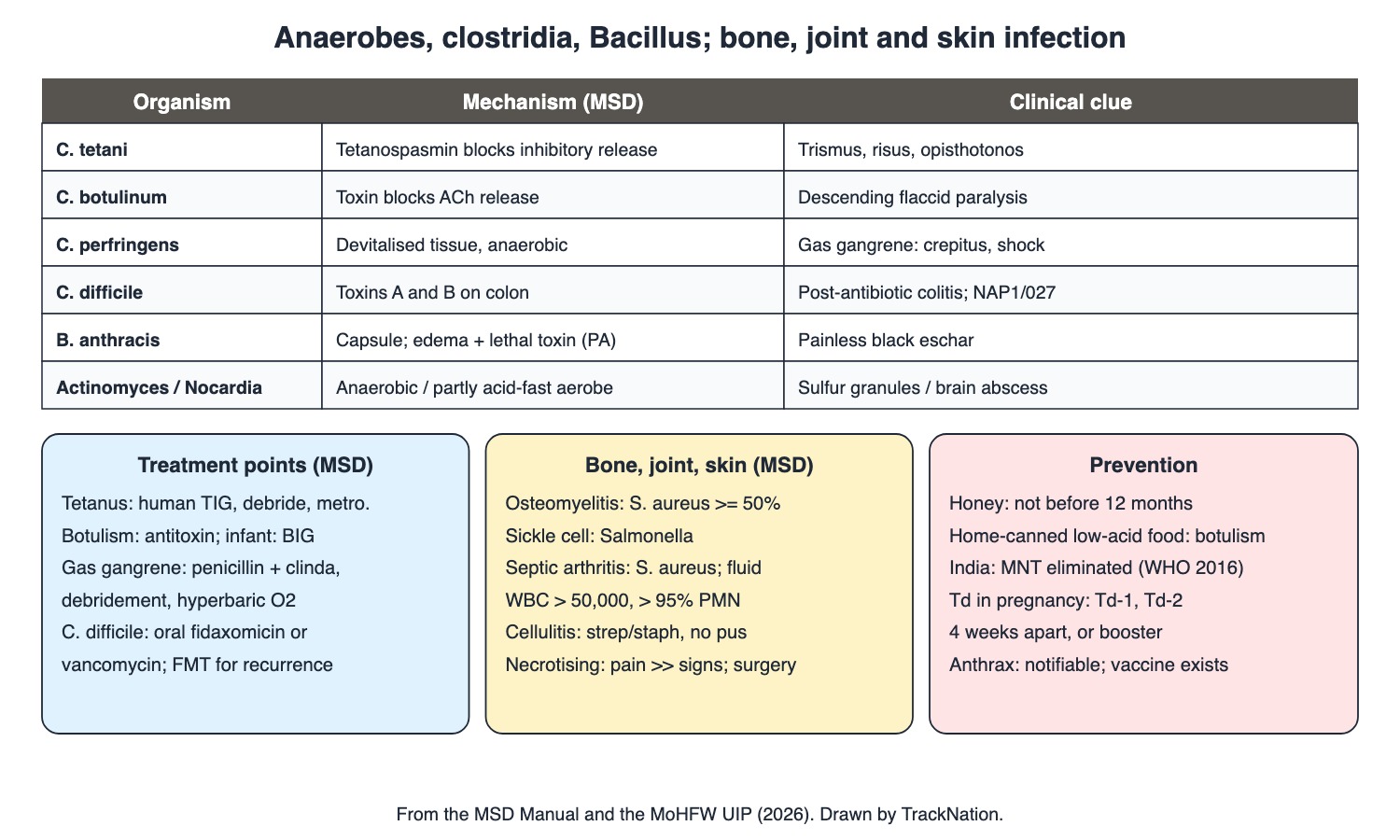
Clostridia, anthrax, actinomycetes and bone, joint and skin infections. Drawn by TrackNation.
Anaerobes and Tetanus (MSD)
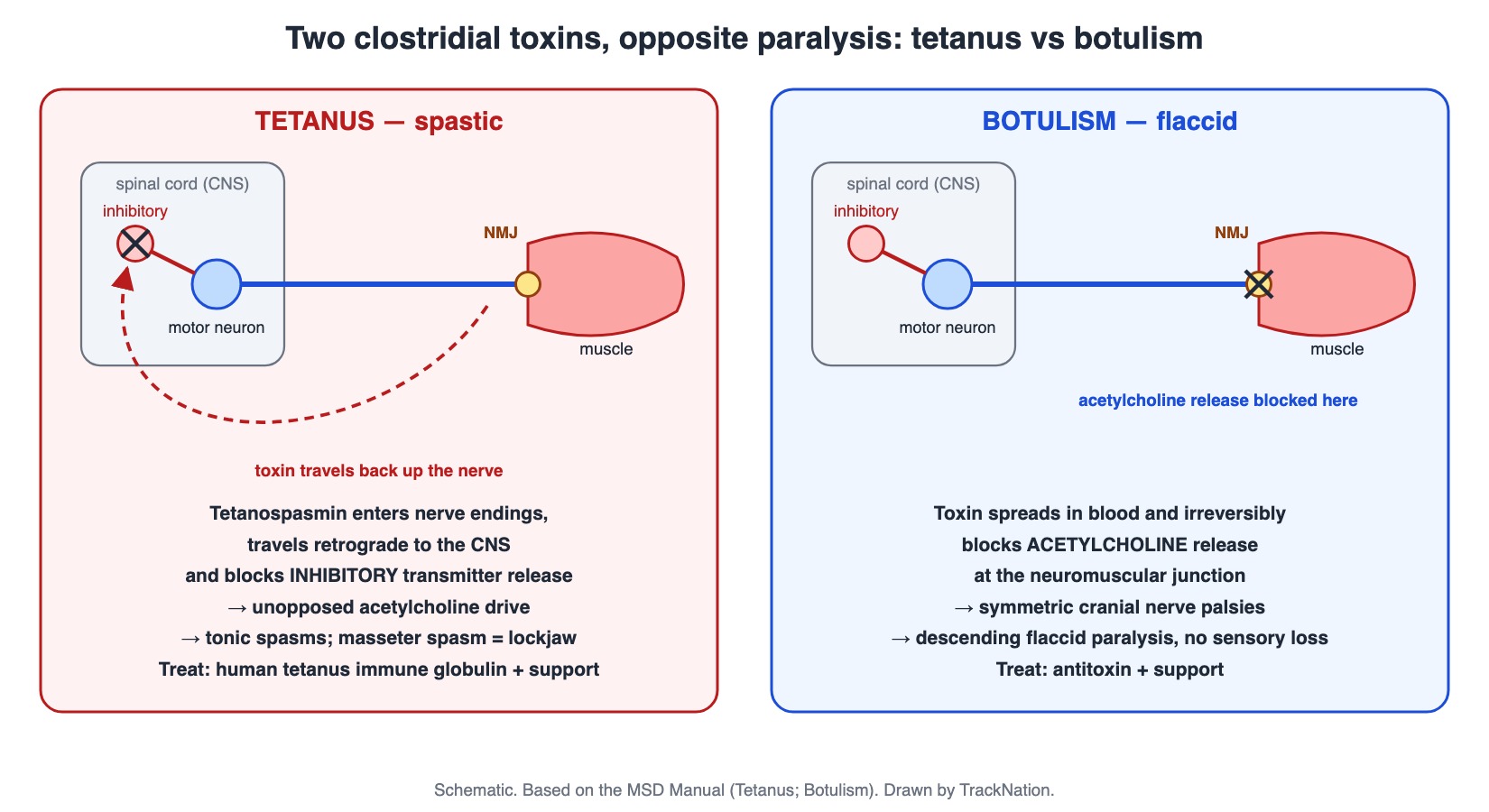
Tetanus vs botulinum toxin: where each acts and why one is spastic, the other flaccid. Drawn by TrackNation.
Obligate anaerobes grow in necrotic, devitalised tissue — oxygen is toxic to them. Suspect them when pus smells foul or Gram stain shows mixed organisms but aerobic cultures are sterile. Bacteroides fragilis (bowel flora) dominates intra-abdominal and pelvic abscesses. Culture anaerobically only from normally sterile sites. Lung abscess: clindamycin or a beta-lactam/beta-lactamase inhibitor.
Tetanus: C. tetani spores in soil and faeces. Tetanospasmin travels retrograde up axons and blocks release of inhibitory transmitters → unopposed contraction. Incubation 2–50 days (average 5–10).
Signs: jaw stiffness (commonest) → trismus/lockjaw, risus sardonicus, opisthotonos, painful spasms, autonomic instability, with an intact sensorium and normal CSF.
Treatment: human tetanus immune globulin (bound toxin cannot be neutralised), wound debridement, metronidazole, intensive care (magnesium sulphate for autonomic storm), and vaccination. India was certified free of maternal and neonatal tetanus by WHO in 2016; pregnant women get Td-1 and Td-2 four weeks apart (or a booster).
Botulism, Gas Gangrene and C. difficile (MSD)
Botulism: toxin blocks acetylcholine release at nerve endings → symmetric cranial nerve palsies and descending flaccid paralysis, no sensory loss, alert mind. Sources: home-canned low-acid food; wound botulism; inhalation. Cooking destroys the toxin but not the spores. Treat with antitoxin and support.
Infant botulism: ingested spores colonise the gut; constipation first (90%), then weakness; linked to honey — no honey before 12 months; treat with human botulism immune globulin.
Gas gangrene (clostridial myonecrosis): C. perfringens after crush or penetrating trauma devitalises tissue; oedema, pain, crepitus, foul exudate, shock. Treat with penicillin + clindamycin and surgical debridement; hyperbaric oxygen may help. C. septicum infection → look for colon cancer.
C. difficile: the commonest cause of antibiotic-associated diarrhoea; toxins A and B → colitis, rarely toxic megacolon or perforation; hypervirulent BI/NAP1/027. Diagnose by stool antigen or toxin; treat with oral fidaxomicin or vancomycin; faecal transplant for frequent recurrence. Infants are often asymptomatic carriers.
Anthrax, Actinomyces and Nocardia (MSD)
Bacillus anthracis: encapsulated, toxin-producing gram-positive spore-former; from infected animals or animal products. Virulence: antiphagocytic capsule, edema toxin and lethal toxin, both entering cells via protective antigen.
Cutaneous (commonest): papule → painless black eschar ("malignant pustule") with oedema. Inhalational: haemorrhagic mediastinitis, shock. Treat with a fluoroquinolone or doxycycline; vaccine available; notifiable.
Actinomyces israelii (anaerobe): abscesses with multiple draining sinuses and sulfur granules; forms — cervicofacial (lumpy jaw, after periodontal disease), thoracic (aspiration), abdominal, pelvic (IUD). Treat with long high-dose penicillin ± drainage.
Nocardia: obligate aerobic, partially acid-fast, beaded, branching gram-positive bacilli; pneumonia in the immunocompromised with brain abscess in ~37%; N. brasiliensis → skin infection. Treat with sulfonamides (co-trimoxazole).
Bone, Joint, Skin and Soft Tissue (MSD)
Osteomyelitis: S. aureus in ≥50%; contiguous spread in diabetic/vascular feet; Salmonella in sickle cell disease; Pseudomonas (and Serratia) in injection-drug users.
Septic arthritis: S. aureus commonest (nongonococcal); gonococcal arthritis is less destructive; Kingella in young children. Synovial fluid usually >50,000 WBC/µL with >95% neutrophils; diagnosis needs fluid analysis and culture.
Cellulitis: streptococci or staphylococci, spreading erythema without pus; erysipelas has sharply demarcated margins; lymphangitis = red streaks to nodes.
Necrotising soft-tissue infection: polymicrobial (type I) or monomicrobial (e.g. streptococcal); pain out of proportion to findings, bullae, crepitus; Fournier gangrene of the perineum; LRINEC score helps but surgery must not wait for tests.
Traps the Examiner Sets
Tetanus = spastic (inhibition blocked); botulism = flaccid (ACh blocked). Both spare consciousness.
Infant botulism starts with constipation; honey is the classic source.
Anthrax eschar is painless; Nocardia is partially acid-fast and aerobic, Actinomyces is anaerobic with sulfur granules.
Antibiotics do not replace debridement in tetanus or gas gangrene.
Salmonella osteomyelitis → sickle cell disease.
Memory Hooks & Shortcuts
Shortcuts to lock in this article's numbers and lists. Each one only re-packages facts proven above.
🧠 'Tetanus Tightens, Botulism Becomes floppy' — inhibitory block vs ACh block — toxins
🧠 'Honey → Hypotonic baby' — infant botulism — infant botulism
🧠 'Perfringens Pops (crepitus) after Pressure (crush)' — gas gangrene
🧠 'Anthrax = Ash-black, Absent pain' — anthrax
🧠 'ActiNOmyces = No Oxygen, Nocardia = Needs Oxygen and is partly acid-fast' — actinomycetes
Rapid-Revision Cards
Anaerobe clue
Foul pus, mixed Gram stain, sterile aerobic culture.
B. fragilis
Intra-abdominal, pelvic abscess.
Tetanospasmin
Blocks inhibitory release; retrograde.
Tetanus signs
Trismus, risus, opisthotonos; alert.
Tetanus incubation
2–50 d (avg 5–10).
Tetanus treatment
Human TIG, debride, metronidazole.
India MNT
Eliminated 2016; Td-1, Td-2 4 wk apart.
Botulism
ACh block; descending flaccid; no sensory loss.
Botulism source
Home-canned low-acid food.
Cooking
Destroys toxin, not spores.
Infant botulism
Honey; constipation; BIG.
Gas gangrene
C. perfringens; crush; crepitus.
Gas gangrene Rx
Penicillin + clindamycin + debridement.
C. septicum
Colon cancer.
C. difficile
Toxins A/B; fidaxomicin or oral vancomycin.
Anthrax toxins
Edema + lethal via protective antigen.
Cutaneous anthrax
Painless black eschar.
Actinomyces
Sulfur granules, sinuses; penicillin.
Nocardia
Partially acid-fast; brain abscess; sulfonamides.
Osteomyelitis
S. aureus ≥50%; sickle → Salmonella.
Septic joint fluid
>50,000 WBC, >95% PMN.
Sources
Facts in this article were checked against these documents.
MSD Manual Professional: Anaerobic Bacteria; Mixed Anaerobic Infections; Tetanus; Botulism; Infant Botulism; Clostridial Soft-Tissue Infections; C. difficile Infection; Anthrax; Actinomycosis; Nocardiosis; Osteomyelitis; Acute Infectious Arthritis; Cellulitis; Necrotizing Soft-Tissue Infection — Merck & Co. (MSD Manuals), 2024–26 (link)
Universal Immunization Programme — Ministry of Health and Family Welfare, Government of India, 2026
Competency Based Undergraduate Curriculum, Vol I: Microbiology (MI5.1–5.3) — National Medical Commission, 2024
Test Yourself: Practice Questions
Thirty questions in NEET PG style, most of them clinical vignettes.
Practice Questions (NEET PG pattern)
Original questions written in the style of the exam: +4 for a correct answer, −1 for a wrong one. Every answer was checked against the sources listed above. NEET PG papers are not published by NBEMS, so these are not past-paper questions.
Q1. Anaerobic infection is suggested when pus
(a) smells foul and shows mixed bacteria on Gram stain but aerobic cultures are sterile
(b) is odourless and sterile
(c) grows on MacConkey agar
(d) contains only gram-positive cocci
Show answer
Answer: (a) — MSD.
Q2. The anaerobe most often isolated from intra-abdominal and pelvic abscesses is
(a) Bacteroides fragilis
(b) Clostridium tetani
(c) Actinomyces israelii
(d) Peptostreptococcus only
Show answer
Answer: (a) — Bowel flora.
Q3. Tetanospasmin causes spasms by
(a) stimulating sensory nerves
(b) blocking acetylcholine release
(c) blocking release of inhibitory neurotransmitters
(d) destroying motor neurons
Show answer
Answer: (c) — Retrograde transport.
Q4. The commonest first symptom of generalised tetanus is
(a) diarrhoea
(b) descending paralysis
(c) jaw stiffness (trismus)
(d) fever with rash
Show answer
Answer: (c) — Lockjaw.
Q5. A man with a puncture wound has trismus, a fixed grin and arching spasms but is fully alert with normal CSF. The key specific treatment is
(a) high-dose steroids
(b) human tetanus immune globulin with wound debridement
(c) botulinum antitoxin
(d) IV acyclovir
Show answer
Answer: (b) — Bound toxin cannot be neutralised.
Q6. The average incubation period of tetanus is
(a) 1–2 months
(b) 6 months
(c) 6–12 hours
(d) 5–10 days
Show answer
Answer: (d) — Range 2–50 days.
Q7. WHO certified India free of maternal and neonatal tetanus in
(a) 2014
(b) 2020
(c) 2016
(d) 2005
Show answer
Answer: (c) — Polio-free certified 2014.
Q8. Botulinum toxin causes weakness by
(a) blocking acetylcholine release at nerve endings
(b) demyelination
(c) blocking inhibitory interneurons
(d) muscle necrosis
Show answer
Answer: (a) — Flaccid.
Q9. After eating home-canned vegetables, a woman develops diplopia, dysphagia and symmetric descending weakness with normal sensation. The diagnosis is
(a) myasthenia gravis
(b) Guillain–Barré syndrome
(c) botulism
(d) tetanus
Show answer
Answer: (c) — Descending.
Q10. Regarding botulism, cooking
(a) destroys the spores but not the toxin
(b) destroys the toxin but not the spores
(c) destroys both
(d) destroys neither
Show answer
Answer: (b) — MSD.
Q11. A 4-month-old fed honey develops constipation followed by weakness. Treatment is
(a) steroids
(b) human botulism immune globulin
(c) penicillin
(d) tetanus immune globulin
Show answer
Answer: (b) — Infant botulism.
Q12. Gas gangrene after a crush injury is most often due to
(a) Clostridium perfringens
(b) Bacillus cereus
(c) C. difficile
(d) C. tetani
Show answer
Answer: (a) — Crepitus.
Q13. Management of clostridial myonecrosis is
(a) penicillin plus clindamycin with surgical debridement
(b) observation
(c) metronidazole alone
(d) antitoxin
Show answer
Answer: (a) — Hyperbaric O2 may help.
Q14. Spontaneous clostridial myonecrosis due to C. septicum should prompt a search for
(a) diabetes
(b) colon cancer
(c) HIV
(d) lung cancer
Show answer
Answer: (b) — Occult colon perforation.
Q15. First-line treatment of C. difficile infection is
(a) IV vancomycin
(b) oral metronidazole only
(c) ciprofloxacin
(d) oral fidaxomicin or vancomycin
Show answer
Answer: (d) — FMT for recurrences.
Q16. The hypervirulent C. difficile strain prominent in hospital outbreaks is
(a) USA300
(b) El Tor
(c) O157:H7
(d) BI/NAP1/027
Show answer
Answer: (d) — More toxin.
Q17. Patients with frequent C. difficile recurrences benefit from
(a) probiotics only
(b) faecal microbiota transplantation
(c) antimotility drugs
(d) more broad-spectrum antibiotics
Show answer
Answer: (b) — MSD.
Q18. Anthrax toxins enter host cells with the help of
(a) protective antigen
(b) M protein
(c) protein A
(d) streptolysin
Show answer
Answer: (a) — Edema and lethal toxins.
Q19. A person who handles animal products develops a painless papule that becomes a black eschar with marked oedema. The organism is
(a) Orientia
(b) Pseudomonas
(c) Bacillus anthracis
(d) Staphylococcus aureus
Show answer
Answer: (c) — Malignant pustule.
Q20. Inhalational anthrax classically causes
(a) pleural empyema
(b) bronchiectasis
(c) haemorrhagic mediastinitis
(d) lobar pneumonia only
Show answer
Answer: (c) — MSD.
Q21. Anthrax is treated empirically with
(a) metronidazole
(b) vancomycin
(c) a fluoroquinolone or doxycycline
(d) penicillin alone
Show answer
Answer: (c) — Notifiable.
Q22. A jaw swelling after periodontal disease discharges pus with granules through multiple sinuses. The organism is
(a) Mycobacterium tuberculosis
(b) Nocardia asteroides
(c) Staphylococcus aureus
(d) Actinomyces israelii
Show answer
Answer: (d) — Lumpy jaw; penicillin.
Q23. Pelvic actinomycosis is associated with
(a) oral contraceptives
(b) pregnancy
(c) tampons
(d) certain intrauterine devices
Show answer
Answer: (d) — MSD.
Q24. A transplant recipient has pneumonia and a brain abscess; sputum shows beaded, branching, partially acid-fast gram-positive rods. Treatment is
(a) antitubercular therapy
(b) a sulfonamide such as co-trimoxazole
(c) penicillin
(d) amphotericin B
Show answer
Answer: (b) — Nocardia.
Q25. The commonest cause of osteomyelitis is
(a) M. tuberculosis
(b) Pseudomonas
(c) Staphylococcus aureus
(d) Salmonella
Show answer
Answer: (c) — ≥50%.
Q26. Osteomyelitis in a child with sickle cell disease is classically due to
(a) Pseudomonas
(b) anaerobes
(c) Salmonella
(d) Kingella
Show answer
Answer: (c) — MSD.
Q27. Synovial fluid in bacterial (nongonococcal) arthritis typically shows
(a) WBC > 50,000/µL with > 95% neutrophils
(b) normal fluid
(c) crystals only
(d) WBC < 2000 with lymphocytes
Show answer
Answer: (a) — Culture essential.
Q28. Erysipelas differs from other cellulitis in having
(a) sharply demarcated raised margins
(b) deep fascial necrosis
(c) purulent drainage
(d) crepitus
Show answer
Answer: (a) — Streptococcal.
Q29. A diabetic has severe leg pain out of proportion to a mild-looking red swelling, with bullae and crepitus. The next step is
(a) MRI before any treatment
(b) topical antibiotics
(c) urgent surgical exploration with IV antibiotics, not waiting for tests
(d) oral antibiotics and review in a week
Show answer
Answer: (c) — Necrotising infection.
Q30. Necrotising infection of the perineum is called
(a) pyoderma gangrenosum
(b) Fournier gangrene
(c) Ludwig angina
(d) Meleney ulcer
Show answer
Answer: (b) — MSD.
Active Recall
From memory: list clues to anaerobic infection, compare tetanus and botulism mechanisms, signs and treatment, describe infant botulism, gas gangrene and C. difficile, explain anthrax virulence and forms, distinguish Actinomyces from Nocardia, and give the organisms and key findings of osteomyelitis, septic arthritis, cellulitis and necrotising infection.