Hepatitis Viruses for NEET PG Microbiology: HAV, HBV Serology, HCV, HDV and HEV, With India's HBV Birth-Dose and Pregnancy Screening
Start Here
🎯 Exam priority: Very high. Expect: which hepatitis viruses are faecal–oral and which become chronic, HBV markers (HBsAg, IgM anti-HBc, anti-HBs, HBeAg) and the window period, chronicity by age at infection, HCC with or without cirrhosis, HCV genotypes and DAAs, HDV coinfection vs superinfection, HEV in pregnancy and pigs, and India's HBsAg screening, HBIG and birth-dose rules.
CBME mapping: MI4.7–4.8. Fact-checked against the MSD Manual, the NACO EVTHS guidelines (2024) and the MoHFW UIP (2026).
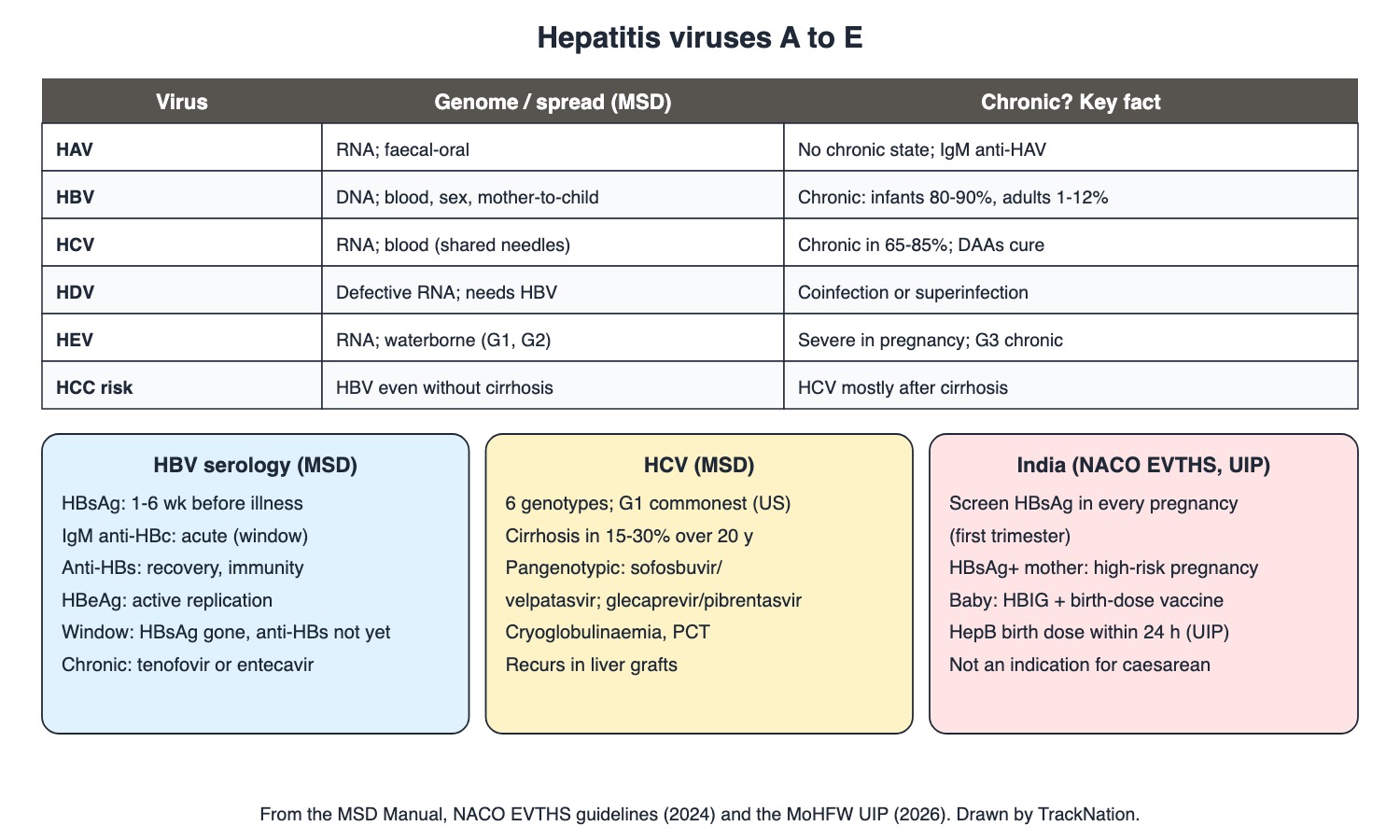
Hepatitis A–E, HBV serology, HCV and Indian prevention. Drawn by TrackNation.
Hepatitis A and E: Faecal–Oral (MSD)
HAV and HEV spread faecal–orally; hepatitis B and C predispose to chronic hepatitis and liver cancer, hepatitis A does not.
HAV: enterically transmitted RNA virus; young children often asymptomatic; no chronic carrier state, no cirrhosis. IgM anti-HAV = acute infection; total anti-HAV = immunity. Immune globulin protects non-immune contacts; vaccine available.
HEV: four genotypes; genotypes 1 and 2 cause waterborne outbreaks (Asia, Africa); genotype 3 is zoonotic (pigs) and can become chronic in the immunocompromised. Liver failure and death are rare except in pregnancy.
Hepatitis B: Serology and Chronicity (MSD)
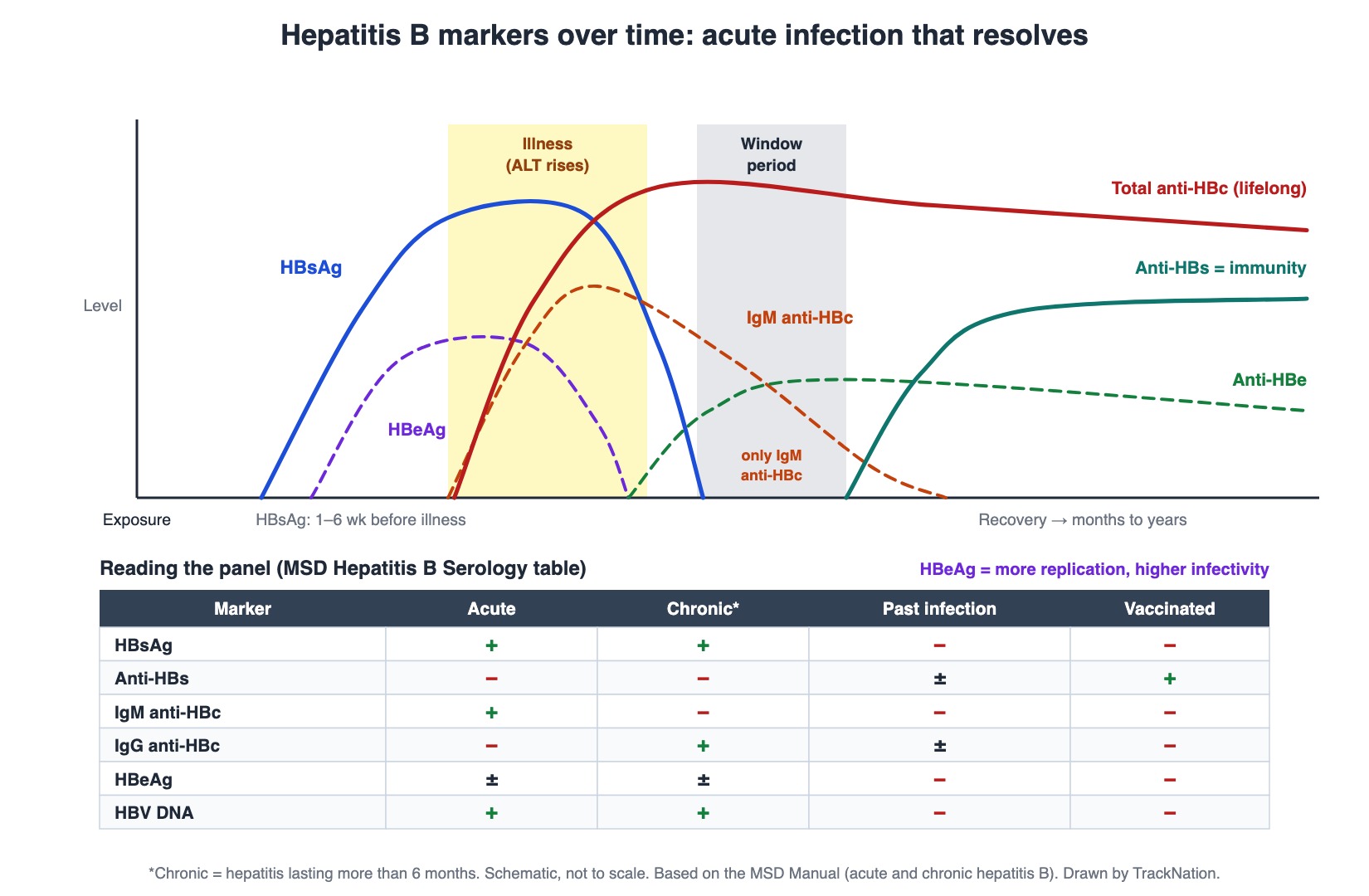
Hepatitis B markers over time, the window period, and how to read the serology panel. Drawn by TrackNation.
HBV is a DNA virus spread parenterally, sexually (body fluids) and from mother to child — babies of infected mothers have a 70–90% risk at delivery without HBIG and vaccine.
Markers: HBsAg appears in the incubation period, 1–6 weeks before illness, and implies infectivity; IgM anti-HBc marks acute infection and fills the window period (HBsAg gone, anti-HBs not yet present); anti-HBs appears after recovery and gives lifelong immunity; HBeAg suggests active replication.
Chronicity depends on age at infection: infants 80–90%, children 1–5 years ~30%, adults 1–12%. HBV can cause hepatocellular carcinoma even without cirrhosis.
Chronic HBV: oral tenofovir or entecavir control but do not cure the virus; tenofovir in the third trimester for high viral loads reduces vertical spread.
Hepatitis C and D (MSD)
HCV: RNA virus spread mainly by blood — shared needles, unsterile tattoos; sexual and vertical spread are uncommon; no vaccine. Acute infection becomes chronic in 65–85%; cirrhosis in 15–30% over 20 years; HCC mostly after cirrhosis.
Six genotypes (genotype 1 commonest in the US). Direct-acting antivirals can permanently clear the virus — pangenotypic sofosbuvir/velpatasvir or glecaprevir/pibrentasvir. Extrahepatic: mixed cryoglobulinaemia, porphyria cutanea tarda; HCV recurs in liver grafts.
HDV (delta agent): a defective RNA virus that replicates only with HBV — as coinfection with acute hepatitis B or superinfection of chronic hepatitis B.
India: Preventing Mother-to-Child HBV (NACO, UIP)
Every pregnant woman is screened for HBsAg at first contact, preferably in the first trimester (and in labour if unscreened).
HBsAg-positive women are high-risk pregnancies delivered at centres with vaccine and HBIG; HBV is not a reason for termination or for caesarean section; refer to NVHCP treatment sites.
The newborn gets HBIG plus the hepatitis B birth-dose vaccine immediately after delivery; under the UIP the birth dose is given as early as possible, within 24 hours.
Traps the Examiner Sets
In the window period HBsAg and anti-HBs are both negative — only IgM anti-HBc is positive.
Anti-HBs alone = immunity (vaccine or recovery); HBsAg = current infection.
The younger the age at HBV infection, the higher the chance of chronic infection.
HEV is dangerous in pregnancy; HAV never becomes chronic.
HDV needs HBV — preventing HBV prevents HDV.
Memory Hooks & Shortcuts
Shortcuts to lock in this article's numbers and lists. Each one only re-packages facts proven above.
🧠 'Vowels hit the Bowels' — hepatitis A and E are faecal–oral — routes
🧠 'B is a DNA Boss; the rest are RNA' — genomes
🧠 Window period: 'S is gone, S-antibody not yet — Core IgM holds the Fort' — HBV serology
🧠 'The younger the host, the longer B stays' — 80–90% of infants, 1–12% of adults — chronicity
🧠 'E for Expectant mothers in danger' — HEV
Rapid-Revision Cards
Faecal–oral
HAV, HEV.
Chronic
HBV, HCV (and HDV).
HAV
RNA; no carrier; IgM anti-HAV acute.
HBV genome
DNA.
HBsAg
1–6 wk before illness; infectivity.
Window period
Only IgM anti-HBc.
Anti-HBs
Recovery or vaccine immunity.
HBeAg
Active replication.
HBV chronicity
Infants 80–90%; adults 1–12%.
Vertical HBV
70–90% without prophylaxis.
HBV + HCC
Even without cirrhosis.
HBV drugs
Tenofovir, entecavir (control).
HCV spread
Needles; sexual/vertical rare; no vaccine.
HCV chronic
65–85%; cirrhosis 15–30%/20 y.
HCV cure
DAAs: sofosbuvir/velpatasvir.
HCV extrahepatic
Cryoglobulinaemia, PCT.
HDV
Needs HBV; co- or superinfection.
HEV
G1/2 waterborne; G3 pigs.
HEV danger
Pregnancy.
NACO HBV
Universal HBsAg in pregnancy; HBIG + vaccine.
UIP HepB
Birth dose within 24 h.
Sources
Facts in this article were checked against these documents.
MSD Manual Professional: Overview of Acute Viral Hepatitis; Hepatitis A; Hepatitis B (acute, chronic); Hepatitis C (acute, chronic); Hepatitis D; Hepatitis E — Merck & Co. (MSD Manuals), 2024–26 (link)
National Guidelines for Elimination of Vertical Transmission of HIV and Syphilis (chapter 8: Hepatitis B) — National AIDS Control Organisation, MoHFW, 2024
Universal Immunization Programme — Ministry of Health and Family Welfare, Government of India, 2026
Competency Based Undergraduate Curriculum, Vol I: Microbiology (MI4.7–4.8) — National Medical Commission, 2024
Test Yourself: Practice Questions
Thirty questions in NEET PG style, many of them clinical and serology scenarios.
Practice Questions (NEET PG pattern)
Original questions written in the style of the exam: +4 for a correct answer, −1 for a wrong one. Every answer was checked against the sources listed above. NEET PG papers are not published by NBEMS, so these are not past-paper questions.
Q1. Hepatitis viruses spread mainly by the faecal–oral route are
(a) C and D
(b) B and D
(c) B and C
(d) A and E
Show answer
Answer: (d) — MSD.
Q2. Hepatitis A
(a) is a DNA virus
(b) becomes chronic in 10%
(c) has no chronic carrier state
(d) causes HCC
Show answer
Answer: (c) — MSD.
Q3. Acute hepatitis A is diagnosed by
(a) HBsAg
(b) HAV culture
(c) total anti-HAV
(d) IgM anti-HAV
Show answer
Answer: (d) — Total = immunity.
Q4. Hepatitis B virus has a genome of
(a) positive-sense RNA
(b) DNA
(c) defective RNA
(d) negative-sense RNA
Show answer
Answer: (b) — MSD.
Q5. The first serological marker to appear in acute HBV, before symptoms, is
(a) anti-HBs
(b) anti-HBe
(c) HBsAg
(d) IgG anti-HBc
Show answer
Answer: (c) — 1–6 weeks before illness.
Q6. During the window period of acute hepatitis B, the only positive marker is
(a) HBsAg
(b) anti-HBs
(c) HBeAg
(d) IgM anti-HBc
Show answer
Answer: (d) — MSD.
Q7. A vaccinated health worker who never had hepatitis B will be positive for
(a) anti-HBs only
(b) HBsAg
(c) IgM anti-HBc
(d) HBeAg
Show answer
Answer: (a) — Anti-HBs = immunity.
Q8. Presence of HBeAg in an HBsAg-positive patient suggests
(a) recovery
(b) HDV superinfection
(c) immunity
(d) active viral replication and high infectivity
Show answer
Answer: (d) — MSD.
Q9. The risk of chronic infection after acute HBV is highest when infection occurs in
(a) adulthood
(b) old age
(c) adolescence
(d) infancy (80–90%)
Show answer
Answer: (d) — Adults 1–12%.
Q10. Without prophylaxis, a baby born to an HBV-infected mother has a risk of infection at delivery of about
(a) 25%
(b) 5%
(c) 70–90%
(d) under 1%
Show answer
Answer: (c) — Give HBIG + vaccine.
Q11. Hepatocellular carcinoma can develop even without cirrhosis in
(a) hepatitis D alone
(b) hepatitis A
(c) acute hepatitis E
(d) chronic hepatitis B
Show answer
Answer: (d) — HCV mostly after cirrhosis.
Q12. Chronic hepatitis B is treated with
(a) ribavirin
(b) interferon only as a cure
(c) tenofovir or entecavir, which control but do not cure
(d) sofosbuvir
Show answer
Answer: (c) — MSD.
Q13. The commonest route of hepatitis C transmission is
(a) sharing needles and other blood exposure
(b) faecal–oral
(c) mother to child
(d) sexual contact
Show answer
Answer: (a) — Sexual and vertical are uncommon.
Q14. The proportion of acute hepatitis C infections that become chronic is
(a) 20%
(b) 100%
(c) 1–5%
(d) 65–85%
Show answer
Answer: (d) — MSD.
Q15. A vaccine is available for all EXCEPT
(a) hepatitis A
(b) none
(c) hepatitis B
(d) hepatitis C
Show answer
Answer: (d) — No HCV vaccine.
Q16. Chronic hepatitis C can now be permanently cleared with
(a) tenofovir
(b) interferon-gamma
(c) direct-acting antivirals such as sofosbuvir/velpatasvir
(d) acyclovir
Show answer
Answer: (c) — Pangenotypic.
Q17. An extrahepatic manifestation typical of chronic HCV is
(a) Reye syndrome
(b) erythema nodosum leprosum
(c) aplastic anaemia only
(d) mixed cryoglobulinaemia
Show answer
Answer: (d) — Also PCT.
Q18. Chronic HCV leads to cirrhosis in about
(a) 15–30% over 20 years
(b) 50% in 1 year
(c) 1% ever
(d) 90% in 5 years
Show answer
Answer: (a) — MSD.
Q19. Hepatitis D can replicate only in the presence of
(a) hepatitis C virus
(b) HIV
(c) hepatitis A virus
(d) hepatitis B virus
Show answer
Answer: (d) — Defective RNA.
Q20. HDV infecting a person who already has chronic hepatitis B is called
(a) seroconversion
(b) reactivation
(c) superinfection
(d) coinfection
Show answer
Answer: (c) — Coinfection = with acute HBV.
Q21. Waterborne epidemics of hepatitis in India and Asia are typically due to
(a) HDV
(b) HAV only
(c) HCV
(d) HEV genotypes 1 and 2
Show answer
Answer: (d) — Faecal contamination of water.
Q22. Hepatitis E is especially dangerous in
(a) vaccinated adults
(b) smokers
(c) children under 5
(d) pregnancy
Show answer
Answer: (d) — MSD.
Q23. The main animal reservoir of zoonotic HEV is the
(a) bat
(b) rat
(c) pig
(d) monkey
Show answer
Answer: (c) — Genotype 3.
Q24. Chronic hepatitis E has been reported in
(a) children only
(b) immunocompromised patients such as transplant recipients
(c) never
(d) all pregnant women
Show answer
Answer: (b) — Genotype 3.
Q25. Under NACO's EVTHS guidelines, HBsAg screening in pregnancy is
(a) only in labour
(b) only for high-risk women
(c) universal, preferably in the first trimester
(d) not recommended
Show answer
Answer: (c) — NACO 2024.
Q26. An HBsAg-positive pregnant woman should be
(a) given hepatitis B vaccine for herself
(b) managed as a high-risk pregnancy with delivery where HBIG and vaccine are available
(c) delivered by caesarean routinely
(d) offered termination
Show answer
Answer: (b) — NACO.
Q27. The newborn of an HBsAg-positive mother should receive
(a) nothing until tested
(b) vaccine at 6 weeks only
(c) HBIG alone
(d) HBIG plus hepatitis B vaccine immediately after delivery
Show answer
Answer: (d) — NACO.
Q28. Under India's UIP, the hepatitis B birth dose is given
(a) at 6 weeks
(b) at 9 months
(c) only to high-risk babies
(d) as early as possible, within 24 hours
Show answer
Answer: (d) — UIP 2026.
Q29. The commonest mode of hepatitis B spread emphasised in NACO counselling is
(a) mosquitoes
(b) mother to newborn
(c) casual contact
(d) food
Show answer
Answer: (b) — NACO.
Q30. Non-immune household contacts of a patient with hepatitis A can be protected by
(a) HBIG
(b) standard immune globulin (or vaccine)
(c) nothing works
(d) acyclovir
Show answer
Answer: (b) — MSD.
Active Recall
From memory: give the genome, route and chronicity of hepatitis A to E, explain the HBV serological markers and window period, state chronicity by age and cancer risk, outline HCV genotypes and treatment, distinguish HDV coinfection from superinfection, describe HEV, and state India's HBV screening and newborn prophylaxis policy.