General Virology and Herpesviruses for NEET PG Microbiology: Virus Structure, Replication, HSV, VZV, EBV, CMV, HHV-6/8 and Prions
Start Here
🎯 Exam priority: High. Expect: naked vs enveloped viruses, Baltimore groups, replication steps and latency, how viruses are cultured, viroid vs virusoid (HDV), prion diseases, the herpesvirus number and latency site, Tzanck smear, chickenpox infectivity and incubation, Reye syndrome, zoster signs (Hutchinson, Ramsay Hunt), heterophile test limits, CMV owl's-eye cells, roseola timing and HHV-8.
CBME mapping: MI1.2, MI5.5. Fact-checked against OpenStax Microbiology (chapter 6) and the MSD Manual.
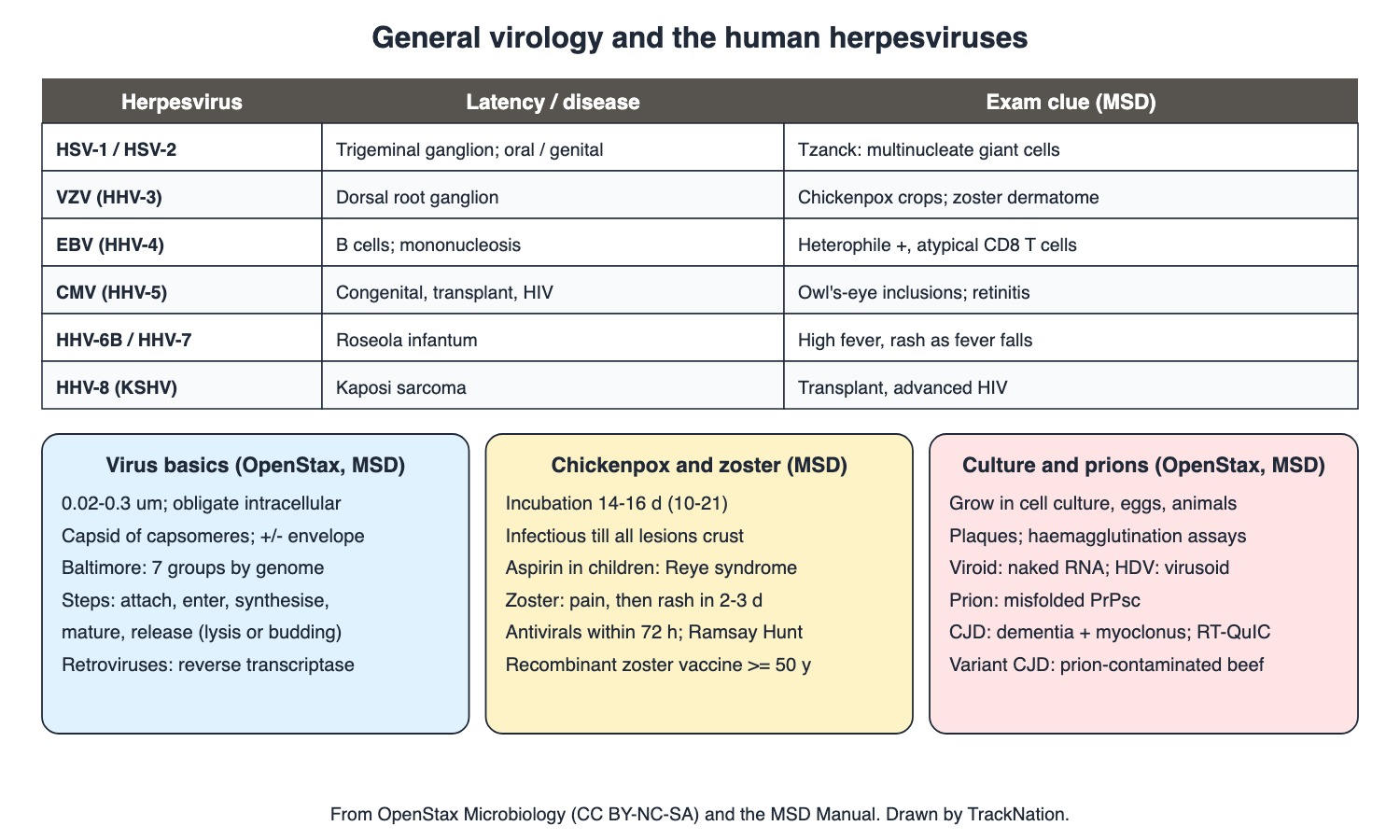
Virus basics, herpesviruses and prions. Drawn by TrackNation.
Virus Structure and Replication (OpenStax, MSD)
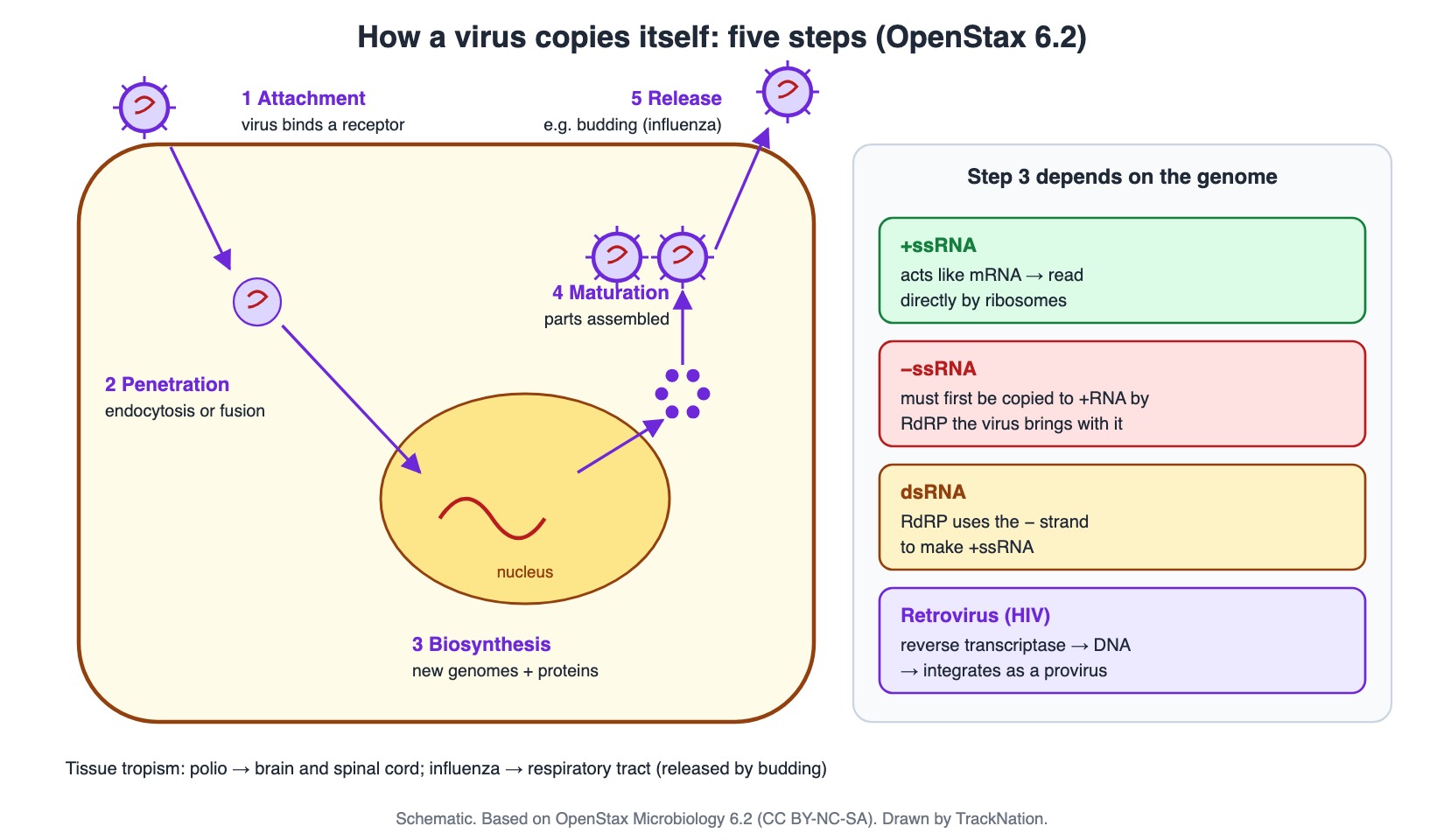
The five steps of viral replication and how each genome type makes its proteins. Drawn by TrackNation.
Viruses are among the smallest microbes (0.02–0.3 µm) and depend completely on host cells. Discovery: Ivanovski (1892) and Beijerinck (1899) with tobacco mosaic disease.
A capsid made of capsomeres encloses DNA or RNA; naked viruses have only capsid and genome, while enveloped viruses carry host membrane picked up as they bud.
Baltimore classification sorts viruses into seven groups by genome (DNA/RNA, single/double strand, positive or negative sense, replication route). Retroviruses carry reverse transcriptase and integrate a DNA copy into the host genome.
Replication: attachment (receptors set tissue tropism) → entry → biosynthesis → maturation → release by lysis or budding. Persistent infection is latent (genome present, no replication) or chronic. Infected cells release interferons.
Culture: cell culture (primary cells or lines), embryonated eggs (most influenza vaccine), or animals; counted as plaques; many viruses haemagglutinate red cells.
Sub-viral agents: viroids — short circular RNA only (plant disease); virusoids need a helper virus — hepatitis D needs hepatitis B. Prions are misfolded PrPsc that convert normal protein; human TSEs: kuru, fatal familial insomnia, GSS and CJD; resistant to heat, chemicals and radiation.
Herpes Simplex and Varicella-Zoster (MSD)
Herpesviruses are dsDNA viruses giving lifelong infection with lytic and latent phases; eight infect humans.
HSV-1: gingivostomatitis, herpes labialis (latent in the trigeminal ganglion), keratitis, herpetic whitlow; HSV-2: genital lesions. Clusters of painful vesicles on a red base; severe forms — encephalitis, meningitis, neonatal herpes. Tzanck smear shows multinucleate giant cells (HSV or VZV) but is insensitive. Treat with acyclovir, valacyclovir or famciclovir.
Chickenpox (VZV = HHV-3): extremely contagious; incubation 14–16 days (10–21); lesions in crops (macule → papule → vesicle → crust); infectious until all lesions crust. Aspirin in children risks Reye syndrome.
Herpes zoster: reactivation from the dorsal root ganglion — dermatomal pain, then vesicles in 2–3 days; antivirals best within 72 hours; postherpetic neuralgia. Nose-tip vesicles (Hutchinson sign) warn of eye involvement; Ramsay Hunt (geniculate ganglion) — ear vesicles, facial palsy. Recombinant zoster vaccine for adults ≥50.
EBV, CMV, HHV-6/7 and HHV-8 (MSD)
EBV (HHV-4): spread in saliva (kissing); infects B cells; the atypical lymphocytes are mainly reactive CD8 T cells. Fever, pharyngitis, nodes, fatigue; risks — airway obstruction, splenic rupture (no contact sports for a month). Heterophile (Monospot) is positive in 85–90% of adolescents/adults but only ~50% of children aged 2–5. Linked to Burkitt lymphoma, nasopharyngeal carcinoma. Primary HIV can mimic it.
CMV (HHV-5): mononucleosis-like illness without much pharyngitis; severe in neonates, transplant recipients and HIV (retinitis); "owl's eye" inclusions; treat with ganciclovir/valganciclovir.
Roseola infantum: HHV-6B (less often HHV-7) — high fever, then a rash during or after defervescence; febrile seizures possible.
HHV-8 (KSHV): Kaposi sarcoma, much more likely with transplantation or advanced HIV.
CJD: rapidly progressive dementia with myoclonus; CSF RT-QuIC; variant CJD from prion-contaminated beef; iatrogenic from corneal or dural grafts.
Traps the Examiner Sets
The atypical lymphocytes of mononucleosis are T cells, though EBV infects B cells.
A negative Monospot in a young child does not exclude EBV.
Roseola rash appears as the fever falls; chickenpox lesions are in different stages at once.
Hepatitis D cannot infect without hepatitis B.
Prions survive standard sterilisation (article 03).
Memory Hooks & Shortcuts
Shortcuts to lock in this article's numbers and lists. Each one only re-packages facts proven above.
🧠 Herpes ladder 'Simple Simple Varicella Epstein Cyto Rose Rose Kaposi' = HHV-1 to HHV-8 — herpesviruses
🧠 'Roseola: Rash Rises as temperature Retreats' — roseola
🧠 'Hutchinson's Hooter warns of the eye' — nose-tip zoster — zoster
🧠 'D needs B' — hepatitis D needs hepatitis B — HDV
🧠 'Owls watch CMV' — CMV
Rapid-Revision Cards
Virus size
0.02–0.3 µm.
Naked vs enveloped
Envelope from host membrane on budding.
Baltimore
7 groups by genome.
Retrovirus
Reverse transcriptase; provirus.
Culture
Cells, eggs, animals; plaques.
Viroid
Circular RNA only.
HDV
Needs HBV.
Prion diseases
Kuru, FFI, GSS, CJD.
CJD
Dementia + myoclonus; RT-QuIC.
Herpesviruses
8 types; dsDNA; latency.
HSV-1 latency
Trigeminal ganglion.
Tzanck
Giant cells; HSV/VZV.
Chickenpox
Crops; incubation 14–16 d; crusted = non-infectious.
Reye
Aspirin + varicella/flu.
Zoster
DRG reactivation; antivirals <72 h.
Hutchinson sign
Nose tip → eye risk.
Ramsay Hunt
Geniculate; facial palsy.
EBV
B cells; atypical CD8 T; Monospot 50% under 5.
CMV
Owl's eye; ganciclovir.
Roseola
HHV-6B; rash as fever falls.
HHV-8
Kaposi sarcoma.
Sources
Facts in this article were checked against these documents.
Microbiology (sections 6.1–6.4) — Parker N, Schneegurt M, Thi Tu A-H, Lister P, Forster BM (OpenStax), 2016 (link)
MSD Manual Professional: Overview of Viruses; Herpesviruses; HSV; Chickenpox; Herpes Zoster; Infectious Mononucleosis; CMV; Roseola Infantum; Kaposi Sarcoma; CJD — Merck & Co. (MSD Manuals), 2024–26 (link)
Competency Based Undergraduate Curriculum, Vol I: Microbiology (MI1.2, MI5.5) — National Medical Commission, 2024
Test Yourself: Practice Questions
Thirty questions in NEET PG style, many of them clinical vignettes.
Practice Questions (NEET PG pattern)
Original questions written in the style of the exam: +4 for a correct answer, −1 for a wrong one. Every answer was checked against the sources listed above. NEET PG papers are not published by NBEMS, so these are not past-paper questions.
Q1. The typical size range of viruses is
(a) 5–10 µm
(b) 10–50 µm
(c) 0.02–0.3 µm
(d) 1–5 µm
Show answer
Answer: (c) — MSD.
Q2. A virus whose particle has only a capsid and genome is
(a) a prion
(b) enveloped
(c) a viroid
(d) naked (non-enveloped)
Show answer
Answer: (d) — OpenStax.
Q3. The viral envelope is derived from
(a) host cell membrane as the virion buds
(b) bacterial wall
(c) viral nucleic acid
(d) capsomeres
Show answer
Answer: (a) — OpenStax.
Q4. The Baltimore system classifies viruses by
(a) genome type and replication strategy into seven groups
(b) host range
(c) size only
(d) disease caused
Show answer
Answer: (a) — OpenStax.
Q5. Retroviruses copy their RNA genome into DNA using
(a) integrase alone
(b) reverse transcriptase
(c) RNA replicase
(d) DNA ligase
Show answer
Answer: (b) — Provirus integrates.
Q6. Most annual influenza vaccine is grown in
(a) plants
(b) embryonated hens' eggs
(c) human volunteers
(d) bacterial culture
Show answer
Answer: (b) — OpenStax.
Q7. Clumping of red cells by viral surface spikes is
(a) cytolysis
(b) flocculation
(c) haemagglutination
(d) plaque formation
Show answer
Answer: (c) — OpenStax.
Q8. An infectious agent made only of short circular self-replicating RNA is a
(a) plasmid
(b) prion
(c) virusoid
(d) viroid
Show answer
Answer: (d) — Plant disease.
Q9. Hepatitis D virus requires co-infection with
(a) HIV
(b) hepatitis B virus
(c) hepatitis A virus
(d) hepatitis C virus
Show answer
Answer: (b) — Helper virus.
Q10. Human prion diseases include
(a) SSPE
(b) rabies
(c) kuru, fatal familial insomnia and CJD
(d) PML
Show answer
Answer: (c) — TSEs.
Q11. A 65-year-old has rapidly progressive dementia with myoclonus. The CSF test that detects prion activity is
(a) RT-QuIC
(b) oligoclonal bands
(c) VDRL
(d) PCR for HSV
Show answer
Answer: (a) — CJD.
Q12. The number of herpesvirus types that infect humans is
(a) three
(b) eight
(c) twelve
(d) five
Show answer
Answer: (b) — dsDNA, lifelong.
Q13. After herpes labialis, HSV-1 remains latent in the
(a) trigeminal ganglion
(b) salivary glands
(c) B lymphocytes
(d) dorsal root ganglion of T4
Show answer
Answer: (a) — MSD.
Q14. A Tzanck smear from a vesicle base shows
(a) multinucleate giant cells (HSV or VZV)
(b) Negri bodies
(c) owl's-eye inclusions
(d) Donovan bodies
Show answer
Answer: (a) — Low sensitivity.
Q15. A painful, swollen, red fingertip with vesicles is
(a) paronychia by Candida
(b) cutaneous anthrax
(c) herpetic whitlow
(d) erysipeloid
Show answer
Answer: (c) — HSV inoculation.
Q16. The incubation period of chickenpox averages
(a) 30–40 days
(b) 2–3 days
(c) 14–16 days
(d) 6–12 hours
Show answer
Answer: (c) — Range 10–21.
Q17. A child with chickenpox may return to school when
(a) all lesions have crusted
(b) fever settles
(c) after 3 days regardless
(d) new lesions appear
Show answer
Answer: (a) — MSD.
Q18. A child given aspirin during chickenpox develops vomiting and encephalopathy a week later. This is
(a) SSPE
(b) Guillain–Barré
(c) Reye syndrome
(d) varicella pneumonia
Show answer
Answer: (c) — Avoid aspirin.
Q19. Herpes zoster results from reactivation of VZV latent in the
(a) liver
(b) trigeminal nucleus
(c) B cells
(d) dorsal root ganglion
Show answer
Answer: (d) — Dermatome.
Q20. Vesicles on the tip of the nose in ophthalmic zoster (Hutchinson sign) indicate
(a) trigeminal motor palsy
(b) Ramsay Hunt syndrome
(c) nasociliary involvement and higher risk of eye disease
(d) a mild course
Show answer
Answer: (c) — Refer to ophthalmology.
Q21. Ear pain, vesicles in the ear canal and facial palsy are due to zoster of the
(a) gasserian ganglion
(b) ciliary ganglion
(c) geniculate ganglion (Ramsay Hunt)
(d) spinal T1
Show answer
Answer: (c) — Herpes zoster oticus.
Q22. Antivirals for zoster work best when started within
(a) 24 hours of exposure only
(b) 72 hours of rash
(c) 2 weeks
(d) 1 month
Show answer
Answer: (b) — MSD.
Q23. In infectious mononucleosis, EBV infects
(a) red cells
(b) neutrophils
(c) T cells only
(d) B lymphocytes, and the atypical cells are mainly CD8 T cells
Show answer
Answer: (d) — MSD.
Q24. A 4-year-old with fever, sore throat and splenomegaly has a negative Monospot. This
(a) proves CMV
(b) excludes EBV
(c) proves HIV
(d) does not exclude EBV, as heterophile antibodies appear in only ~50% at this age
Show answer
Answer: (d) — 85–90% in adolescents.
Q25. A teenager with mononucleosis should avoid contact sports for at least a month because of risk of
(a) airway collapse only
(b) hepatic failure
(c) myocarditis
(d) splenic rupture
Show answer
Answer: (d) — MSD.
Q26. EBV is associated with
(a) hepatocellular carcinoma
(b) cervical cancer
(c) Burkitt lymphoma and nasopharyngeal carcinoma
(d) Kaposi sarcoma
Show answer
Answer: (c) — MSD.
Q27. 'Owl's eye' intranuclear inclusions on biopsy indicate
(a) cytomegalovirus
(b) HSV
(c) adenovirus only
(d) rabies
Show answer
Answer: (a) — MSD.
Q28. A kidney transplant recipient with CMV disease is treated first-line with
(a) oseltamivir
(b) acyclovir
(c) IV ganciclovir or oral valganciclovir
(d) ribavirin
Show answer
Answer: (c) — MSD.
Q29. An infant has high fever without localising signs; as the fever falls a rubelliform rash appears. The cause is
(a) measles
(b) rubella
(c) HHV-6B (roseola infantum)
(d) parvovirus B19
Show answer
Answer: (c) — Febrile seizures possible.
Q30. Kaposi sarcoma is caused by
(a) HHV-8
(b) EBV
(c) HPV
(d) HHV-6
Show answer
Answer: (a) — Transplant, advanced HIV.
Active Recall
From memory: describe virus structure, Baltimore groups, replication and persistence, how viruses are cultured, viroids, HDV and prions, then list the eight herpesviruses with their latency site, key diseases, diagnostic clues and treatment.