Arboviruses, Rabies, Polio and Enteroviruses for NEET PG Microbiology: Dengue, Chikungunya, JE, KFD, India's Rabies Prophylaxis and HFMD
Start Here
🎯 Exam priority: High. Expect: vector–virus matching (Aedes, Culex, Haemaphysalis), dengue tests by day of illness and warning signs, chikungunya genus and arthritis, JE amplifying hosts, rabies categories, ID and IM schedules and wound care, polio paralysis features and cVDPV, and which coxsackie/enterovirus causes which syndrome.
CBME mapping: MI6.2, MI9.1, MI9.5. Fact-checked against the MSD Manual, NCVBDC dengue and chikungunya guidelines (2023), the AES/JE guidance, India's National Guidelines on Rabies Prophylaxis and the UIP.
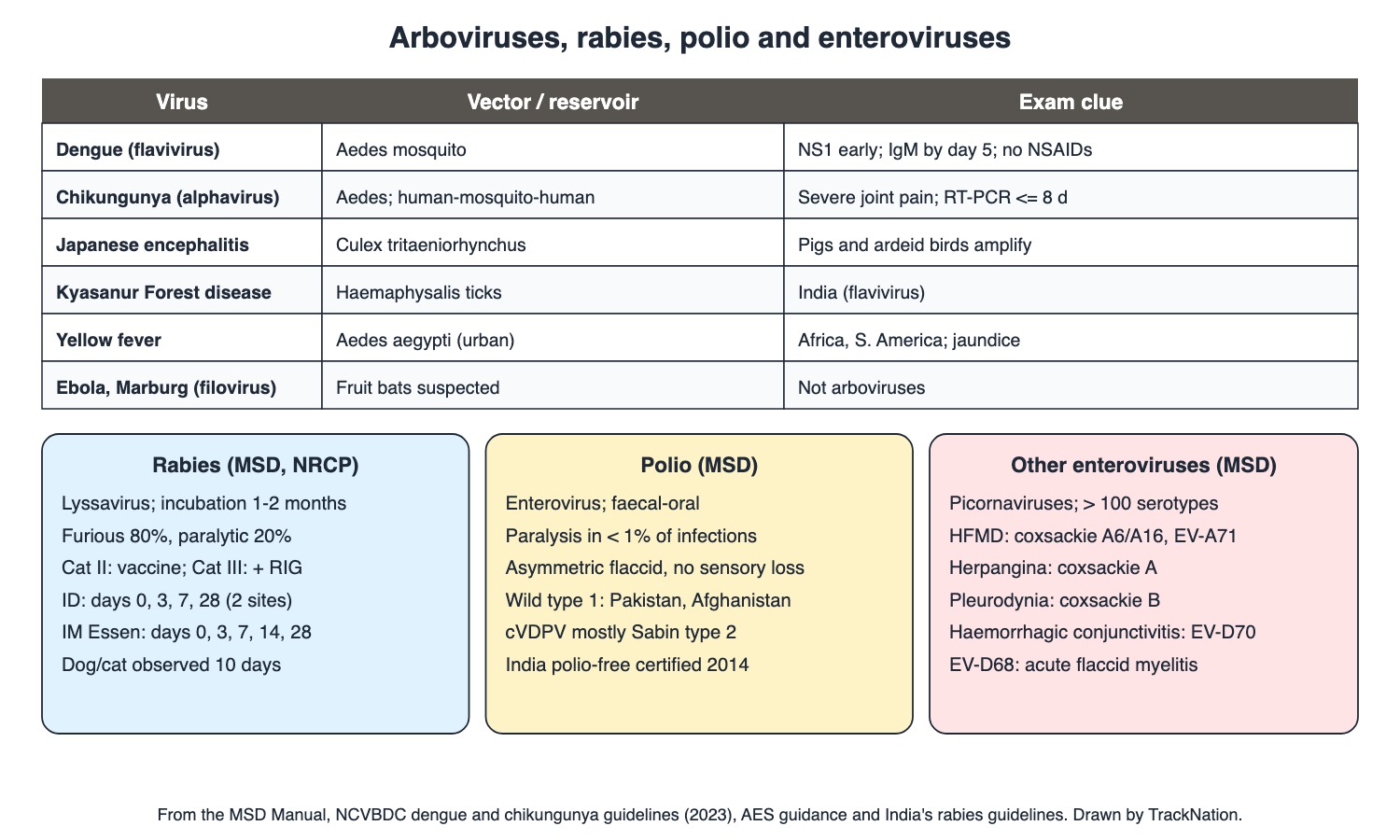
Arboviruses, rabies, polio and enteroviruses. Drawn by TrackNation.
Mosquito- and Tick-Borne Viruses (MSD, NCVBDC)
Dengue: a flavivirus spread by Aedes. Tests: NS1 antigen and PCR early; IgM (MAC-ELISA) is usually detectable by day 5. Warning signs: abdominal pain, persistent vomiting, mucosal bleeding, hepatomegaly, lethargy/restlessness, haemoconcentration → risk of severe dengue; with shock it is dengue shock syndrome. Use paracetamol; avoid NSAIDs and aspirin.
Chikungunya: Alphavirus (Togaviridae) spread by Aedes aegypti (and albopictus) in a human–mosquito–human cycle; first isolated in Tanzania (1953); hallmark severe joint pain; RT-PCR in the first 8 days.
Japanese encephalitis: spread by Culex tritaeniorhynchus / vishnui; pigs and water birds (Ardeidae) are the main reservoirs; epidemic potential and high fatality.
Kyasanur Forest disease (India): flavivirus spread by Haemaphysalis ticks. Yellow fever: urban cycle by Aedes aegypti, endemic in tropical South America and sub-Saharan Africa — relative bradycardia, jaundice, haemorrhage; never biopsy the liver during illness.
Not arboviruses: filoviruses (Ebola, Marburg — fruit bats suspected) and arenaviruses (Lassa — rodents; person-to-person spread possible).
Rabies (MSD, National Rabies Guidelines)
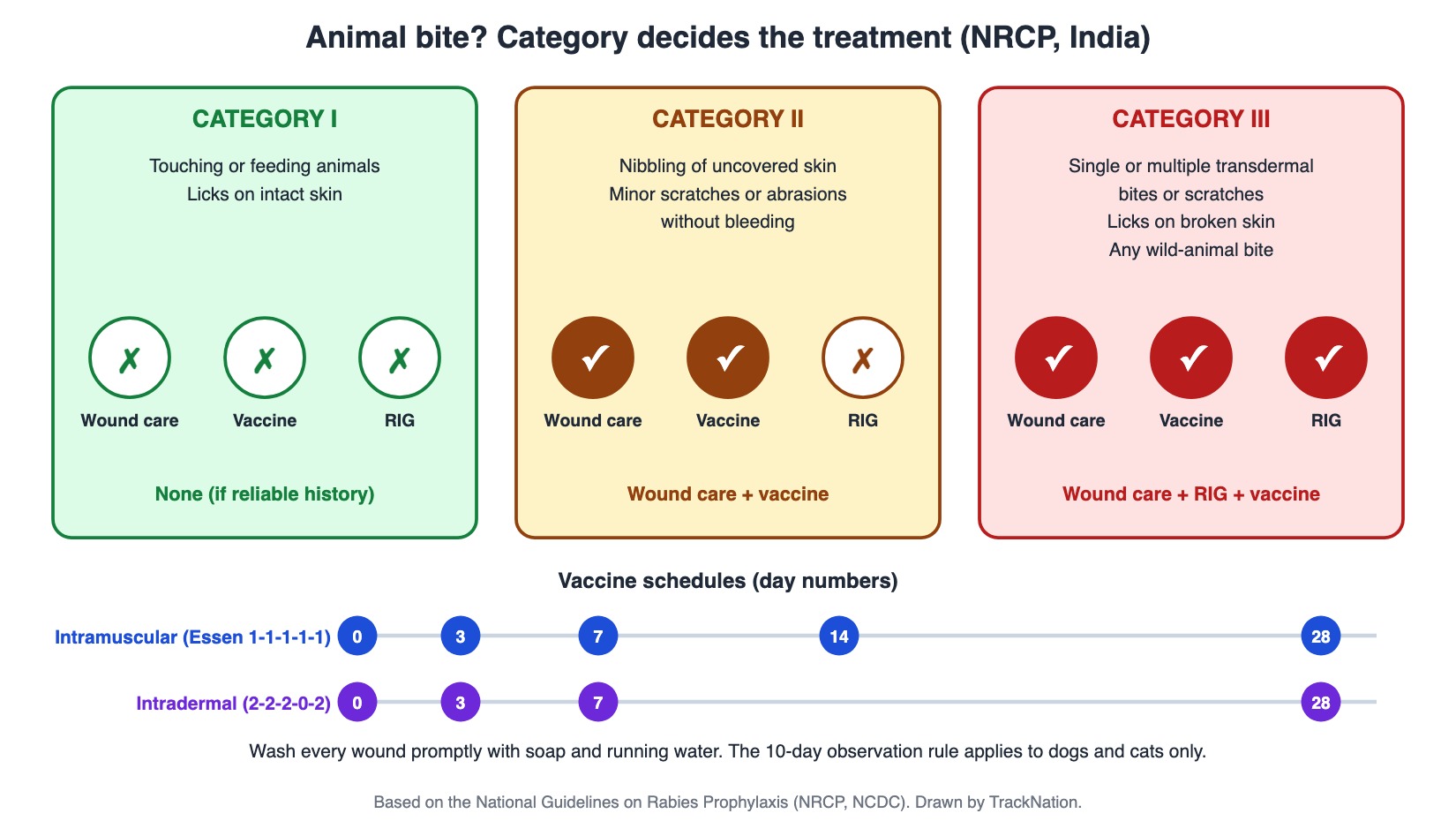
Rabies exposure categories I–III and the vaccine schedules (NRCP). Drawn by TrackNation.
Lyssavirus (Rhabdoviridae); >59,000 deaths a year, mostly in Africa and Asia. Incubation 1–2 months (can exceed a year). Furious (encephalitic, 80%) with hydrophobia or paralytic (dumb, 20%). Diagnosis: skin biopsy fluorescent antibody or PCR. Almost universally fatal once symptomatic; prompt PEP almost always prevents it.
Exposure categories: I — touching, feeding, licks on intact skin → nothing; II — nibbling uncovered skin, minor scratches without bleeding → wound care + vaccine; III — transdermal bites or scratches, licks on broken skin → wound care + rabies immunoglobulin + vaccine.
Wounds: wash; no cauterisation; delay suturing a few hours; infiltrate RIG into and around category III wounds.
Vaccine: intradermal Updated Thai Red Cross (2-2-2-0-2) — two sites on days 0, 3, 7 and 28; intramuscular Essen (1-1-1-1-1) — days 0, 3, 7, 14, 28. The 10-day observation rule applies only to dogs and cats, and PEP starts immediately anyway.
Polio and Other Enteroviruses (MSD, UIP)
Poliovirus (an enterovirus) spreads faecal–orally; most infections are silent or minor; paralysis in <1% — asymmetric flaccid limb paralysis or bulbar palsy without sensory loss.
Wild type 1 remains endemic in Pakistan and Afghanistan; circulating vaccine-derived poliovirus is mostly Sabin type 2. India was certified polio-free in March 2014.
Enteroviruses are picornaviruses (>100 serotypes). HFMD — coxsackie A6/A16 and EV-A71 (EV-A71 worse); herpangina — group A coxsackie, posterior pharyngeal ulcers; pleurodynia (Bornholm) — coxsackie B; acute haemorrhagic conjunctivitis — EV-D70, coxsackie A24; EV-D68 — respiratory illness and acute flaccid myelitis; myocarditis and aseptic meningitis also occur.
Traps the Examiner Sets
Early dengue: NS1 positive, IgM may still be negative.
JE: Culex, not Aedes; pigs amplify.
Category III needs RIG; a lick on broken skin is category III.
Polio paralysis is asymmetric and spares sensation.
Ebola and Lassa are not arboviruses.
Memory Hooks & Shortcuts
Shortcuts to lock in this article's numbers and lists. Each one only re-packages facts proven above.
🧠 'Aedes carries the A-list: dengue, chikungunya, yellow fever; Culex Carries JE' — vectors
🧠 'NS1 first, IgM by Five' — dengue tests
🧠 Rabies categories '1 Touch, 2 Scratch, 3 Blood/Broken skin' — rabies
🧠 ID PEP '0-3-7-28', IM Essen '0-3-7-14-28' — rabies schedules
🧠 'Coxsackie A = mouth and hands (HFMD, herpangina); Coxsackie B = Bornholm (pleurodynia)' — enteroviruses
Rapid-Revision Cards
Dengue
Flavivirus; Aedes.
Dengue tests
NS1 early; IgM by day 5.
Dengue warning signs
Pain, vomiting, bleeding, hepatomegaly, ↑Hct.
Dengue analgesia
Paracetamol; no NSAIDs.
Chikungunya
Alphavirus; Aedes; arthritis.
JE
Culex tritaeniorhynchus; pigs, ardeid birds.
KFD
Haemaphysalis ticks; India.
Yellow fever
Aedes aegypti; Africa, S. America.
Filoviruses
Ebola, Marburg; bats; not arbo.
Lassa
Rodents; person-to-person.
Rabies
Lyssavirus; incubation 1–2 months.
Rabies forms
Furious 80%, paralytic 20%.
Category II
Wound care + vaccine.
Category III
+ RIG (licks on broken skin too).
ID PEP
Days 0, 3, 7, 28; 2 sites.
IM Essen
Days 0, 3, 7, 14, 28.
Wound care
No cautery; delay sutures.
Polio
<1% paralysis; asymmetric; no sensory loss.
cVDPV
Mostly Sabin type 2.
HFMD
Coxsackie A6/A16, EV-A71.
Enterovirus quick list
Coxsackie B pleurodynia; EV-D70 conjunctivitis; EV-D68 AFM.
Sources
Facts in this article were checked against these documents.
MSD Manual Professional: Dengue; Chikungunya; Yellow Fever; Arbovirus, Arenavirus and Filovirus Infections; Rabies; Poliomyelitis; Enterovirus Infections; HFMD; Herpangina — Merck & Co. (MSD Manuals), 2024–26 (link)
National Guidelines for Clinical Management of Dengue; Chikungunya — National Center for Vector Borne Diseases Control, MoHFW, 2023
Guidelines for clinical management of AES including JE — National Vector Borne Disease Control Programme, MoHFW, —
National Guidelines on Rabies Prophylaxis — National Rabies Control Programme, NCDC, MoHFW, —
Competency Based Undergraduate Curriculum, Vol I: Microbiology (MI6.2, MI9.1, MI9.5) — National Medical Commission, 2024
Test Yourself: Practice Questions
Thirty questions in NEET PG style, many of them clinical and programme scenarios.
Practice Questions (NEET PG pattern)
Original questions written in the style of the exam: +4 for a correct answer, −1 for a wrong one. Every answer was checked against the sources listed above. NEET PG papers are not published by NBEMS, so these are not past-paper questions.
Q1. Dengue virus is a
(a) picornavirus
(b) bunyavirus spread by ticks
(c) flavivirus spread by Aedes
(d) alphavirus spread by Culex
Show answer
Answer: (c) — MSD.
Q2. On day 2 of fever in suspected dengue, the most useful test is
(a) NS1 antigen (or PCR)
(b) IgG
(c) IgM ELISA only
(d) Widal
Show answer
Answer: (a) — IgM by day 5.
Q3. A dengue warning sign is
(a) rash on day 2 only
(b) mild headache
(c) persistent vomiting or mucosal bleeding
(d) retro-orbital pain alone
Show answer
Answer: (c) — MSD.
Q4. For fever and pain in dengue, avoid
(a) paracetamol
(b) oral fluids
(c) NSAIDs including aspirin
(d) ORS
Show answer
Answer: (c) — Bleeding risk.
Q5. Chikungunya virus belongs to
(a) Flaviviridae
(b) Picornaviridae
(c) Bunyaviridae
(d) genus Alphavirus, family Togaviridae
Show answer
Answer: (d) — NCVBDC.
Q6. The hallmark of chikungunya is
(a) encephalitis
(b) jaundice
(c) haemorrhage
(d) severe joint pain
Show answer
Answer: (d) — NCVBDC.
Q7. Chikungunya RNA by RT-PCR is detectable
(a) within about 8 days of onset
(b) only in CSF
(c) only in convalescence
(d) only after 3 weeks
Show answer
Answer: (a) — Acute phase.
Q8. Japanese encephalitis is transmitted by
(a) Haemaphysalis ticks
(b) Culex tritaeniorhynchus
(c) Aedes aegypti
(d) Anopheles
Show answer
Answer: (b) — Culex vishnui group.
Q9. The main reservoirs/amplifying hosts of JE virus are
(a) rodents
(b) pigs and ardeid water birds
(c) monkeys
(d) dogs and cats
Show answer
Answer: (b) — AES guidelines.
Q10. Kyasanur Forest disease is transmitted by
(a) Culex
(b) sandflies
(c) Aedes
(d) Haemaphysalis ticks
Show answer
Answer: (d) — India.
Q11. Urban yellow fever is spread by
(a) Culex
(b) Aedes aegypti
(c) ticks
(d) Anopheles
Show answer
Answer: (b) — Africa, S. America.
Q12. Ebola and Marburg viruses are not arboviruses because
(a) they infect only plants
(b) they spread by ticks
(c) they are DNA viruses
(d) their suspected reservoir is fruit bats, not arthropods
Show answer
Answer: (d) — Filoviridae.
Q13. Lassa fever virus
(a) is mosquito-borne
(b) never infects humans
(c) is a herpesvirus
(d) is rodent-borne and can spread person to person
Show answer
Answer: (d) — Arenavirus.
Q14. Rabies virus belongs to
(a) genus Lyssavirus, family Rhabdoviridae
(b) Flaviviridae
(c) Paramyxoviridae
(d) Picornaviridae
Show answer
Answer: (a) — MSD.
Q15. The average incubation period of rabies is
(a) 2–3 days
(b) 2 weeks exactly
(c) 1–2 months
(d) 5 years
Show answer
Answer: (c) — May exceed a year.
Q16. The commoner clinical form of rabies is
(a) furious (encephalitic) rabies, about 80%
(b) paralytic rabies, 80%
(c) silent rabies
(d) ocular rabies
Show answer
Answer: (a) — Dumb 20%.
Q17. Ante-mortem diagnosis of rabies uses
(a) blood culture
(b) stool PCR
(c) Widal
(d) skin biopsy fluorescent antibody or PCR
Show answer
Answer: (d) — MSD.
Q18. A dog nibbles a child's uncovered arm, causing a minor scratch without bleeding. Under India's guidelines this is
(a) Category I: no treatment
(b) not an exposure
(c) Category II: wound care and vaccine
(d) Category III: RIG and vaccine
Show answer
Answer: (c) — No RIG needed.
Q19. A dog licks a fresh abrasion on a man's leg. Management is
(a) nothing
(b) antibiotics only
(c) wound care, rabies immunoglobulin and vaccine (Category III)
(d) vaccine only
Show answer
Answer: (c) — Licks on broken skin.
Q20. The intradermal (Updated Thai Red Cross) rabies PEP schedule is
(a) two sites on days 0, 3, 7 and 28
(b) one site daily for 14 days
(c) a single dose
(d) days 0, 7, 21
Show answer
Answer: (a) — 2-2-2-0-2.
Q21. The intramuscular Essen rabies schedule is
(a) days 0, 7, 28
(b) days 0, 3, 7, 14 and 28
(c) days 0 and 3
(d) days 0, 3, 7, 28 (two sites)
Show answer
Answer: (b) — 1-1-1-1-1.
Q22. In wound management after a category III bite,
(a) suturing is delayed a few hours and RIG infiltrated into the wound
(b) no washing is needed
(c) the wound is sutured immediately
(d) the wound is cauterised
Show answer
Answer: (a) — Cauterisation no longer recommended.
Q23. The 10-day observation of the biting animal applies to
(a) all mammals
(b) dogs and cats only
(c) bats
(d) monkeys
Show answer
Answer: (b) — Start PEP immediately anyway.
Q24. Paralytic poliomyelitis develops in
(a) 90%
(b) all infected children
(c) fewer than 1% of infections
(d) about 50%
Show answer
Answer: (c) — Most are silent.
Q25. Acute polio paralysis is typically
(a) symmetric ascending with sensory loss
(b) spastic
(c) asymmetric flaccid paralysis without sensory loss
(d) descending with cranial nerves first
Show answer
Answer: (c) — MSD.
Q26. Most circulating vaccine-derived poliovirus is derived from
(a) wild type 1
(b) IPV
(c) Sabin OPV type 2
(d) type 3 wild virus
Show answer
Answer: (c) — MSD.
Q27. India (with the WHO South-East Asia Region) was certified polio-free in
(a) 2000
(b) 2020
(c) 2014
(d) 2011
Show answer
Answer: (c) — Last case 2011.
Q28. Vesicles on the palms, soles and mouth of a child are hand-foot-and-mouth disease, caused by
(a) coxsackievirus A6/A16 and enterovirus A71
(b) measles
(c) HSV-1
(d) VZV
Show answer
Answer: (a) — EV-A71 more severe.
Q29. Epidemic pleurodynia (Bornholm disease) is caused by
(a) poliovirus
(b) coxsackie B viruses
(c) coxsackie A viruses
(d) EV-D70
Show answer
Answer: (b) — MSD.
Q30. Acute flaccid myelitis in children has been linked to
(a) rotavirus
(b) coxsackie A16
(c) enterovirus D68
(d) EV-D70
Show answer
Answer: (c) — Respiratory illness first.
Active Recall
From memory: match each arbovirus to its vector and key test or sign, explain dengue tests by day and warning signs, describe rabies forms, India's exposure categories, wound care and vaccine schedules, outline polio features and vaccine-derived virus, and list enterovirus syndromes.