HIV for NEET PG Microbiology: Structure, Entry, Natural History, NACO Strategy III Testing, Infant Diagnosis and India's 2024 Estimates
Start Here
🎯 Exam priority: Very high. Expect: which HIV protein does what, co-receptors, HIV-2 features, when antibodies appear, CD4 thresholds for each opportunistic infection, NACO strategy III rules, why infants need PCR, the first-line regimen, and India's latest estimates.
CBME mapping: MI3.13, MI9.2. Fact-checked against NACO testing (2024), treatment (2021) and estimation (2025) documents and the MSD Manual.
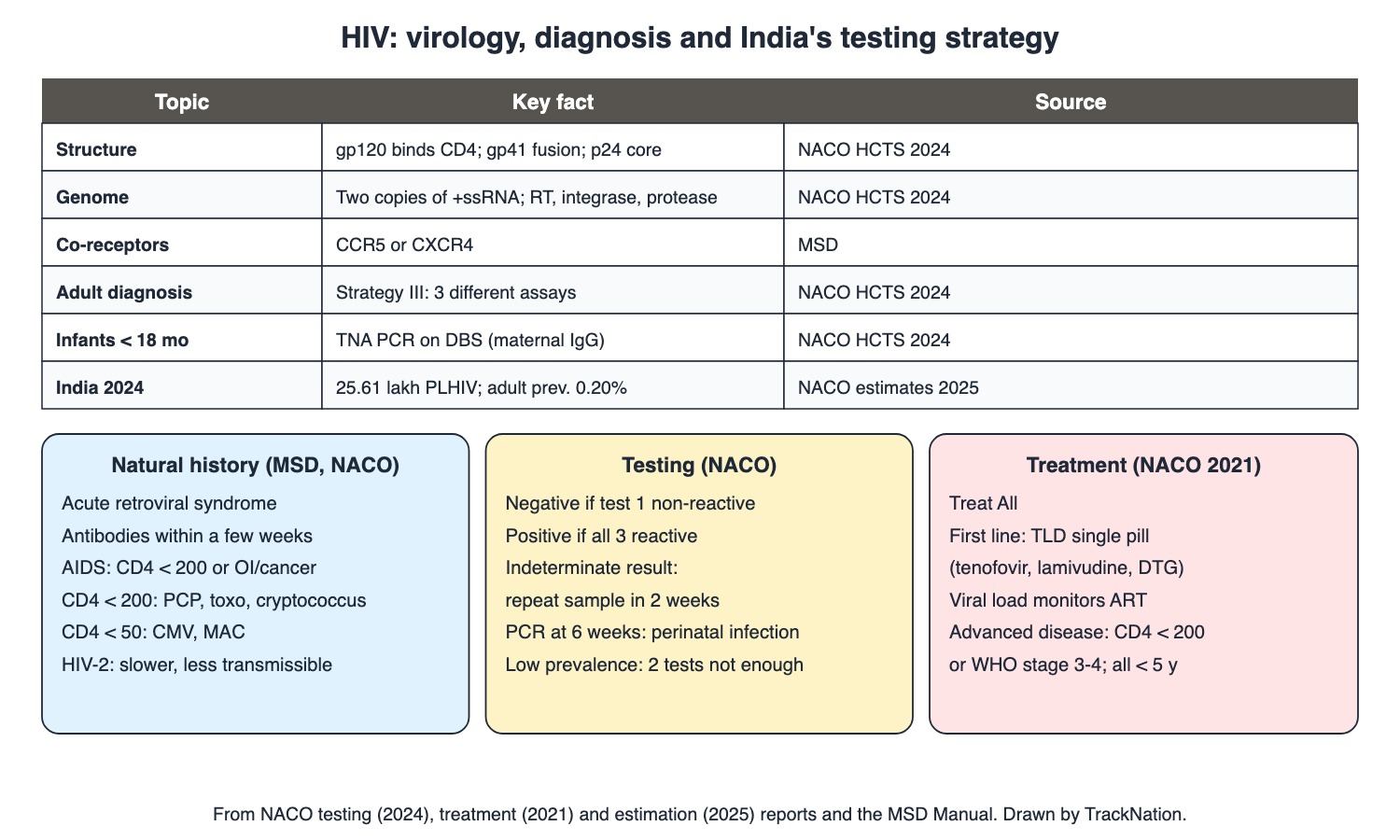
HIV virology, natural history, testing and treatment. Drawn by TrackNation.
The Virus (NACO, MSD)
HIV is a lentivirus ("slow virus"). Envelope gp120 binds CD4 and co-receptors; gp41 is the transmembrane protein that drives fusion; matrix p17; bullet-shaped core of p24.
The core holds two copies of positive-sense single-stranded RNA and three enzymes — reverse transcriptase, integrase and protease.
Entry: gp120 binds CD4, then a co-receptor (CCR5 or CXCR4); gp41 then fuses the envelope with the cell membrane.
HIV-1 and HIV-2 share routes and both cause AIDS, but HIV-2 has slower progression and lower sexual and perinatal transmission.
Natural History and Opportunistic Infections (MSD, NACO)
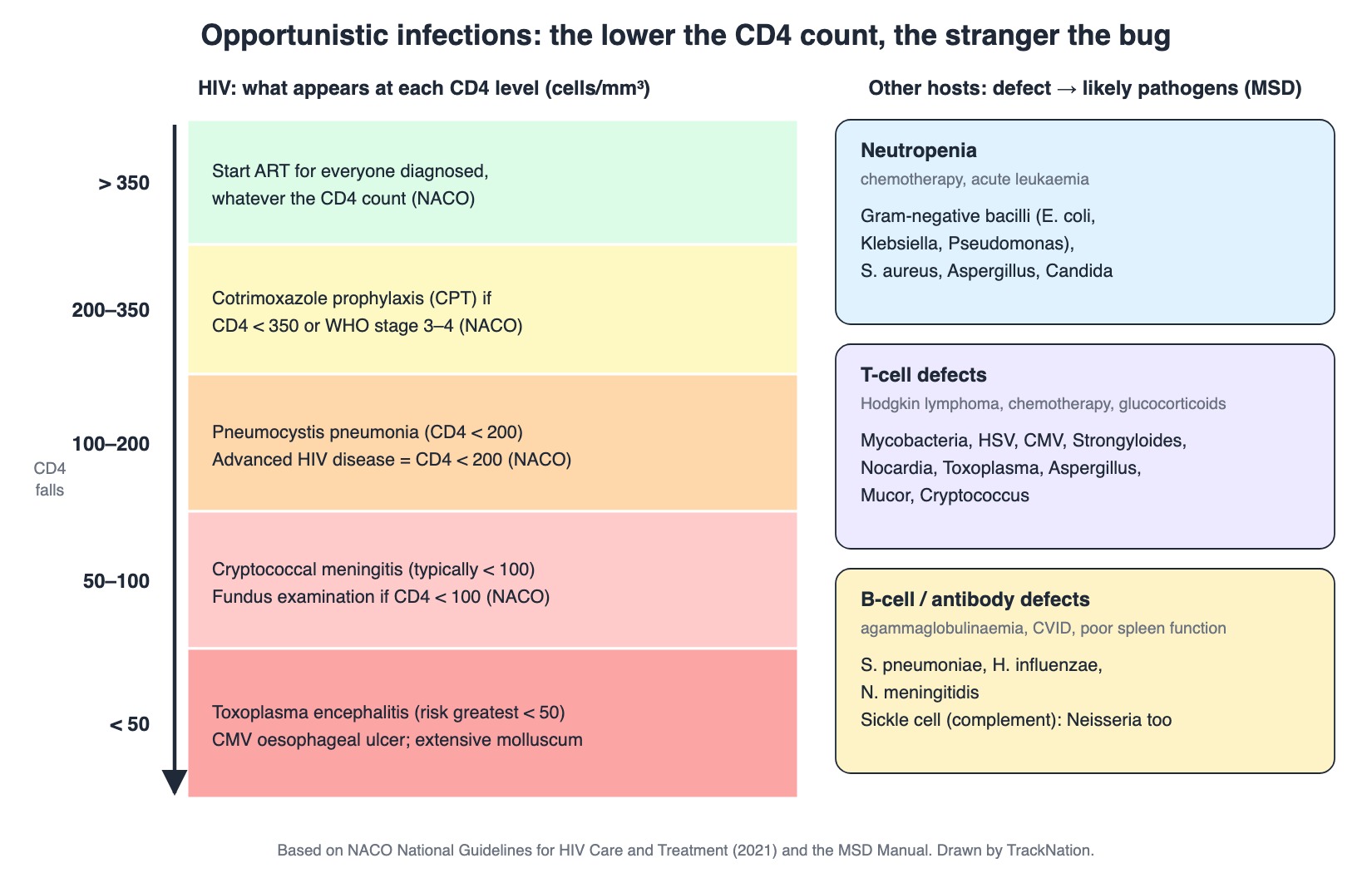
Which opportunistic infections appear at which CD4 count, with NACO's action points. Drawn by TrackNation.
Primary infection may be silent or cause a transient acute retroviral syndrome; antibodies are usually measurable within a few weeks.
AIDS: serious opportunistic infection or cancer, or CD4 <200/µL (or CD4 <14%). NACO's advanced HIV disease: CD4 <200 or WHO stage 3–4 in adults and children over 5; all children under 5.
CD4 <200: Pneumocystis pneumonia, toxoplasmic encephalitis, cryptococcal meningitis. CD4 <50: CMV and MAC.
Vertical transmission: in utero, at delivery, and through breastfeeding.
Testing in India (NACO HCTS 2024)
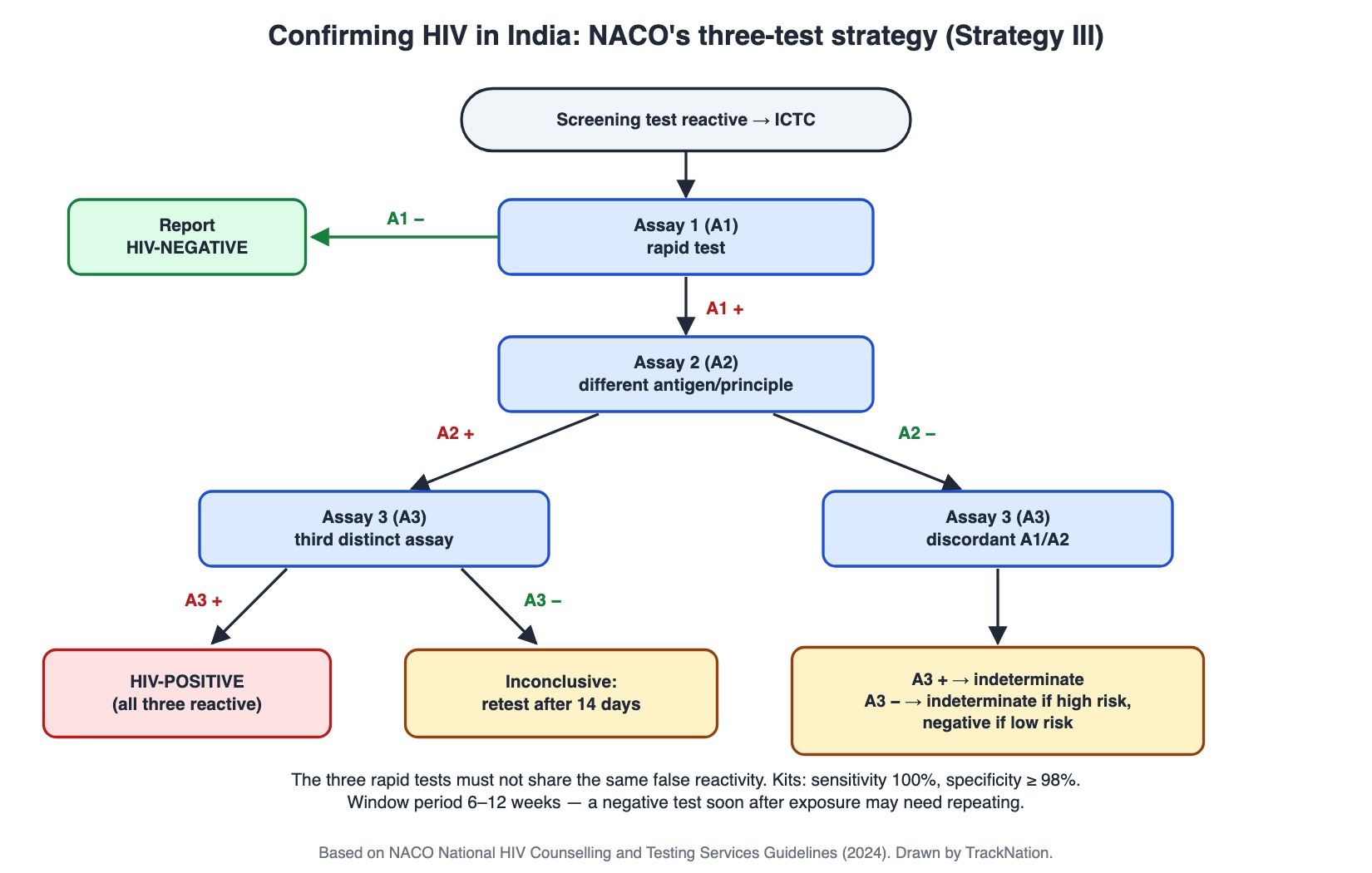
NACO's three-test strategy for confirming HIV, step by step. Drawn by TrackNation.
Strategy III (general population, low prevalence, provider-initiated testing): three different assays that do not share false reactivity, run in sequence. Negative if the first test is non-reactive; positive only if all three are reactive; in low prevalence, two reactive tests give too low a positive predictive value.
Screening anywhere; confirmation at the ICTC with three rapid tests. An indeterminate result → fresh sample after two weeks.
Babies under 18 months: antibody tests mislead because of maternal anti-HIV IgG; use qualitative TNA PCR on dried blood spots (screening, then confirmatory PCR on a fresh DBS). A positive PCR at 6 weeks indicates perinatal infection.
Laboratory tools (MSD): antibody ± p24 antigen tests; HIV RNA (viral load) by nucleic acid amplification.
Treatment and India's Numbers (NACO)
Treat All: first-line TLD — tenofovir 300 + lamivudine 300 + dolutegravir 50 mg as one pill once daily; viral load is the monitoring tool, baseline CD4 guides OI prophylaxis.
India 2024: about 25.61 lakh PLHIV; adult prevalence 0.20%; highest in Mizoram and Nagaland; between 2020 and 2024 new infections fell 19.4% and vertical transmission rates 63.7%.
Traps the Examiner Sets
gp120 attaches; gp41 fuses; p24 is the core antigen.
An antibody test in a baby under 18 months reflects the mother — use PCR.
One non-reactive first test = negative; all three reactive = positive.
PCP, toxoplasma and cryptococcus below 200; CMV and MAC below 50.
Memory Hooks & Shortcuts
Shortcuts to lock in this article's numbers and lists. Each one only re-packages facts proven above.
🧠 '120 grabs, 41 fuses, 24 is the core' — gp120, gp41, p24 — structure
🧠 'Rapid Into Proteins' — Reverse transcriptase, Integrase, Protease — enzymes
🧠 'Two hundred: PCP, Toxo, Crypto; fifty: CMV and MAC' — CD4
🧠 Strategy III: 'One No = No; Three Yes = Yes' — testing
🧠 'Babies borrow Mum's antibodies — PCR them' — infant diagnosis
Rapid-Revision Cards
Lentivirus
'Slow virus'.
gp120
Binds CD4 + co-receptor.
gp41
Fusion.
p24
Core; antigen tests.
p17
Matrix.
Genome
2 copies of +ssRNA.
Enzymes
RT, integrase, protease.
Co-receptors
CCR5, CXCR4.
HIV-2
Slower, less transmissible.
Acute HIV
Acute retroviral syndrome.
AIDS
CD4 <200 or OI/cancer.
CD4 <200
PCP, toxo, cryptococcus.
CD4 <50
CMV, MAC.
Strategy III
3 different assays.
Negative / positive
Test 1 non-reactive / all 3 reactive.
Indeterminate
Repeat in 2 weeks.
Infant <18 mo
TNA PCR on DBS.
PCR at 6 weeks
Perinatal infection.
TLD
Tenofovir + lamivudine + dolutegravir.
India 2024
25.61 lakh PLHIV; 0.20%.
Highest states
Mizoram, Nagaland.
Sources
Facts in this article were checked against these documents.
National HIV Counselling and Testing Services Guidelines — National AIDS Control Organisation, MoHFW, 2024
National Guidelines for HIV Care and Treatment — National AIDS Control Organisation, MoHFW, 2021
India HIV Estimates 2024: Fact Sheet — National AIDS Control Organisation and ICMR–NIMS, 2025
MSD Manual Professional: Human Immunodeficiency Virus (HIV) Infection — Merck & Co. (MSD Manuals), 2024–26 (link)
Competency Based Undergraduate Curriculum, Vol I: Microbiology (MI3.13, MI9.2) — National Medical Commission, 2024
Test Yourself: Practice Questions
Thirty questions in NEET PG style, many of them programme and clinical scenarios.
Practice Questions (NEET PG pattern)
Original questions written in the style of the exam: +4 for a correct answer, −1 for a wrong one. Every answer was checked against the sources listed above. NEET PG papers are not published by NBEMS, so these are not past-paper questions.
Q1. HIV belongs to the lentiviruses, a name meaning
(a) lethal virus
(b) lymph virus
(c) slow virus
(d) lipid virus
Show answer
Answer: (c) — NACO.
Q2. The HIV envelope protein that binds CD4 is
(a) gp120
(b) gp41
(c) p24
(d) p17
Show answer
Answer: (a) — gp41 fuses.
Q3. The HIV protein that mediates fusion of envelope and cell membrane is
(a) reverse transcriptase
(b) p24
(c) gp120
(d) gp41
Show answer
Answer: (d) — MSD.
Q4. The HIV core (capsid) protein detected in combined antigen–antibody tests is
(a) p24
(b) gp41
(c) p17
(d) gp160
Show answer
Answer: (a) — NACO; MSD.
Q5. The HIV genome consists of
(a) double-stranded DNA
(b) two copies of positive-sense single-stranded RNA
(c) segmented RNA
(d) one negative-sense RNA
Show answer
Answer: (b) — NACO.
Q6. The three enzymes inside the HIV core are
(a) thymidine kinase, protease, lipase
(b) reverse transcriptase, integrase and protease
(c) DNA polymerase, helicase, ligase
(d) neuraminidase, haemagglutinin, polymerase
Show answer
Answer: (b) — Drug targets.
Q7. Besides CD4, HIV entry requires a co-receptor such as
(a) CD8
(b) CD21
(c) MHC I
(d) CCR5 or CXCR4
Show answer
Answer: (d) — MSD.
Q8. Compared with HIV-1, HIV-2 shows
(a) no AIDS
(b) slower progression and less sexual and perinatal transmission
(c) different transmission routes
(d) faster progression
Show answer
Answer: (b) — NACO.
Q9. A transient febrile illness weeks after exposure in primary HIV infection is
(a) AIDS
(b) acute retroviral syndrome
(c) IRIS
(d) seroreversion
Show answer
Answer: (b) — MSD.
Q10. AIDS is defined by an opportunistic infection or cancer, or a CD4 count below
(a) 50/µL
(b) 200/µL
(c) 350/µL
(d) 500/µL
Show answer
Answer: (b) — Or <14%.
Q11. With CD4 below 200/µL, the risk rises for
(a) MAC only
(b) CMV retinitis only
(c) Pneumocystis pneumonia, toxoplasmic encephalitis and cryptococcal meningitis
(d) no infections
Show answer
Answer: (c) — MSD.
Q12. CMV retinitis and disseminated MAC typically occur when CD4 falls below
(a) 200/µL only
(b) 500/µL
(c) 350/µL
(d) 50/µL
Show answer
Answer: (d) — MSD.
Q13. Under NACO strategy III, a person is reported HIV-negative when
(a) two tests are non-reactive
(b) the third test is non-reactive
(c) any one of three tests is non-reactive
(d) the first test is non-reactive
Show answer
Answer: (d) — NACO.
Q14. Under strategy III, HIV-positive status requires
(a) one reactive test
(b) reactivity on all three different assays
(c) two reactive tests
(d) Western blot
Show answer
Answer: (b) — NACO.
Q15. Three tests are needed in low-prevalence settings because
(a) the positive predictive value of two tests is too low
(b) HIV-2 is common
(c) antibodies appear late
(d) tests are cheap
Show answer
Answer: (a) — NACO.
Q16. The three assays used in strategy III must
(a) all be Western blots
(b) be different and not share the same false reactivity
(c) be PCR tests
(d) be the same kit repeated
Show answer
Answer: (b) — NACO.
Q17. An indeterminate HIV antibody result at the ICTC should be followed by
(a) immediate ART
(b) a CD4 count
(c) declaring negative
(d) a fresh sample after two weeks
Show answer
Answer: (d) — NACO.
Q18. Confirmation of HIV diagnosis in asymptomatic people is done at the
(a) ART centre with viral load
(b) PHC with one test
(c) ICTC with three rapid tests
(d) blood bank
Show answer
Answer: (c) — NACO.
Q19. Antibody tests cannot diagnose HIV in a 6-month-old born to an HIV-positive mother because
(a) p24 is absent
(b) infants make no antibodies
(c) maternal anti-HIV IgG is present
(d) the virus is absent in blood
Show answer
Answer: (c) — Use PCR.
Q20. Early infant diagnosis under NACO uses
(a) CD4 count
(b) rapid antibody tests
(c) qualitative TNA PCR on dried blood spots
(d) Western blot
Show answer
Answer: (c) — Confirm on fresh DBS.
Q21. A positive HIV PCR at 6 weeks of age indicates
(a) false positive always
(b) perinatal infection
(c) HIV-2 only
(d) maternal antibody
Show answer
Answer: (b) — NACO.
Q22. Vertical HIV transmission can occur
(a) only during delivery
(b) only in utero
(c) only through breastfeeding
(d) in utero, during delivery and through breastfeeding
Show answer
Answer: (d) — NACO; MSD.
Q23. The preferred first-line ART regimen in India is
(a) zidovudine monotherapy
(b) nevirapine-based
(c) TLD: tenofovir, lamivudine and dolutegravir in one pill
(d) protease inhibitor alone
Show answer
Answer: (c) — NACO 2021.
Q24. Under 'Treat All', the main tool for monitoring ART response is
(a) ESR
(b) CD4 alone
(c) p24 antigen
(d) viral load
Show answer
Answer: (d) — NACO.
Q25. NACO defines advanced HIV disease in all
(a) pregnant women
(b) HIV-2 infections
(c) children under 5 years with HIV
(d) adults with CD4 above 500
Show answer
Answer: (c) — Adults: CD4 <200 or stage 3–4.
Q26. India's estimated number of people living with HIV in 2024 was about
(a) 25.61 lakh
(b) 50 lakh
(c) 1 crore
(d) 2.5 lakh
Show answer
Answer: (a) — NACO 2025.
Q27. India's adult HIV prevalence in 2024 was estimated at
(a) 1%
(b) 0.02%
(c) 2%
(d) 0.20%
Show answer
Answer: (d) — NACO.
Q28. Between 2020 and 2024, India's vertical transmission rate fell by about
(a) 5%
(b) 19.4%
(c) 100%
(d) 63.7%
Show answer
Answer: (d) — New infections −19.4%.
Q29. The states with the highest adult HIV prevalence in India are
(a) Mizoram and Nagaland
(b) Punjab and Haryana
(c) Bihar and UP
(d) Kerala and Goa
Show answer
Answer: (a) — NACO estimates.
Q30. HIV viral load is measured by
(a) rapid antibody test
(b) CD4 count
(c) Western blot
(d) nucleic acid amplification of HIV RNA
Show answer
Answer: (d) — MSD.
Active Recall
From memory: describe HIV structure, genome and entry, compare HIV-1 and HIV-2, outline natural history and CD4-linked infections, explain NACO strategy III and its interpretation, how infants are diagnosed, the first-line regimen and India's 2024 estimates.