Respiratory and Exanthematous Viruses for NEET PG Microbiology: Influenza Drift and Shift, RSV, Measles, Mumps, Rubella, CRS and SARS-CoV-2
Start Here
🎯 Exam priority: High. Expect: drift vs shift, influenza incubation and Reye syndrome, avian strains, RSV in infants, adenovirus syndromes, coronavirus reservoirs, measles prodrome, Koplik spots, complications and SSPE, mumps orchitis and pancreatitis, rubella nodes and CRS defects, and UIP MR timing.
CBME mapping: MI7.3, MI5.5. Fact-checked against the MSD Manual and the MoHFW UIP (2026).
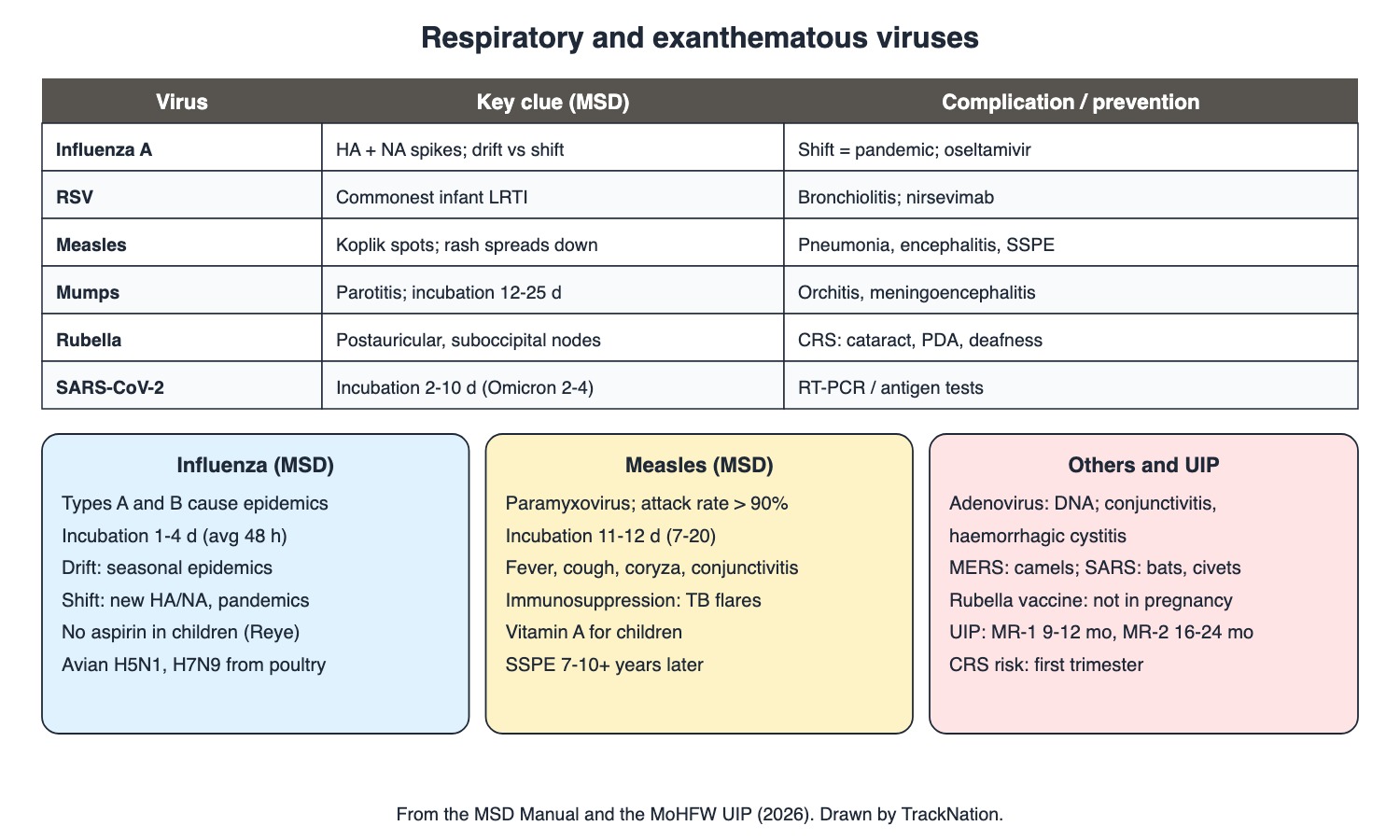
Respiratory and exanthematous viruses. Drawn by TrackNation.
Influenza and Other Respiratory Viruses (MSD)
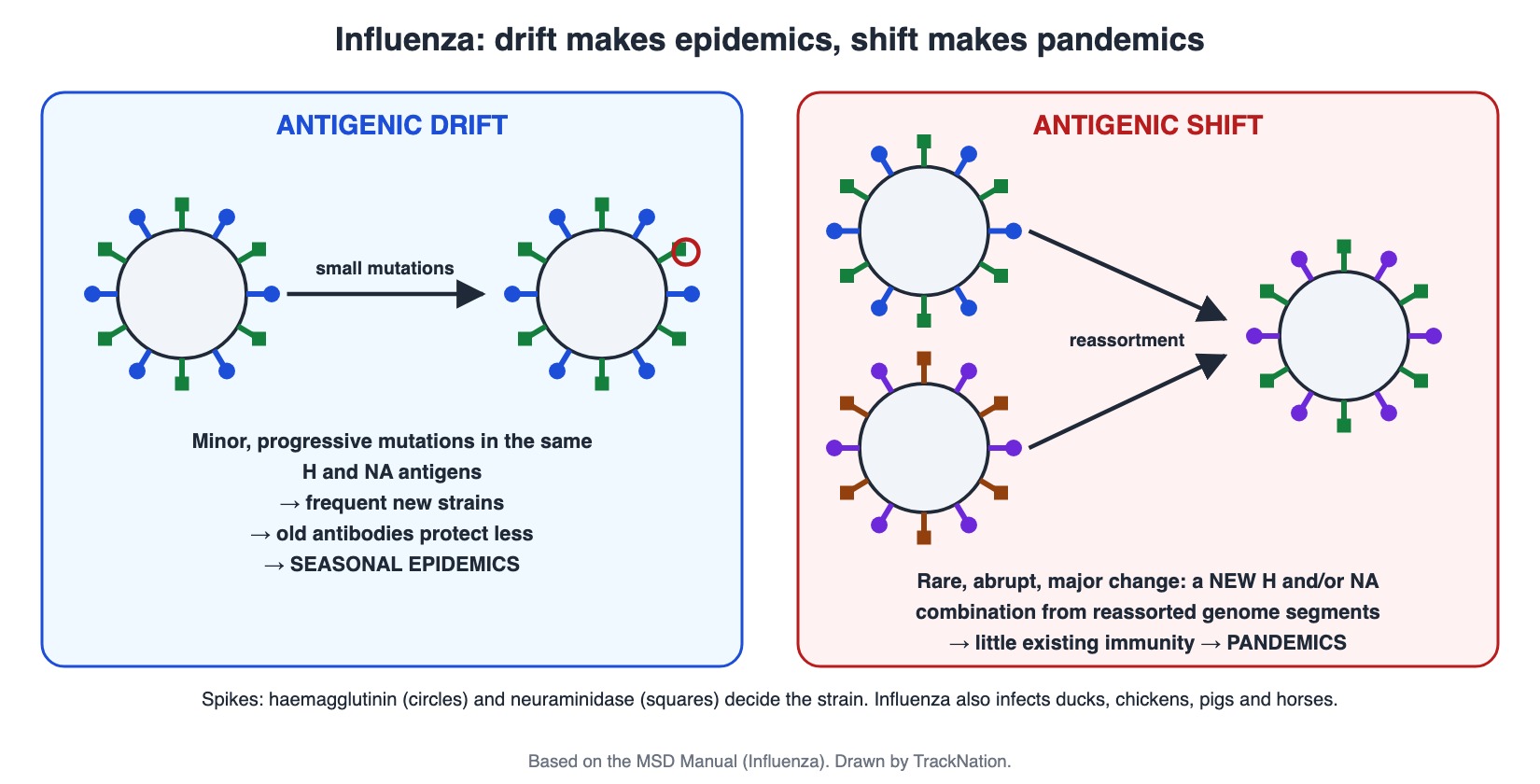
Antigenic drift (epidemics) vs antigenic shift (pandemics). Drawn by TrackNation.
Influenza: surface haemagglutinin (HA) and neuraminidase (NA) define the strain. Antigenic drift (minor changes) → seasonal epidemics; antigenic shift (new HA/NA combinations) → pandemics, because existing antibodies give little protection. Types A and B cause epidemics; H3N2 has caused most seasonal epidemics since 1968.
Incubation 1–4 days (average 48 h). Complications: primary influenza pneumonia or secondary bacterial pneumonia; avoid aspirin in children (Reye syndrome). Antivirals such as oseltamivir shorten illness.
Avian influenza (influenza A of wild birds and poultry): H5N1, H7N9; reassortment could give a pandemic strain.
RSV: the commonest cause of lower respiratory illness in young infants — bronchiolitis, pneumonia; monoclonal antibody (nirsevimab) protects infants under 8 months.
Adenoviruses (DNA): respiratory infection, keratoconjunctivitis, gastroenteritis, haemorrhagic cystitis.
Coronaviruses: MERS — dromedary camels; SARS-CoV-1 — civets infected from bats; SARS-CoV-2 (COVID-19) — incubation 2–10 days (Omicron 2–4), loss of smell or taste; diagnosis by RT-PCR/NAAT or antigen test.
Measles and SSPE (MSD)
Measles: a paramyxovirus, human only, no carriers; secondary attack rate >90% in susceptibles. Incubation 11–12 days (7–20).
Prodrome of fever, cough, coryza, conjunctivitis; Koplik spots (white "grains of sand" on red mucosa); maculopapular rash spreading head to toe.
Complications: pneumonia, encephalitis; immunosuppression can worsen tuberculosis and blunt the tuberculin test. Vitamin A is given to children.
SSPE: rare, fatal, up to 7–10+ years after measles — mental decline, myoclonic jerks, seizures.
Mumps, Rubella and the UIP (MSD, MoHFW)
Mumps: incubation 12–25 days (usually 16–18); salivary (mostly parotid) swelling; complications — orchitis, meningoencephalitis, pancreatitis, rarely hearing loss.
Rubella: incubation ~17 days; suboccipital, postauricular and posterior cervical nodes; rash starts on the face; transient arthritis in adults.
Congenital rubella: infection in early pregnancy, especially the first trimester → cataracts, cardiac defects (PDA, pulmonary artery stenosis), hearing loss, microcephaly, fetal death. Rubella vaccine is contraindicated in pregnancy.
UIP 2026: MR-1 at 9–12 months, MR-2 at 16–24 months.
Traps the Examiner Sets
Drift = epidemic; shift = pandemic.
Koplik spots appear before the rash.
SSPE follows measles by years, not weeks.
Classic CRS triad: cataract, heart defect (PDA), deafness.
No aspirin for children with influenza or chickenpox.
Memory Hooks & Shortcuts
Shortcuts to lock in this article's numbers and lists. Each one only re-packages facts proven above.
🧠 'Drift Drizzles (epidemic), Shift Storms (pandemic)' — influenza
🧠 Measles 3 Cs — Cough, Coryza, Conjunctivitis — plus Koplik — measles
🧠 'SSPE: Slow Sequel, Pediatric, Eventually fatal' — SSPE
🧠 'Mumps MOPs': Meningitis, Orchitis, Pancreatitis — mumps
🧠 CRS 'C-H-E': Cataract, Heart (PDA), Ears (deafness) — rubella
Rapid-Revision Cards
HA / NA
Influenza strain proteins.
Drift
Seasonal epidemics.
Shift
New HA/NA; pandemics.
Influenza incubation
1–4 d (avg 48 h).
Reye
No aspirin in children.
Avian flu
H5N1, H7N9; poultry.
RSV
Infant bronchiolitis; nirsevimab.
Adenovirus
DNA; conjunctivitis, haemorrhagic cystitis.
MERS / SARS
Camels / bats → civets.
COVID-19
Incubation 2–10 d; Omicron 2–4 d.
Measles
Paramyxovirus; attack >90%.
Measles prodrome
Fever, cough, coryza, conjunctivitis.
Koplik spots
Grains of sand; before rash.
Measles rash
Head to toe.
Measles care
Vitamin A.
SSPE
7–10+ y later; myoclonus.
Mumps
Parotid; orchitis, pancreatitis.
Rubella
Postauricular, suboccipital nodes; 17 d.
CRS
Cataract, PDA, deafness; 1st trimester.
Rubella vaccine
Not in pregnancy.
UIP MR
9–12 mo and 16–24 mo.
Sources
Facts in this article were checked against these documents.
MSD Manual Professional: Influenza; Avian Influenza; RSV and hMPV; Adenovirus; Coronaviruses (SARS, MERS); COVID-19; Measles; SSPE; Mumps; Rubella; Congenital Rubella — Merck & Co. (MSD Manuals), 2024–26 (link)
Universal Immunization Programme — Ministry of Health and Family Welfare, Government of India, 2026
Competency Based Undergraduate Curriculum, Vol I: Microbiology (MI7.3, MI5.5) — National Medical Commission, 2024
Test Yourself: Practice Questions
Thirty questions in NEET PG style, many of them clinical vignettes.
Practice Questions (NEET PG pattern)
Original questions written in the style of the exam: +4 for a correct answer, −1 for a wrong one. Every answer was checked against the sources listed above. NEET PG papers are not published by NBEMS, so these are not past-paper questions.
Q1. The influenza surface proteins that define the strain are
(a) haemagglutinin and neuraminidase
(b) F and G proteins
(c) VP1 and VP4
(d) gp120 and gp41
Show answer
Answer: (a) — HA, NA.
Q2. Seasonal influenza epidemics result from
(a) reactivation
(b) antigenic drift
(c) antigenic shift
(d) latency
Show answer
Answer: (b) — Minor changes.
Q3. Influenza pandemics result from
(a) antigenic drift
(b) point mutations only
(c) antigenic shift producing new HA/NA combinations
(d) loss of NA
Show answer
Answer: (c) — Little cross-protection.
Q4. The incubation period of influenza is
(a) 6–12 hours
(b) 6 months
(c) 1–4 days (average 48 hours)
(d) 2–3 weeks
Show answer
Answer: (c) — MSD.
Q5. A child with influenza should not be given aspirin because of the risk of
(a) agranulocytosis
(b) Stevens–Johnson syndrome
(c) Reye syndrome
(d) bleeding only
Show answer
Answer: (c) — Also chickenpox.
Q6. The avian influenza strains that have caused most severe human infection include
(a) H1N1 only
(b) B/Victoria
(c) H3N2
(d) H5N1 and H7N9
Show answer
Answer: (d) — Poultry.
Q7. The commonest cause of lower respiratory illness (bronchiolitis) in young infants is
(a) influenza B
(b) adenovirus
(c) RSV
(d) rhinovirus
Show answer
Answer: (c) — MSD.
Q8. A monoclonal antibody given to infants under 8 months to prevent RSV is
(a) palivizumab only for adults
(b) ribavirin
(c) nirsevimab
(d) oseltamivir
Show answer
Answer: (c) — Or clesrovimab.
Q9. Haemorrhagic cystitis in a child is a recognised feature of
(a) RSV
(b) measles
(c) mumps
(d) adenovirus
Show answer
Answer: (d) — DNA virus.
Q10. The primary reservoir of MERS coronavirus is
(a) rodents
(b) civets
(c) dromedary camels
(d) pigs
Show answer
Answer: (c) — SARS: bats → civets.
Q11. The incubation period of the SARS-CoV-2 Omicron variant is estimated at
(a) 14–21 days
(b) 2–4 days
(c) 1 month
(d) 6 hours
Show answer
Answer: (b) — Overall 2–10 days.
Q12. COVID-19 is diagnosed by
(a) blood culture
(b) Paul–Bunnell
(c) Widal
(d) RT-PCR/NAAT or antigen testing of respiratory secretions
Show answer
Answer: (d) — MSD.
Q13. Measles virus is a
(a) paramyxovirus
(b) picornavirus
(c) togavirus
(d) herpesvirus
Show answer
Answer: (a) — Human only.
Q14. The secondary attack rate of measles among susceptible contacts is
(a) about 50%
(b) under 1%
(c) over 90%
(d) about 10%
Show answer
Answer: (c) — Extremely communicable.
Q15. A child with fever, cough, coryza and conjunctivitis has white spots like grains of sand on the buccal mucosa. These are
(a) Nagayama spots
(b) Forchheimer spots
(c) Koplik spots
(d) aphthous ulcers
Show answer
Answer: (c) — Measles.
Q16. The measles rash characteristically
(a) starts on the trunk
(b) appears as fever falls
(c) is vesicular in crops
(d) spreads from head to feet (cephalocaudally)
Show answer
Answer: (d) — MSD.
Q17. The incubation period of measles is about
(a) 2 days
(b) 6 months
(c) 30 days
(d) 11–12 days
Show answer
Answer: (d) — Range 7–20.
Q18. Children with measles should receive
(a) antiviral acyclovir
(b) vitamin A
(c) zinc only
(d) vitamin D
Show answer
Answer: (b) — MSD.
Q19. Measles can worsen which co-existing infection by causing immunosuppression?
(a) malaria
(b) tuberculosis
(c) mumps
(d) hepatitis A
Show answer
Answer: (b) — Blunts tuberculin test.
Q20. A 12-year-old with measles in infancy develops progressive intellectual decline and myoclonic jerks. The diagnosis is
(a) PML
(b) acute measles encephalitis
(c) SSPE
(d) CJD
Show answer
Answer: (c) — Years later.
Q21. The commonest incubation period of mumps is
(a) 2–3 days
(b) 40 days
(c) 16–18 days
(d) 6 months
Show answer
Answer: (c) — Range 12–25.
Q22. A complication of mumps in males is
(a) Koplik spots
(b) haemorrhagic cystitis
(c) orchitis
(d) Reye syndrome
Show answer
Answer: (c) — Also meningoencephalitis, pancreatitis.
Q23. Severe epigastric pain and vomiting towards the end of the first week of mumps suggests
(a) appendicitis
(b) pancreatitis
(c) hepatitis
(d) peptic ulcer
Show answer
Answer: (b) — MSD.
Q24. Tender suboccipital, postauricular and posterior cervical nodes with a mild rash suggest
(a) rubella
(b) scarlet fever
(c) roseola
(d) measles
Show answer
Answer: (a) — MSD.
Q25. The average incubation period of rubella is
(a) 3 days
(b) 7 days
(c) 40 days
(d) 17 days
Show answer
Answer: (d) — 12–23 days.
Q26. Congenital rubella is most likely when maternal infection occurs
(a) in the first trimester
(b) in the third trimester
(c) before conception only
(d) after delivery
Show answer
Answer: (a) — MSD.
Q27. A baby has cataracts, a patent ductus arteriosus and hearing loss. The likely congenital infection is
(a) toxoplasmosis
(b) syphilis
(c) rubella
(d) CMV only
Show answer
Answer: (c) — PDA, pulmonary stenosis.
Q28. Rubella vaccine in pregnancy is
(a) required before delivery
(b) given with anti-D
(c) recommended in the first trimester
(d) contraindicated
Show answer
Answer: (d) — Live vaccine.
Q29. Under India's UIP, the first measles-rubella dose is given at
(a) birth
(b) 6 weeks
(c) 5 years
(d) 9–12 months
Show answer
Answer: (d) — MR-2 at 16–24 months.
Q30. Secondary bacterial pneumonia is a recognised complication of
(a) rubella
(b) roseola
(c) influenza
(d) mumps
Show answer
Answer: (c) — MSD.
Active Recall
From memory: explain influenza strain proteins, drift and shift, incubation and complications, avian strains, RSV and adenovirus, coronavirus reservoirs and COVID-19 incubation, measles features and complications including SSPE, mumps complications, rubella and congenital rubella, and the UIP MR schedule.