Antiarrhythmics and Lipid-Lowering Drugs for NEET PG Pharmacology: Atrial Fibrillation (ICMR 2026), Adenosine, Amiodarone, Statins
Start Here
🎯 Exam priority: High. Expect: a narrow-complex tachycardia given adenosine, amiodarone side effects, AF anticoagulation, digoxin toxicity with hypokalaemia, and statin myopathy.
CBME mapping: PH 4.6–4.7. Atrial fibrillation follows India's ICMR workflow (January 2026).
Atrial Fibrillation (ICMR 2026)
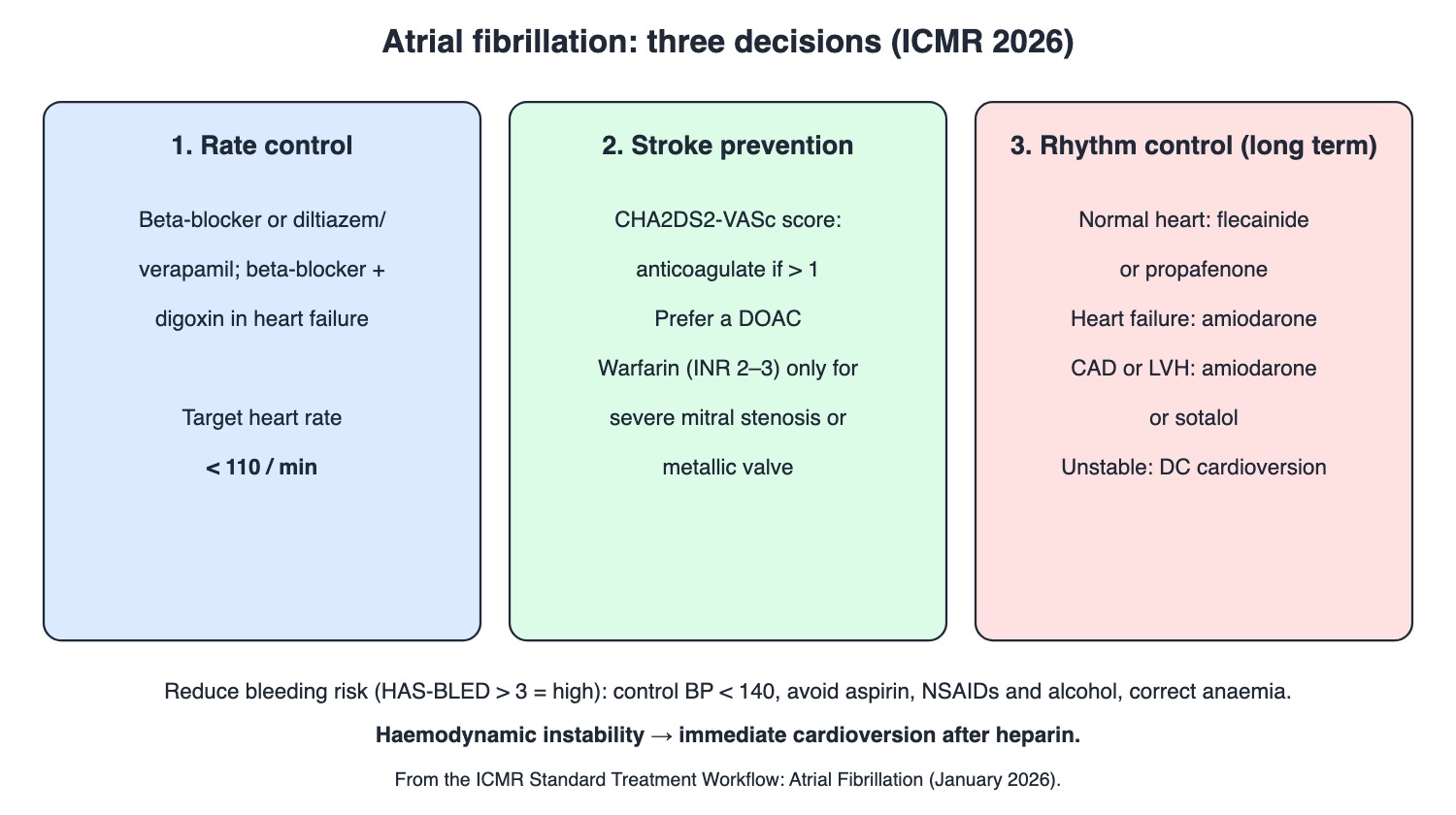
Atrial fibrillation decisions per the ICMR Standard Treatment Workflow (January 2026). Drawn by TrackNation.
Signs: irregularly irregular pulse. Types: paroxysmal (< 7 days), persistent (7 days–1 year), long-standing persistent (> 1 year), permanent.
Rate control (target < 110/min): metoprolol, diltiazem or verapamil if no heart failure; beta-blocker + digoxin in heart failure.
Stroke prevention: anticoagulate if CHA2DS2-VASc > 1 (age > 75 and prior stroke/TIA score 2 each). Prefer a DOAC; warfarin (INR 2–3) only for severe mitral stenosis or a metallic valve. HAS-BLED > 3 = high bleeding risk.
Rhythm control: unstable → immediate cardioversion after heparin. Long term: flecainide or propafenone with a normal heart (flecainide also as a single "pill in the pocket" dose); amiodarone in heart failure; amiodarone or sotalol with CAD or LVH.
Antiarrhythmic Drugs
Drug | Use (label / ICMR) | Key toxicity or rule (label) |
Adenosine | Converts PSVT (including WPW-related) | Rapid IV bolus; half-life < 10 s; blocked by caffeine and theophylline, potentiated by dipyridamole |
Amiodarone | Life-threatening arrhythmias only; AF rhythm control in heart failure, CAD, LVH (ICMR) | Boxed: pulmonary, hepatic, cardiac toxicity; thyroid (hypo or hyper); corneal deposits, optic neuropathy; half-life 15–142 days |
Flecainide | SVT prevention without structural heart disease; AF 'pill in the pocket' (ICMR) | CAST trial: excess mortality after MI |
Sotalol | AF rhythm control (ICMR) | Boxed proarrhythmia; reduce or stop if QT ≥ 500 ms; dose by creatinine clearance |
Procainamide | — | Lupus-like syndrome; positive ANA |
Diltiazem IV | Rate control in AF or flutter; converts PSVT | — |
Digoxin | Rate control with a beta-blocker in heart failure (ICMR) | Toxicity: nausea, vomiting, visual disturbance, arrhythmias; worse with low K or Mg, high Ca, renal failure, old age; antidote digoxin immune Fab |
Children (ICMR paediatric tachyarrhythmia workflow): adenosine 100–200 mcg/kg by rapid IV push followed at once by a 5–10 mL saline flush, recording the ECG.
Digoxin levels rise with quinidine and amiodarone (measure digoxin first; with amiodarone cut the digoxin dose by about 15–30%); digoxin is not recommended in acute MI.
Lipid-Lowering Drugs
Drug | Action (label) | Key point |
Statins (atorvastatin, rosuvastatin) | HMG-CoA reductase inhibitors | Myopathy and rhabdomyolysis (age ≥ 65, hypothyroidism, renal impairment, interacting drugs, high dose); rosuvastatin starts at 5 mg in Asian patients; ICMR high-intensity: atorvastatin 40–80 or rosuvastatin 20–40 mg |
Ezetimibe | Blocks intestinal cholesterol absorption via NPC1L1 | Added to statins |
Fenofibrate | Lowers triglycerides | Severe hypertriglyceridaemia (≥ 500 mg/dL) |
Evolocumab | PCSK9 inhibitor (injection) | Reduces major cardiovascular events |
Traps the Examiner Sets
Adenosine needs a fast push and flush (half-life < 10 s); theophylline blocks it, dipyridamole boosts it.
Amiodarone: lungs, liver, thyroid (both ways), eyes, skin — and it lasts for weeks after stopping.
Flecainide is avoided after MI or with structural heart disease (CAST).
AF rate target is < 110/min; DOAC first; warfarin only for severe MS or metallic valve.
Digoxin toxicity is worse with hypokalaemia; antidote is digoxin immune Fab.
Statin myopathy: stop if CK is markedly raised.
Memory Hooks & Shortcuts
Shortcuts to lock in this article's numbers and lists. Each one only re-packages facts proven above.
🧠 Adenosine: Ten seconds, Theophylline stops it — half-life < 10 s; methylxanthines antagonise
🧠 Amiodarone's PFT-LET (Pulmonary, Function of Thyroid, Liver, Eyes, Toxicity lasts) — lung, thyroid, liver, eye toxicity; very long half-life
🧠 Flecainide Fails after infarction — CAST: excess deaths after MI
🧠 AF: 110, score 2, DOAC first — rate < 110; anticoagulate if CHA2DS2-VASc > 1; DOAC preferred
🧠 Low K, high toxicity — hypokalaemia predisposes to digoxin toxicity
🧠 Statins Strain the muscles — myopathy and rhabdomyolysis
Rapid-Revision Cards
AF rate target (ICMR)
< 110/min.
AF rate drugs
Metoprolol, diltiazem, verapamil (no HF); BB + digoxin in HF.
AF anticoagulation
CHA2DS2-VASc > 1; DOAC preferred.
Warfarin in AF
Only severe MS or metallic valve; INR 2–3.
HAS-BLED
> 3 = high bleeding risk.
Unstable AF
Immediate cardioversion after heparin.
AF rhythm drug
Normal heart flecainide/propafenone; HF amiodarone.
Adenosine
PSVT; rapid bolus; t½ < 10 s.
Adenosine interactions
Blocked by theophylline/caffeine; boosted by dipyridamole.
Paediatric adenosine (ICMR)
100–200 mcg/kg push + 5–10 mL flush.
Amiodarone boxed
Pulmonary, hepatic, cardiac toxicity.
Amiodarone extras
Thyroid (both), corneal deposits, optic neuropathy; t½ 15–142 days.
Flecainide
No structural heart disease; CAST excess deaths after MI.
Sotalol
Proarrhythmia; act if QT ≥ 500 ms; dose by CrCl.
Procainamide
Lupus-like; ANA.
Digoxin toxicity
Nausea, vomiting, yellow-green vision, arrhythmias (bigeminy).
Digoxin precipitants
Low K, low Mg, high Ca, renal failure, old age.
Digoxin antidote
Digoxin immune Fab.
Digoxin interactions
Amiodarone: cut digoxin 15–30%; quinidine: 30–50%.
Statins
HMG-CoA reductase inhibitors; myopathy risk factors.
Rosuvastatin Asian dose
Start 5 mg.
High-intensity statin (ICMR)
Atorvastatin 40–80 or rosuvastatin 20–40.
Ezetimibe
NPC1L1; blocks cholesterol absorption.
Fenofibrate
TG ≥ 500 mg/dL.
Evolocumab
PCSK9 inhibitor.
Sources
Facts in this article were checked against these documents.
Standard Treatment Workflow: Atrial Fibrillation — Indian Council of Medical Research / Department of Health Research, MoHFW, January 2026
Standard Treatment Workflow: Tachyarrhythmia (paediatric) — Indian Council of Medical Research, MoHFW, July 2024
Prescribing labels: amiodarone, adenosine, flecainide, sotalol, procainamide, diltiazem injection, Lanoxin, Lipitor, Crestor, Zetia, fenofibrate, Repatha — DailyMed, US National Library of Medicine, current labels, accessed November 2026 (link)
Competency Based Undergraduate Curriculum, Pharmacology (PH 4.6–4.7) — National Medical Commission, 2024
Test Yourself: Practice Questions
Twenty-four questions in NEET PG style, most of them clinical vignettes.
Practice Questions (NEET PG pattern)
Original questions written in the style of the exam: +4 for a correct answer, −1 for a wrong one. Every answer was checked against the sources listed above. NEET PG papers are not published by NBEMS, so these are not past-paper questions.
Q1. A 28-year-old has a regular narrow-complex tachycardia at 190/min with stable BP; vagal manoeuvres fail. The drug of choice is
(a) atropine
(b) digoxin orally
(c) amiodarone infusion
(d) adenosine by rapid IV bolus
Show answer
Answer: (d) — Adenosine converts PSVT (including WPW-related) to sinus rhythm; it must be given as a rapid bolus.
Q2. Adenosine must be pushed fast and flushed because
(a) it binds plasma proteins
(b) it is a prodrug
(c) it is irritant to veins
(d) its half-life in blood is less than 10 seconds
Show answer
Answer: (d) — Cleared by cellular uptake with a half-life < 10 seconds.
Q3. A patient on theophylline for COPD gets usual-dose adenosine for PSVT without effect. The reason is
(a) adenosine is renally cleared
(b) COPD blocks adenosine receptors
(c) theophylline competitively antagonises adenosine
(d) theophylline induces adenosine metabolism
Show answer
Answer: (c) — Methylxanthines (caffeine, theophylline) antagonise adenosine; dipyridamole potentiates it.
Q4. The ICMR paediatric dose of adenosine is
(a) 0.01 mg/kg orally
(b) 100–200 mcg/kg rapid IV push followed by a 5–10 mL saline flush
(c) 1 mg/kg IM
(d) 6 mg/kg slow infusion
Show answer
Answer: (b) — ICMR tachyarrhythmia workflow.
Q5. A man on amiodarone for 2 years develops dry cough and breathlessness with bilateral infiltrates. Suspect
(a) ACE-inhibitor cough
(b) beta-blocker bronchospasm
(c) amiodarone pulmonary toxicity
(d) digoxin toxicity
Show answer
Answer: (c) — Boxed warning: pulmonary toxicity (hypersensitivity or interstitial pneumonitis), fatal in about 10% of cases.
Q6. A woman on amiodarone becomes tired, cold-intolerant and gains weight. Check
(a) CK
(b) ANA
(c) thyroid function: amiodarone causes hypo- or hyperthyroidism
(d) serum digoxin
Show answer
Answer: (c) — Thyroid abnormalities (hyper or hypo) are listed warnings.
Q7. Amiodarone adverse effects may persist for weeks after stopping because
(a) it is a prodrug
(b) its half-life is 15–142 days
(c) it causes enzyme induction
(d) it is renally excreted unchanged
Show answer
Answer: (b) — Long half-life of amiodarone and its active metabolite.
Q8. A patient on amiodarone reports haloes; slit-lamp shows corneal deposits. These are
(a) common and reversible
(b) a sign of imminent blindness
(c) an indication to start steroids
(d) due to digoxin
Show answer
Answer: (a) — Corneal microdeposits are common and reversible; optic neuropathy is rare but can cause blindness.
Q9. Flecainide is avoided in a man with a past myocardial infarction because
(a) it is ineffective
(b) it causes lupus
(c) the CAST trial showed excess mortality or cardiac arrest
(d) it causes thyroid disease
Show answer
Answer: (c) — CAST: higher mortality or non-fatal cardiac arrest with flecainide after MI; it is used without structural heart disease.
Q10. On sotalol, a patient's QT interval reaches 520 ms. The label advises
(a) reduce the dose, lengthen the interval or stop the drug
(b) add amiodarone
(c) double the dose
(d) ignore unless symptomatic
Show answer
Answer: (a) — If QT ≥ 500 ms: reduce dose, lengthen interval or discontinue; dose by creatinine clearance.
Q11. Long-term procainamide can produce
(a) pulmonary fibrosis
(b) a lupus-like syndrome with positive ANA
(c) hypothyroidism
(d) gingival hyperplasia
Show answer
Answer: (b) — Positive ANA with or without lupus-like syndrome.
Q12. A 70-year-old with AF, hypertension and diabetes (CHA2DS2-VASc 3) and no valve disease needs stroke prevention. ICMR prefers
(a) a direct oral anticoagulant
(b) warfarin in all cases
(c) no anticoagulation
(d) aspirin alone
Show answer
Answer: (a) — OAC if score > 1; DOAC preferred; VKA only for severe mitral stenosis or metallic valve.
Q13. In AF, the ICMR target heart rate for rate control is
(a) exactly 80 per minute
(b) below 60 per minute
(c) below 150 per minute
(d) below 110 per minute
Show answer
Answer: (d) — Rate aim < 110/min with a beta-blocker, calcium blocker, or BB + digoxin in heart failure.
Q14. A woman with AF has a metallic mitral valve. Her anticoagulant is
(a) warfarin with INR 2–3
(b) a DOAC
(c) aspirin
(d) clopidogrel
Show answer
Answer: (a) — VKA (warfarin) only if severe MS or metallic valve; aim INR 2–3.
Q15. A man with AF and heart failure needs rate control. ICMR suggests
(a) verapamil
(b) diltiazem alone
(c) flecainide
(d) a beta-blocker plus digoxin
Show answer
Answer: (d) — BB + digoxin in HF; metoprolol, diltiazem or verapamil only if no evidence of CHF.
Q16. A patient with AF becomes hypotensive and confused at a rate of 170/min. The management is
(a) start warfarin and wait
(b) oral metoprolol and review next week
(c) immediate cardioversion after heparin
(d) digoxin orally
Show answer
Answer: (c) — Haemodynamic instability: immediate cardioversion after heparinisation.
Q17. For long-term rhythm control in AF with heart failure, ICMR lists
(a) amiodarone
(b) digoxin
(c) propafenone
(d) flecainide
Show answer
Answer: (a) — CHF: amiodarone; normal heart: flecainide or propafenone.
Q18. An elderly woman with heart failure on digoxin and high-dose furosemide develops nausea, yellow-green vision and bigeminy. A key precipitating factor is
(a) hyperkalaemia
(b) hypokalaemia
(c) hypocalcaemia
(d) hypernatraemia
Show answer
Answer: (b) — Furosemide causes hypokalaemia; hypokalaemia (also hypercalcaemia, hypomagnesaemia, renal impairment, old age) predisposes to digoxin toxicity. Yellow-green vision and bigeminy are classic toxicity signs.
Q19. The specific antidote for life-threatening digoxin toxicity is
(a) naloxone
(b) digoxin immune Fab
(c) atropine
(d) calcium gluconate
Show answer
Answer: (b) — Digoxin Immune Fab (Digibind, DigiFab).
Q20. A patient stable on digoxin is started on amiodarone. The label advises
(a) checking digoxin levels and reducing the digoxin dose
(b) doubling digoxin
(c) no change
(d) stopping amiodarone after 1 day
Show answer
Answer: (a) — Amiodarone raises digoxin levels: measure digoxin first and reduce the dose by about 15–30% (30–50% with quinidine).
Q21. A 70-year-old with hypothyroidism on atorvastatin 80 mg develops muscle pain with a very high CK. The label advises
(a) ignoring it
(b) stopping the statin
(c) adding a fibrate
(d) doubling the dose
Show answer
Answer: (b) — Risk factors include age ≥ 65 and uncontrolled hypothyroidism; discontinue if CK is markedly raised or myopathy suspected.
Q22. Rosuvastatin in Asian patients should start at
(a) 5 mg once daily
(b) 80 mg once daily
(c) 40 mg once daily
(d) 20 mg twice daily
Show answer
Answer: (a) — Crestor label: initiate at 5 mg in Asian patients.
Q23. Ezetimibe lowers cholesterol by
(a) activating PPAR-alpha
(b) inhibiting HMG-CoA reductase
(c) blocking intestinal cholesterol absorption via NPC1L1
(d) inhibiting PCSK9
Show answer
Answer: (c) — Zetia inhibits absorption of cholesterol by the small intestine; target NPC1L1.
Q24. A man has triglycerides of 900 mg/dL. A drug indicated specifically to lower such severe hypertriglyceridaemia is
(a) colestyramine
(b) fenofibrate
(c) ezetimibe
(d) evolocumab
Show answer
Answer: (b) — Fenofibrate: severe hypertriglyceridaemia (TG ≥ 500 mg/dL).
Active Recall
From memory: outline the ICMR approach to atrial fibrillation (rate target, anticoagulation rule, DOAC vs warfarin, rhythm drug by heart type); give the uses and toxicities of adenosine, amiodarone, flecainide, sotalol, procainamide and digoxin; and compare statins, ezetimibe, fibrates and PCSK9 inhibitors.