Diuretics for NEET PG Pharmacology: Loop, Thiazide, Potassium-Sparing, Acetazolamide, Mannitol and Tolvaptan
Start Here
🎯 Exam priority: High. Expect: which diuretic raises calcium or potassium, a deaf patient on furosemide and gentamicin, lithium toxicity after a thiazide, gynaecomastia on spironolactone, acetazolamide on a trek, and mannitol for raised ICP.
Indian use follows the ICMR Hypertension (May 2026) and Heart Failure (January 2026) workflows.
Where Each Diuretic Acts
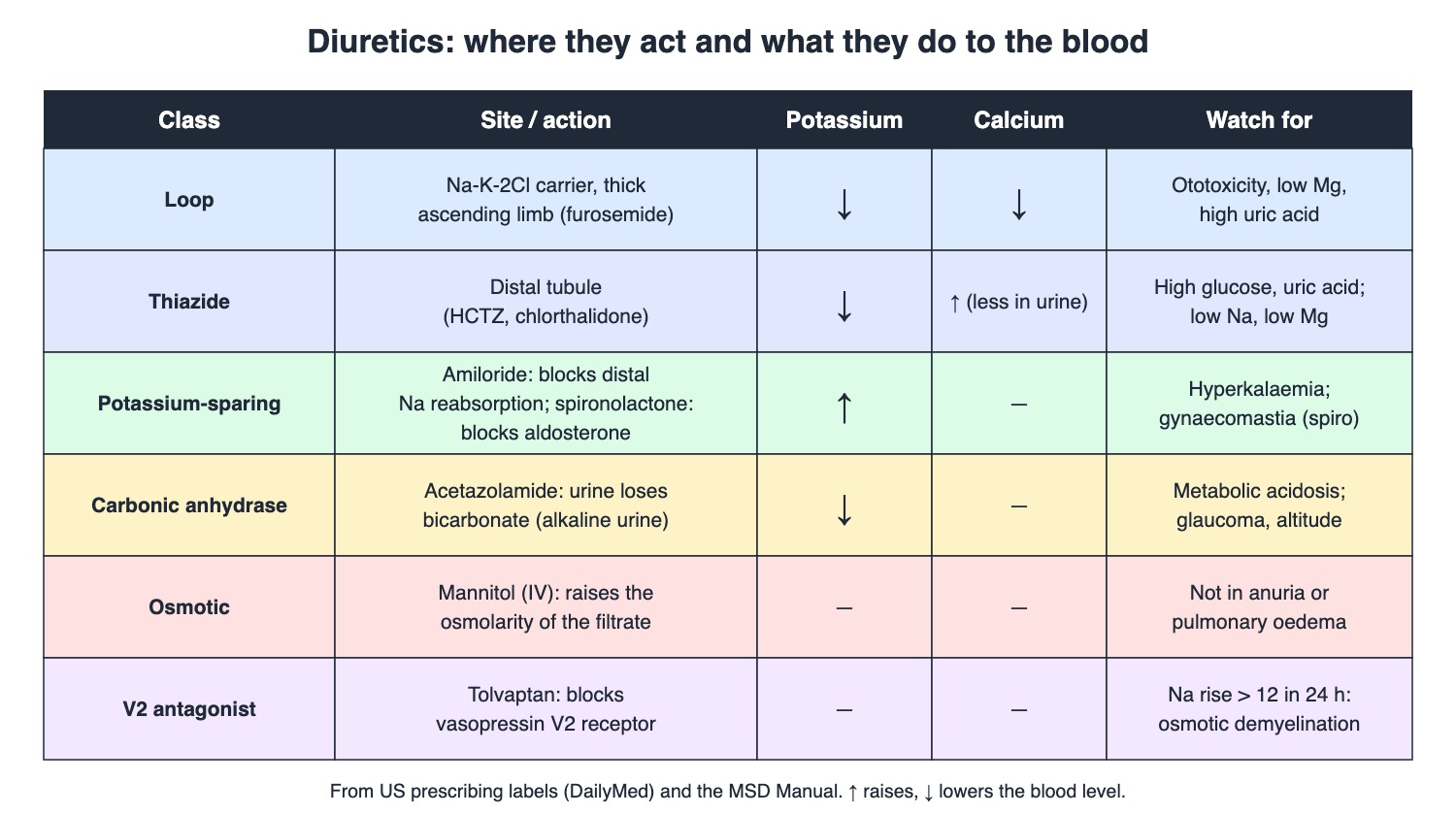
Diuretic classes: site or mechanism and effect on blood potassium and calcium, from the drugs' prescribing labels. Drawn by TrackNation.
Loop (furosemide, torsemide): block the Na-K-2Cl carrier in the thick ascending limb; that site makes them the most powerful. Lower K, Ca and Mg; raise uric acid.
Thiazide (HCTZ) and thiazide-like (chlorthalidone, indapamide): distal tubule. Lower K, Na and Mg; reduce urinary calcium (serum Ca may rise slightly; marked hypercalcaemia suggests hidden hyperparathyroidism); raise glucose and uric acid.
Potassium-sparing: amiloride blocks Na reabsorption in the distal tubule and collecting duct; spironolactone and eplerenone block aldosterone. All other diuretics cause significant potassium loss.
Acetazolamide inhibits carbonic anhydrase: bicarbonate, Na, water and K are lost in alkaline urine, leaving acidosis.
Mannitol raises the osmolarity of the filtrate. Tolvaptan blocks vasopressin V2 receptors.
Uses and Cautions
Drug | Main uses (label / ICMR) | Key cautions (label) |
Furosemide | Oedema; IV decongestion in heart failure (ICMR) | Anuria; ototoxicity (fast IV, high dose, renal failure, aminoglycosides); sulfonamide allergy; hepatic coma |
Chlorthalidone 12.5–25 mg, HCTZ 12.5 mg | Hypertension (ICMR) | Contraindicated: pregnancy, gout; low Na, low K, high Ca, glucose intolerance; angle-closure glaucoma |
Indapamide | Hypertension | Severe hyponatraemia with hypokalaemia, mostly in elderly women |
Spironolactone | Heart failure (ICMR: with ARNI), cirrhotic or nephrotic oedema, primary hyperaldosteronism | Hyperkalaemia, Addison's disease; gynaecomastia (about 9% of men in RALES) |
Eplerenone | Heart failure after MI; hypertension | Check K before and during; not with strong CYP3A inhibitors (ketoconazole) |
Amiloride | Added to thiazide or other potassium-losing diuretics in heart failure or hypertension | Hyperkalaemia (about 10%); not if K > 5.5 |
Acetazolamide | Glaucoma, epilepsy, acute mountain sickness | Low Na or K, cirrhosis (hepatic encephalopathy), hyperchloraemic acidosis |
Mannitol | Raised intracranial or intraocular pressure (0.25 g/kg every 6–8 h for ICP) | Anuria, severe hypovolaemia, pulmonary congestion or oedema |
Tolvaptan | Hypervolaemic or euvolaemic hyponatraemia, including SIADH | Start in hospital; Na rise > 12 mEq/L in 24 h → osmotic demyelination; not for ADPKD |
Hypertension (ICMR): a CCB or a thiazide/thiazide-like diuretic joins telmisartan in the stepwise protocol. Heart failure (ICMR): decongest with IV furosemide, then start ARNI and spironolactone.
Interactions
Lithium: diuretics reduce its renal clearance → lithium toxicity.
Aminoglycosides: furosemide adds to their ototoxicity, especially with poor kidneys.
Digoxin: diuretic-induced hypokalaemia worsens digoxin's effect on the heart.
Potassium-sparing drugs with ACE inhibitors, ARBs or poor kidneys: hyperkalaemia; spironolactone is never combined with eplerenone.
Traps the Examiner Sets
Calcium: loop lowers it, thiazide keeps it in (urinary Ca falls).
Potassium: only the potassium-sparing group raises it.
Acetazolamide makes the urine alkaline and the blood acidic.
Mannitol is wrong in anuria and pulmonary oedema.
Correct sodium no faster than 12 mEq/L in 24 hours with tolvaptan.
Memory Hooks & Shortcuts
Shortcuts to lock in this article's numbers and lists. Each one only re-packages facts proven above.
🧠 Loops Lose calcium; Thiazides Take it back — loop lowers serum Ca; thiazide reduces urinary Ca
🧠 Thiazide raises GUC: Glucose, Uric acid, Calcium — hyperglycaemia, hyperuricaemia, slight hypercalcaemia
🧠 Spiro Swells the chest — gynaecomastia
🧠 Acetazolamide: Alkaline urine, Acid blood, Altitude — three A's
🧠 Mannitol Must have urine — contraindicated in anuria
🧠 Tolvaptan: Twelve is the limit — do not raise sodium more than 12 mEq/L in 24 hours
🧠 Lithium hates diuretics — toxicity from reduced clearance
Rapid-Revision Cards
Loop site
Na-K-2Cl, thick ascending limb; most efficacious.
Loop effects
↓K, ↓Ca, ↓Mg, ↑uric acid.
Furosemide ototoxicity
Fast IV, high dose, renal failure, aminoglycosides.
Furosemide cautions
Anuria; sulfa allergy; hepatic coma.
Thiazide site
Distal tubule.
Thiazide effects
↓K, ↓Na, ↓Mg, ↓urinary Ca, ↑glucose, ↑uric acid.
Thiazide eye
Acute myopia, angle-closure glaucoma.
ICMR thiazide doses
Chlorthalidone 12.5–25 mg; HCTZ 12.5 mg.
ICMR thiazide contraindications
Pregnancy, gout.
Indapamide
Severe hyponatraemia + hypokalaemia in elderly women.
Diuretics + lithium
Lithium toxicity.
Amiloride
Distal Na reabsorption block; ~10% hyperkalaemia; not if K > 5.5.
Spironolactone uses
HF, cirrhotic/nephrotic oedema, hyperaldosteronism.
Spironolactone don'ts
Hyperkalaemia, Addison's, with eplerenone; gynaecomastia.
Eplerenone
Check K; no strong CYP3A inhibitors.
Acetazolamide
Carbonic anhydrase; glaucoma, epilepsy, altitude.
Acetazolamide pH
Alkaline urine, metabolic acidosis.
Acetazolamide no-go
Cirrhosis (encephalopathy), low Na/K.
Mannitol
Osmotic; ICP 0.25 g/kg every 6–8 h; also IOP.
Mannitol no-go
Anuria, hypovolaemia, pulmonary oedema.
Tolvaptan
V2 antagonist; hyponatraemia incl. SIADH.
Tolvaptan rule
Start in hospital; ≤ 12 mEq/L rise per 24 h.
ICMR HF
IV furosemide, then ARNI + spironolactone.
Sources
Facts in this article were checked against these documents.
Standard Treatment Workflows: Hypertension in Adults (May 2026); Heart Failure (January 2026) — Indian Council of Medical Research / Department of Health Research, MoHFW, 2026
Medications for Hypertension — MSD Manual Professional Version, accessed November 2026 (link)
Prescribing labels: furosemide, torsemide, hydrochlorothiazide, chlorthalidone, indapamide, amiloride, Aldactone, Inspra, acetazolamide, Osmitrol, Samsca — DailyMed, US National Library of Medicine, current labels, accessed November 2026 (link)
Competency Based Undergraduate Curriculum, Pharmacology — National Medical Commission, 2024
Test Yourself: Practice Questions
Twenty-four questions in NEET PG style, most of them clinical vignettes.
Practice Questions (NEET PG pattern)
Original questions written in the style of the exam: +4 for a correct answer, −1 for a wrong one. Every answer was checked against the sources listed above. NEET PG papers are not published by NBEMS, so these are not past-paper questions.
Q1. Furosemide acts mainly by inhibiting
(a) the Na-K-2Cl carrier in the thick ascending limb
(b) carbonic anhydrase
(c) the aldosterone receptor
(d) the vasopressin V2 receptor
Show answer
Answer: (a) — Loop diuretics act in the thick ascending limb (torsemide label); the site explains their high efficacy (furosemide label).
Q2. A patient on IV gentamicin with renal impairment is given high-dose IV furosemide and develops hearing loss. The reason is
(a) gentamicin causes hypokalaemia
(b) furosemide causes hypercalcaemia
(c) an allergic reaction
(d) furosemide increases aminoglycoside ototoxicity
Show answer
Answer: (d) — Furosemide ototoxicity: rapid injection, high doses, renal failure and aminoglycosides.
Q3. Which diuretic class decreases urinary calcium excretion?
(a) carbonic anhydrase inhibitor
(b) thiazide
(c) loop
(d) osmotic
Show answer
Answer: (b) — Thiazides decrease urinary calcium excretion; loop diuretics lower serum calcium.
Q4. A man on lithium for bipolar disorder starts hydrochlorothiazide for hypertension and becomes tremulous and confused. The cause is
(a) lithium inducing thiazide metabolism
(b) reduced renal clearance of lithium causing toxicity
(c) hypercalcaemia alone
(d) thiazide-induced hypoglycaemia
Show answer
Answer: (b) — Diuretics reduce lithium clearance and add a high risk of lithium toxicity.
Q5. A 60-year-old with gout needs antihypertensive treatment. Per the ICMR table, which class is contraindicated?
(a) ARBs
(b) Thiazide/thiazide-like diuretics
(c) ACE inhibitors
(d) Calcium-channel blockers
Show answer
Answer: (b) — ICMR lists pregnancy and gout as contraindications to chlorthalidone and HCTZ.
Q6. A prediabetic man's fasting glucose rises after starting a thiazide. The label explanation is
(a) thiazides cause insulin overdose
(b) thiazides stimulate glucagon only
(c) thiazides can cause hyperglycaemia and unmask latent diabetes
(d) it is unrelated
Show answer
Answer: (c) — Hyperglycaemia may occur; latent diabetes may become manifest.
Q7. An elderly woman on indapamide is brought in confused. The electrolyte picture to expect is
(a) severe hyponatraemia with hypokalaemia
(b) hypercalcaemia only
(c) normal electrolytes
(d) hypernatraemia with hyperkalaemia
Show answer
Answer: (a) — Indapamide label: severe hyponatraemia with hypokalaemia, mainly in elderly females.
Q8. Soon after starting hydrochlorothiazide, a woman develops sudden blurred vision and eye pain. Suspect
(a) cataract
(b) retinal detachment from hypokalaemia
(c) acute myopia with secondary angle-closure glaucoma
(d) optic neuritis from gout
Show answer
Answer: (c) — HCTZ, a sulfonamide, can cause an idiosyncratic acute transient myopia and acute angle-closure glaucoma, typically within hours to weeks.
Q9. A man with heart failure on spironolactone develops tender breast enlargement. The label says
(a) this is from furosemide
(b) it is due to digoxin only
(c) it means hyperkalaemia
(d) spironolactone causes gynaecomastia (about 9% of men in RALES)
Show answer
Answer: (d) — Aldactone warning: gynaecomastia.
Q10. Spironolactone is contraindicated in
(a) primary hyperaldosteronism
(b) cirrhotic ascites
(c) hypokalaemia
(d) hyperkalaemia and Addison's disease
Show answer
Answer: (d) — Contraindications: hyperkalaemia, Addison's disease, use with eplerenone. Hyperaldosteronism and cirrhotic oedema are indications.
Q11. A patient on amiloride and an ACE inhibitor has serum potassium 6.1 mEq/L. Amiloride
(a) lowers potassium
(b) is safe with any potassium
(c) should be doubled
(d) should not be used when potassium exceeds 5.5 mEq/L
Show answer
Answer: (d) — Hyperkalaemia occurs in about 10% with amiloride; contraindicated if K > 5.5.
Q12. Which diuretic does not cause significant potassium loss?
(a) Spironolactone
(b) Hydrochlorothiazide
(c) Furosemide
(d) Acetazolamide
Show answer
Answer: (a) — MSD: all diuretics except potassium-sparing distal diuretics cause significant potassium loss.
Q13. A patient with heart failure after MI is on eplerenone and is prescribed ketoconazole. The label says
(a) no interaction
(b) switch to spironolactone plus eplerenone
(c) double eplerenone
(d) eplerenone is contraindicated with strong CYP3A inhibitors
Show answer
Answer: (d) — Contraindicated with strong CYP3A inhibitors such as ketoconazole; check potassium before and during treatment.
Q14. A trekker planning rapid ascent to high altitude asks for prophylaxis. A suitable drug is
(a) mannitol
(b) acetazolamide
(c) spironolactone
(d) furosemide
Show answer
Answer: (b) — Acetazolamide prevents or lessens acute mountain sickness in rapid ascent.
Q15. On acetazolamide, the urine and blood change as follows:
(a) acid urine with acidosis
(b) alkaline urine with metabolic acidosis
(c) no change in pH
(d) acid urine with alkalosis
Show answer
Answer: (b) — Bicarbonate (with Na, water, K) is lost, alkalinising the urine; the acidotic state can be corrected with bicarbonate.
Q16. Acetazolamide is contraindicated in a patient with cirrhosis because of the risk of
(a) hepatic encephalopathy
(b) ototoxicity
(c) gynaecomastia
(d) hyperkalaemia
Show answer
Answer: (a) — Acetazolamide label.
Q17. A head-injury patient has raised intracranial pressure. Mannitol is given at
(a) 0.25 g/kg IV every 6–8 hours
(b) 0.25 mg/kg SC
(c) 5 g/kg orally once
(d) 1 g IV once weekly
Show answer
Answer: (a) — Osmitrol: 0.25 g/kg infused over 30 minutes every 6–8 hours for raised ICP.
Q18. Mannitol is contraindicated in a patient with
(a) normal renal function
(b) raised intraocular pressure
(c) anuria or pulmonary oedema
(d) cerebral oedema
Show answer
Answer: (c) — Contraindications: anuria, severe hypovolaemia, severe pulmonary congestion or oedema, active intracranial bleeding (except craniotomy).
Q19. A patient with SIADH and sodium 118 mEq/L is started on tolvaptan; next day sodium is 133. The danger is
(a) osmotic demyelination from too-rapid correction
(b) gynaecomastia
(c) ototoxicity
(d) hyperkalaemia
Show answer
Answer: (a) — Correction > 12 mEq/L in 24 hours can cause osmotic demyelination; start in hospital with sodium monitoring.
Q20. Tolvaptan acts as
(a) a loop diuretic
(b) an aldosterone antagonist
(c) a selective vasopressin V2-receptor antagonist
(d) a carbonic anhydrase inhibitor
Show answer
Answer: (c) — Samsca label.
Q21. A man with acute heart failure and pulmonary congestion arrives at a district hospital. ICMR's first diuretic step is
(a) acetazolamide
(b) decongest with IV furosemide
(c) IV mannitol
(d) oral spironolactone alone
Show answer
Answer: (b) — ICMR HF workflow: decongest with IV furosemide; then start ARNI and spironolactone.
Q22. An elderly woman with heart failure on digoxin is started on furosemide without potassium monitoring. The risk is
(a) hyperkalaemia blocking digoxin
(b) hypercalcaemia
(c) no interaction
(d) hypokalaemia exaggerating digoxin's cardiac effects
Show answer
Answer: (d) — Furosemide causes hypokalaemia; digitalis exaggerates its effects on the heart.
Q23. A patient on a thiazide has a serum calcium of 12.5 mg/dL (markedly raised). The label suggests
(a) adding calcium
(b) it is always due to the thiazide alone
(c) doubling the thiazide
(d) looking for hidden hyperparathyroidism
Show answer
Answer: (d) — Thiazides cause only slight rises; marked hypercalcaemia may indicate hidden hyperparathyroidism.
Q24. A patient with sulfonamide allergy is due to start furosemide. The label warns
(a) they may also be allergic to furosemide
(b) there is no cross-reactivity
(c) furosemide is a penicillin
(d) give it IV to avoid allergy
Show answer
Answer: (a) — Patients allergic to sulfonamides may also be allergic to furosemide.
Active Recall
From memory: for each diuretic class give its site or mechanism, its effect on potassium, calcium and sodium, its main uses and its key adverse effects and interactions (lithium, aminoglycosides, digoxin).