Anticoagulants, Antiplatelets, Thrombolytics and Haematinics for NEET PG Pharmacology: ICMR STEMI Protocol, Heparin, Warfarin, DOACs, Iron
Start Here
🎯 Exam priority: Very high. Expect: a STEMI patient far from a cath lab, a thrombolysis contraindication, heparin vs warfarin monitoring and antidotes, clopidogrel with omeprazole, and an anaemic pregnant woman's iron dose.
CBME mapping: PH 4.8–4.11. Indian doses follow the ICMR STEMI and NSTEMI workflows (January 2026) and Anemia Mukt Bharat.
Acute Coronary Syndrome: ICMR Protocol
STEMI, first steps: aspirin 325 mg + clopidogrel 300 mg + atorvastatin 80 mg; oxygen only if saturation < 90%.
Reperfusion: transfer for PCI if it can be done within 120 minutes; otherwise thrombolyse within 12 hours of symptom onset, preferably with a fibrin-specific agent (tenecteplase, alteplase, reteplase), streptokinase if those are unavailable. Start within 10 minutes.
After thrombolysis: ECG at 60–90 minutes. Success = > 50% ST resolution with pain relief → PCI within 3–24 hours; failure → transfer immediately. Enoxaparin (preferred over UFH) until PCI or discharge.
Absolute contraindications to thrombolysis include previous intracerebral haemorrhage or stroke of unknown cause, ischaemic stroke in the last 6 months, major trauma, surgery, head injury or GI bleed within 1 month, a known bleeding tendency (except menses), severe uncontrolled hypertension, CNS tumour or AV malformation, and aortic dissection.
Dual antiplatelets: at least 1 year after STEMI; after PCI for NSTEMI, at least 12 months with a drug-eluting stent and 3 months with a bare-metal stent.
Drug | ICMR dose (STEMI / NSTEMI, 2026) |
Aspirin | 325 mg loading, then 75 mg once daily |
Clopidogrel | 300 mg loading, then 75 mg once daily |
Prasugrel | 60 mg loading, then 10 mg once daily |
Ticagrelor | 180 mg loading, then 90 mg twice daily |
Enoxaparin | 1 mg/kg SC every 12 hours |
Unfractionated heparin | 60 U/kg bolus (maximum 5000 U), then 12 U/kg/hour; keep aPTT 50–70 s |
Tenecteplase | Single IV bolus by weight: 35 mg (60–70 kg), 40 mg (70–80 kg), 45 mg (> 80 kg) |
Streptokinase | 1.5 million units IV over 60 minutes |
Antiplatelets and Fibrinolytics
Antiplatelet | How it works (label / MSD) | Exam point |
Aspirin | Irreversibly inhibits COX-1 and COX-2 | Other NSAIDs inhibit COX reversibly |
Clopidogrel | Prodrug; active metabolite (via CYP2C19) irreversibly blocks P2Y12 | Poor CYP2C19 metabolisers: use another P2Y12 inhibitor; avoid omeprazole |
Prasugrel | P2Y12 inhibitor | Contraindicated after TIA or stroke; generally not for age ≥ 75 |
Ticagrelor | Reversibly binds P2Y12 | Dyspnoea (self-limiting); give with aspirin 75–100 mg |
Fibrinolytics (tenecteplase, alteplase, reteplase, streptokinase) are plasminogen activators. Streptokinase can cause allergic reactions, especially if given before. Tenecteplase is one bolus over 5 seconds.
Acute ischaemic stroke: the ICMR stroke workflow allows IV tPA within 0–4.5 hours; the US alteplase label says within 3 hours, at 0.9 mg/kg (maximum 90 mg), 10% as a 1-minute bolus. Aspirin is for secondary prevention after ischaemic stroke.
Anticoagulants
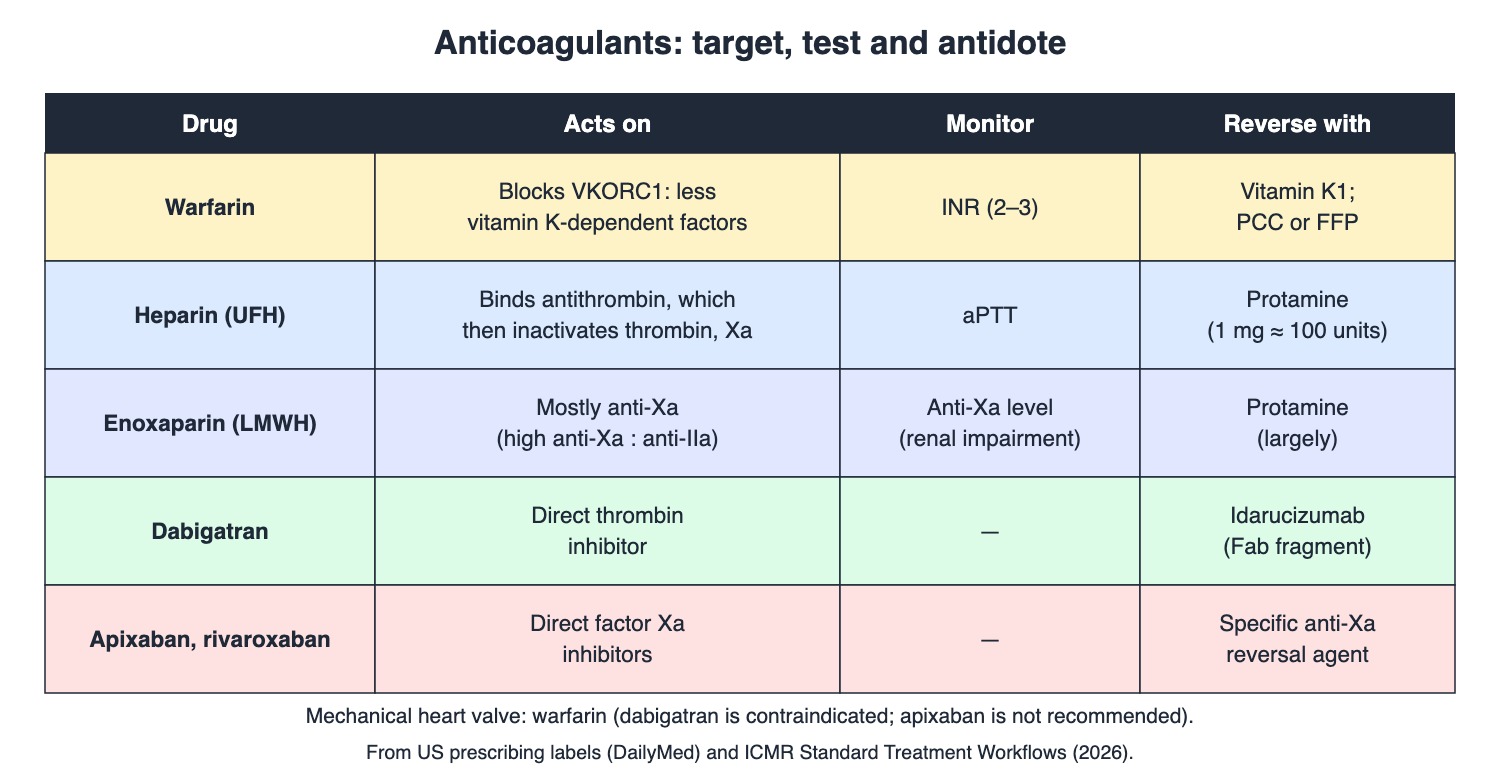
Anticoagulants: target, monitoring test and reversal agent, from the drugs' prescribing labels. Drawn by TrackNation.
Heparin: changes antithrombin's shape so it inhibits Xa and thrombin. Watch for HIT: platelets fall 5–10 days after first exposure; stop heparin.
Enoxaparin: boxed warning for spinal or epidural haematoma with neuraxial anaesthesia. With creatinine clearance < 30 mL/min, the dose was given once every 24 hours.
Warfarin: dose varies with CYP2C9 and VKORC1 genes, diet and drugs; INR 2–3. Contraindicated in pregnancy (embryopathy) except with mechanical valves. Skin necrosis is linked to protein C or S deficiency.
DOACs: dabigatran (thrombin) causes dyspepsia; apixaban and rivaroxaban (Xa); rivaroxaban is taken with food. Not for mechanical valves.
Vitamin K injection: boxed warning for fatal hypersensitivity by IV or IM route; prefer subcutaneous.
Haematinics and Erythropoietin
Situation | What to give (source) |
IFA tablet in India | 60 mg elemental iron + 500 mcg folic acid (Anemia Mukt Bharat) |
Adolescents 10–19 years | 1 blue IFA tablet weekly |
Pregnancy prophylaxis | 1 tablet daily from the 4th month, for 180 days, continued 180 days after delivery |
Pregnancy, Hb 7–10.9 g/dL | 2 IFA tablets daily (IV iron sucrose or ferric carboxymaltose may be used, e.g. if detected late) |
Pregnancy, Hb < 7 g/dL | Severe: refer urgently to the district hospital / FRU |
Pernicious anaemia | Vitamin B12 by injection, monthly for life; folic acid alone is wrong treatment |
Anaemia of CKD | Erythropoietin; don't aim for Hb > 11 g/dL (boxed: death, MI, stroke) |
Pregnancy anaemia cut-offs: mild 10–10.9, moderate 7–9.9, severe < 7 g/dL. Vitamin C helps iron absorption. Ferric carboxymaltose has a boxed warning for severe, prolonged hypophosphataemia. Pernicious anaemia may cause subacute combined degeneration of the cord; oral B12 is unreliable in it.
Traps the Examiner Sets
PCI within 120 minutes beats thrombolysis; otherwise thrombolyse within 12 hours.
Heparin → aPTT, protamine. Warfarin → INR, vitamin K. Dabigatran → idarucizumab.
Clopidogrel needs CYP2C19 to work; omeprazole blunts it.
Prasugrel is contraindicated after a stroke or TIA.
Ticagrelor is reversible and causes breathlessness.
Folic acid alone in B12 deficiency is wrong treatment.
Memory Hooks & Shortcuts
Shortcuts to lock in this article's numbers and lists. Each one only re-packages facts proven above.
🧠 120 to cut, 12 to clot-bust — PCI if within 120 minutes; otherwise thrombolysis within 12 hours
🧠 Heparin → aPTT → Protamine; Warfarin → INR → K — test and antidote pairs
🧠 Dabigatran's Dab of Idarucizumab — dabigatran is reversed by idarucizumab
🧠 Clopi needs a CYP key (2C19) — clopidogrel must be activated; omeprazole blocks the key
🧠 Prasugrel: no Past Stroke — contraindicated after TIA or stroke
🧠 Ticagrelor makes you Tired of breathing — dyspnoea
🧠 60–500 for mums: iron 60, folate 500 — Anemia Mukt Bharat IFA tablet
Rapid-Revision Cards
STEMI loading (ICMR)
Aspirin 325 + clopidogrel 300 + atorvastatin 80.
PCI or lyse?
PCI if within 120 min; else thrombolyse within 12 h.
Thrombolysis start
Within 10 min; fibrin-specific preferred.
Tenecteplase dose
35/40/45 mg bolus by weight.
Streptokinase dose
1.5 million U over 60 min; allergy on reuse.
Successful lysis
>50% ST resolution + pain relief → PCI in 3–24 h.
Absolute contraindications
Past ICH, ischaemic stroke < 6 months, trauma/surgery/GI bleed < 1 month, aortic dissection.
Ticagrelor (ICMR)
180 mg, then 90 mg BD; reversible; dyspnoea.
Prasugrel
60 mg then 10 mg; not after TIA/stroke.
Clopidogrel
Prodrug via CYP2C19; irreversible; avoid omeprazole.
Aspirin
Irreversible COX-1 and COX-2 inhibitor.
DAPT duration
≥ 12 months with DES; 3 months with BMS.
UFH (ICMR)
60 U/kg (max 5000), 12 U/kg/h, aPTT 50–70 s.
Protamine
1 mg ≈ 100 U heparin; 1 mg per 1 mg enoxaparin.
HIT
Platelets fall day 5–10; stop heparin.
Enoxaparin
1 mg/kg SC 12-hourly; daily if CrCl < 30; spinal haematoma.
Warfarin
VKORC1; INR 2–3; vitamin K, PCC/FFP.
Warfarin in pregnancy
Contraindicated (embryopathy) except mechanical valves.
Dabigatran
Thrombin inhibitor; idarucizumab; dyspepsia.
Apixaban, rivaroxaban
Xa inhibitors; rivaroxaban with food.
Mechanical valve
Warfarin, not DOACs.
Alteplase (stroke)
0.9 mg/kg, max 90, 10% bolus; ICMR ≤ 4.5 h.
IFA tablet (AMB)
60 mg iron + 500 mcg folic acid.
Pregnancy IFA
1 daily from 4th month, 180 days; 2 daily if Hb 7–10.9.
Severe anaemia in pregnancy
Hb < 7: refer urgently to DH/FRU.
B12 vs folate
Folic acid alone wrong in B12 deficiency.
EPO warning
Hb target > 11 raises death, MI, stroke.
Sources
Facts in this article were checked against these documents.
Standard Treatment Workflows: STEMI; Unstable Angina/NSTEMI; Atrial Fibrillation — Indian Council of Medical Research / Department of Health Research, MoHFW, January 2026
Standard Treatment Workflow for the Management of Stroke — Indian Council of Medical Research, MoHFW, October 2019
Anemia Mukt Bharat: Intensified National Iron Plus Initiative, Operational Guidelines — Ministry of Health and Family Welfare, 2018
Medications for Acute Coronary Syndromes; Treatment of Pain — MSD Manual Professional Version, accessed November 2026 (link)
Prescribing labels: warfarin (Jantoven), heparin sodium, Lovenox, Eliquis, Xarelto, dabigatran, Praxbind, Plavix, Brilinta, Effient, Activase, TNKase, phytonadione injection, Injectafer, Venofer, cyanocobalamin, folic acid, Epogen — DailyMed, US National Library of Medicine, current labels, accessed November 2026 (link)
Competency Based Undergraduate Curriculum, Pharmacology (PH 4.8–4.11) — National Medical Commission, 2024
Test Yourself: Practice Questions
Twenty-eight questions in NEET PG style, most of them clinical vignettes.
Practice Questions (NEET PG pattern)
Original questions written in the style of the exam: +4 for a correct answer, −1 for a wrong one. Every answer was checked against the sources listed above. NEET PG papers are not published by NBEMS, so these are not past-paper questions.
Q1. A 55-year-old with a 3-hour anterior STEMI is at a hospital without a cath lab; the nearest PCI centre cannot do PCI within 120 minutes. Per ICMR, the next step is
(a) observe and repeat ECG in 24 hours
(b) heparin alone
(c) thrombolysis, preferably with a fibrin-specific agent
(d) transfer anyway and wait for PCI
Show answer
Answer: (c) — Transfer only if PCI can be done within 120 minutes; otherwise thrombolyse within 12 hours of onset (fibrin-specific preferred).
Q2. A 75-kg man with STEMI is to receive tenecteplase. The ICMR dose is
(a) 50 mg infusion over 1 hour
(b) 35 mg single IV bolus
(c) 40 mg single IV bolus
(d) 1.5 million units over 60 minutes
Show answer
Answer: (c) — 35 mg if 60–70 kg, 40 mg if 70–80 kg, 45 mg if > 80 kg.
Q3. A woman with STEMI had an ischaemic stroke 2 months ago. Thrombolysis is
(a) allowed with half dose
(b) allowed if BP is normal
(c) absolutely contraindicated
(d) preferred over PCI
Show answer
Answer: (c) — ICMR lists ischaemic stroke in the last 6 months among absolute contraindications.
Q4. Ninety minutes after tenecteplase for STEMI, chest pain is gone and ST elevation has fallen by 70%. ICMR advises
(a) repeat thrombolysis
(b) no further intervention ever
(c) transfer for PCI within 3–24 hours
(d) immediate rescue PCI
Show answer
Answer: (c) — Success = > 50% ST resolution with pain relief; then PCI within 3–24 hours. Failure → immediate transfer.
Q5. A man received streptokinase for an MI years ago and now has another STEMI. A concern with repeating streptokinase is
(a) QT prolongation
(b) allergic reactions, especially after previous use
(c) hypokalaemia
(d) hypoglycaemia
Show answer
Answer: (b) — MSD: streptokinase may induce allergic reactions, especially if used previously.
Q6. The ICMR loading doses on diagnosing STEMI are
(a) aspirin 150 mg + heparin 1000 U
(b) aspirin 325 mg + clopidogrel 300 mg + atorvastatin 80 mg
(c) aspirin 75 mg alone
(d) clopidogrel 75 mg + warfarin
Show answer
Answer: (b) — General measures in the STEMI workflow.
Q7. In NSTEMI, ticagrelor is given as
(a) 300 mg loading, then 75 mg daily
(b) 60 mg loading, then 10 mg daily
(c) 325 mg loading, then 75 mg daily
(d) 180 mg loading, then 90 mg twice daily
Show answer
Answer: (d) — ICMR UA/NSTEMI drug table.
Q8. A 68-year-old with NSTEMI had a TIA last year. Which P2Y12 inhibitor is contraindicated?
(a) Prasugrel
(b) None of them
(c) Clopidogrel
(d) Ticagrelor
Show answer
Answer: (a) — Effient is contraindicated after prior TIA or stroke (and generally not recommended at ≥ 75).
Q9. A patient on clopidogrel after a stent is prescribed omeprazole for dyspepsia. The label advises
(a) doubling clopidogrel
(b) avoiding omeprazole because it reduces clopidogrel's effect
(c) no concern
(d) stopping clopidogrel
Show answer
Answer: (b) — Clopidogrel needs CYP2C19 activation; omeprazole and esomeprazole inhibit CYP2C19.
Q10. Genetic testing shows a patient is a CYP2C19 poor metaboliser. For ACS antiplatelet therapy, consider
(a) a higher clopidogrel dose only
(b) another P2Y12 inhibitor instead of clopidogrel
(c) aspirin alone
(d) warfarin
Show answer
Answer: (b) — Clopidogrel is a prodrug activated mainly by CYP2C19.
Q11. A man started on ticagrelor after MI complains of breathlessness; exam and ECG are unchanged. The likely cause is
(a) pulmonary embolism from ticagrelor
(b) reinfarction
(c) aspirin asthma
(d) ticagrelor-induced dyspnoea, usually self-limiting
Show answer
Answer: (d) — Dyspnoea is more common with Brilinta and self-limiting.
Q12. Aspirin differs from other NSAIDs because it
(a) selectively inhibits COX-2
(b) blocks P2Y12
(c) inhibits COX-1 and COX-2 irreversibly
(d) activates plasminogen
Show answer
Answer: (c) — MSD Manual, Treatment of Pain.
Q13. After NSTEMI, a patient gets a drug-eluting stent. ICMR advises dual antiplatelet therapy for
(a) 2 weeks
(b) at least 12 months
(c) 3 months only
(d) lifelong double therapy
Show answer
Answer: (b) — At least 12 months with DES; 3 months with a bare-metal stent.
Q14. The ICMR unfractionated heparin regimen in ACS is
(a) 1 mg/kg SC once daily
(b) 5000 U SC twice daily without monitoring
(c) titrate to INR 2–3
(d) 60 U/kg bolus (max 5000 U), then 12 U/kg/hour, aPTT 50–70 s
Show answer
Answer: (d) — ICMR UA/NSTEMI and STEMI drug tables.
Q15. A patient on IV heparin bleeds heavily. Heparin is reversed with protamine, and
(a) vitamin K is equally effective
(b) each mg of protamine neutralises about 100 units of heparin
(c) the dose is 1 mg per kg
(d) idarucizumab is the antidote
Show answer
Answer: (b) — Heparin label.
Q16. On day 7 of heparin for DVT, a woman's platelet count halves and she develops a new clot. The step is
(a) stop heparin (suspected HIT)
(b) increase heparin
(c) give platelets and continue heparin
(d) add protamine
Show answer
Answer: (a) — HIT is immune-mediated; platelets fall 5–10 days after first exposure; discontinue heparin.
Q17. A patient with creatinine clearance 20 mL/min needs enoxaparin for ACS. In the label's trials, the dose was
(a) 1 mg/kg every 12 hours
(b) 1 mg/kg every 24 hours
(c) 1.5 mg/kg every 6 hours
(d) not adjusted
Show answer
Answer: (b) — Severe renal insufficiency (CrCl < 30): 1 mg/kg every 24 hours; anti-Xa levels can guide monitoring.
Q18. A patient on enoxaparin is scheduled for spinal anaesthesia. The boxed warning is
(a) epidural or spinal haematoma
(b) hypokalaemia
(c) hepatotoxicity
(d) QT prolongation
Show answer
Answer: (a) — Lovenox boxed warning.
Q19. Warfarin acts by
(a) directly inhibiting thrombin
(b) activating antithrombin
(c) inhibiting VKORC1, reducing regeneration of vitamin K
(d) blocking factor Xa directly
Show answer
Answer: (c) — Jantoven label.
Q20. After starting warfarin, a woman with hereditary protein C deficiency develops skin necrosis. The label links this to
(a) an infection only
(b) heparin allergy
(c) vitamin K overdose
(d) warfarin lowering protein C and S
Show answer
Answer: (d) — Warfarin reduces protein C and S synthesis; deficiency is linked to tissue necrosis.
Q21. A woman on warfarin for a past DVT (no heart valve) finds she is 6 weeks pregnant. Warfarin is
(a) only a concern after 36 weeks
(b) safe throughout pregnancy
(c) preferred over heparin in pregnancy
(d) contraindicated: it causes warfarin embryopathy
Show answer
Answer: (d) — Contraindicated in pregnancy except with mechanical valves.
Q22. A man on dabigatran for AF needs emergency surgery. The specific reversal agent is
(a) vitamin K
(b) fresh frozen plasma only
(c) protamine
(d) idarucizumab
Show answer
Answer: (d) — Idarucizumab is a humanised monoclonal antibody fragment that reverses dabigatran.
Q23. A patient with a mechanical mitral valve and AF needs anticoagulation. The drug is
(a) warfarin
(b) apixaban
(c) dabigatran
(d) aspirin alone
Show answer
Answer: (a) — Dabigatran is contraindicated and apixaban is not recommended with prosthetic valves; ICMR: VKA for metallic valve.
Q24. A 60-year-old with acute ischaemic stroke arrives 2 hours after onset; CT shows no bleed. Alteplase is dosed at
(a) 0.9 mg/kg (max 90 mg), 10% as a bolus
(b) 0.1 mg/kg infusion over 24 hours
(c) a fixed 10 mg
(d) 1.5 mg/kg as a single bolus
Show answer
Answer: (a) — Activase label; ICMR stroke workflow allows IV tPA within 0–4.5 hours.
Q25. At 22 weeks, a pregnant woman has Hb 8.5 g/dL. Under Anemia Mukt Bharat she gets
(a) immediate blood transfusion
(b) 1 IFA tablet weekly
(c) folic acid alone
(d) 2 IFA tablets daily
Show answer
Answer: (d) — Moderate anaemia (7–9.9 g/dL): two IFA tablets daily; < 7 g/dL: refer urgently to DH/FRU.
Q26. Each Anemia Mukt Bharat IFA tablet for pregnant women contains
(a) 100 mg elemental iron + 5 mg folic acid
(b) 60 mg elemental iron + 500 mcg folic acid
(c) 200 mg ferrous sulphate only
(d) 30 mg iron + 400 mcg folic acid
Show answer
Answer: (b) — Prophylaxis: 1 tablet daily from the 4th month for 180 days, continued 180 days post-partum.
Q27. A 65-year-old with macrocytic anaemia and a low serum B12 level is started on folic acid alone. This is
(a) safe if given IV
(b) improper: folic acid alone does not treat B12-deficient megaloblastic anaemia
(c) correct first-line therapy
(d) preferred over B12
Show answer
Answer: (b) — Folic acid label; pernicious anaemia needs B12 by injection, monthly for life.
Q28. A dialysis patient's erythropoietin dose is raised to reach Hb 13 g/dL. The boxed warning is that targeting Hb above 11 g/dL
(a) increases the risk of death, MI and stroke
(b) causes iron overload only
(c) has no added risk
(d) causes hypoglycaemia
Show answer
Answer: (a) — Epogen boxed warning (CKD trials).
Active Recall
From memory: give the ICMR STEMI reperfusion rules and loading doses, the absolute contraindications to thrombolysis, how heparin, enoxaparin, warfarin and DOACs are monitored and reversed, the differences between aspirin, clopidogrel, prasugrel and ticagrelor, and the Anemia Mukt Bharat iron-folic acid regimen in pregnancy.