HIV Infection for NEET PG Medicine: Testing, Treat-All ART, Opportunistic Infections, PEP and PPTCT
Start Here
🎯 Exam priority: High. Expect: the window period and 4th-generation test, NACO Strategy III, treat-all and same-day TLD, viral-load targets and failure, advanced HIV disease, CPT threshold, CD4 cut-offs for PCP, toxoplasma, cryptococcus, CMV and MAC, ART timing with TB, TB meningitis and cryptococcal meningitis, IRIS, PEP timing and regimen, infant prophylaxis.
CBME mapping: GM 6.1–6.22. Programme structure (ICTC, ART centres, targets) is in Community Medicine; HIV virology in Microbiology; antiretroviral pharmacology in Pharmacology.
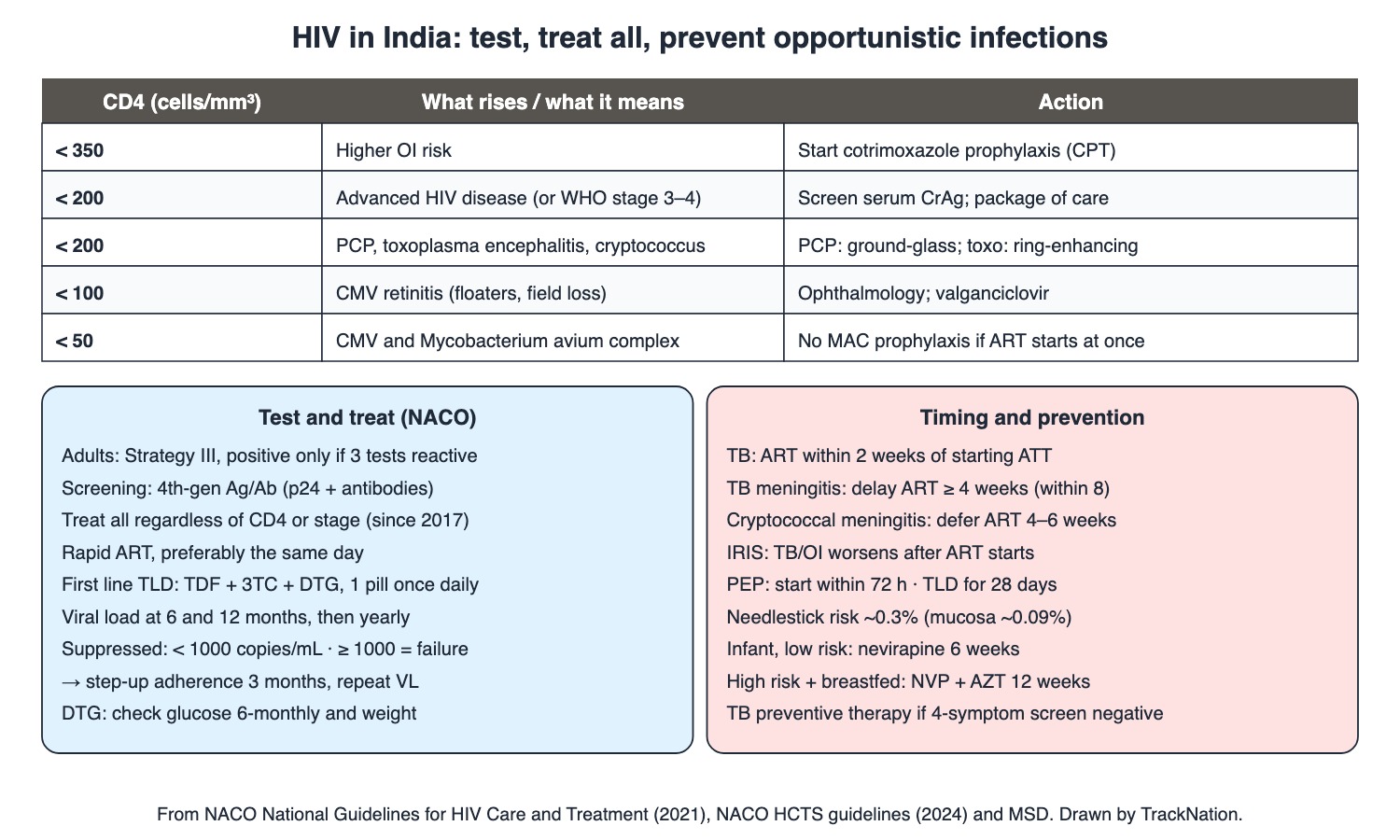
HIV: CD4 thresholds, NACO testing and treatment, ART timing and prevention. Drawn by TrackNation.
Virus, Course and Testing
gp120 binds CD4, then a co-receptor (CCR5 or CXCR4); gp41 mediates fusion. Reverse transcriptase turns the RNA genome into DNA; integrase inserts it into the host genome.
Acute retroviral syndrome begins 2–4 weeks after infection — fever, malaise, sore throat, dermatitis (rash), arthralgia, generalised lymphadenopathy — often mistaken for infectious mononucleosis. Antibody tests may still be negative in this window period; HIV RNA testing helps.
Screening: the 4th-generation antigen/antibody assay detects HIV-1/2 antibodies and p24 antigen.
NACO Strategy III (adults): a person is HIV-positive only when all three tests are reactive.
Clues to HIV: oral thrush, oral hairy leukoplakia (white verrucous growths on the lateral tongue), multi-dermatome zoster, Kaposi sarcoma (HHV-8).
ART in the National Programme
Treat all regardless of CD4 count or clinical stage (national programme since 2017), with rapid ART — preferably the same day.
First line: TLD — tenofovir 300 + lamivudine 300 + dolutegravir 50 mg, one fixed-dose pill once daily. Monitor glucose six-monthly and weight on DTG.
Viral load at 6 and 12 months, then yearly; at 6 months it should be < 1000 copies/mL. VL ≥ 1000 → step-up adherence counselling for 3 months, then repeat VL before calling it failure.
Advanced HIV disease: CD4 < 200 cells/mm³ or a WHO stage 3–4 event. Cotrimoxazole prophylaxis (CPT) when CD4 < 350 or stage 3–4.
Abacavir: hypersensitivity (HLA-B*5701); never re-challenge after a reaction. With rifampicin-based ATT, a boosted-PI regimen needs rifabutin instead of rifampicin.
Opportunistic Infections
CD4 < 200: PCP, toxoplasma encephalitis, cryptococcal meningitis. CD4 < 100: CMV retinitis. CD4 < 50: CMV and MAC.
Opportunistic infection | CD4 clue | Key finding | Treatment / note |
Pneumocystis pneumonia (PCP) | < 200 | Subacute dyspnoea, dry cough; bilateral perihilar ground-glass; may be normal early | High-dose cotrimoxazole; add prednisone if PaO2 < 70 mm Hg |
Toxoplasma encephalitis | < 200 | Focal deficits, seizures; multiple ring-enhancing lesions (basal ganglia) | Imaging before lumbar puncture |
Cryptococcal meningitis | < 200 | Headache; CSF India ink (negative does not exclude); CrAg | Amphotericin B + flucytosine induction, then fluconazole; ART after 4–6 weeks |
CMV retinitis | < 100 | Floaters, scotomata, field defects | Valganciclovir (or IV ganciclovir); refer ophthalmology |
Mycobacterium avium complex | < 50 | Disseminated disease | No primary prophylaxis if ART is started at once |
Oesophageal candidiasis | — | Dysphagia, odynophagia with oral thrush | WHO clinical stage 4 |
PML (JC virus) | — | Progressive white-matter disease | No specific drug; ART |
TB, IRIS, PEP and Mothers
HIV–TB: screen every visit with the 4 symptoms (fever, cough, weight loss, night sweats). Start ART within 2 weeks of ATT; in TB meningitis delay ART at least 4 weeks (start within 8). If the 4-symptom screen is negative and there is no active TB, give TB preventive therapy.
Cryptococcal meningitis: immediate ART raises mortality — defer ART 4–6 weeks after antifungals start.
Paradoxical IRIS: a treated OI (e.g. TB) worsens after ART starts as immunity returns.
PEP: start within 72 hours; preferred regimen TLD for 28 days. Percutaneous exposure risk is about 0.3%; mucous membrane about 0.09%.
Infant prophylaxis: low risk (mother's VL < 1000 after 32 weeks) → nevirapine 6 weeks; high risk → nevirapine + zidovudine, 12 weeks if breastfed, 6 weeks if replacement-fed. All exposed infants start cotrimoxazole at 6 weeks. Normal vaginal delivery unless there is an obstetric indication.
Traps the Examiner Sets
Window period: antibody tests negative — the 4th-generation test also picks up p24.
Do not wait for CD4 to start ART: treat all, same day.
Cotrimoxazole at CD4 < 350 (NACO), not < 200.
TB: ART within 2 weeks; TB meningitis ≥ 4 weeks; cryptococcal meningitis 4–6 weeks.
Toxoplasma: CT/MRI before LP. Negative India ink does not exclude cryptococcus.
Memory Hooks & Shortcuts
Shortcuts to lock in this article's numbers and lists. Each one only re-packages facts proven above.
🧠 NACO 'Strategy III' = Three tests, Three reactive — testing
🧠 TLD = 'The Last Drug you need': one pill, once a day — first-line ART
🧠 CD4 '200-100-50': Pneumocystis-Toxo-Crypto → CMV retinitis → MAC — OI thresholds
🧠 ART timing '2-4-6': TB within 2 wk, TB meningitis after 4, crypto after 4–6 — ART timing
🧠 PEP '72-28': start within 72 hours, take for 28 days — PEP
🧠 Brain lesion in HIV: picture first, puncture later — toxoplasma
Rapid-Revision Cards
Acute retroviral syndrome
2–4 weeks after infection; mono-like.
4th-gen test
HIV-1/2 antibody + p24 antigen.
NACO Strategy III
Positive only if all 3 tests reactive.
HIV co-receptors
CCR5 or CXCR4.
When to start ART
Treat all, same day if possible.
First-line ART
TLD: TDF + 3TC + DTG, 1 pill OD.
VL monitoring
6 and 12 months, then yearly.
VL target
< 1000 copies/mL at 6 months.
VL ≥ 1000
3 months step-up adherence → repeat VL.
Advanced HIV disease
CD4 < 200 or WHO stage 3–4.
CPT threshold (NACO)
CD4 < 350 or stage 3–4.
CD4 < 200
PCP, toxoplasma, cryptococcus.
CD4 < 100 / < 50
CMV retinitis / CMV + MAC.
PCP X-ray
Bilateral perihilar ground-glass (butterfly).
PCP steroids
PaO2 < 70 mm Hg.
Toxoplasma
Ring-enhancing lesions; image before LP.
Cryptococcus
India ink 60–80%; CrAg; AmB + 5-FC.
ART timing
TB ≤ 2 wk; TBM 4–8 wk; crypto 4–6 wk.
Paradoxical IRIS
Treated OI worsens after ART.
PEP
Within 72 h; TLD × 28 days.
Needlestick risk
~0.3% (mucosa ~0.09%).
Infant prophylaxis
Low risk NVP 6 wk; high risk NVP + AZT 12 wk if breastfed.
DTG monitoring
Glucose 6-monthly, weight.
Abacavir
HLA-B*5701; never re-challenge.
Sources
Facts in this article were checked against these documents.
National Guidelines for HIV Care and Treatment — National AIDS Control Organisation, MoHFW, 2021 (link)
National Guidelines for HIV Counselling and Testing Services — National AIDS Control Organisation, MoHFW, 2024 (link)
MSD Manual Professional: Human Immunodeficiency Virus (HIV) Infection — Merck & Co. (MSD Manuals), reviewed 2025–26 (link)
Competency Based Undergraduate Curriculum, General Medicine (GM 6) — National Medical Commission, 2024
Test Yourself: Practice Questions
Thirty questions in NEET PG style, most of them clinical vignettes.
Practice Questions (NEET PG pattern)
Original questions written in the style of the exam: +4 for a correct answer, −1 for a wrong one. Every answer was checked against the sources listed above. NEET PG papers are not published by NBEMS, so these are not past-paper questions.
Q1. Three weeks after unprotected sex, a man develops fever, sore throat, a rash and generalised lymphadenopathy resembling infectious mononucleosis. The likely diagnosis is
(a) chronic HIV with AIDS
(b) secondary syphilis only
(c) rubella
(d) acute retroviral syndrome
Show answer
Answer: (d) — Begins 2–4 weeks after infection.
Q2. In suspected recent HIV infection, the preferred screening test that also detects the p24 antigen is
(a) CD4 count
(b) fourth-generation antigen/antibody immunoassay
(c) Western blot
(d) rapid antibody-only test
Show answer
Answer: (b) — Narrows the window period.
Q3. Under NACO testing Strategy III, an adult is reported HIV-positive when
(a) all three tests are reactive
(b) any one test is reactive
(c) two of three are reactive
(d) the CD4 count is low
Show answer
Answer: (a) — Three different kits.
Q4. HIV enters CD4 cells after gp120 binds CD4 and then a co-receptor, which is
(a) CD21
(b) CD8
(c) CCR5 or CXCR4
(d) ICAM-1
Show answer
Answer: (c) — gp41 then mediates fusion.
Q5. A newly diagnosed adult has CD4 650 cells/mm³ and no symptoms. Per NACO,
(a) wait until CD4 < 200
(b) start only if symptomatic
(c) wait until CD4 < 350
(d) start ART now, preferably the same day
Show answer
Answer: (d) — Treat all since 2017.
Q6. The preferred first-line ART regimen for adults in India is
(a) zidovudine + lamivudine + nevirapine
(b) tenofovir + lamivudine + dolutegravir once daily
(c) stavudine-based
(d) lopinavir/ritonavir monotherapy
Show answer
Answer: (b) — TLD — one fixed-dose pill.
Q7. Six months after starting ART, the viral load should be below
(a) 50,000 copies/mL
(b) 1000 copies/mL
(c) 10,000 copies/mL
(d) 100,000 copies/mL
Show answer
Answer: (b) — Most suppress by 24 weeks.
Q8. A patient on TLD has a viral load of 4200 copies/mL at 12 months. The next step is
(a) stop ART
(b) step-up adherence counselling for 3 months, then repeat viral load
(c) switch regimen the same day
(d) add a fourth drug
Show answer
Answer: (b) — Confirm failure after adherence support.
Q9. For a stable patient on first-line ART, viral load is checked
(a) once at diagnosis
(b) only if CD4 falls
(c) every month
(d) at 6 and 12 months, then yearly
Show answer
Answer: (d) — Every 6 months on second/third line.
Q10. Advanced HIV disease in adults is defined by
(a) weight loss alone
(b) CD4 < 200 cells/mm³ or a WHO stage 3–4 event
(c) CD4 < 500
(d) any detectable viral load
Show answer
Answer: (b) — Triggers the advanced disease package (CrAg screening, CPT, TB tests).
Q11. Per NACO, cotrimoxazole preventive therapy is started in adults with a CD4 count below
(a) 100 cells/mm³
(b) 750 cells/mm³
(c) 350 cells/mm³ (or WHO stage 3–4)
(d) 50 cells/mm³
Show answer
Answer: (c) — Prevents PCP, toxoplasma and bacterial infections.
Q12. A person with HIV and a low CD4 count has subacute progressive breathlessness, fever and dry cough; the chest X-ray shows bilateral perihilar ground-glass infiltrates. The likely diagnosis is
(a) tuberculous cavity
(b) lung abscess
(c) lobar pneumococcal pneumonia
(d) Pneumocystis jirovecii pneumonia
Show answer
Answer: (d) — Butterfly pattern; X-ray can be normal early.
Q13. In moderate–severe PCP, corticosteroids are added when
(a) the patient has a fever
(b) cough is productive
(c) CD4 is below 350
(d) PaO2 is below 70 mm Hg on room air
Show answer
Answer: (d) — Or an alveolar–arterial gradient > 35 mm Hg.
Q14. A person with HIV has seizures and focal weakness; MRI shows multiple ring-enhancing lesions. The most likely diagnosis is
(a) HIV-associated dementia
(b) toxoplasma encephalitis
(c) PML
(d) cryptococcal meningitis
Show answer
Answer: (b) — Lesions favour the basal ganglia.
Q15. In a person with HIV with a focal neurological deficit, the order of investigation is
(a) CT/MRI first, then lumbar puncture if indicated
(b) lumbar puncture first
(c) no imaging needed
(d) EEG only
Show answer
Answer: (a) — To prevent coning.
Q16. A person with HIV has headache; CSF India ink is negative. Regarding cryptococcal meningitis,
(a) only blood culture matters
(b) it is excluded
(c) a negative India ink does not rule it out — test CrAg
(d) treat as TB
Show answer
Answer: (c) — India ink is positive in 60–80%.
Q17. The preferred induction for cryptococcal meningitis in the NACO guideline is
(a) amphotericin B deoxycholate plus flucytosine
(b) caspofungin
(c) fluconazole 150 mg once
(d) itraconazole
Show answer
Answer: (a) — Followed by fluconazole consolidation.
Q18. A patient started treatment for cryptococcal meningitis today. ART should be started
(a) after 4–6 weeks of antifungal treatment
(b) after 6 months
(c) today
(d) never
Show answer
Answer: (a) — Immediate ART increases mortality.
Q19. A person with HIV and CD4 count of 60 cells/mm³ complains of floaters and a patchy field defect. The likely diagnosis and drug are
(a) CMV retinitis — valganciclovir
(b) toxoplasma retinitis — pyrimethamine only
(c) HIV retinopathy — no treatment
(d) cataract — surgery
Show answer
Answer: (a) — CMV retinitis at CD4 < 100.
Q20. Disseminated Mycobacterium avium complex typically occurs at a CD4 count below
(a) 200 only
(b) 350
(c) 50 cells/mcL
(d) 500
Show answer
Answer: (c) — Along with CMV.
Q21. White, verrucous, non-removable growths on the lateral margins of the tongue in a person with HIV are
(a) oral hairy leukoplakia
(b) geographic tongue
(c) lichen planus
(d) oral candidiasis
Show answer
Answer: (a) — Candidiasis is a white exudate over raw mucosa.
Q22. A person with HIV starts ATT for pulmonary TB. ART should be started
(a) after 8 weeks always
(b) only if CD4 < 50
(c) as soon as possible, within 2 weeks of starting ATT
(d) after ATT finishes
Show answer
Answer: (c) — Regardless of CD4 count.
Q23. A person with HIV has TB meningitis. ART should be
(a) withheld for a year
(b) delayed at least 4 weeks and started within 8 weeks
(c) started within 2 weeks
(d) started the same day
Show answer
Answer: (b) — Exception to the 2-week rule.
Q24. Soon after starting ART, a patient receiving ATT for TB has worsening TB features; a new infection, treatment failure and drug toxicity have been excluded. The likely explanation is
(a) new HIV strain
(b) drug-resistant TB in all cases
(c) ART failure
(d) paradoxical IRIS
Show answer
Answer: (d) — A diagnosis of exclusion.
Q25. A nurse has a needlestick injury from an HIV-positive patient. PEP should be started
(a) within 7 days for 7 days
(b) only if the nurse seroconverts
(c) after a 6-week test
(d) preferably within 72 hours, as TLD for 28 days
Show answer
Answer: (d) — As early as possible.
Q26. The approximate risk of HIV transmission after a percutaneous needlestick from an infected source is
(a) 0.3%
(b) 30%
(c) 3%
(d) 0.003%
Show answer
Answer: (a) — About 0.09% after mucous membrane exposure.
Q27. A woman on ART has a viral load below 1000 copies/mL at 34 weeks and plans to breastfeed. Her infant should receive
(a) no prophylaxis
(b) syrup nevirapine for 6 weeks
(c) nevirapine + zidovudine for 12 weeks
(d) lopinavir from birth
Show answer
Answer: (b) — Low-risk infant: 6 weeks regardless of feeding.
Q28. A woman with HIV was not on ART during pregnancy and will breastfeed. Her infant needs
(a) cotrimoxazole only
(b) nevirapine for 6 weeks
(c) dual nevirapine + zidovudine for 12 weeks
(d) no prophylaxis
Show answer
Answer: (c) — High-risk infant.
Q29. A patient on dolutegravir-based ART should be monitored for
(a) hearing
(b) visual fields
(c) QT interval monthly
(d) blood glucose six-monthly and weight gain
Show answer
Answer: (d) — Metabolic effects of DTG.
Q30. A patient who had fever and rash on a previous course of abacavir should
(a) restart at half dose
(b) restart with antihistamines
(c) continue with steroids
(d) never be re-challenged — risk of fatal hypersensitivity
Show answer
Answer: (d) — HLA-B*5701 screening before use.
Active Recall
From memory: describe HIV entry, acute retroviral syndrome and the window period, NACO Strategy III, when and with what to start ART, viral-load targets and failure, advanced HIV disease and CPT, CD4 thresholds and findings of PCP, toxoplasma, cryptococcus, CMV and MAC, ART timing with TB and cryptococcal meningitis, IRIS, PEP and infant prophylaxis.