Sepsis, Meningitis, Encephalitis, Tetanus, Rabies and COVID-19 for NEET PG Medicine
Start Here
🎯 Exam priority: High. Expect: septic shock definition and first-hour care, meningitis organisms and empirical cover, dexamethasone timing, CSF patterns, HSV encephalitis, tetanus signs and treatment, tetanus prophylaxis for wounds, rabies categories and schedules, RIG dose, re-exposure, and COVID-19 treatment by severity.
CBME mapping: GM 26.1–26.35. Malaria, dengue, typhoid and fevers are in article 9; HIV in article 10; TB in article 7. Immunisation schedules are in Community Medicine.
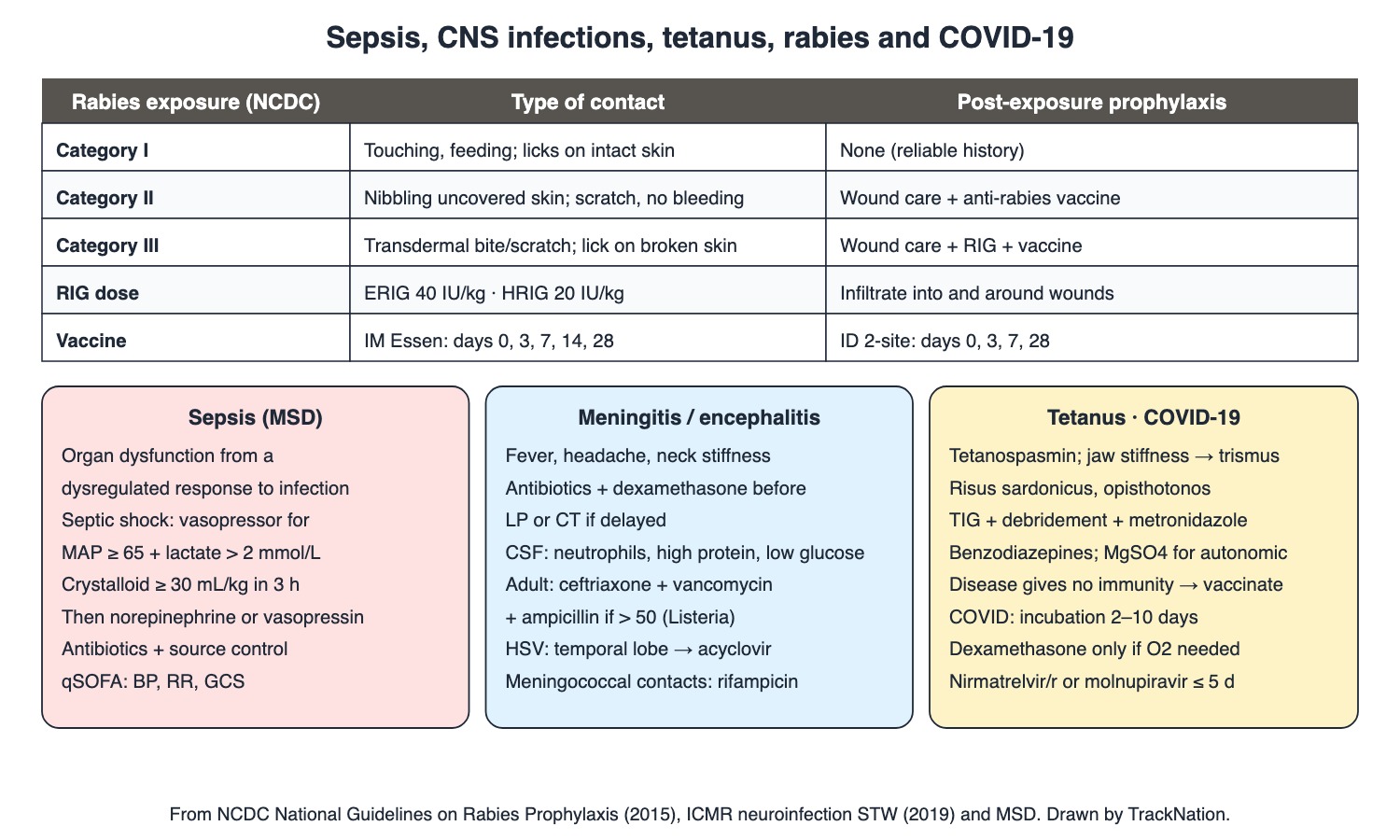
Rabies categories and schedules, sepsis, meningitis, tetanus and COVID-19. Drawn by TrackNation.
Sepsis and Septic Shock
Sepsis: life-threatening organ dysfunction caused by a dysregulated host response to infection.
Septic shock: sepsis needing vasopressors to keep MAP ≥ 65 mm Hg with lactate > 2 mmol/L despite adequate fluids. Mortality is about 40–60%.
qSOFA uses blood pressure, respiratory rate and GCS — no lab tests needed; best outside the ICU.
Resuscitation: crystalloid, usually at least 30 mL/kg in the first 3 hours; then norepinephrine or vasopressin to MAP ≥ 65. Early antibiotics and source control (drain abscesses, remove infected catheters).
Meningitis and Encephalitis
Headache, fever and neck stiffness; petechiae or purpura suggest meningococcaemia. Meningococcal sepsis can cause bilateral adrenal haemorrhage (Waterhouse–Friderichsen).
Do not delay treatment: give antibiotics and dexamethasone (before or with the first antibiotic dose, every 6 h for 4 days; best evidence in pneumococcal meningitis) — before CT if the lumbar puncture will be delayed.
Bacterial CSF: turbid, raised pressure, neutrophils, high protein, low glucose (CSF:blood ratio < 0.23 strongly suggests bacteria).
Meningococcal contacts: rifampicin 600 mg 12-hourly × 4 doses, or one dose of ceftriaxone 250 mg IM.
HSV encephalitis: olfactory auras (temporal lobe), MRI oedema in orbitofrontal and temporal areas, CSF PCR for HSV; treat with acyclovir.
ICMR: intubate if GCS < 8.
Age (MSD) | Usual organisms | Empirical therapy |
18–50 years | S. pneumoniae, N. meningitidis, S. aureus | Ceftriaxone or cefotaxime + vancomycin (+ acyclovir if HSV possible) |
> 50 years | S. pneumoniae, L. monocytogenes, S. aureus, gram-negatives | Ceftriaxone or cefotaxime + ampicillin + vancomycin |
ICMR STW (India) | Suspected pyogenic meningitis | Ceftriaxone 2 g + vancomycin, within 30 min of arrival; add ampicillin if > 50 or immunocompromised |
Tetanus and Botulism
Clostridium tetani toxin (tetanospasmin) binds nerve endings irreversibly and travels retrograde to the CNS. Incubation 2–50 days (average 5–10).
Jaw stiffness is the most frequent first symptom, then trismus, risus sardonicus, opisthotonos and spasms; autonomic instability. Neonatal tetanus starts from a poorly cleaned umbilical stump in babies of unimmunised mothers.
Treatment: human tetanus immune globulin (TIG 500 units IM), wound debridement, metronidazole, benzodiazepines for spasms, magnesium sulfate for autonomic instability, ventilation if needed. The disease gives no immunity — complete the vaccine series.
Wound prophylaxis: unknown or < 3 doses → toxoid for any wound plus TIG for dirty wounds; ≥ 3 doses → toxoid if ≥ 10 years (clean) or ≥ 5 years (dirty) since the last dose, no TIG.
Botulism: symmetric cranial nerve palsies with descending flaccid paralysis and no sensory loss.
Rabies
Incubation averages 1–2 months (can exceed a year). Furious form (80%) with hydrophobia; paralytic form (20%). Almost always fatal once symptoms start.
Wound care first: wash with soap and running water; avoid suturing; no irritants.
RIG for all category III (and category II in the immunocompromised): ERIG 40 IU/kg or HRIG 20 IU/kg, infiltrated into and around the wounds.
Vaccine: IM Essen days 0, 3, 7, 14, 28 in the deltoid (never gluteal); or intradermal updated Thai Red Cross 2-2-2-0-2 (two sites on days 0, 3, 7, 28).
Start PEP at once; the 10-day observation applies only to dogs and cats. Pregnancy and infancy are not contraindications. Previously vaccinated: two boosters on days 0 and 3, no RIG.
Category (NCDC) | Contact | Prophylaxis |
I | Touching or feeding animals; licks on intact skin | None if the history is reliable |
II | Nibbling of uncovered skin; minor scratches without bleeding | Wound care + anti-rabies vaccine |
III | Single or multiple transdermal bites or scratches; licks on broken skin; any wild-animal bite | Wound care + rabies immunoglobulin + vaccine |
COVID-19
Incubation typically 2–10 days; diagnosis by RT-PCR/NAAT or antigen test; imaging shows ground-glass opacities and consolidation.
High-risk mild–moderate: nirmatrelvir/ritonavir (preferred) or molnupiravir, started within 5 days of symptoms.
Dexamethasone only when supplemental oxygen is needed — not for patients who do not need oxygen.
MIS-C: post-infectious inflammatory syndrome in children resembling Kawasaki disease.
Traps the Examiner Sets
Septic shock needs BOTH vasopressor-dependent MAP ≥ 65 and lactate > 2.
Over 50 with meningitis → add ampicillin for Listeria.
Dexamethasone goes with or before the first antibiotic dose, not after.
Rabies: lick on broken skin = category III; previously vaccinated = 2 boosters, no RIG.
Tetanus: descending paralysis is botulism, not tetanus.
Memory Hooks & Shortcuts
Shortcuts to lock in this article's numbers and lists. Each one only re-packages facts proven above.
🧠 Septic shock '65/2': MAP 65 on pressors, lactate above 2 — septic shock
🧠 Meningitis over fifty → add 'A for Aged' Ampicillin (Listeria) — meningitis > 50
🧠 HSV loves the Temporal lobe: smells and memory — HSV encephalitis
🧠 Tetanus: 'Lockjaw, Laugh (risus), Leaning back (opisthotonos)' — tetanus signs
🧠 Rabies Essen '0-3-7-14-28'; ID Thai '2-2-2-0-2' — rabies schedules
🧠 ERIG 40, HRIG 20 — Horse needs double — RIG dose
Rapid-Revision Cards
Sepsis
Organ dysfunction from dysregulated host response.
Septic shock
Vasopressor for MAP ≥ 65 + lactate > 2 mmol/L.
Sepsis fluids
≥ 30 mL/kg crystalloid in 3 h.
qSOFA
BP, RR, GCS.
Meningitis 18–50
Ceftriaxone + vancomycin.
Meningitis > 50
Add ampicillin (Listeria).
Dexamethasone in meningitis
Before/with first antibiotic; q6h × 4 d.
Bacterial CSF
Neutrophils, protein ↑, glucose ratio < 0.23.
Waterhouse–Friderichsen
Meningococcal sepsis + bilateral adrenal haemorrhage.
Meningococcal contacts
Rifampicin 600 mg q12h × 4, or ceftriaxone 250 mg IM.
HSV encephalitis
Temporal lobe, olfactory aura; acyclovir.
Tetanus toxin
Tetanospasmin; irreversible binding, retrograde.
Tetanus signs
Jaw stiffness → trismus, risus sardonicus, opisthotonos.
Tetanus Rx
TIG 500 U IM, debride, metronidazole, benzodiazepines, MgSO4.
Tetanus immunity
Disease gives none — vaccinate.
Dirty wound, ≥ 3 doses
Toxoid if ≥ 5 years; no TIG.
Botulism
Descending flaccid paralysis, no sensory loss.
Rabies forms
Furious 80% (hydrophobia), paralytic 20%.
Rabies Cat III
Transdermal bite, lick on broken skin, wild animal → RIG + vaccine.
RIG dose
ERIG 40 IU/kg, HRIG 20 IU/kg, into wound.
Essen IM
Days 0, 3, 7, 14, 28 (deltoid).
ID Thai Red Cross
2-2-2-0-2: days 0, 3, 7, 28.
Rabies re-exposure
Boosters days 0 and 3; no RIG.
COVID dexamethasone
Only if oxygen needed.
Sources
Facts in this article were checked against these documents.
National Guidelines on Rabies Prophylaxis — National Centre for Disease Control (National Rabies Control Programme), MoHFW, 2015 (link)
Standard Treatment Workflow: Neuroinfections — Indian Council of Medical Research, DHR, 2019 (link)
MSD Manual Professional: Sepsis and Septic Shock; Acute Bacterial Meningitis; Encephalitis; Tetanus; Rabies; Botulism; COVID-19 — Merck & Co. (MSD Manuals), reviewed 2025–26 (link)
Competency Based Undergraduate Curriculum, General Medicine (GM 26) — National Medical Commission, 2024
Test Yourself: Practice Questions
Thirty questions in NEET PG style, most of them clinical vignettes.
Practice Questions (NEET PG pattern)
Original questions written in the style of the exam: +4 for a correct answer, −1 for a wrong one. Every answer was checked against the sources listed above. NEET PG papers are not published by NBEMS, so these are not past-paper questions.
Q1. Sepsis is currently defined as
(a) two SIRS criteria with infection
(b) bacteraemia with fever
(c) life-threatening organ dysfunction caused by a dysregulated host response to infection
(d) any positive blood culture
Show answer
Answer: (c) — SIRS-based definitions are no longer used.
Q2. A patient with pneumonia remains hypotensive after adequate fluids and needs norepinephrine to keep MAP at 65 mm Hg. Septic shock also requires
(a) positive blood culture
(b) temperature > 39 °C
(c) WBC > 12,000
(d) serum lactate > 2 mmol/L
Show answer
Answer: (d) — Both vasopressor need and lactate.
Q3. In sepsis-induced hypotension, most patients need crystalloid of at least
(a) 100 mL/kg in 1 hour
(b) no fluids
(c) 30 mL/kg in the first 3 hours
(d) 5 mL/kg over 24 hours
Show answer
Answer: (c) — The goal is reperfusion without pulmonary oedema.
Q4. A septic patient remains hypotensive despite fluid resuscitation. The drug used to raise MAP to at least 65 mm Hg is
(a) nitroglycerin
(b) norepinephrine (or vasopressin)
(c) propranolol
(d) furosemide
Show answer
Answer: (b) — Epinephrine may be added second.
Q5. The qSOFA score uses
(a) platelets and PaO2
(b) temperature and WBC
(c) lactate, creatinine and bilirubin
(d) blood pressure, respiratory rate and Glasgow Coma Scale
Show answer
Answer: (d) — No lab results needed.
Q6. A septic ICU patient's likely source is an infected central venous catheter. Besides antibiotics, the key step is
(a) leave it and add steroids
(b) start heparin
(c) remove the catheter (source control)
(d) flush it with saline
Show answer
Answer: (c) — Source control as soon as possible.
Q7. A young adult has fever, headache, neck stiffness and a petechial rash. The most likely organism is
(a) Streptococcus agalactiae
(b) Listeria monocytogenes
(c) Cryptococcus
(d) Neisseria meningitidis
Show answer
Answer: (d) — Petechiae or purpura suggest meningococcaemia.
Q8. A 68-year-old has acute bacterial meningitis. Compared with a younger adult, the empirical regimen adds
(a) doxycycline
(b) metronidazole
(c) azithromycin
(d) ampicillin to cover Listeria
Show answer
Answer: (d) — Ceftriaxone + vancomycin + ampicillin.
Q9. Per the ICMR neuroinfection workflow, empirical antibiotics in suspected pyogenic meningitis should be given
(a) only after MRI
(b) within 30 minutes of arrival — ceftriaxone 2 g + vancomycin
(c) after CSF culture results
(d) after 24 hours of observation
Show answer
Answer: (b) — Add ampicillin if older than 50 or immunocompromised.
Q10. In suspected bacterial meningitis, dexamethasone should be given
(a) after 3 days of antibiotics
(b) immediately before or with the first antibiotic dose
(c) only if cultures grow S. aureus
(d) never
Show answer
Answer: (b) — Every 6 hours for 4 days; best evidence in pneumococcal meningitis.
Q11. A patient with suspected bacterial meningitis needs a CT before lumbar puncture, which will take an hour. Antibiotics should be
(a) started before neuroimaging
(b) withheld until CT is reported
(c) given only orally
(d) withheld until the CSF is obtained
Show answer
Answer: (a) — Never delay treatment for imaging.
Q12. CSF in acute bacterial meningitis typically shows
(a) eosinophils only
(b) normal cells and protein
(c) lymphocytes with normal glucose
(d) neutrophils, raised protein and low CSF:blood glucose ratio
Show answer
Answer: (d) — A ratio < 0.23 strongly suggests bacteria.
Q13. A patient with meningococcal sepsis develops shock with bilateral adrenal haemorrhage. This is
(a) Addison disease from TB
(b) Nelson syndrome
(c) Sheehan syndrome
(d) Waterhouse–Friderichsen syndrome
Show answer
Answer: (d) — Treat with hydrocortisone as well.
Q14. A household contact of a meningococcal meningitis patient should receive
(a) penicillin for 2 weeks
(b) vancomycin
(c) no prophylaxis
(d) rifampicin 600 mg 12-hourly for 4 doses (or single-dose ceftriaxone 250 mg IM)
Show answer
Answer: (d) — Postexposure chemoprophylaxis for close contacts.
Q15. A patient with fever and confusion reports auras of smelling burnt meat; MRI shows temporal and orbitofrontal oedema. The drug to start is
(a) acyclovir
(b) amphotericin B
(c) praziquantel
(d) ceftriaxone alone
Show answer
Answer: (a) — HSV encephalitis; confirm with CSF PCR.
Q16. Tetanus toxin causes disease by
(a) destroying motor neurons by bacterial invasion
(b) blocking acetylcholine release at the neuromuscular junction
(c) binding nerve endings irreversibly and travelling retrograde to the CNS
(d) invading muscle directly
Show answer
Answer: (c) — Blocking ACh release is botulism.
Q17. A man with an untreated deep puncture wound has jaw stiffness, a fixed smile with raised eyebrows and painful spasms. The facial sign is
(a) mask facies
(b) Bell palsy
(c) myasthenic snarl
(d) risus sardonicus
Show answer
Answer: (d) — Jaw stiffness is the commonest early symptom.
Q18. The most frequent early symptom of generalised tetanus is
(a) hydrophobia
(b) descending paralysis
(c) jaw stiffness
(d) sensory loss
Show answer
Answer: (c) — Trismus follows.
Q19. In a patient with tetanus, the antibiotic of choice is
(a) ciprofloxacin
(b) chloramphenicol
(c) gentamicin
(d) metronidazole
Show answer
Answer: (d) — Antibiotics matter less than debridement and support.
Q20. Human tetanus immune globulin in tetanus
(a) replaces vaccination
(b) reverses toxin already bound to nerves
(c) is given orally
(d) neutralises only unbound toxin; 500 units IM once is effective
Show answer
Answer: (d) — Bound toxin cannot be neutralised.
Q21. In tetanus, magnesium sulfate infusion is used mainly to
(a) neutralise toxin
(b) prevent hypoglycaemia
(c) control autonomic instability (catecholamine surges)
(d) treat infection
Show answer
Answer: (c) — Benzodiazepines control spasms.
Q22. A patient recovering from tetanus asks whether they are now immune. The answer is
(a) yes, for 10 years
(b) yes, for life
(c) only if TIG was given
(d) no — tetanus infection gives no immunity; complete the vaccine series
Show answer
Answer: (d) — Vaccinate after recovery.
Q23. An adult with a dirty wound had a full primary tetanus series; the last dose was 7 years ago. Management is
(a) toxoid + TIG
(b) TIG only
(c) tetanus toxoid booster, no TIG
(d) nothing
Show answer
Answer: (c) — ≥ 5 years since last dose for dirty wounds.
Q24. A patient has symmetric cranial nerve palsies with descending flaccid paralysis and no sensory loss after eating home-canned food. The diagnosis is
(a) Guillain–Barré syndrome
(b) botulism
(c) tetanus
(d) rabies
Show answer
Answer: (b) — Toxin blocks acetylcholine release; no sensory loss.
Q25. A stray dog licks a child's abraded (broken) skin. Under the national guidelines this is
(a) no exposure
(b) category II — vaccine only
(c) category III — wound care, rabies immunoglobulin and vaccine
(d) category I — no treatment
Show answer
Answer: (c) — Licks on broken skin are category III.
Q26. A man has a minor scratch without bleeding from a dog. The prophylaxis is
(a) no treatment
(b) RIG only
(c) wound care + RIG + vaccine
(d) wound care + anti-rabies vaccine
Show answer
Answer: (d) — Category II; add RIG only if immunocompromised.
Q27. The dose of equine rabies immunoglobulin is
(a) 40 IU/kg infiltrated into and around the wounds
(b) 10 IU/kg IV
(c) 1 mL per wound regardless of weight
(d) 20 IU/kg into the gluteus
Show answer
Answer: (a) — HRIG is 20 IU/kg.
Q28. The intramuscular Essen schedule of anti-rabies vaccine is given on days
(a) 0, 7, 21 in the gluteus
(b) 0 and 28 only
(c) 0, 1, 2, 3, 4
(d) 0, 3, 7, 14 and 28 in the deltoid
Show answer
Answer: (d) — Gluteal injection impairs absorption.
Q29. A veterinarian who completed full rabies vaccination 2 years ago is bitten by a dog. Management is
(a) RIG only
(b) full course plus RIG
(c) no treatment
(d) wound care and two booster doses on days 0 and 3, no RIG
Show answer
Answer: (d) — Previously vaccinated persons need only boosters.
Q30. A patient with COVID-19 has a normal oxygen saturation on room air. Regarding dexamethasone,
(a) give a high dose for 3 weeks
(b) it is not recommended unless supplemental oxygen is needed
(c) it replaces antivirals
(d) give to all patients
Show answer
Answer: (b) — Survival benefit only in those needing oxygen or ventilation.
Active Recall
From memory: define sepsis and septic shock and outline resuscitation; give meningitis organisms, empirical antibiotics by age, dexamethasone timing and CSF findings; describe HSV encephalitis; describe tetanus signs, treatment and wound prophylaxis; give rabies categories, RIG dose, vaccine schedules and re-exposure; and state when dexamethasone is used in COVID-19.