Fever and Tropical Infections for NEET PG Medicine: Malaria, Dengue, Typhoid, Leptospirosis, Scrub Typhus, Fever of Unknown Origin
Start Here
🎯 Exam priority: High. Expect: the national malaria regimens and primaquine doses, severe malaria criteria, IV artesunate schedule, malaria in pregnancy, dengue warning signs and test timing, NSAIDs and platelets in dengue, typhoid week-by-week tests and complications, eschar in scrub typhus and the FUO definition.
CBME mapping: GM 4.1–4.20. Programme indicators and vector control are in Community Medicine; parasite biology in Microbiology; malaria pathology in Pathology article 7.
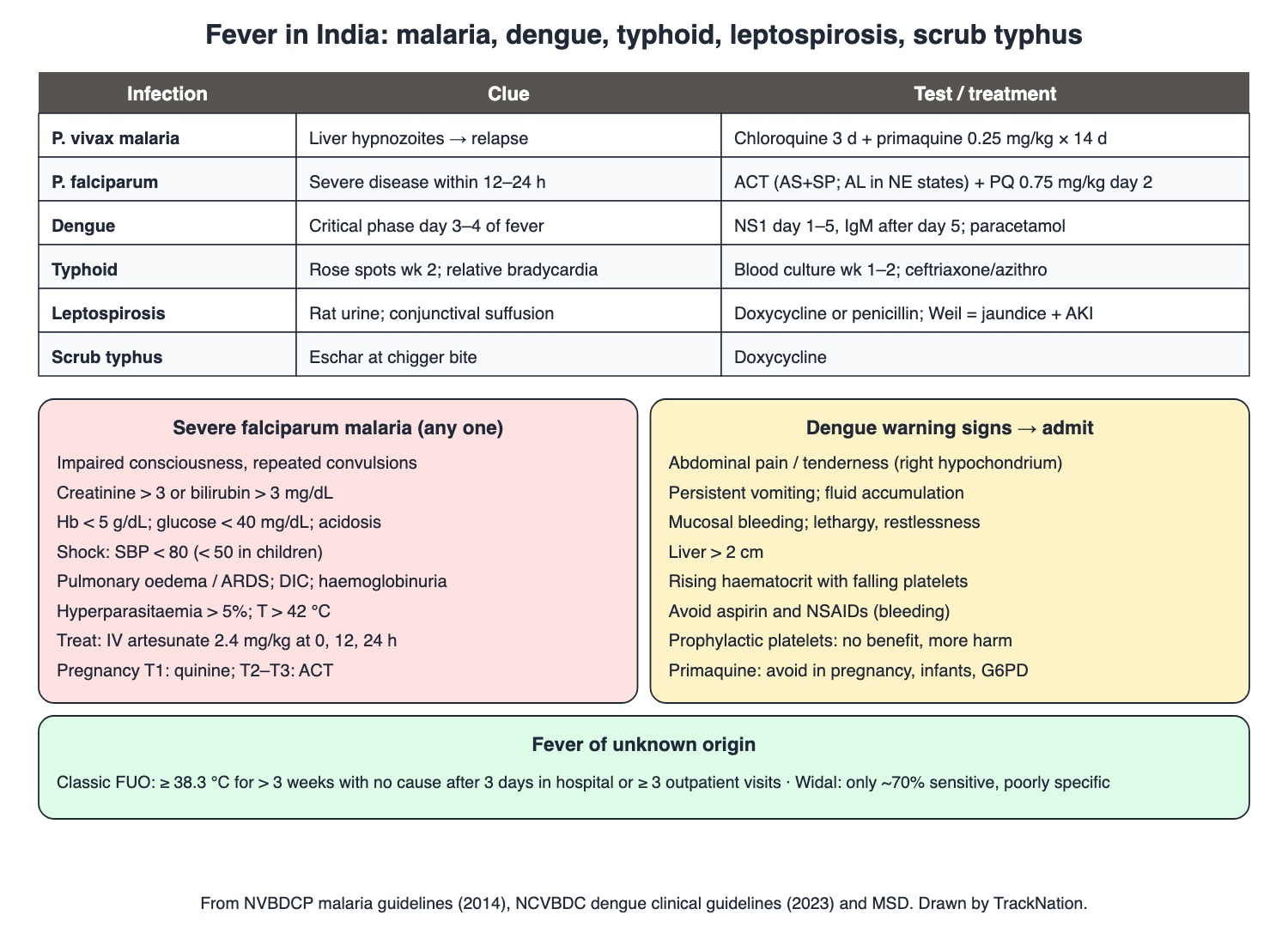
Malaria, dengue, typhoid, leptospirosis, scrub typhus and FUO. Drawn by TrackNation.
Malaria
Test every suspected case immediately by microscopy and/or RDT.
P. vivax forms dormant liver hypnozoites that cause relapse — hence 14 days of primaquine. P. falciparum can turn severe within 12–24 hours.
Severe malaria (any one): impaired consciousness/coma, repeated convulsions, creatinine > 3 mg/dL, bilirubin > 3 mg/dL, Hb < 5 g/dL, pulmonary oedema/ARDS, glucose < 40 mg/dL, metabolic acidosis, shock (SBP < 80; < 50 in children), abnormal bleeding/DIC, haemoglobinuria, temperature > 42 °C, parasitaemia > 5%.
Situation (national programme) | Treatment |
P. vivax | Chloroquine 3 days (10, 10, 5 mg/kg) + primaquine 0.25 mg/kg daily × 14 days (radical cure of hypnozoites) |
P. falciparum (most of India) | ACT: artesunate + sulfadoxine–pyrimethamine × 3 days + single primaquine 0.75 mg/kg on day 2 |
P. falciparum (north-eastern states) | Artemether–lumefantrine (ACT-AL) + primaquine |
Severe malaria | IV (preferred) or IM artesunate 2.4 mg/kg at 0, 12, 24 h, then daily |
Pregnancy, falciparum | Quinine in 1st trimester; ACT in 2nd and 3rd trimesters |
Primaquine contraindicated | Pregnancy, infants, known G6PD deficiency (haemolysis) |
Dengue
Three phases: febrile, critical (leakage; from about day 3–4 of fever, lasting 24–48 hours; commoner in secondary infection) and recovery. Do a tourniquet test and look for petechiae.
Warning signs (admit): abdominal pain or tenderness, persistent vomiting, fluid accumulation (ascites, effusion), mucosal bleeding, lethargy or restlessness, liver > 2 cm, rising haematocrit with falling platelets.
Tests: NS1 antigen for samples from day 1–5; IgM after day 5.
Treatment: no specific antiviral; paracetamol and fluids; avoid aspirin and NSAIDs (mucosal bleeding). Prophylactic platelet transfusion does not prevent bleeding better than supportive care and causes adverse events.
Typhoid, Leptospirosis, Scrub Typhus, FUO
Typhoid (S. Typhi; humans are the only host): prolonged fever, relative bradycardia, rose spots on chest and abdomen in week 2 (5–30%). Blood culture is positive in the first 2 weeks, stool culture in weeks 3–5; bone marrow culture is the most sensitive. The Widal test is only ~70% sensitive and non-specific. Complications: distal ileal perforation (1–2%) in week 3. Treatment: ceftriaxone, a fluoroquinolone or azithromycin.
Leptospirosis: from urine of carrier animals (rats, dogs, cattle); conjunctival suffusion on day 3–4. Weil syndrome = icteric leptospirosis with jaundice and azotaemia. Doxycycline or penicillin.
Scrub typhus (Orientia tsutsugamushi, mite-borne): an eschar at the chigger bite at fever onset; doxycycline.
Classic FUO: temperature ≥ 38.3 °C for more than 3 weeks with no cause after 3 days in hospital or 3 outpatient visits.
Traps the Examiner Sets
Primaquine: 14 days for vivax (0.25 mg/kg), single dose for falciparum (0.75 mg/kg) — never in pregnancy, infants, G6PD deficiency.
North-east India uses artemether–lumefantrine, not AS+SP.
Dengue: NS1 before day 5, IgM after.
Typhoid week 1–2 blood culture; week 3 perforation.
Fever + eschar → scrub typhus → doxycycline.
Memory Hooks & Shortcuts
Shortcuts to lock in this article's numbers and lists. Each one only re-packages facts proven above.
🧠 Vivax = 'V-for-Vacation in the liver' → 14 days primaquine — vivax
🧠 Falciparum = 'Fast and Fatal' (12–24 h) → artesunate — falciparum
🧠 Primaquine: no P-I-G (Pregnancy, Infants, G6PD) — primaquine contraindications
🧠 Dengue: 'NS1 till 5, IgM after 5' — dengue tests
🧠 Typhoid: Blood first (wk 1–2), Stool later (wk 3–5), Marrow most sensitive — typhoid test timing
🧠 Scrub typhus: Spot of black (eschar) → Doxy — scrub typhus
Rapid-Revision Cards
Malaria first step
Microscopy and/or RDT.
Vivax treatment
Chloroquine 3 d + primaquine 0.25 mg/kg × 14 d.
Hypnozoites
Vivax liver stage → relapse.
Falciparum (most of India)
AS+SP × 3 d + PQ 0.75 mg/kg day 2.
Falciparum NE states
Artemether–lumefantrine.
Primaquine CI
Pregnancy, infants, G6PD deficiency.
Severe malaria labs
Cr > 3, bili > 3, Hb < 5, glucose < 40, parasites > 5%.
Severe malaria shock
SBP < 80 (< 50 children).
Severe malaria Rx
IV artesunate 2.4 mg/kg at 0, 12, 24 h.
Malaria in pregnancy
T1 quinine; T2–T3 ACT.
Dengue phases
Febrile → critical (day 3–4, 24–48 h) → recovery.
Dengue warning signs
Pain, vomiting, fluid, bleeding, lethargy, liver > 2 cm, Hct ↑ platelets ↓.
Dengue tests
NS1 day 1–5; IgM after day 5.
Dengue analgesic
Paracetamol; no NSAIDs.
Prophylactic platelets
No benefit; adverse events.
Typhoid signs
Relative bradycardia; rose spots week 2.
Typhoid tests
Blood culture wk 1–2; stool wk 3–5; marrow most sensitive.
Widal
~70% sensitive, non-specific.
Typhoid perforation
Distal ileum, week 3, 1–2%.
Leptospirosis
Rat urine; conjunctival suffusion; doxy/penicillin.
Weil syndrome
Jaundice + azotaemia.
Scrub typhus
Orientia; eschar; doxycycline.
Classic FUO
≥ 38.3 °C > 3 weeks, no cause after 3 hospital days.
Sources
Facts in this article were checked against these documents.
Guidelines for Diagnosis and Treatment of Malaria in India — National Vector Borne Disease Control Programme, MoHFW, 2014 (link)
National Guidelines for Clinical Management of Dengue Fever — National Center for Vector Borne Diseases Control, MoHFW, 2023 (link)
MSD Manual Professional: Malaria; Dengue; Typhoid Fever; Leptospirosis; Scrub Typhus; Fever of Unknown Origin — Merck & Co. (MSD Manuals), reviewed 2025–26 (link)
Competency Based Undergraduate Curriculum, General Medicine (GM 4) — National Medical Commission, 2024
Test Yourself: Practice Questions
Thirty questions in NEET PG style, most of them clinical vignettes.
Practice Questions (NEET PG pattern)
Original questions written in the style of the exam: +4 for a correct answer, −1 for a wrong one. Every answer was checked against the sources listed above. NEET PG papers are not published by NBEMS, so these are not past-paper questions.
Q1. An adult in a malaria-endemic district has fever with chills. The first step under the national guidelines is
(a) Widal test
(b) immediate microscopy and/or RDT
(c) start ACT without testing in all
(d) chest X-ray
Show answer
Answer: (b) — Confirm before treating.
Q2. A man with smear-confirmed P. vivax malaria is treated with chloroquine. Primaquine is added at
(a) 0.75 mg/kg single dose
(b) not needed
(c) 0.25 mg/kg daily for 14 days
(d) 15 mg once weekly
Show answer
Answer: (c) — To clear liver hypnozoites and prevent relapse.
Q3. Primaquine is given in vivax malaria to
(a) kill gametocytes only
(b) prevent anaemia
(c) kill dormant liver hypnozoites that cause relapse
(d) reduce fever
Show answer
Answer: (c) — Radical cure.
Q4. Primaquine is contraindicated in all EXCEPT
(a) pregnant women
(b) infants
(c) adult men with normal G6PD
(d) known G6PD deficiency
Show answer
Answer: (c) — It causes haemolysis in G6PD deficiency.
Q5. A patient in Madhya Pradesh has uncomplicated P. falciparum malaria. The national treatment is
(a) chloroquine 3 days
(b) quinine 7 days alone
(c) primaquine 14 days alone
(d) artesunate + sulfadoxine–pyrimethamine for 3 days plus single primaquine 0.75 mg/kg on day 2
Show answer
Answer: (d) — AS+SP is used everywhere except the north-east.
Q6. In the north-eastern states, the ACT for falciparum malaria is
(a) artemether–lumefantrine
(b) artesunate + SP
(c) chloroquine
(d) mefloquine alone
Show answer
Answer: (a) — Changed after AS+SP treatment failures.
Q7. A falciparum malaria patient becomes drowsy with creatinine 3.8 mg/dL. The drug of choice is
(a) IV artesunate 2.4 mg/kg at 0, 12 and 24 hours, then daily
(b) oral chloroquine
(c) primaquine
(d) oral ACT at home
Show answer
Answer: (a) — Severe malaria; IV preferred to IM.
Q8. Which value defines severe falciparum malaria?
(a) temperature 39 °C
(b) Hb 9 g/dL
(c) plasma glucose < 40 mg/dL
(d) creatinine 1.4 mg/dL
Show answer
Answer: (c) — Also Hb < 5, creatinine > 3, bilirubin > 3, parasitaemia > 5%.
Q9. Parasitaemia defining severe malaria is more than
(a) 50%
(b) 0.1%
(c) 1%
(d) 5% of red cells
Show answer
Answer: (d) — Hyperparasitaemia.
Q10. A woman in the first trimester has falciparum malaria. Per the national guidelines, treat with
(a) quinine
(b) ACT
(c) chloroquine plus primaquine
(d) primaquine
Show answer
Answer: (a) — ACT in the 2nd and 3rd trimesters.
Q11. Severe complications of P. falciparum can develop within
(a) 12–24 hours
(b) only after relapse
(c) 2 months
(d) 2 weeks
Show answer
Answer: (a) — Treat promptly.
Q12. A dengue patient on day 4 of fever develops right upper quadrant pain, persistent vomiting and a rising haematocrit with falling platelets. The next step is
(a) give prophylactic platelets
(b) start antibiotics only
(c) admit — these are warning signs
(d) send home on NSAIDs
Show answer
Answer: (c) — Critical phase begins around day 3–4.
Q13. The critical (plasma leakage) phase of dengue usually begins
(a) after the 3rd or 4th day of fever and lasts 24–48 hours
(b) on day 1
(c) after 3 weeks
(d) only after recovery
Show answer
Answer: (a) — Commoner in secondary infection.
Q14. A patient's sample is collected on day 3 of fever for dengue. The test the laboratory should perform is
(a) IgM ELISA
(b) NS1 antigen
(c) paired IgG
(d) Widal
Show answer
Answer: (b) — NS1 for day 1–5; IgM after day 5.
Q15. For fever and body ache in dengue, the recommended drug is
(a) aspirin
(b) ibuprofen
(c) paracetamol
(d) diclofenac
Show answer
Answer: (c) — NSAIDs and salicylates predispose to mucosal bleeding.
Q16. A dengue patient has platelets of 18,000/µL without significant bleeding. Per national guidance, prophylactic platelet transfusion
(a) should be given daily
(b) is not superior to supportive care and has adverse events
(c) is mandatory
(d) prevents all bleeding
Show answer
Answer: (b) — Treat bleeding, not the number.
Q17. Severe plasma leakage in dengue is more common in
(a) first infection in healthy adults only
(b) secondary (repeat) dengue infection
(c) infants only
(d) vaccinated people only
Show answer
Answer: (b) — Also comorbidities and co-infections.
Q18. A patient has 10 days of fever, relative bradycardia and pink blanching spots on the abdomen in the second week. The likely diagnosis is
(a) typhoid fever
(b) leptospirosis
(c) dengue
(d) malaria
Show answer
Answer: (a) — Rose spots appear in 5–30%.
Q19. In suspected typhoid in the first week of illness, the investigation of choice is
(a) stool culture
(b) urine culture
(c) Widal test
(d) blood culture
Show answer
Answer: (d) — Stool culture is positive in weeks 3–5.
Q20. The most sensitive culture in typhoid fever, useful when blood cultures are negative, is
(a) bone marrow culture
(b) throat swab
(c) urine culture
(d) CSF culture
Show answer
Answer: (a) — Highly sensitive.
Q21. The Widal test in typhoid is
(a) the gold standard
(b) positive in week 1 always
(c) 100% specific
(d) only about 70% sensitive and lacks specificity
Show answer
Answer: (d) — Needs a four-fold rise in paired sera.
Q22. A typhoid patient in the third week develops an acute abdomen. The usual site of perforation is
(a) stomach
(b) distal ileum
(c) sigmoid colon
(d) duodenum
Show answer
Answer: (b) — Occurs in 1–2%.
Q23. Drugs used to treat typhoid include
(a) ceftriaxone, a fluoroquinolone or azithromycin
(b) doxycycline only
(c) penicillin G
(d) metronidazole
Show answer
Answer: (a) — Choice depends on local resistance.
Q24. The reservoir of Salmonella Typhi is
(a) pigs
(b) poultry
(c) rats
(d) humans only
Show answer
Answer: (d) — Carriers shed bacilli in stool.
Q25. A farmer exposed to water contaminated by rat urine has fever, severe muscle aches and conjunctival suffusion on day 4. The likely diagnosis is
(a) typhoid
(b) conjunctivitis
(c) leptospirosis
(d) dengue
Show answer
Answer: (c) — Conjunctival suffusion; rodents shed leptospires in urine.
Q26. Leptospirosis with jaundice and renal failure is called
(a) Reiter syndrome
(b) Weil syndrome
(c) Felty syndrome
(d) Waterhouse-Friderichsen syndrome
Show answer
Answer: (b) — Icteric leptospirosis.
Q27. A patient develops an eschar at the site of a chigger (mite) bite as fever begins. The likely diagnosis and drug are
(a) anthrax — penicillin
(b) plague — streptomycin
(c) leishmaniasis — amphotericin
(d) scrub typhus — doxycycline
Show answer
Answer: (d) — Orientia tsutsugamushi; the eschar appears at fever onset.
Q28. Scrub typhus is caused by
(a) Orientia tsutsugamushi
(b) Rickettsia prowazekii
(c) Coxiella burnetii
(d) Leptospira interrogans
Show answer
Answer: (a) — Mites are reservoir and vector.
Q29. Classic fever of unknown origin requires fever ≥ 38.3 °C for more than
(a) 1 week
(b) 3 months
(c) 3 days
(d) 3 weeks without a cause after 3 days in hospital or 3 outpatient visits
Show answer
Answer: (d) — Other categories: health-care-associated, immunodeficient, HIV-related.
Q30. In severe malaria, parenteral artesunate should preferably be given
(a) rectally always
(b) intravenously rather than intramuscularly
(c) orally
(d) subcutaneously
Show answer
Answer: (b) — IM if IV access is not possible.
Active Recall
From memory: give the national regimens for vivax and falciparum malaria, primaquine doses and contraindications, severe malaria criteria and IV artesunate schedule; describe dengue phases, warning signs, test timing and supportive care; give typhoid tests by week and complications; and describe leptospirosis, scrub typhus and classic FUO.