Tuberculosis for NEET PG Medicine: NTEP Regimen and Doses, ATT Toxicity and Hepatitis, TB Meningitis, Pleural and Pericardial TB, TPT, BPaLM
Start Here
🎯 Exam priority: High. Expect: the NTEP regimen and phase lengths, which drug stops after the intensive phase, drug doses and toxicities (ethambutol eye, isoniazid neuropathy), when to stop ATT for hepatitis, TB meningitis features and steroids, pericardial TB and constriction, 3HP preventive therapy, and BPaLM.
CBME mapping: GM 27.1–27.18. NTEP programme indicators and case definitions are in Community Medicine; granuloma pathology in Pathology article 7; ATT pharmacology in Pharmacology.
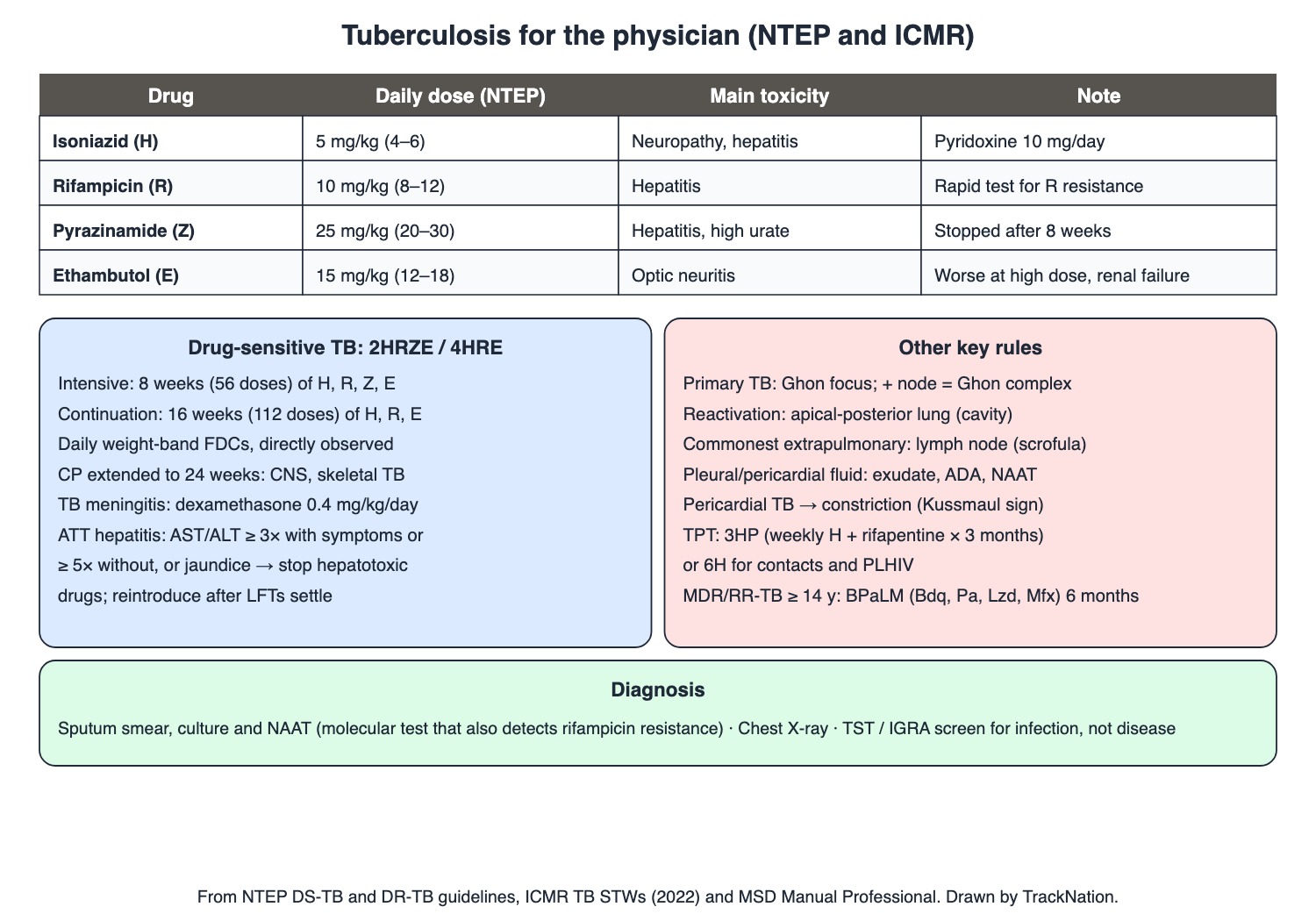
ATT doses and toxicity, DS-TB regimen, ATT hepatitis, EPTB, TPT and BPaLM. Drawn by TrackNation.
Pathogenesis and Presentation
Primary infection: small consolidations (Ghon foci); with lymph node involvement = Ghon complex; calcified = Ranke complex. Bacilli seed the apical-posterior lungs, kidneys, long-bone epiphyses, vertebrae (Pott disease) and meninges.
Pulmonary TB: cough, fever, weight loss, malaise; drenching night sweats are classic but not specific. Chest X-ray often shows an upper-lobe cavity.
Extrapulmonary: lymphadenitis (scrofula) is the commonest; also pleural, pericardial, abdominal, skeletal, CNS and genitourinary TB.
Diagnosis
Sputum smear and culture, with at least one specimen tested by NAAT; rapid molecular tests also detect rifampicin resistance and limit the spread of drug-resistant TB.
Tuberculin skin test and IGRA screen for infection; they do not prove active disease.
Pleural or pericardial fluid: exudate, adenosine deaminase (ADA), NAAT, AFB stain and culture.
Treatment (NTEP)
2HRZE / 4HRE: intensive phase 8 weeks (56 doses) of H, R, Z, E; continuation 16 weeks (112 doses) of H, R, E — only pyrazinamide stops. Daily weight-band fixed-dose combinations under direct observation.
Extend the continuation phase to 24 weeks in CNS TB and skeletal TB (and case-by-case for disseminated TB or slow response).
ATT-induced hepatitis (ICMR): stop all hepatotoxic drugs if AST/ALT ≥ 3× with symptoms, ≥ 5× without symptoms, or jaundice (bilirubin ≥ 2× ULN). Exclude viral hepatitis. If ATT is urgently needed, use non-hepatotoxic drugs (fluoroquinolone, ethambutol, aminoglycoside), then reintroduce first-line drugs as liver tests settle.
IRIS (immune reconstitution inflammatory syndrome): severe cases get glucocorticoids.
Drug | Daily dose (NTEP) | Key toxicity |
Isoniazid (H) | 5 mg/kg (4–6) | Peripheral neuropathy (pyridoxine 10 mg/day), hepatitis, rash; safe in pregnancy |
Rifampicin (R) | 10 mg/kg (8–12) | Hepatitis |
Pyrazinamide (Z) | 25 mg/kg (20–30) | Hepatitis; mild hyperuricaemia (gout rare) |
Ethambutol (E) | 15 mg/kg (12–18) | Optic neuritis — more at high dose (25 mg/kg) and renal failure |
Streptomycin (S) | 15 mg/kg (15–20) | Only in special situations (e.g. TB meningitis, replacing a drug) |
Extrapulmonary TB (ICMR)
TB meningitis: fever ≥ 5 days, headache, vomiting, altered sensorium, neck stiffness, cranial nerve palsies, hemiparesis; imaging shows basal exudates, hydrocephalus, tuberculomas, infarcts. Treat with ATT plus dexamethasone 0.4 mg/kg/day IV initially; continuation phase extended.
Pleural TB: exudative effusion; ADA and NAAT on the fluid help.
Pericardial TB: effusion, tamponade or constriction (Kussmaul sign, pericardium > 4 mm) — ATT plus steroids; pericardiectomy for persistent constriction.
Prevention and Drug Resistance
TB preventive treatment (after excluding active TB) for household contacts and people living with HIV: 3HP (weekly isoniazid + rifapentine for 3 months) or 6H (6 months of isoniazid).
MDR/RR-TB (age ≥ 14, newly confirmed): the 6-month all-oral BPaLM regimen — bedaquiline, pretomanid, linezolid, moxifloxacin; pyridoxine reduces linezolid neuropathy.
Traps the Examiner Sets
Only pyrazinamide stops after 8 weeks; ethambutol continues (2HRZE/4HRE).
CNS and bone TB: continuation 24 weeks.
Ethambutol → eye; isoniazid → nerves (give pyridoxine).
ATT hepatitis: 3× with symptoms, 5× without, or jaundice.
Ghon complex = focus + node; Ranke = calcified complex.
Memory Hooks & Shortcuts
Shortcuts to lock in this article's numbers and lists. Each one only re-packages facts proven above.
🧠 Z Zips out after 2 months (2HRZE → 4HRE) — regimen
🧠 Doses 5-10-25-15: H5, R10, Z25, E15 — doses
🧠 Ethambutol = Eyes; Isoniazid = Injured nerves — toxicity
🧠 3-5-Jaundice: stop ATT at 3× with symptoms, 5× without, or jaundice — ATT hepatitis
🧠 BPaLM = Bedaquiline, Pretomanid, Linezolid, Moxi — 6 months — MDR-TB
🧠 Brain and Bone: 24-week continuation — extended CP
Rapid-Revision Cards
DS-TB regimen
2HRZE / 4HRE.
Intensive phase
8 weeks, 56 doses.
Continuation phase
16 weeks, 112 doses; Z stopped.
CP extended to 24 weeks
CNS TB, skeletal TB.
H dose
5 mg/kg (4–6).
R dose
10 mg/kg (8–12).
Z dose
25 mg/kg (20–30).
E dose
15 mg/kg (12–18).
Isoniazid toxicity
Neuropathy (pyridoxine 10 mg), hepatitis.
Ethambutol toxicity
Optic neuritis.
Pyrazinamide
Hepatitis, hyperuricaemia.
ATT hepatitis stop
ALT ≥ 3× + symptoms, ≥ 5× alone, or jaundice.
Safe ATT in hepatitis
Fluoroquinolone, ethambutol, aminoglycoside.
Ghon complex
Focus + node; Ranke = calcified.
Reactivation site
Apical-posterior lung.
Commonest EPTB
Lymphadenitis (scrofula).
TBM steroid
Dexamethasone 0.4 mg/kg/day.
TBM imaging
Basal exudates, hydrocephalus, tuberculomas.
TB pleural fluid
ADA, NAAT.
Pericardial TB complication
Constriction; Kussmaul sign.
TPT
3HP or 6H.
BPaLM
Bdq, Pa, Lzd, Mfx; 6 months; ≥ 14 y.
Sources
Facts in this article were checked against these documents.
Standard Treatment Workflow: Guidelines for Drug-Sensitive TB Treatment as per NTEP — ICMR / Central TB Division, 2022 (link)
Standard Treatment Workflows (Special Edition on Paediatric and Extrapulmonary TB): Adult TB Meningitis; Pleural TB; Pericardial TB; ATT Hepatitis — ICMR / Central TB Division, 2022 (link)
Guidelines for Programmatic Management of TB Preventive Treatment in India — Central TB Division, MoHFW, 2021 (link)
Guidelines for Programmatic Management of Drug-Resistant TB in India — Central TB Division, MoHFW, 2025 (link)
MSD Manual Professional: Tuberculosis — Merck & Co. (MSD Manuals), reviewed 2025–26 (link)
Competency Based Undergraduate Curriculum, General Medicine (GM 27) — National Medical Commission, 2024
Test Yourself: Practice Questions
Thirty questions in NEET PG style, most of them clinical vignettes.
Practice Questions (NEET PG pattern)
Original questions written in the style of the exam: +4 for a correct answer, −1 for a wrong one. Every answer was checked against the sources listed above. NEET PG papers are not published by NBEMS, so these are not past-paper questions.
Q1. A new patient with drug-sensitive pulmonary TB starts NTEP treatment. The regimen is
(a) 2HRZ / 4HR
(b) 2SHRZE / 6HE
(c) 2HRZE / 4HRE
(d) 6HRZE
Show answer
Answer: (c) — Intensive 8 weeks, continuation 16 weeks.
Q2. Which drug is stopped at the end of the intensive phase of the NTEP regimen?
(a) ethambutol
(b) rifampicin
(c) pyrazinamide
(d) isoniazid
Show answer
Answer: (c) — H, R and E continue.
Q3. The NTEP intensive phase consists of
(a) 6 months of H
(b) 12 weeks of all five drugs
(c) 8 weeks (56 doses) of H, R, Z, E
(d) 4 weeks of H and R
Show answer
Answer: (c) — Continuation: 16 weeks (112 doses).
Q4. For tuberculous meningitis or spinal TB, the NTEP continuation phase is extended to
(a) 12 weeks
(b) 24 weeks
(c) 2 years
(d) 8 weeks
Show answer
Answer: (b) — Also case-by-case for disseminated TB.
Q5. The daily NTEP dose of rifampicin is
(a) 25 mg/kg
(b) 15 mg/kg
(c) 5 mg/kg
(d) 10 mg/kg (8–12)
Show answer
Answer: (d) — H 5, Z 25, E 15 mg/kg.
Q6. The daily NTEP dose of pyrazinamide is
(a) 5 mg/kg
(b) 25 mg/kg (20–30)
(c) 10 mg/kg
(d) 15 mg/kg
Show answer
Answer: (b) — Stopped after the intensive phase.
Q7. A TB patient on treatment complains of blurred vision from optic neuritis. The likely culprit is
(a) rifampicin
(b) isoniazid
(c) ethambutol
(d) pyrazinamide
Show answer
Answer: (c) — Optic neuritis, more at high doses and renal failure.
Q8. Isoniazid-related peripheral neuropathy in a TB patient is prevented by giving
(a) pyridoxine
(b) vitamin C
(c) thiamine
(d) folic acid
Show answer
Answer: (a) — Isoniazid neuropathy; pyridoxine 10 mg/day.
Q9. A TB drug that raises serum uric acid (rarely causing gout) is
(a) ethambutol
(b) pyrazinamide
(c) streptomycin
(d) isoniazid
Show answer
Answer: (b) — Usually mild.
Q10. Two weeks into ATT, a patient has nausea and vomiting with ALT four times the upper limit. Per ICMR, the next step is
(a) continue full ATT
(b) stop only ethambutol
(c) stop all hepatotoxic drugs and evaluate
(d) add a second hepatotoxic drug
Show answer
Answer: (c) — ≥ 3× with symptoms (≥ 5× without, or jaundice).
Q11. An asymptomatic patient on ATT has ALT at what level before hepatotoxic drugs must be stopped (ICMR)?
(a) 2 times
(b) 1.5 times
(c) 5 times the upper limit
(d) 10 times only
Show answer
Answer: (c) — With symptoms the threshold is 3 times.
Q12. A patient with ATT hepatitis needs urgent TB treatment. Non-hepatotoxic options per ICMR are
(a) isoniazid alone
(b) pyrazinamide and rifampicin
(c) isoniazid and rifampicin
(d) fluoroquinolones, ethambutol and aminoglycosides
Show answer
Answer: (d) — Reintroduce first-line drugs as liver tests settle.
Q13. A small lung consolidation with involved hilar lymph nodes in primary TB is a
(a) Ranke complex
(b) Simon focus
(c) Ghon complex
(d) Assmann focus
Show answer
Answer: (c) — Calcified Ghon complex = Ranke complex.
Q14. Reactivation pulmonary TB typically involves the
(a) apical-posterior parts of the lungs
(b) lingula
(c) anterior segments
(d) lower lobes only
Show answer
Answer: (a) — Upper-lobe cavities on X-ray.
Q15. The commonest extrapulmonary form of TB is
(a) lymphadenitis (scrofula)
(b) pericardial TB
(c) renal TB
(d) TB meningitis
Show answer
Answer: (a) — Especially in children.
Q16. A positive IGRA in an asymptomatic health worker indicates
(a) BCG failure only
(b) MDR-TB
(c) active pulmonary TB
(d) TB infection, not necessarily active disease
Show answer
Answer: (d) — TST and IGRA are screening tests.
Q17. A rapid molecular test on sputum is valuable in TB because it
(a) detects only non-tuberculous mycobacteria
(b) replaces clinical examination
(c) detects TB and rifampicin resistance quickly
(d) measures CD4 count
Show answer
Answer: (c) — Limits spread of drug-resistant TB.
Q18. A young man has 2 weeks of fever, headache, vomiting and a cranial nerve palsy; CT shows basal exudates and hydrocephalus. Along with ATT, give
(a) no steroids
(b) IV acyclovir only
(c) dexamethasone
(d) mannitol only
Show answer
Answer: (c) — ICMR: dexamethasone 0.4 mg/kg/day initially.
Q19. Classic imaging findings in tuberculous meningitis include
(a) ring-enhancing frontal abscess only
(b) basal exudates, hydrocephalus, tuberculomas and infarcts
(c) normal scan always
(d) temporal lobe haemorrhage
Show answer
Answer: (b) — Fever of 5 days or more with cranial nerve palsy.
Q20. A useful pleural fluid test for tuberculous effusion is
(a) triglycerides
(b) adenosine deaminase (ADA)
(c) creatinine
(d) amylase
Show answer
Answer: (b) — Plus NAAT, AFB stain and culture.
Q21. A patient treated for pericardial TB develops raised JVP that rises on inspiration and a thickened pericardium. The complication is
(a) cardiac tamponade only
(b) constrictive pericarditis
(c) dilated cardiomyopathy
(d) infective endocarditis
Show answer
Answer: (b) — Kussmaul sign; pericardiectomy if persistent.
Q22. TB preventive treatment regimen '3HP' means
(a) rifampicin for 3 weeks
(b) weekly isoniazid and rifapentine for 3 months
(c) high-dose pyrazinamide
(d) daily isoniazid for 3 months
Show answer
Answer: (b) — 6H (6 months of isoniazid) is the alternative.
Q23. TB preventive treatment in India targets, after excluding active TB,
(a) only children under 1 year with no contact
(b) all healthy adults
(c) only health workers
(d) household contacts and people living with HIV
Show answer
Answer: (d) — And other high-risk groups.
Q24. A 25-year-old with newly confirmed rifampicin-resistant TB is eligible for the NTEP 6-month regimen containing
(a) isoniazid, rifampicin, pyrazinamide and ethambutol
(b) rifapentine and isoniazid
(c) streptomycin and ethionamide for 2 years
(d) bedaquiline, pretomanid, linezolid and moxifloxacin
Show answer
Answer: (d) — BPaLM, for age ≥ 14.
Q25. The minimum age for the BPaLM regimen in NTEP guidance is
(a) 5 years
(b) 14 years
(c) 18 years
(d) 1 year
Show answer
Answer: (b) — Newly confirmed MDR/RR-TB.
Q26. Which first-line TB drug is considered safe in pregnancy?
(a) isoniazid
(b) streptomycin
(c) none
(d) pretomanid
Show answer
Answer: (a) — Adverse effects include hepatitis and neuropathy.
Q27. Severe immune reconstitution inflammatory syndrome (IRIS) in a patient with TB is treated with
(a) glucocorticoids
(b) antifungals
(c) stopping all ATT permanently
(d) increasing pyrazinamide
Show answer
Answer: (a) — Glucocorticoids reduce the inflammation.
Q28. NTEP gives first-line ATT as
(a) thrice-weekly loose drugs
(b) daily fixed-dose combinations by weight band under direct observation
(c) monthly injections
(d) self-administered without monitoring
Show answer
Answer: (b) — Private-sector patients can get NTEP FDCs on request.
Q29. Hepatotoxicity among first-line ATT is caused by
(a) isoniazid, rifampicin and pyrazinamide
(b) ethambutol only
(c) streptomycin only
(d) pyridoxine
Show answer
Answer: (a) — Ethambutol is not hepatotoxic.
Q30. Tuberculosis of the vertebral bodies is called
(a) Ghon disease
(b) Pott disease
(c) Poncet disease
(d) Ranke disease
Show answer
Answer: (b) — Haematogenous seeding of vertebrae.
Active Recall
From memory: describe TB pathogenesis and presentation; list diagnostic tests; give the NTEP regimen, phases, doses and extended courses; state each drug's toxicity and the ICMR rule for ATT hepatitis; describe TB meningitis, pleural and pericardial TB; and outline TB preventive treatment and BPaLM.