Blood Banking and Transfusion for NEET PG Pathology: NBTC Donor Criteria, Cross-Match, Blood Products, Transfusion Reactions
Start Here
🎯 Exam priority: High. Expect: the minimum Hb and weight to donate in India, donation interval for men and women, deferral periods, the mandatory screening tests, the blood group in an emergency, the commonest and the deadliest transfusion reactions, TRALI vs TACO, and irradiated blood.
CBME mapping: PA 21.1–21.6. Indian rules: NBTC Guidelines for Blood Donor Selection and Referral (2017).
The Indian Blood Donor (NBTC 2017)
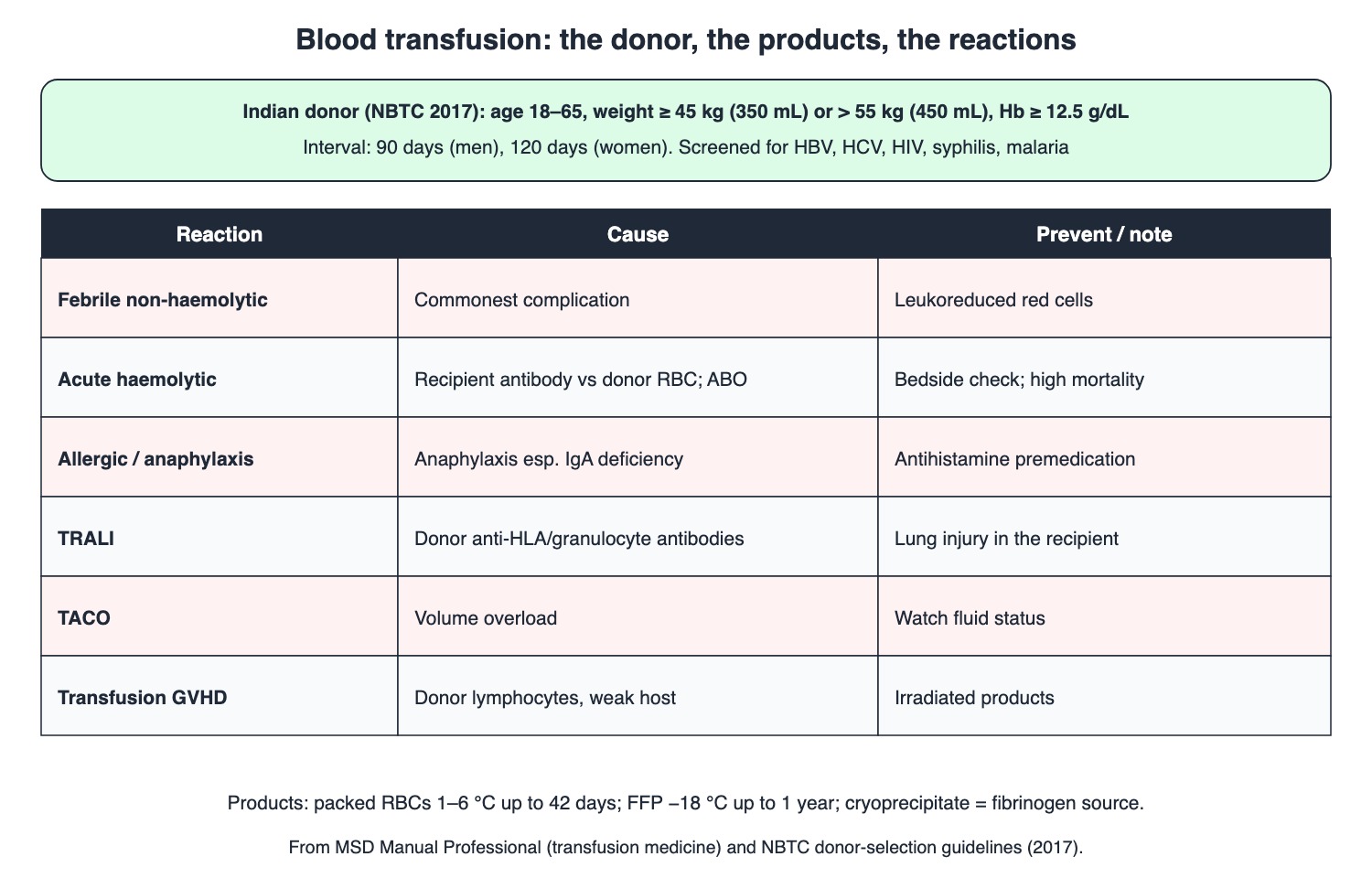
Indian donor criteria, blood products and transfusion reactions. Drawn by TrackNation.
Voluntary, non-remunerated donors only; replacement donation is to be phased out.
Eligibility: age 18–65 (first-time donors not over 60); weight ≥ 45 kg for 350 mL, > 55 kg for 450 mL; Hb ≥ 12.5 g/dL (thalassaemia trait accepted if Hb is adequate); BP 100–140/60–90; pulse 60–100, regular; afebrile.
Interval: 90 days for men, 120 days for women.
Every unit is tested for hepatitis B, hepatitis C, HIV, syphilis and malaria; HIV-reactive donors are referred to ICTC.
Situation (NBTC 2017) | Deferral |
After delivery / abortion / breastfeeding | 12 months / 6 months / whole lactation period |
Received a blood transfusion; tattoo, piercing, acupuncture | 12 months |
Malaria / typhoid / tuberculosis | 3 months / 12 months after recovery / 2 years after cure |
Hepatitis A or E / hepatitis B or C | 12 months / permanent |
Killed vaccines and toxoids / live vaccines | 14 days / 28 days |
Anti-rabies vaccine after a bite, immunoglobulins | 1 year |
Heart attack, epilepsy, insulin-treated diabetes, leprosy, HIV | Permanent |
Before the Transfusion
Compatibility testing: type the recipient's red cells for A, B and Rh(D); screen the plasma for red-cell antibodies; and cross-match the recipient's plasma against the donor's cells.
Emergency: if the group is unknown, give group O red cells (no A or B antigens); use Rh-negative for girls and women of child-bearing age to prevent alloimmunisation.
Bedside check of wristband, unit label and compatibility report — mislabelled samples and wrong-patient transfusions cause most acute haemolytic reactions.
Products: packed red cells (1–6 °C, up to 42 days) to raise Hb; FFP (−18 °C, up to 1 year) supplies all clotting factors without platelets; cryoprecipitate is the fibrinogen source; leukoreduced cells (≥ 99.99% of white cells removed) after febrile reactions; irradiated products prevent transfusion GVHD. Rh immune globulin prevents maternal anti-D.
Autologous donation: 3–4 units collected 2–3 weeks before elective surgery with iron; now reserved for rare blood types or multiple alloantibodies.
Transfusion Reactions
Commonest: febrile non-haemolytic reactions.
Acute haemolytic reaction: recipient antibodies (usually ABO) destroy donor cells; haemolysis is intravascular with haemoglobinuria, often within the first hour, with chills, fever and severe lumbar pain. MSD calls it the commonest cause of transfusion death (TRALI second), but the same chapter notes that TACO is now the commonest cause of transfusion deaths reported to the US FDA. Older exam keys expect "acute haemolytic".
Anaphylaxis: rare, especially in IgA-deficient recipients.
TRALI: donor anti-HLA or anti-granulocyte antibodies activate the recipient's neutrophils in the lungs; the chest X-ray shows non-cardiogenic pulmonary oedema, and diuretics are avoided. TACO: volume overload in people with heart or kidney disease and in older adults.
Transfusion GVHD: donor lymphocytes attack an immunocompromised host (for example stem-cell transplant recipients, neonates) or a recipient of blood from a first-degree relative — prevented by irradiation.
Traps the Examiner Sets
India: Hb 12.5, weight 45 kg, 90/120-day interval, age 18–65.
Five mandatory tests: HBV, HCV, HIV, syphilis, malaria.
Commonest reaction = febrile. Classic "deadliest" key = acute haemolytic (ABO, clerical error); TACO now tops US FDA death reports.
Irradiation prevents GVHD; leukoreduction prevents febrile reactions.
Memory Hooks & Shortcuts
Shortcuts to lock in this article's numbers and lists. Each one only re-packages facts proven above.
🧠 India donates at 18, 45 and 12.5 — age, weight, haemoglobin
🧠 Men 3 months, women 4 — donation interval
🧠 Five tests: B, C, HIV, Syphilis, Malaria — mandatory screening
🧠 O for Orphan blood in emergencies, negative for women — emergency transfusion
🧠 IRradiate to stop GVHD; filter to stop Fever — irradiation vs leukoreduction
🧠 TRALI = donor antibodies; TACO = too much volume — lung reactions
Rapid-Revision Cards
NBTC donor basics
18–65 y, ≥ 45 kg, Hb ≥ 12.5 g/dL.
First-time donor age
Not over 60.
Volume by weight
350 mL ≥ 45 kg; 450 mL > 55 kg.
Donation interval
Men 90 days; women 120 days.
Mandatory screening
HBV, HCV, HIV, syphilis, malaria.
Post-delivery / abortion
12 months / 6 months.
Tattoo, transfusion
12 months.
Malaria / typhoid / TB
3 m / 12 m / 2 y.
Hepatitis B or C
Permanent deferral.
Vaccines
Killed 14 d; live 28 d; anti-rabies after bite 1 y.
Cross-match
Recipient plasma vs donor cells.
Emergency blood
Group O; Rh-negative for women of child-bearing age.
Packed RBCs
1–6 °C, 42 days.
FFP
All factors, no platelets; −18 °C, 1 year.
Cryoprecipitate
Fibrinogen.
Commonest reaction
Febrile non-haemolytic.
Deadliest reaction (classic key)
Acute haemolytic (ABO, labelling error); TRALI second. TACO now leads US FDA death reports.
Anaphylaxis
IgA deficiency.
TRALI
Donor anti-HLA/granulocyte antibodies.
GVHD prevention
Irradiation.
Febrile prevention
Leukoreduction.
Sources
Facts in this article were checked against these documents.
Guidelines for Blood Donor Selection and Blood Donor Referral — National Blood Transfusion Council / NACO, MoHFW, 2017 (link)
MSD Manual Professional: Blood Collection; Blood Products; Technique of Transfusion; Complications of Transfusion — Merck & Co. (MSD Manuals), reviewed 2026 (link)
Competency Based Undergraduate Curriculum, Pathology (PA 21) — National Medical Commission, 2024
Test Yourself: Practice Questions
Twenty-four questions in NEET PG style, most of them clinical vignettes.
Practice Questions (NEET PG pattern)
Original questions written in the style of the exam: +4 for a correct answer, −1 for a wrong one. Every answer was checked against the sources listed above. NEET PG papers are not published by NBEMS, so these are not past-paper questions.
Q1. Under India's NBTC guidelines, the minimum haemoglobin to donate blood is
(a) 14 g/dL
(b) 10 g/dL
(c) 11 g/dL
(d) 12.5 g/dL
Show answer
Answer: (d) — Also age 18–65 and weight ≥ 45 kg.
Q2. A 48-kg healthy man wants to donate. NBTC allows collection of
(a) 450 mL
(b) no donation below 60 kg
(c) 350 mL (≥ 45 kg); 450 mL needs > 55 kg
(d) 500 mL
Show answer
Answer: (c) — NBTC general criteria.
Q3. A regular woman donor last gave whole blood 3 months ago. NBTC says she may donate after
(a) 1 year
(b) 120 days (4 months)
(c) 90 days
(d) 30 days
Show answer
Answer: (b) — 90 days for men, 120 days for women.
Q4. A 62-year-old wants to donate blood for the first time. Under NBTC he is
(a) eligible only for plasma
(b) not eligible: first-time donors must not be over 60
(c) eligible
(d) eligible after an ECG
Show answer
Answer: (b) — Repeat donors may continue to 65.
Q5. Every donated unit in India must be screened for
(a) dengue and typhoid
(b) hepatitis B, hepatitis C, HIV, syphilis and malaria
(c) HIV only
(d) HIV and hepatitis B only
Show answer
Answer: (b) — NBTC donor consent statement.
Q6. A woman who delivered 8 months ago wants to donate. NBTC advises
(a) accept now
(b) defer until 12 months after delivery
(c) permanent deferral
(d) defer 6 weeks
Show answer
Answer: (b) — Abortion: 6 months; breastfeeding: whole lactation period.
Q7. A man got a tattoo 5 months ago. Under NBTC he is
(a) deferred for 12 months
(b) accepted
(c) deferred for 1 month
(d) permanently deferred
Show answer
Answer: (a) — Risk of hepatitis.
Q8. A donor recovered from malaria 2 months ago. NBTC advises
(a) defer 2 years
(b) accept now
(c) defer for 3 months after full recovery
(d) permanent deferral
Show answer
Answer: (c) — Typhoid 12 months; TB 2 years after cure.
Q9. A donor with known hepatitis B is
(a) accepted for plasma only
(b) permanently deferred
(c) deferred 12 months
(d) accepted if asymptomatic
Show answer
Answer: (b) — Hepatitis A or E: 12 months.
Q10. After a live attenuated vaccine, NBTC defers blood donation for
(a) 1 year
(b) 28 days
(c) no deferral
(d) 14 days
Show answer
Answer: (b) — Killed vaccines/toxoids: 14 days; anti-rabies after a bite: 1 year.
Q11. A person with insulin-treated diabetes wants to donate. NBTC says
(a) permanently defer
(b) defer 4 weeks
(c) accept if HbA1c is normal
(d) accept
Show answer
Answer: (a) — Diet- or tablet-controlled diabetes can be accepted.
Q12. Before a routine transfusion, the cross-match tests
(a) donor plasma against recipient cells
(b) the recipient's plasma against the donor's red cells
(c) only the ABO group
(d) only the Rh group
Show answer
Answer: (b) — Along with ABO/Rh typing and antibody screening.
Q13. A bleeding trauma patient of unknown blood group, a 25-year-old woman, needs blood before grouping. Give
(a) no blood until cross-matched
(b) group O Rh-negative packed red cells
(c) group AB Rh-positive whole blood
(d) group A Rh-negative
Show answer
Answer: (b) — Group O has no A or B antigens; Rh-negative for women of child-bearing age.
Q14. The commonest complication of blood transfusion is
(a) acute haemolytic reaction
(b) TRALI
(c) GVHD
(d) febrile non-haemolytic reaction
Show answer
Answer: (d) — MSD.
Q15. Within the first hour of a transfusion, a patient develops chills, fever and severe lumbar pain, and the urine turns dark. Usual cause and mechanism:
(a) bacterial contamination always
(b) volume overload
(c) IgA deficiency
(d) ABO-incompatible blood from a labelling error; intravascular haemolysis
Show answer
Answer: (d) — Acute haemolytic reaction; commonest cause of transfusion death.
Q16. MSD lists four serious transfusion complications with very high mortality. Which of these is NOT one of them?
(a) transfusion-associated GVHD
(b) acute haemolytic reaction
(c) localised urticaria
(d) TRALI
Show answer
Answer: (c) — The four: acute haemolytic (ABO), GVHD, TACO and TRALI. Allergic reactions are usually mild.
Q17. A patient develops anaphylaxis during a blood transfusion. A predisposing condition is
(a) IgA deficiency
(b) thalassaemia trait
(c) G6PD deficiency
(d) iron deficiency
Show answer
Answer: (a) — MSD.
Q18. Acute breathing difficulty develops during a transfusion; the chest X-ray shows non-cardiogenic pulmonary oedema. The mechanism is
(a) volume overload (TACO)
(b) donor anti-HLA or anti-granulocyte antibodies (TRALI)
(c) ABO incompatibility
(d) bacterial sepsis
Show answer
Answer: (b) — MSD.
Q19. To prevent transfusion-associated GVHD in a stem-cell transplant recipient, blood products should be
(a) leukoreduced only
(b) irradiated
(c) warmed
(d) washed only
Show answer
Answer: (b) — Donor lymphocytes attack an immunocompromised host.
Q20. A patient who had a febrile non-haemolytic reaction to a previous transfusion should now receive
(a) leukoreduced red cells
(b) FFP
(c) irradiated red cells only
(d) whole blood
Show answer
Answer: (a) — Filters remove ≥ 99.99% of white cells.
Q21. Packed red cells are stored at
(a) −18 °C for a year
(b) room temperature for 5 days
(c) 1–6 °C for up to 42 days
(d) 37 °C for 24 hours
Show answer
Answer: (c) — FFP: −18 °C up to 1 year.
Q22. A bleeding patient with very low fibrinogen should receive
(a) albumin
(b) platelets only
(c) cryoprecipitate
(d) packed red cells only
Show answer
Answer: (c) — Cryoprecipitate is used as a source of fibrinogen.
Q23. Fresh frozen plasma contains
(a) platelets and factor VIII only
(b) red cells
(c) all clotting factors but no platelets
(d) only fibrinogen
Show answer
Answer: (c) — MSD.
Q24. For planned elective surgery, autologous donation means
(a) using a relative's blood
(b) giving FFP
(c) collecting 3–4 of the patient's own units 2–3 weeks before, with iron
(d) transfusing O-negative blood
Show answer
Answer: (c) — Now reserved for rare blood types or multiple alloantibodies.
Active Recall
From memory: give the NBTC donor criteria, interval and key deferrals; the five mandatory screening tests; the steps of compatibility testing and the emergency blood choice; the main blood products and their storage; and the cause and prevention of each transfusion reaction.