Haemostasis and Bleeding Disorders for NEET PG Pathology: ITP, Haemophilia, von Willebrand Disease, Vitamin K Deficiency, DIC, TTP
Start Here
🎯 Exam priority: Very high. Expect: a boy with a swollen knee and prolonged PTT, a child with petechiae after a viral illness, heavy periods with a family history, a newborn bleeding on day 3, a septic or obstetric patient oozing from lines, and a young woman with thrombosis and recurrent miscarriage.
CBME mapping: PA 20.1–20.2 (and 5.4).
How Bleeding Stops
Adhesion: von Willebrand factor anchors platelets to exposed collagen via platelet GP Ib/IX.
Aggregation: fibrinogen bridges GP IIb/IIIa on neighbouring platelets.
Coagulation: tissue factor with factor VIIa activates factor X (extrinsic pathway). Fibrinolysis: plasmin dissolves fibrin.
Pattern: skin and mucosal bleeding (petechiae, purpura) = platelet or vessel defect; deep bleeding (joints, muscles) = clotting-factor defect.
The Disorders
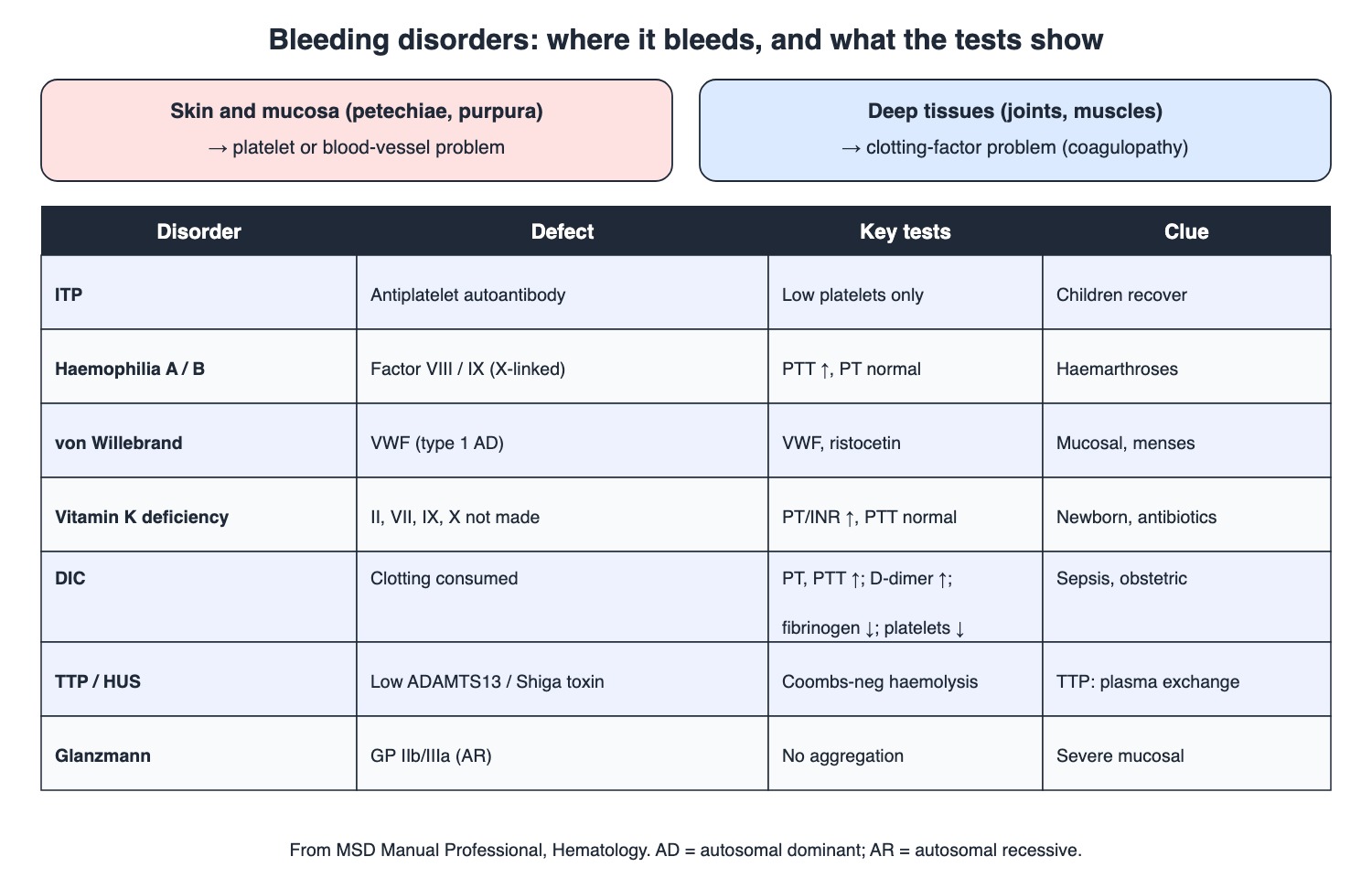
Bleeding disorders: bleeding pattern and test results. Drawn by TrackNation.
ITP: antiplatelet autoantibody, platelets destroyed mainly in the spleen; isolated low platelets with an otherwise normal CBC and smear; most children recover on their own.
Haemophilia: X-linked recessive; A = factor VIII (about 80%), B = factor IX; joint and muscle bleeds; PTT prolonged, PT and platelets normal; factor assays tell them apart.
von Willebrand disease: type 1 (commonest) is autosomal dominant; bruising, mucosal bleeding, heavy periods, bleeding after tooth extraction; test VWF antigen and ristocetin cofactor activity; desmopressin or factor VIII concentrate.
Platelet function: Glanzmann (AR) lacks GP IIb/IIIa — platelets cannot aggregate; Bernard-Soulier is an adhesion defect.
Vitamin K deficiency: factors II, VII, IX, X not made; PT/INR prolonged, PTT and platelets normal; haemorrhagic disease of the newborn (days 1–7), commoner in breastfed babies; broad-spectrum antibiotics contribute. Severe liver disease also impairs factor synthesis.
DIC: low platelets, prolonged PT and PTT, high D-dimer, falling fibrinogen; schistocytes; causes include sepsis and obstetric complications (placental abruption). Replace platelets, plasma and fibrinogen (cryoprecipitate).
TTP: Coombs-negative haemolysis with low ADAMTS13; treated by plasma exchange. HUS: usually children after Shiga-toxin E. coli O157:H7; kidney injury prominent.
Antiphospholipid syndrome: thrombosis or recurrent pregnancy loss; lupus anticoagulant prolongs the PTT in the lab despite causing clots.
Traps the Examiner Sets
Prolonged PTT with normal PT: haemophilia (or lupus anticoagulant). Prolonged PT alone: vitamin K deficiency.
Everything abnormal (platelets, PT, PTT, fibrinogen, D-dimer): DIC.
Mucosal bleeding with a normal platelet count: think von Willebrand disease.
APS: a lab test says "bleeding risk" but the patient clots.
Memory Hooks & Shortcuts
Shortcuts to lock in this article's numbers and lists. Each one only re-packages facts proven above.
🧠 Ib for Initial (adhesion), IIb/IIIa for Integration (aggregation) — platelet receptors
🧠 Haemophilia: boys, joints, PTT — X-linked, haemarthroses, prolonged PTT
🧠 Vitamin K: 2, 7, 9, 10 (1972) — vitamin K-dependent factors
🧠 DIC: Down platelets, Increased D-dimer, Consumed fibrinogen — DIC labs
🧠 TTP: ADAMTS13 Tiny → Thrombi — low ADAMTS13
🧠 APS: Prolonged test, Paradoxical clots, Pregnancy loss — lupus anticoagulant
Rapid-Revision Cards
Platelet adhesion
VWF + GP Ib/IX.
Platelet aggregation
Fibrinogen + GP IIb/IIIa.
Extrinsic pathway
Tissue factor + VIIa → X.
Fibrinolysis
Plasmin.
Superficial bleeding
Platelet or vessel.
Deep bleeding
Coagulation factors.
ITP
Antiplatelet antibody; isolated thrombocytopenia; children recover.
Haemophilia
X-linked; A = VIII (80%), B = IX; PTT ↑, PT normal.
vWD
Type 1 AD; mucosal bleeding; ristocetin cofactor; desmopressin.
Glanzmann
AR; GP IIb/IIIa; no aggregation.
Bernard-Soulier
Adhesion defect.
Vitamin K
II, VII, IX, X; PT ↑, PTT normal.
HDN
Days 1–7; breastfed infants.
DIC
Platelets ↓, PT/PTT ↑, D-dimer ↑, fibrinogen ↓.
TTP
Low ADAMTS13; Coombs-neg haemolysis; plasma exchange.
HUS
Children; E. coli O157:H7; kidney injury.
APS
Clots + pregnancy loss; lupus anticoagulant prolongs PTT.
Sources
Facts in this article were checked against these documents.
MSD Manual Professional: Overview of Hemostasis; Excessive Bleeding; Immune Thrombocytopenia; Hemophilia; von Willebrand Disease; Inherited Platelet Function Disorders; Overview of Coagulation Disorders; DIC; TTP; HUS; Antiphospholipid Syndrome; Vitamin K Deficiency — Merck & Co. (MSD Manuals), reviewed 2025–2026 (link)
Competency Based Undergraduate Curriculum, Pathology (PA 20) — National Medical Commission, 2024
Test Yourself: Practice Questions
Twenty-five questions in NEET PG style, most of them clinical vignettes.
Practice Questions (NEET PG pattern)
Original questions written in the style of the exam: +4 for a correct answer, −1 for a wrong one. Every answer was checked against the sources listed above. NEET PG papers are not published by NBEMS, so these are not past-paper questions.
Q1. A 6-year-old boy has a swollen, painful knee after a minor fall; his maternal uncle had similar bleeds. PTT is prolonged; PT and platelets are normal. The diagnosis is
(a) vitamin K deficiency
(b) von Willebrand disease
(c) ITP
(d) haemophilia
Show answer
Answer: (d) — X-linked recessive; factor VIII or IX deficiency.
Q2. Haemophilia A is due to deficiency of
(a) factor IX
(b) factor VIII (about 80% of haemophilia)
(c) factor VII
(d) von Willebrand factor
Show answer
Answer: (b) — Haemophilia B is factor IX.
Q3. Haemophilia A and B are distinguished by
(a) platelet count
(b) PT
(c) bleeding pattern
(d) specific factor VIII and IX assays
Show answer
Answer: (d) — Clinical features and screening tests are identical.
Q4. Bleeding into joints and muscles suggests
(a) a vessel wall defect
(b) a platelet defect
(c) normal haemostasis
(d) a clotting-factor defect (coagulopathy)
Show answer
Answer: (d) — Superficial bleeding suggests platelets or vessels.
Q5. Petechiae and gum bleeding suggest
(a) a platelet or vessel problem
(b) haemophilia
(c) factor XIII deficiency
(d) vitamin K deficiency only
Show answer
Answer: (a) — MSD.
Q6. Two weeks after a viral illness, a child has petechiae; platelets are 15,000/µL with an otherwise normal blood count and smear. The diagnosis and outlook are
(a) immune thrombocytopenia; most children recover spontaneously
(b) aplastic anaemia; poor
(c) haemophilia; lifelong
(d) ALL; poor
Show answer
Answer: (a) — Isolated thrombocytopenia.
Q7. In ITP, platelets are destroyed mainly in the
(a) spleen
(b) kidney
(c) lungs
(d) liver
Show answer
Answer: (a) — Antiplatelet autoantibodies.
Q8. A woman has lifelong heavy periods, nosebleeds and bleeding after a tooth extraction; her mother is similar. Platelets are normal. The likely diagnosis is
(a) von Willebrand disease (type 1, autosomal dominant)
(b) Glanzmann
(c) ITP
(d) haemophilia A
Show answer
Answer: (a) — Mucosal bleeding, menorrhagia.
Q9. A test of von Willebrand factor function is
(a) PT
(b) D-dimer
(c) osmotic fragility
(d) ristocetin cofactor activity
Show answer
Answer: (d) — Along with VWF antigen.
Q10. Initial platelet adhesion to damaged vessel wall requires von Willebrand factor and the platelet receptor
(a) thromboxane receptor
(b) glycoprotein Ib/IX
(c) glycoprotein IIb/IIIa
(d) P2Y12
Show answer
Answer: (b) — IIb/IIIa mediates aggregation.
Q11. A child with severe nosebleeds has platelets that do not aggregate; the defect is in GP IIb/IIIa. The diagnosis is
(a) ITP
(b) Glanzmann thrombasthenia (autosomal recessive)
(c) haemophilia
(d) Bernard-Soulier syndrome
Show answer
Answer: (b) — MSD.
Q12. Bernard-Soulier syndrome is a disorder of platelet
(a) adhesion
(b) production
(c) aggregation only
(d) survival
Show answer
Answer: (a) — Like von Willebrand disease (impaired ristocetin response).
Q13. A breastfed baby not given vitamin K at birth starts bleeding on day 3. PT/INR is prolonged; PTT and platelets are normal. The diagnosis is
(a) DIC
(b) haemophilia
(c) haemorrhagic disease of the newborn (vitamin K deficiency)
(d) ITP
Show answer
Answer: (c) — Usually days 1–7; commoner in breastfed infants.
Q14. Vitamin K is needed to make clotting factors
(a) XI and XII
(b) V and VIII
(c) II, VII, IX and X
(d) I and XIII
Show answer
Answer: (c) — Made in the liver.
Q15. In vitamin K deficiency, the coagulation tests show
(a) prolonged PTT only
(b) high D-dimer
(c) low platelets
(d) prolonged PT/INR with normal PTT, platelets and fibrinogen
Show answer
Answer: (d) — MSD.
Q16. A woman with placental abruption oozes from IV sites; platelets are low, PT and PTT are prolonged, D-dimer is high and fibrinogen is falling. The diagnosis is
(a) DIC
(b) vitamin K deficiency
(c) haemophilia
(d) ITP
Show answer
Answer: (a) — Obstetric complications are classic triggers.
Q17. In DIC with a very low fibrinogen, fibrinogen is replaced with
(a) packed red cells
(b) vitamin K alone
(c) cryoprecipitate
(d) albumin
Show answer
Answer: (c) — Plus platelets and fresh frozen plasma.
Q18. A woman has confusion, low platelets and Coombs-negative haemolytic anaemia with schistocytes; ADAMTS13 is very low. The diagnosis and treatment are
(a) DIC — heparin
(b) TTP — plasma exchange
(c) HUS — antibiotics
(d) ITP — steroids alone
Show answer
Answer: (b) — MSD.
Q19. A 4-year-old develops kidney injury, low platelets and haemolysis a week after bloody diarrhoea. The usual cause is
(a) Giardia
(b) Salmonella typhi
(c) rotavirus
(d) Shiga toxin-producing E. coli O157:H7 (HUS)
Show answer
Answer: (d) — HUS usually follows such an infection in children.
Q20. A young woman with recurrent miscarriages and a DVT has a prolonged PTT. The likely diagnosis is
(a) vitamin K deficiency
(b) von Willebrand disease
(c) haemophilia carrier
(d) antiphospholipid syndrome (lupus anticoagulant)
Show answer
Answer: (d) — Lupus anticoagulant prolongs phospholipid-dependent tests yet causes thrombosis.
Q21. Fibrinogen links activated platelets together by binding to
(a) collagen
(b) tissue factor
(c) glycoprotein Ib/IX
(d) glycoprotein IIb/IIIa
Show answer
Answer: (d) — MSD.
Q22. The extrinsic pathway starts when factor VIIa combines with
(a) factor XII
(b) kallikrein
(c) factor VIII
(d) tissue factor, activating factor X
Show answer
Answer: (d) — MSD.
Q23. Fibrin is broken down by
(a) thrombin
(b) factor XIII
(c) plasmin
(d) antithrombin
Show answer
Answer: (c) — Activated by tissue plasminogen activator.
Q24. A man with cirrhosis bleeds easily with prolonged clotting times. The main reason is
(a) ITP
(b) excess vitamin K
(c) haemophilia
(d) impaired clotting-factor synthesis by the liver
Show answer
Answer: (d) — MSD.
Q25. A child with severe mucosal bleeding has unusually large platelets that do not aggregate with ristocetin but aggregate normally with ADP, collagen and epinephrine. The defect is in
(a) ADAMTS13
(b) glycoprotein Ib/IX (Bernard-Soulier syndrome)
(c) glycoprotein IIb/IIIa (Glanzmann)
(d) factor VIII
Show answer
Answer: (b) — Glanzmann (IIb/IIIa): aggregation absent with ADP, collagen and epinephrine; ristocetin response normal or impaired (MSD).
Active Recall
From memory: describe platelet adhesion and aggregation and the start of coagulation, the bleeding pattern that points to platelets vs factors, and the defect and test pattern in ITP, haemophilia, von Willebrand disease, Glanzmann, vitamin K deficiency, DIC, TTP, HUS and APS.