Respiratory System for NEET PG Pathology: Pneumonia, Lung Abscess, COPD, Bronchiectasis, Pneumoconioses, Lung Cancer, Mesothelioma
Start Here
🎯 Exam priority: High. Expect: match a dust to its disease, the chronic bronchitis definition, alpha-1 antitrypsin, lung abscess site after aspiration, the commonest lung cancer type, Pancoast/Horner, and asbestos-related pleural disease and mesothelioma.
CBME mapping: PA 25.1–25.7. Tuberculosis is in article 7; paraneoplastic syndromes of lung cancer in article 4.
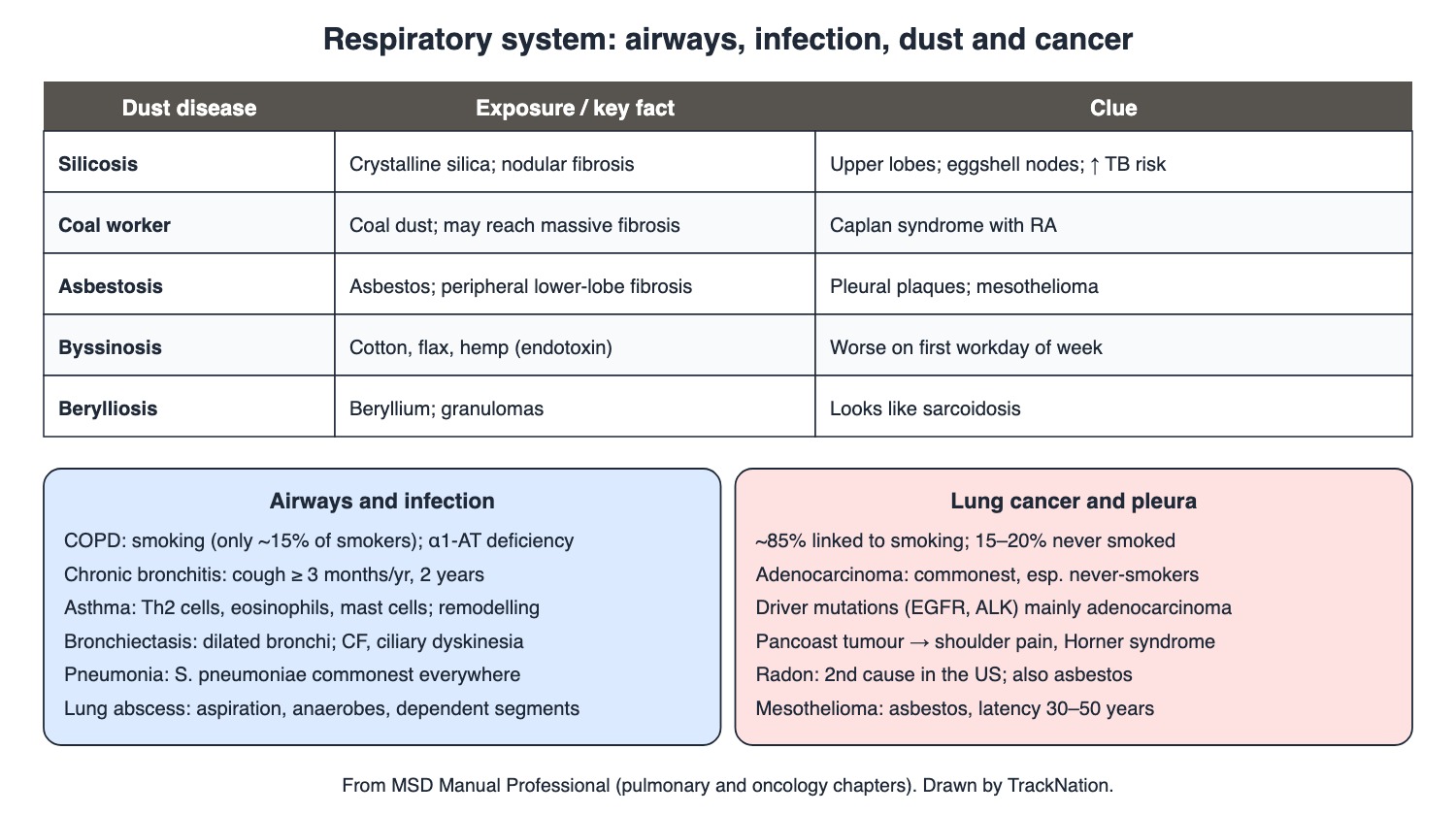
Occupational lung disease, airways and infection, lung cancer and mesothelioma. Drawn by TrackNation.
Infection
Pneumonia: Streptococcus pneumoniae is the commonest pathogen in all ages, settings and regions. Other community-acquired causes: H. influenzae, atypicals (Chlamydia pneumoniae, Mycoplasma, Legionella) and viruses.
Lung abscess: a pus-filled cavity, usually from aspiration of oral secretions; anaerobes dominate. It forms in segments that are dependent when lying down — posterior segments of the upper lobes, superior or lateral basal segments of the lower lobes — with an air-fluid level.
Acute hypoxaemic respiratory failure: PaO2 < 60 mm Hg, PaO2/FiO2 < 300 or SpO2 < 88%.
Obstructive Airway Disease
COPD = chronic obstructive bronchitis and/or emphysema. Smoking is the main cause, yet only about 15% of smokers develop clinical COPD. Chronic bronchitis: productive cough on most days for at least 3 months a year for 2 consecutive years.
Alpha-1 antitrypsin deficiency: unchecked proteases destroy lung tissue (emphysema in adults); abnormal protein stuck in the liver causes liver disease. A cause of COPD in non-smokers.
Asthma: bronchoconstriction, airway oedema and inflammation, hyperreactivity and remodelling, driven by Th2 cells, eosinophils and mast cells.
Bronchiectasis: permanent dilation and destruction of large bronchi from chronic infection — cystic fibrosis, immune defects, primary ciliary dyskinesia; chronic cough with purulent sputum.
Occupational Lung Disease
Silicosis (crystalline silica): nodular fibrosis, upper-lobe 1–3 mm nodules, eggshell-calcified hilar nodes; higher risk of TB, COPD and lung cancer.
Coal worker pneumoconiosis: from mild disease to progressive massive fibrosis; with rheumatoid arthritis → Caplan syndrome (rheumatoid nodules).
Asbestosis: peripheral lower-lobe fibrosis; asbestos bodies support (but are not needed for) diagnosis. Asbestos pleural disease: plaques, calcification, thickening, effusion and mesothelioma (latency 30–50 years).
Byssinosis: cotton, flax and hemp dust (endotoxin) — chest tightness worst on the first working day of the week. Chronic beryllium disease: granulomas that mimic sarcoidosis.
Lung Cancer
The leading cause of cancer death worldwide; about 85% linked to smoking, but 15–20% of patients never or barely smoked. Risk falls after quitting but never returns to baseline. Radon is the second cause in the US; asbestos, arsenic and other carcinogens add risk.
Small cell vs non-small cell. Adenocarcinoma is the commonest subtype, especially in never-smokers; targetable drivers (EGFR, ALK) are mostly found here. Squamous cell carcinoma carries TP53 mutations in about 91%.
Pancoast (superior sulcus) tumour: invades brachial plexus, pleura or ribs → shoulder and arm pain, hand weakness, and Horner syndrome (ptosis, miosis, anhidrosis) when the sympathetic chain is involved. Small cell paraneoplastic syndromes: article 4.
Traps the Examiner Sets
Silicosis = upper lobes + TB risk; asbestosis = lower lobes + pleural plaques + mesothelioma.
Byssinosis = "Monday" chest tightness.
Adenocarcinoma = commonest and the type in non-smokers.
Aspiration abscess: dependent segments, anaerobes.
Memory Hooks & Shortcuts
Shortcuts to lock in this article's numbers and lists. Each one only re-packages facts proven above.
🧠 Silica Settles Up (upper lobes) and Summons TB — silicosis
🧠 Asbestos goes to the Abdomen-end (lower lobes) and the pleura — asbestosis
🧠 Byssinosis = Blue Monday — byssinosis timing
🧠 Adeno for the Abstainers (non-smokers) — adenocarcinoma
🧠 Pancoast Pinches the sympathetic chain → Ptosis, Pupil small — Pancoast and Horner
🧠 3 months × 2 years = chronic bronchitis — definition
Rapid-Revision Cards
Commonest pneumonia bug
S. pneumoniae — all ages, settings, regions.
Atypical CAP
Mycoplasma, Chlamydia pneumoniae, Legionella.
Lung abscess
Aspiration; anaerobes; dependent segments; air-fluid level.
Chronic bronchitis
Cough ≥ 3 months/yr × 2 yr.
COPD in smokers
Only ~15%.
α1-antitrypsin deficiency
Emphysema + liver disease; non-smokers.
Asthma cells
Th2, eosinophils, mast cells.
Bronchiectasis
Dilated bronchi; CF, immune defects, PCD.
AHRF
PaO2 < 60, P/F < 300, SpO2 < 88%.
Silicosis
Upper lobes, eggshell nodes, TB risk.
Caplan syndrome
Pneumoconiosis + RA nodules.
Asbestosis
Lower lobes, pleural plaques, asbestos bodies.
Mesothelioma
Asbestos; latency 30–50 yr.
Byssinosis
Cotton/flax/hemp; Monday tightness.
Berylliosis
Granulomas like sarcoid.
Lung cancer and smoking
~85%; 15–20% never smoked.
Commonest lung cancer
Adenocarcinoma (never-smokers too).
Pancoast
Shoulder/arm pain, Horner syndrome.
Radon
2nd cause of lung cancer (US).
Sources
Facts in this article were checked against these documents.
MSD Manual Professional: Pneumonia; Lung Abscess; COPD; Alpha-1 Antitrypsin Deficiency; Asthma; Bronchiectasis; Acute Hypoxemic Respiratory Failure — Merck & Co. (MSD Manuals), reviewed 2025–26 (link)
MSD Manual Professional: Silicosis; Coal Worker Pneumoconiosis; Asbestosis; Asbestos-Related Pleural Disease; Mesothelioma; Byssinosis; Beryllium Disease — Merck & Co. (MSD Manuals), reviewed 2026 (link)
MSD Manual Professional: Lung Carcinoma — Merck & Co. (MSD Manuals), reviewed 2026 (link)
Competency Based Undergraduate Curriculum, Pathology (PA 25) — National Medical Commission, 2024
Test Yourself: Practice Questions
Thirty questions in NEET PG style, most of them clinical vignettes.
Practice Questions (NEET PG pattern)
Original questions written in the style of the exam: +4 for a correct answer, −1 for a wrong one. Every answer was checked against the sources listed above. NEET PG papers are not published by NBEMS, so these are not past-paper questions.
Q1. The commonest bacterial cause of pneumonia across all age groups and settings is
(a) Streptococcus pneumoniae
(b) Staphylococcus aureus
(c) Klebsiella
(d) Pseudomonas
Show answer
Answer: (a) — Its incidence is falling in some countries.
Q2. Which of these is an 'atypical' cause of community-acquired pneumonia?
(a) Streptococcus pneumoniae
(b) Escherichia coli
(c) Haemophilus influenzae
(d) Mycoplasma pneumoniae
Show answer
Answer: (d) — Also Chlamydia pneumoniae and Legionella.
Q3. A patient at risk of aspiration develops a lung cavity with an air-fluid level. The usual organisms and the cause are
(a) a pulmonary infarct
(b) fungal infection
(c) TB reactivation
(d) anaerobes after aspiration of oral secretions
Show answer
Answer: (d) — Often mixed anaerobes and aerobes.
Q4. An aspiration lung abscess in a recumbent patient typically forms in the
(a) posterior segments of the upper lobes or superior/lateral basal segments of the lower lobes
(b) anterior segment of the upper lobe only
(c) lingula only
(d) apex only
Show answer
Answer: (a) — The dependent segments.
Q5. Chronic bronchitis is defined clinically as productive cough on most days for at least
(a) 6 weeks once
(b) 1 year continuously
(c) 1 month a year
(d) 3 months a year for 2 consecutive years
Show answer
Answer: (d) — Emphysema is defined pathologically or radiologically.
Q6. Of people who smoke, the share who develop clinically apparent COPD is about
(a) 90%
(b) 50%
(c) 15%
(d) 1%
Show answer
Answer: (c) — Smoking is still the main risk factor.
Q7. A non-smoker has emphysema and liver disease. The likely inherited cause is
(a) alpha-1 antitrypsin deficiency
(b) Marfan syndrome
(c) cystic fibrosis
(d) Kartagener syndrome
Show answer
Answer: (a) — Unopposed proteases destroy lung; abnormal protein accumulates in the liver.
Q8. The cells that drive allergic (T2-high) asthma include
(a) plasma cells only
(b) neutrophils only
(c) NK cells only
(d) Th2 lymphocytes, eosinophils and mast cells
Show answer
Answer: (d) — With airway remodelling over time.
Q9. A young adult has chronic cough with large amounts of purulent sputum; CT shows dilated, thick-walled bronchi. A common underlying cause is
(a) asthma
(b) pulmonary embolism
(c) cystic fibrosis
(d) sarcoidosis
Show answer
Answer: (c) — Also immune defects, recurrent infection and primary ciliary dyskinesia.
Q10. Bronchiectasis can result from a congenital defect in mucociliary clearance called
(a) alpha-1 antitrypsin deficiency
(b) surfactant deficiency
(c) primary ciliary dyskinesia
(d) sickle cell disease
Show answer
Answer: (c) — About 3% of previously 'idiopathic' cases.
Q11. Acute hypoxaemic respiratory failure is defined by
(a) pH < 7.35 only
(b) PaCO2 > 50 only
(c) PaO2 < 60 mm Hg, PaO2/FiO2 < 300 or SpO2 < 88%
(d) SpO2 < 95%
Show answer
Answer: (c) — From shunting and V/Q mismatch.
Q12. A worker with years of dust exposure has upper-lobe nodular opacities and eggshell calcification of hilar nodes. The disease and a key complication are
(a) asbestosis — mesothelioma
(b) byssinosis — asthma
(c) berylliosis — sarcoid
(d) silicosis — increased tuberculosis risk
Show answer
Answer: (d) — Also COPD and lung cancer.
Q13. Silicosis is caused by inhaling
(a) respirable crystalline silica
(b) beryllium fumes
(c) asbestos fibres
(d) cotton dust
Show answer
Answer: (a) — Nodular pulmonary fibrosis.
Q14. A coal miner with rheumatoid arthritis develops multiple lung nodules. This is
(a) TB
(b) Caplan syndrome (rheumatoid pneumoconiosis)
(c) silicosis
(d) metastatic cancer always
Show answer
Answer: (b) — Must be distinguished from cancer and infection.
Q15. A worker has bilateral peripheral lower-lobe fibrosis and calcified pleural plaques. The likely exposure is
(a) asbestos
(b) cotton
(c) coal
(d) silica
Show answer
Answer: (a) — Asbestos bodies support the diagnosis.
Q16. The hallmark of asbestos exposure in the pleura is
(a) pleural plaques (often calcified)
(b) pneumothorax
(c) chylothorax
(d) empyema
Show answer
Answer: (a) — Also thickening, effusion and mesothelioma.
Q17. A man develops a primary pleural cancer decades after occupational mineral-fibre exposure. The tumour and typical latency are
(a) lymphoma — 5 years
(b) sarcoma — 6 months
(c) mesothelioma — 30 to 50 years
(d) adenocarcinoma — 1 year
Show answer
Answer: (c) — Asbestos causes the great majority of cases.
Q18. A textile mill worker gets chest tightness that is worst on the first day back at work each week. The diagnosis is
(a) silicosis
(b) byssinosis (cotton, flax, hemp dust)
(c) farmer's lung
(d) asbestosis
Show answer
Answer: (b) — Endotoxin is the likely agent.
Q19. Chronic beryllium disease is easily confused with
(a) sarcoidosis (both form granulomas)
(b) asbestosis
(c) TB always
(d) asthma
Show answer
Answer: (a) — Granulomas in lungs and intrathoracic nodes.
Q20. The proportion of lung cancers related to cigarette smoking is about
(a) 25%
(b) 100%
(c) 50%
(d) 85%
Show answer
Answer: (d) — 15–20% occur in never or minimal smokers.
Q21. A non-smoking woman develops lung cancer. The most likely histological type is
(a) large cell carcinoma
(b) adenocarcinoma
(c) squamous cell carcinoma
(d) small cell carcinoma
Show answer
Answer: (b) — The commonest subtype overall, especially in never-smokers.
Q22. A smoker has shoulder and arm pain, hand wasting, ptosis and a small pupil on the same side. The lesion is
(a) a Pancoast (superior sulcus) tumour with Horner syndrome
(b) a central squamous carcinoma
(c) mesothelioma
(d) a cervical rib only
Show answer
Answer: (a) — Sympathetic chain involvement causes Horner syndrome.
Q23. After a smoker quits, the risk of lung cancer
(a) returns to normal within a year
(b) falls but never returns to that of a never-smoker
(c) is unchanged
(d) rises
Show answer
Answer: (b) — MSD.
Q24. A non-occupational radioactive gas that raises lung cancer risk, especially in smokers, is
(a) radon
(b) nitrogen
(c) ozone
(d) carbon monoxide
Show answer
Answer: (a) — Second leading cause of lung cancer in the US.
Q25. The mutation found in about 91% of lung squamous cell carcinomas is in
(a) EGFR
(b) ALK
(c) KRAS
(d) TP53
Show answer
Answer: (d) — Receptor tyrosine kinase mutations are less frequent in SCC.
Q26. Lung cancer is first divided histologically into
(a) primary and secondary only
(b) small cell and non-small cell
(c) benign and malignant only
(d) central and peripheral only
Show answer
Answer: (b) — NSCLC includes adenocarcinoma, squamous and large cell.
Q27. Which of these is a confirmed lung carcinogen besides tobacco smoke?
(a) fluoride
(b) caffeine
(c) vitamin C
(d) asbestos
Show answer
Answer: (d) — Also arsenic, chromium, nickel, coke-oven emissions.
Q28. The disease that is the leading cause of cancer death in men and women worldwide is
(a) lung carcinoma
(b) breast cancer
(c) colon cancer
(d) prostate cancer
Show answer
Answer: (a) — MSD.
Q29. Coal worker pneumoconiosis at its most severe becomes
(a) pleural plaques
(b) bronchiectasis
(c) progressive massive fibrosis
(d) mesothelioma
Show answer
Answer: (c) — COPD and bronchitis are common in miners.
Q30. Asthma pathophysiology includes all of the following EXCEPT
(a) airway hyperreactivity
(b) airway remodelling
(c) bronchoconstriction
(d) alveolar wall destruction as the main lesion
Show answer
Answer: (d) — Alveolar wall destruction is emphysema.
Active Recall
From memory: name the commonest pneumonia pathogen and the atypicals; describe lung abscess cause and site; define chronic bronchitis and the role of alpha-1 antitrypsin; describe asthma and bronchiectasis; match silica, coal, asbestos, cotton and beryllium to their diseases; and summarise lung cancer risk factors, types, Pancoast tumour and mesothelioma.