Clinical Pathology for NEET PG: Urine Casts, Body Fluids (Light's Criteria, SAAG, CSF), Semen Analysis WHO 2021, LFT, RFT, TFT
Start Here
🎯 Exam priority: High. Expect: which urinary cast means what, the definitions of haematuria and nephrotic-range proteinuria, KDIGO AKI and prerenal indices, Light's criteria, SAAG and SBP, CSF patterns, WHO semen values, the AST:ALT ratio in alcohol, and TSH-based thyroid patterns.
CBME mapping: PA 22.1–22.5. Urine and the semen/thyroid panel are hands-on skills; the liver and kidney panels are the two that need certification.
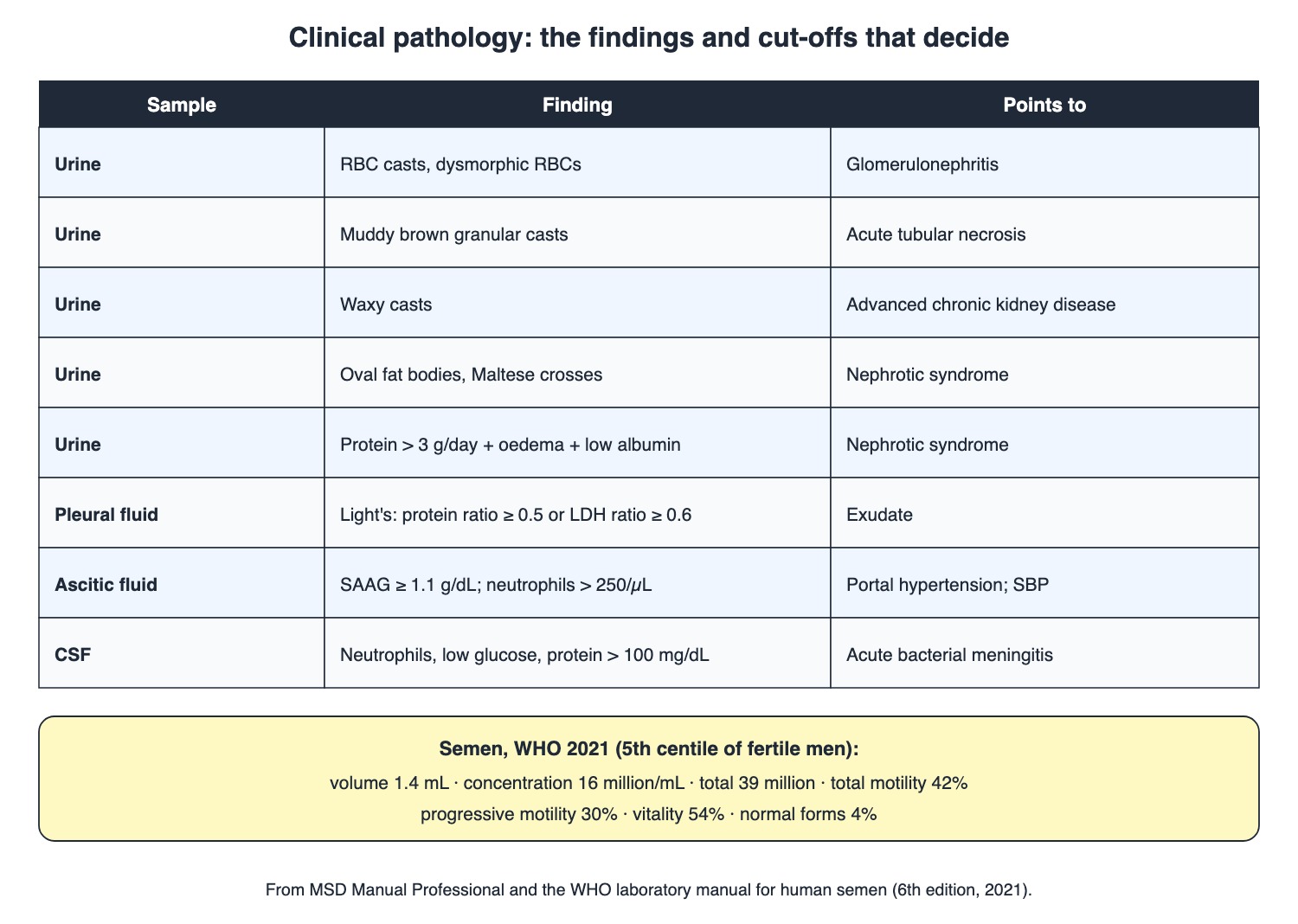
Urine, pleural, ascitic and CSF findings with their meaning, and WHO 2021 semen values. Drawn by TrackNation.
Urine: Dipstick and Sediment
Dipstick: specific gravity 1.001–1.035; nitrites are not normally present and mean bacteriuria; leukocyte esterase comes from lysed neutrophils; glucose spills when blood glucose exceeds ~180 mg/dL. Intact red cells give a speckled pattern, free haemoglobin or myoglobin a uniform colour.
Haematuria = > 3 RBCs per high-power field. Red urine without RBCs: haemoglobin, myoglobin, porphyria, beets, some drugs. Glomerular RBCs are small and dysmorphic. Pyuria = > 5 WBCs/HPF.
Proteinuria: normal up to 150 mg/day; albumin 30–300 mg/day = moderately increased albuminuria (old "microalbuminuria"); > 3 g/day with oedema and low albumin = nephrotic syndrome. Tubular proteinuria is mostly light chains. Orthostatic proteinuria is benign, mostly in children and adolescents.
Casts are Tamm-Horsfall protein moulds from the thick ascending limb, so they prove a renal origin: hyaline (non-specific, even normal); RBC casts (virtually pathognomonic of glomerulonephritis); WBC casts (pyelonephritis); muddy brown granular (acute tubular necrosis); waxy (advanced CKD); fatty casts and oval fat bodies with Maltese crosses (nephrotic syndrome).
Nephritic urine: haematuria, dysmorphic RBCs, often RBC casts, variable protein.
Kidney Function Tests
Creatinine clearance overestimates GFR by 10–20% (creatinine is also secreted by tubules).
KDIGO AKI: creatinine up ≥ 0.3 mg/dL in 48 h, or ≥ 1.5× baseline within 7 days, or urine < 0.5 mL/kg/h for 6 h.
Prerenal vs tubular injury: urine Na < 10 vs > 40 mmol/L; FENa < 1% vs > 1%; BUN:creatinine > 20 vs < 10.
CKD: eGFR < 60 mL/min/1.73 m² for ≥ 3 months is the most reliable evidence; small kidneys on ultrasound usually mean CKD.
Body Fluids
Pleural fluid — Light's criteria (any one = exudate): fluid:serum protein ≥ 0.5, fluid:serum LDH ≥ 0.6, fluid LDH ≥ 2/3 of the serum upper limit. Commonest transudates: heart failure, cirrhosis, nephrotic syndrome.
ADA > 40 U/L in pleural fluid: about 95% sensitive and specific for tuberculous pleuritis (can also rise in cancer). Milky fluid high in triglycerides = chylothorax (thoracic duct). Haemothorax = fluid haematocrit > 50% of blood. A parapneumonic effusion with pH < 7.20 or glucose < 60 mg/dL needs drainage.
Ascitic fluid: SAAG = serum albumin − ascitic albumin; ≥ 1.1 g/dL with low protein points to portal hypertension. Neutrophils > 250/µL = spontaneous bacterial peritonitis; bloody fluid suggests tumour or TB.
CSF: a CSF glucose ≤ 18 mg/dL or CSF:blood glucose < 0.23 strongly suggests bacterial meningitis.
CSF (MSD table) | Cells | Glucose | Protein |
Normal (pressure 100–200 mm H₂O) | 0–3 lymphocytes/µL | 50–100 mg/dL | 20–45 mg/dL |
Acute bacterial meningitis | 100–10,000, neutrophils | Low | > 100 mg/dL |
Viral infection | 100–2000, lymphocytes | Normal | Normal or raised |
Subacute/chronic (TB, Cryptococcus) | 100–700, lymphocytes | Low | Raised |
Guillain-Barré syndrome | 0–100, lymphocytes | Normal | > 100 mg/dL |
Semen Analysis (WHO 2021)
The semen gel (from the seminal vesicles) is liquefied by prostatic proteases, usually within 30 minutes; examination should start within 30, at most 60, minutes. WHO's fertile reference men had abstained for 2–7 days.
Terms: oligozoospermia = too few sperm; azoospermia = none, and only after no sperm are found in a centrifuged sample.
pH < 7.2 suggests lack of alkaline seminal-vesicle fluid (or urine contamination); fructose shows at least one ejaculatory duct is patent.
WHO 2021 gives the values below as the 5th centile of fertile men and warns they are not decision limits for infertility.
Semen parameter (WHO 2021) | 5th centile of fertile men |
Volume | 1.4 mL |
Sperm concentration | 16 million/mL |
Total sperm number | 39 million per ejaculate |
Total motility (progressive + non-progressive) | 42% |
Progressive motility | 30% |
Vitality | 54% |
Normal forms | 4% |
Liver and Thyroid Panels
LFT: aminotransferases rise with liver-cell injury, ALP with cholestasis. AST:ALT is usually < 1 but > 2 in alcohol-related liver disease. GGT confirms a hepatic source of raised ALP (it does not rise with bone disease, childhood or pregnancy); raised GGT with normal ALP is seen in alcohol-associated hepatitis. Synthetic function = PT/INR and albumin (half-life ~20 days, so it changes slowly). Unconjugated bilirubin is water-insoluble and never appears in urine.
TFT: TSH is the best screening test. Primary hypothyroidism: high TSH, low T4/T3. Subclinical hypothyroidism: high TSH, normal free T4. Primary hyperthyroidism: undetectable TSH; T3 toxicosis = only T3 raised. Central hypothyroidism: the pituitary makes too little TSH.
Traps the Examiner Sets
RBC casts = glomerulonephritis; muddy brown = ATN; waxy = advanced CKD; WBC casts = pyelonephritis.
Dipstick positive for blood but no RBCs = haemoglobin or myoglobin.
Light's ratios: protein 0.5, LDH 0.6. SAAG 1.1. SBP > 250 neutrophils.
WHO 2021 concentration 16 million/mL; 39 million is the total per ejaculate — do not swap them.
AST:ALT > 2 = alcohol.
Memory Hooks & Shortcuts
Shortcuts to lock in this article's numbers and lists. Each one only re-packages facts proven above.
🧠 Red casts, Glomerulus Red-handed — RBC casts = glomerulonephritis
🧠 Muddy Brown = Many dead tubules — granular casts = ATN
🧠 WAXY = Wasted kidney — waxy casts = advanced CKD
🧠 Light is half and six-tenths — Light's ratios 0.5 and 0.6
🧠 SAAG 1.1 = Portal high — SAAG ≥ 1.1 = portal hypertension
🧠 Sixteen, thirty-nine, four — WHO 2021: 16 M/mL, 39 M total, 4% normal forms
🧠 Alcohol: AST is Twice ALT — AST:ALT > 2 in alcohol
Rapid-Revision Cards
Casts come from
Tamm-Horsfall protein, thick ascending limb → renal origin.
RBC casts
Glomerulonephritis.
WBC casts
Pyelonephritis.
Muddy brown granular casts
Acute tubular necrosis.
Waxy casts
Advanced CKD.
Maltese cross
Cholesterol in oval fat bodies → nephrotic.
Haematuria
> 3 RBC/HPF; dysmorphic = glomerular.
Pyuria
> 5 WBC/HPF.
Blood on dipstick, no RBCs
Haemoglobin or myoglobin.
Renal glucose threshold
~180 mg/dL.
Proteinuria limits
Normal ≤ 150 mg/day; albumin 30–300 = moderately increased; > 3 g = nephrotic.
KDIGO AKI
Cr ↑ ≥ 0.3 in 48 h / ≥ 1.5× in 7 d / urine < 0.5 mL/kg/h × 6 h.
Prerenal indices
UNa < 10, FENa < 1%, BUN:Cr > 20.
CKD evidence
eGFR < 60 for ≥ 3 months; small kidneys.
Light's criteria
Protein ratio ≥ 0.5 / LDH ratio ≥ 0.6 / LDH ≥ 2/3 ULN.
Pleural ADA
> 40 U/L → TB pleuritis.
SAAG ≥ 1.1
Portal hypertension.
SBP
Ascitic neutrophils > 250/µL.
Bacterial CSF
Neutrophils, glucose ↓, protein > 100.
GBS CSF
Protein > 100 with few cells.
WHO 2021 semen
1.4 mL; 16 M/mL; 39 M total; motility 42%; progressive 30%; normal forms 4%.
AST:ALT > 2
Alcohol-related liver disease.
Best thyroid screen
TSH.
Sources
Facts in this article were checked against these documents.
WHO laboratory manual for the examination and processing of human semen, sixth edition — World Health Organization, 2021 (link)
MSD Manual Professional: Evaluation of the Renal Patient; Proteinuria; Hematuria; Nephrotic and Nephritic Syndrome; AKI; CKD — Merck & Co. (MSD Manuals), reviewed 2025–26 (link)
MSD Manual Professional: Pleural Effusion; Ascites; Lumbar Puncture; Acute Bacterial Meningitis; Sperm Disorders — Merck & Co. (MSD Manuals), reviewed 2025–26 (link)
MSD Manual Professional: Laboratory Tests of the Liver and Gallbladder; Overview of Thyroid Function; Hypothyroidism; Hyperthyroidism — Merck & Co. (MSD Manuals), reviewed 2025–26 (link)
Competency Based Undergraduate Curriculum, Pathology (PA 22) — National Medical Commission, 2024
Test Yourself: Practice Questions
Twenty-nine questions in NEET PG style, most of them clinical vignettes.
Practice Questions (NEET PG pattern)
Original questions written in the style of the exam: +4 for a correct answer, −1 for a wrong one. Every answer was checked against the sources listed above. NEET PG papers are not published by NBEMS, so these are not past-paper questions.
Q1. A patient has haematuria, oedema and hypertension. Urine microscopy shows red-orange cylindrical casts containing red cells. These casts are virtually pathognomonic of
(a) glomerulonephritis
(b) nephrotic syndrome
(c) pyelonephritis
(d) acute tubular necrosis
Show answer
Answer: (a) — RBC casts plus dysmorphic RBCs = nephritic picture.
Q2. A patient with acute kidney injury has many 'muddy brown' granular casts in the urine. The likely lesion is
(a) prerenal azotaemia only
(b) minimal change disease
(c) acute tubular necrosis
(d) cystitis
Show answer
Answer: (c) — MSD urinary casts table.
Q3. Broad, highly refractile casts formed in atrophic tubules are seen in
(a) acute cystitis
(b) advanced chronic kidney disease
(c) healthy athletes
(d) early nephritic syndrome
Show answer
Answer: (b) — Waxy casts.
Q4. A child with heavy proteinuria and oedema has urine sediment showing oval fat bodies that form a Maltese cross under polarised light. The Maltese cross is due to
(a) uric acid
(b) calcium oxalate
(c) cholesterol
(d) haemosiderin
Show answer
Answer: (c) — Lipiduria is most characteristic of nephrotic syndrome.
Q5. Nephrotic syndrome is defined by
(a) > 3 g protein/day from a glomerular disorder plus oedema and low albumin
(b) > 150 mg protein/day
(c) RBC casts and hypertension
(d) albumin 30–300 mg/day
Show answer
Answer: (a) — MSD.
Q6. In a patient with a urinary infection, finding WBC casts in the urine suggests
(a) cystitis only
(b) pyelonephritis (kidney involvement)
(c) urethritis
(d) contamination
Show answer
Answer: (b) — Casts prove a renal origin.
Q7. Phase-contrast microscopy shows small red cells with spicules, folds and blebs. The bleeding is most likely from the
(a) bladder
(b) prostate
(c) urethra
(d) glomerulus
Show answer
Answer: (d) — Non-glomerular RBCs keep their normal shape.
Q8. Microscopic haematuria is defined as
(a) > 10 RBCs per HPF
(b) > 5 WBCs per HPF
(c) > 3 RBCs per high-power field
(d) any RBC on dipstick
Show answer
Answer: (c) — > 5 WBCs/HPF is pyuria.
Q9. Red urine gives a uniform positive dipstick reaction for blood, but microscopy shows no red cells. The pigment is most likely
(a) free haemoglobin or myoglobin
(b) intact red cells
(c) bilirubin
(d) urobilinogen
Show answer
Answer: (a) — Intact RBCs give a speckled pattern.
Q10. With normal kidney function, glucose usually appears in the urine when blood glucose exceeds about
(a) 180 mg/dL
(b) 300 mg/dL
(c) 100 mg/dL
(d) 126 mg/dL
Show answer
Answer: (a) — Dipstick detection threshold is 50 mg/dL.
Q11. Persistent urinary albumin excretion of 30–300 mg/day is called
(a) moderately increased albuminuria (formerly microalbuminuria)
(b) nephrotic-range proteinuria
(c) tubular proteinuria
(d) normal
Show answer
Answer: (a) — > 300 mg/day = severely increased (overt).
Q12. A hospitalised patient's creatinine rises from 1.0 to 1.4 mg/dL within 48 hours. By KDIGO this is
(a) only significant if creatinine doubles
(b) chronic kidney disease
(c) acute kidney injury (rise ≥ 0.3 mg/dL in 48 h)
(d) normal variation
Show answer
Answer: (c) — Or ≥ 1.5× baseline in 7 days, or urine < 0.5 mL/kg/h for 6 h.
Q13. Which set of urinary indices suggests prerenal AKI rather than tubular injury?
(a) BUN:creatinine < 10
(b) urine Na < 10, FENa < 1%, BUN:creatinine > 20
(c) muddy brown casts
(d) urine Na > 40, FENa > 1%
Show answer
Answer: (b) — MSD urinary diagnostic indices.
Q14. The most reliable evidence that kidney disease is chronic rather than acute is
(a) eGFR < 60 mL/min/1.73 m² for ≥ 3 months
(b) haematuria
(c) a single high creatinine
(d) normal-sized kidneys
Show answer
Answer: (a) — Small kidneys on ultrasound usually mean CKD.
Q15. Pleural fluid:serum protein ratio is 0.6 and LDH ratio is 0.7. The effusion is
(a) an exudate (Light's criteria met)
(b) a haemothorax
(c) a transudate
(d) a chylothorax
Show answer
Answer: (a) — Any one of: protein ratio ≥ 0.5, LDH ratio ≥ 0.6, fluid LDH ≥ 2/3 serum ULN.
Q16. An exudative pleural effusion has adenosine deaminase of 60 U/L. The most likely diagnosis is
(a) cirrhosis
(b) tuberculous pleuritis
(c) nephrotic syndrome
(d) heart failure
Show answer
Answer: (b) — ADA > 40 U/L: about 95% sensitive and specific; can also rise in cancer.
Q17. Thoracentesis yields milky white fluid high in triglycerides. This is
(a) chylothorax from thoracic duct damage
(b) a transudate
(c) empyema
(d) haemothorax
Show answer
Answer: (a) — Often traumatic, surgical or lymphoma.
Q18. A patient with ascites has serum albumin 3.0 g/dL and ascitic albumin 1.2 g/dL, with low ascitic protein. This points to
(a) peritoneal tuberculosis
(b) pancreatitis
(c) portal hypertension (SAAG 1.8 ≥ 1.1)
(d) peritoneal carcinomatosis
Show answer
Answer: (c) — SAAG = serum minus ascitic albumin.
Q19. A patient with cirrhotic ascites has an ascitic neutrophil count of 400 cells/µL. This indicates
(a) malignant ascites
(b) spontaneous bacterial peritonitis
(c) chylous ascites
(d) normal cirrhotic ascites
Show answer
Answer: (b) — Cut-off > 250 neutrophils/µL.
Q20. CSF: raised pressure, thousands of cells mostly neutrophils, low glucose, protein 200 mg/dL. Diagnosis:
(a) normal CSF
(b) viral meningitis
(c) Guillain-Barré syndrome
(d) acute bacterial meningitis
Show answer
Answer: (d) — CSF glucose ≤ 18 mg/dL or CSF:blood ratio < 0.23 strongly suggests bacterial.
Q21. CSF shows a few hundred lymphocytes with normal glucose. Most likely:
(a) viral infection
(b) tuberculous meningitis with low glucose
(c) acute bacterial meningitis
(d) subarachnoid haemorrhage
Show answer
Answer: (a) — MSD CSF table.
Q22. Subacute meningitis: CSF shows a few hundred lymphocytes, low glucose and raised protein. Likely causes include
(a) tuberculosis or Cryptococcus
(b) migraine
(c) enterovirus
(d) Guillain-Barré syndrome
Show answer
Answer: (a) — Lymphocytes + low glucose = subacute/chronic meningitis.
Q23. CSF shows protein above 100 mg/dL with very few cells and normal glucose. Of these, the pattern fits
(a) Guillain-Barré syndrome
(b) brain abscess
(c) bacterial meningitis
(d) viral encephalitis
Show answer
Answer: (a) — High protein with few cells.
Q24. According to the WHO manual (2021), the 5th-centile sperm concentration of fertile men is
(a) 39 million/mL
(b) 16 million/mL
(c) 20 million/mL
(d) 60 million/mL
Show answer
Answer: (b) — 39 million is total sperm number per ejaculate.
Q25. No spermatozoa are seen in replicate wet preparations of a semen sample. Before calling it azoospermia, WHO requires
(a) a repeat after 1 week only
(b) no sperm in the sediment of a centrifuged sample
(c) a testicular biopsy
(d) fructose testing only
Show answer
Answer: (b) — Azoospermia is a description, not a diagnosis.
Q26. A semen sample has pH 6.8 (no urine contamination). A pH below 7.2 suggests
(a) prostatitis
(b) lack of alkaline seminal-vesicle fluid
(c) excess prostatic fluid
(d) normal semen
Show answer
Answer: (b) — WHO manual.
Q27. A man with heavy drinking has AST 240 U/L and ALT 90 U/L. The AST:ALT pattern suggests
(a) alcohol-related liver disease
(b) obstructive jaundice
(c) viral hepatitis
(d) normal liver
Show answer
Answer: (a) — Ratio usually < 1; > 2 in alcohol (pyridoxal phosphate deficiency).
Q28. A woman with minimal symptoms has raised TSH and normal free T4. This is
(a) central hypothyroidism
(b) T3 toxicosis
(c) overt primary hypothyroidism
(d) subclinical hypothyroidism
Show answer
Answer: (d) — Overt primary: high TSH with low T4/T3.
Q29. A thyrotoxic patient has undetectable TSH, normal T4 and raised T3. This is
(a) euthyroid sick syndrome
(b) subclinical hypothyroidism
(c) TSH-secreting adenoma
(d) T3 toxicosis
Show answer
Answer: (d) — Primary hyperthyroidism = undetectable TSH.
Active Recall
From memory: match each urinary cast to its disease, define haematuria and nephrotic-range proteinuria, give the KDIGO AKI criteria and prerenal indices, state Light's criteria and the SAAG and SBP cut-offs, compare CSF in bacterial, viral, TB meningitis and GBS, list the WHO 2021 semen values, and interpret AST:ALT and TSH patterns.