Liver, Gallbladder and Pancreas for NEET PG Pathology: Jaundice, Hepatitis B Serology, Cirrhosis, Portal Hypertension, HCC, Gallstones
Start Here
🎯 Exam priority: High. Expect: classify a jaundice, read an HBV serology panel, alcohol pathology (Mallory bodies, AST:ALT), causes of portal hypertension, HCC risks, Wilson vs haemochromatosis, gallstone types and pancreatitis triggers.
CBME mapping: PA 24.1–24.8. LFT interpretation is also in article 16.
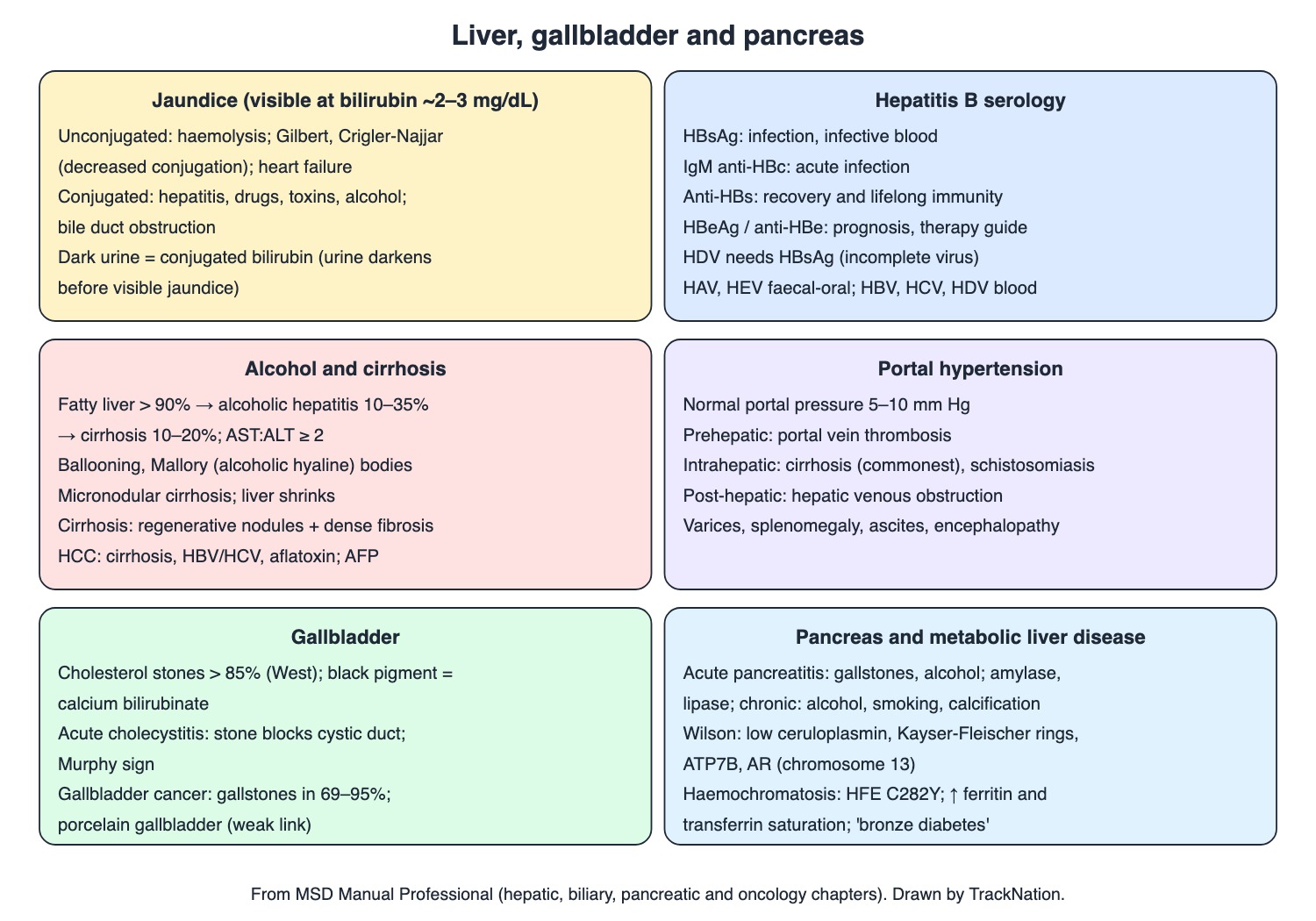
Jaundice, hepatitis B, alcohol and cirrhosis, portal hypertension, gallbladder and pancreas. Drawn by TrackNation.
Bilirubin and Jaundice
Haemoglobin breakdown gives unconjugated bilirubin, carried on albumin to the liver for conjugation. Jaundice shows at about 2–3 mg/dL.
Unconjugated: haemolysis, reduced uptake (heart failure, fasting), reduced conjugation (Gilbert syndrome; Crigler-Najjar). Conjugated: hepatocellular disease (drugs, toxins, viral hepatitis, alcohol) or bile-flow obstruction. Dark urine marks conjugated bilirubin and can appear before visible jaundice.
Hepatitis
HAV and HEV spread faecal-orally (epidemics); HBV, HCV and HDV by blood. HDV is an incomplete virus that needs HBV. Chronic HBV leads to cirrhosis and raises HCC risk even without cirrhosis. Donor screening for HBsAg has nearly eliminated transfusion hepatitis B.
HBV marker (MSD) | Meaning |
HBsAg | Current infection; blood is infective |
IgM anti-HBc | Acute infection |
Anti-HBs | Recovery; lifelong relative immunity (or vaccination) |
HBeAg / anti-HBe | Used for prognosis and to guide antivirals |
Alcohol, Cirrhosis and Portal Hypertension
Alcohol: fatty liver (> 90%), alcoholic hepatitis (10–35%), cirrhosis (10–20%). Ballooned hepatocytes and Mallory (alcoholic hyaline) bodies; AST:ALT ≥ 2 because pyridoxal phosphate deficiency lowers ALT. Micronodular cirrhosis; the liver shrinks.
Cirrhosis: regenerative nodules surrounded by dense fibrosis.
Portal hypertension (normal 5–10 mm Hg): prehepatic (portal vein thrombosis), intrahepatic (cirrhosis — the commonest — schistosomiasis), post-hepatic (hepatic venous obstruction). Varices, splenomegaly/hypersplenism, ascites, portosystemic encephalopathy.
HCC: usually in cirrhosis; HBV and HCV; aflatoxin in subtropical regions; AFP and ultrasound screening in high-risk patients.
Wilson disease: autosomal recessive (ATP7B, chromosome 13) — low ceruloplasmin, high urinary copper, Kayser-Fleischer rings; penicillamine. Haemochromatosis: HFE C282Y in over 80% — raised ferritin and transferrin saturation, liver disease, "bronze diabetes"; phlebotomy.
Gallbladder and Pancreas
Gallstones: cholesterol stones > 85% in the West; black pigment stones are calcium bilirubinate. Risks: female sex, obesity, age. Acute cholecystitis: a stone blocks the cystic duct; Murphy sign. Gallbladder cancer: older women, gallstones in 69–95%; porcelain gallbladder is weakly linked.
Acute pancreatitis: commonest triggers are gallstones and alcohol; diagnosis with amylase, lipase and imaging. Chronic pancreatitis: alcohol and smoking; calcification and duct stones; exocrine and endocrine failure.
Traps the Examiner Sets
Gilbert = unconjugated (conjugation defect); dark urine = conjugated.
IgM anti-HBc = acute; anti-HBs = immunity.
Alcohol: AST:ALT ≥ 2, Mallory bodies, micronodular cirrhosis.
Wilson = low ceruloplasmin + KF rings; haemochromatosis = high transferrin saturation.
Memory Hooks & Shortcuts
Shortcuts to lock in this article's numbers and lists. Each one only re-packages facts proven above.
🧠 Gilbert Gets yellow when fasting — Gilbert syndrome
🧠 Vowels hit the bowels: A and E faecal-oral — hepatitis transmission
🧠 D depends on B — hepatitis D
🧠 Mallory for the Malt drinker — alcoholic hyaline
🧠 Wilson Wears copper rings (KF) — Wilson disease
🧠 Stones and Spirits start pancreatitis — pancreatitis triggers
Rapid-Revision Cards
Visible jaundice
Bilirubin ~2–3 mg/dL.
Unconjugated causes
Haemolysis; Gilbert, Crigler-Najjar; heart failure, fasting.
Dark urine
Conjugated bilirubin — can precede jaundice.
Faecal-oral hepatitis
A, E (epidemics).
HDV
Needs HBV.
HBsAg / IgM anti-HBc / anti-HBs
Infection / acute / immunity.
Chronic HBV
HCC risk even without cirrhosis.
Alcohol spectrum
Fatty > 90%; hepatitis 10–35%; cirrhosis 10–20%.
Mallory bodies
Alcoholic hyaline in ballooned hepatocytes.
AST:ALT ≥ 2
Alcohol; low B6 lowers ALT.
Cirrhosis
Regenerative nodules + dense fibrosis.
Portal pressure
Normal 5–10 mm Hg.
Portal HT causes
Pre: PVT; intra: cirrhosis, schisto; post: hepatic vein block.
HCC
Cirrhosis, HBV/HCV, aflatoxin; AFP.
Wilson
AR, ATP7B, chr 13; low ceruloplasmin; KF rings.
Haemochromatosis
HFE C282Y; ↑ transferrin saturation; phlebotomy.
Gallstones
Cholesterol > 85%; black = Ca bilirubinate.
Acute cholecystitis
Cystic duct stone; Murphy sign.
Gallbladder cancer
Gallstones 69–95%.
Pancreatitis
Acute: stones, alcohol; chronic: alcohol, smoking, calcification.
Sources
Facts in this article were checked against these documents.
MSD Manual Professional: Jaundice; Overview of Acute Viral Hepatitis; Hepatitis B; Alcohol-Related Liver Disease; Cirrhosis; Portal Hypertension — Merck & Co. (MSD Manuals), reviewed 2024–26 (link)
MSD Manual Professional: Hepatocellular Carcinoma; Wilson Disease; Hereditary Hemochromatosis; Cholelithiasis; Acute Cholecystitis; Gallbladder Tumors; Pancreatitis — Merck & Co. (MSD Manuals), reviewed 2024–26 (link)
Competency Based Undergraduate Curriculum, Pathology (PA 24) — National Medical Commission, 2024
Test Yourself: Practice Questions
Thirty questions in NEET PG style, most of them clinical vignettes.
Practice Questions (NEET PG pattern)
Original questions written in the style of the exam: +4 for a correct answer, −1 for a wrong one. Every answer was checked against the sources listed above. NEET PG papers are not published by NBEMS, so these are not past-paper questions.
Q1. Jaundice usually becomes visible when serum bilirubin reaches about
(a) 20 mg/dL
(b) 10 mg/dL
(c) 2–3 mg/dL
(d) 0.5 mg/dL
Show answer
Answer: (c) — Seen first in the sclerae.
Q2. A healthy young man becomes mildly yellow during fasting; bilirubin is unconjugated and liver enzymes and blood count are normal. The likely cause is
(a) hepatitis A
(b) haemolytic anaemia
(c) Gilbert syndrome (reduced conjugation)
(d) gallstones
Show answer
Answer: (c) — Fasting is listed among causes of unconjugated hyperbilirubinaemia.
Q3. A patient notices dark urine days before the eyes turn yellow. This points to
(a) conjugated (or mixed) hyperbilirubinaemia
(b) haemolysis only
(c) pure unconjugated hyperbilirubinaemia
(d) Gilbert syndrome
Show answer
Answer: (a) — Only conjugated bilirubin enters urine.
Q4. Unconjugated bilirubin is carried in blood bound to
(a) haptoglobin
(b) transferrin
(c) ceruloplasmin
(d) albumin
Show answer
Answer: (d) — Then taken up and conjugated in hepatocytes.
Q5. Which hepatitis viruses spread mainly by the faecal-oral route and cause epidemics?
(a) B and C
(b) B and D
(c) C and D
(d) A and E
Show answer
Answer: (d) — B, C and D spread by blood.
Q6. A patient becomes infected with hepatitis D. This is only possible because
(a) HDV causes no liver disease
(b) HDV is a DNA virus
(c) HDV spreads by water
(d) HDV is incomplete and needs hepatitis B to replicate
Show answer
Answer: (d) — Testing requires HBsAg positivity.
Q7. A patient with acute hepatitis has positive HBsAg and IgM anti-HBc. This means
(a) chronic carrier only
(b) vaccination
(c) acute hepatitis B
(d) past infection with immunity
Show answer
Answer: (c) — IgM anti-HBc marks acute infection.
Q8. After recovery from hepatitis B, the marker that indicates lifelong relative immunity is
(a) HBsAg
(b) HBeAg
(c) IgM anti-HBc
(d) anti-HBs
Show answer
Answer: (d) — Appears weeks or months after recovery.
Q9. In chronic hepatitis B, the risk of hepatocellular carcinoma
(a) does not exist
(b) exists only after cirrhosis
(c) is lower than normal
(d) is increased even without cirrhosis
Show answer
Answer: (d) — Cirrhosis often develops without treatment.
Q10. In heavy drinkers, the commonest liver lesion is
(a) cirrhosis
(b) hepatocellular carcinoma
(c) fatty liver (> 90%)
(d) alcoholic hepatitis
Show answer
Answer: (c) — Hepatitis 10–35%; cirrhosis 10–20%.
Q11. Liver biopsy in alcoholic hepatitis shows swollen hepatocytes containing fibrillar cytoplasmic protein. These inclusions are
(a) Lewy bodies
(b) Councilman bodies
(c) Russell bodies
(d) Mallory (alcoholic hyaline) bodies
Show answer
Answer: (d) — Along with balloon degeneration.
Q12. In alcohol-related liver disease, AST is typically at least twice ALT because
(a) AST comes from the brain
(b) ALT is destroyed by alcohol in blood
(c) of kidney failure
(d) pyridoxal phosphate (B6) deficiency lowers ALT activity
Show answer
Answer: (d) — Elevations are moderate (< 300 IU/L).
Q13. Alcoholic cirrhosis typically produces
(a) cysts
(b) no fibrosis
(c) small (micronodular) nodules and a shrunken liver
(d) a huge liver with large nodules always
Show answer
Answer: (c) — Later, broad fibrous bands can form larger nodules.
Q14. The defining histology of cirrhosis is
(a) regenerative nodules surrounded by dense fibrous tissue
(b) granulomas
(c) cholestasis only
(d) fatty change only
Show answer
Answer: (a) — Widespread distortion of liver architecture.
Q15. Normal portal venous pressure is
(a) 20–30 mm Hg
(b) 0–2 mm Hg
(c) 5–10 mm Hg
(d) 40–50 mm Hg
Show answer
Answer: (c) — Higher values define portal hypertension.
Q16. A young man from an endemic area has portal hypertension. A typical intrahepatic cause besides cirrhosis is
(a) portal vein thrombosis (prehepatic)
(b) hepatic vein obstruction (post-hepatic)
(c) heart failure
(d) schistosomiasis
Show answer
Answer: (d) — Cirrhosis is the commonest intrahepatic cause.
Q17. Consequences of portal hypertension include
(a) polycythaemia
(b) hypertension in the arms
(c) hypercalcaemia
(d) oesophageal varices, splenomegaly, ascites and encephalopathy
Show answer
Answer: (d) — Splenomegaly from raised splenic vein pressure.
Q18. A man with hepatitis B cirrhosis has a liver mass and a rising AFP. The likely diagnosis is
(a) hydatid cyst
(b) focal nodular hyperplasia
(c) haemangioma
(d) hepatocellular carcinoma
Show answer
Answer: (d) — Usually arises in cirrhosis; HBV and HCV.
Q19. A fungal food contaminant linked to hepatocellular carcinoma in subtropical regions is
(a) nitrite
(b) aflatoxin
(c) ergotamine
(d) ochratoxin in all cases
Show answer
Answer: (b) — Food contaminated with fungal aflatoxins.
Q20. A teenager has liver and neurological disease; copper is deposited at the rim of the cornea. Serum ceruloplasmin is low. The diagnosis is
(a) Wilson disease
(b) alpha-1 antitrypsin deficiency
(c) haemochromatosis
(d) Gilbert syndrome
Show answer
Answer: (a) — Kayser-Fleischer rings; high urinary copper.
Q21. Wilson disease is inherited as
(a) X-linked
(b) autosomal dominant
(c) mitochondrial
(d) autosomal recessive (ATP7B, chromosome 13)
Show answer
Answer: (d) — Treated with a low-copper diet and penicillamine.
Q22. A man has diabetes, liver disease and dark skin; ferritin and transferrin saturation are high. The commonest genetic cause is
(a) JAK2 V617F
(b) ATP7B mutation
(c) alpha-1 antitrypsin Z allele
(d) homozygous HFE C282Y
Show answer
Answer: (d) — 'Bronze diabetes'; treated by phlebotomy.
Q23. The commonest complication of hereditary haemochromatosis is
(a) kidney failure
(b) anaemia
(c) stroke
(d) liver disease progressing to cirrhosis
Show answer
Answer: (d) — MSD.
Q24. In the Western world, most gallstones are
(a) black pigment stones
(b) cholesterol stones (> 85%)
(c) calcium oxalate stones
(d) brown stones
Show answer
Answer: (b) — Black pigment stones are calcium bilirubinate.
Q25. A patient with chronic haemolysis forms small, hard gallstones of calcium bilirubinate. These are
(a) uric acid stones
(b) brown stones of infection
(c) black pigment stones
(d) cholesterol stones
Show answer
Answer: (c) — MSD.
Q26. A woman has hours of right upper quadrant pain; deep inspiration during palpation of the RUQ halts her breath. The usual cause is
(a) a gallstone obstructing the cystic duct (acute cholecystitis)
(b) hepatitis A
(c) appendicitis
(d) pancreatic cancer
Show answer
Answer: (a) — Positive Murphy sign.
Q27. Gallbladder carcinoma is most strongly associated with
(a) gallstones (present in 69–95%)
(b) Gilbert syndrome
(c) smoking only
(d) hepatitis A
Show answer
Answer: (a) — Porcelain gallbladder is only weakly associated.
Q28. The two commonest triggers of acute pancreatitis are
(a) smoking and coffee
(b) gallstones and alcohol
(c) mumps and trauma
(d) hyperkalaemia and drugs
Show answer
Answer: (b) — Diagnosed with amylase, lipase and imaging.
Q29. A heavy drinker and smoker has chronic abdominal pain; CT shows pancreatic calcification and duct stones. The diagnosis is
(a) pancreatic cancer always
(b) acute pancreatitis
(c) gallstones only
(d) chronic pancreatitis
Show answer
Answer: (d) — Leads to exocrine and endocrine insufficiency.
Q30. Routine screening of donated blood for which marker has nearly eliminated transfusion-transmitted hepatitis B?
(a) HBsAg
(b) ALT
(c) HBeAg
(d) anti-HBs
Show answer
Answer: (a) — Shared needles remain a common route.
Active Recall
From memory: classify jaundice into unconjugated and conjugated with causes; give hepatitis transmission routes and the meaning of each HBV marker; describe alcohol-related liver pathology and cirrhosis; list causes and effects of portal hypertension; give HCC risk factors; contrast Wilson disease and haemochromatosis; and describe gallstones, cholecystitis, gallbladder cancer and pancreatitis.