Skin Lumps, Cleft Lip and Palate, Oral Cancer and Salivary Glands for NEET PG Surgery: Lipoma, Skin Cancers, Pleomorphic Adenoma, Stones
Start Here
🎯 Exam priority: High. Expect: identify a lump from its description, BCC vs SCC vs melanoma, melanoma ABCDE and Breslow, haemangioma natural history and propranolol, cleft repair timing, oral cancer risk factors and the second-primary search, the commonest salivary tumour and cancer, the parotid share, and submandibular stones.
CBME mapping: SU18 (skin and subcutaneous tissue), SU19 (cleft lip and palate), SU20 (oral and oropharyngeal cancer), SU21 (salivary glands).
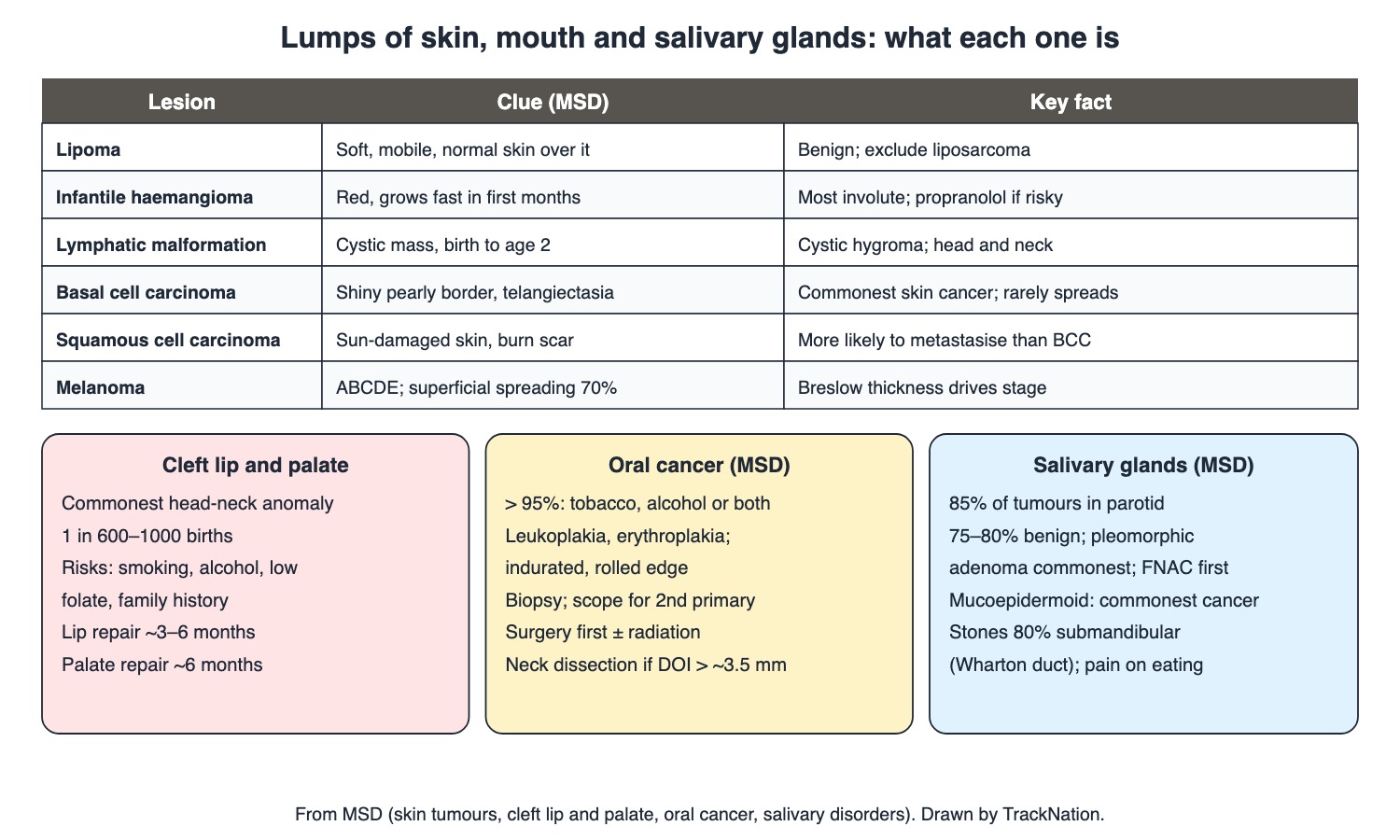
Skin lumps and skin cancers; cleft lip and palate; oral cancer; salivary tumours and stones. Drawn by TrackNation.
Skin and Subcutaneous Lumps (MSD)
Lipoma: soft, mobile subcutaneous fat lump with normal skin; benign, malignant change exceedingly rare — the concern is to distinguish liposarcoma.
Infantile haemangioma: the commonest tumour of infancy (5–10%); appears in the first weeks, reaches 80% of size by 3 months, most involute. Periocular lesions are an emergency; high-risk lesions → oral propranolol; surgery usually avoided. Lymphatic malformation (cystic hygroma): present at birth or by age 2, mainly head and neck.
Basal cell carcinoma: commonest skin cancer; shiny papule with a pearly border, telangiectasia and central ulcer; locally destructive, metastasis rare; rare in dark skin; Gorlin syndrome; Mohs surgery for high-risk sites. Squamous cell carcinoma: second commonest; on sun-damaged skin, actinic keratosis, oral leukoplakia or a burn scar; more likely to metastasise.
Melanoma: ABCDE — Asymmetry, Border, Colour, Diameter > 6 mm, Evolution. Types: superficial spreading (70%), lentigo maligna (15%, elderly), nodular, acral lentiginous (palms, soles, nails — Hutchinson sign; the commonest type in dark-skinned people). Biopsy before radical surgery; Breslow thickness and ulceration drive staging; sentinel node biopsy.
Cleft Lip and Palate (MSD)
Commonest congenital anomalies of the head and neck — 1 in 600–1000 births; 30% syndromic, 70% isolated. Risks: maternal smoking, alcohol, folate deficiency, family history. Mildest form: bifid uvula.
Cleft palate disturbs feeding and speech and causes ear infections; special bottles and plates bridge the gap. Repair: lip at about 3–6 months; palate at about 6 months (better speech than at 12 months); with combined clefts, lip and soft palate by 6 months and hard palate at 9–18 months.
Oral Cancer (MSD)
Oral cavity = vermilion border to the junction of hard and soft palate and the posterior third of the tongue. > 95% of patients use tobacco, alcohol or both; chewing tobacco, betel quid and chronic irritation add risk. Lower-lip cancers are sun-related.
Early lesions are painless — leukoplakia or erythroplakia, later an indurated ulcer with a rolled border, then pain, dysarthria, dysphagia. Biopsy any suspicious area; laryngoscopy and oesophagoscopy to exclude a second primary; CT/PET for staging.
Surgery is the first treatment, with radiation or chemoradiation after for advanced disease; neck dissection when depth of invasion exceeds about 3.5 mm (nodal risk > 15–20%); reconstruction and speech therapy.
Salivary Glands (MSD)
Tumours: 85% in the parotid; 75–80% benign; the smaller the gland, the higher the chance of cancer. Pleomorphic adenoma is the commonest benign tumour (can turn malignant after 15–20 years); Warthin tumour is another benign type. Mucoepidermoid carcinoma is the commonest salivary cancer; adenoid cystic carcinoma is the commonest cancer of minor glands and spreads along nerves (pain, facial palsy). Painless lump → FNAC, CT/MRI; treat by excision (recurrence if incomplete) ± radiation.
Stones: mostly calcium phosphate; 80% submandibular (Wharton duct), the rest mostly parotid (Stensen duct); swelling and pain after eating; massage, sialagogues, sialendoscopy or surgery. Sialadenitis: mostly parotid, after stasis; Staphylococcus aureus is the commonest bacterium.
Traps the Examiner Sets
BCC rarely spreads; SCC can.
Parotid tumours are mostly benign; minor-gland tumours are more often malignant.
Stones favour the submandibular gland; infection favours the parotid.
Do not excise a suspected melanoma radically before biopsy.
Memory Hooks & Shortcuts
Shortcuts to lock in this article's numbers and lists. Each one only re-packages facts proven above.
🧠 'Pearly BCC stays home; scaly SCC travels' — skin cancer
🧠 Melanoma 'A-B-C-D-E: Asymmetry, Border, Colour, Diameter > 6, Evolving' — ABCDE
🧠 Cleft timing 'lip by 3–6, palate by 6' months — cleft
🧠 Salivary 'the smaller the gland, the more likely the cancer' — salivary
🧠 'Wharton — the Wet stone duct': submandibular stones — stones
Rapid-Revision Cards
Lipoma
Soft, mobile; rule out liposarcoma.
Haemangioma
Commonest infant tumour; involutes.
Risky haemangioma
Oral propranolol.
Cystic hygroma
Lymphatic malformation, head/neck.
BCC
Pearly border, telangiectasia; rarely spreads.
Commonest skin cancer
BCC.
SCC
Burn scar; metastasises more.
Melanoma ABCDE
D > 6 mm; E evolving.
Commonest melanoma
Superficial spreading (70%).
Nail melanoma
Acral lentiginous; Hutchinson sign.
Melanoma staging
Breslow thickness.
Cleft prevalence
1 in 600–1000.
Cleft risks
Smoking, alcohol, low folate.
Lip repair
3–6 months.
Palate repair
~6 months.
Oral cancer risks
Tobacco, alcohol (> 95%).
Oral cancer work-up
Scope for second primary.
Neck dissection
DOI > ~3.5 mm.
Salivary tumours
85% parotid; 75–80% benign.
Commonest salivary cancer
Mucoepidermoid.
Salivary stones
80% submandibular (Wharton).
Sources
Facts in this article were checked against these documents.
MSD Manual Professional: Lipomas; Lymphatic Malformations; Infantile Hemangiomas; Basal Cell Carcinoma; Squamous Cell Carcinoma; Melanoma; Cleft Lip and Cleft Palate; Oral Squamous Cell Carcinoma; Salivary Gland Tumors; Salivary Stones; Sialadenitis — Merck & Co. (MSD Manuals), 2025–26 (link)
Competency Based Undergraduate Curriculum, Vol III: General Surgery (SU18–SU21) — National Medical Commission, 2024
Test Yourself: Practice Questions
Thirty questions in NEET PG style, most of them clinical vignettes.
Practice Questions (NEET PG pattern)
Original questions written in the style of the exam: +4 for a correct answer, −1 for a wrong one. Every answer was checked against the sources listed above. NEET PG papers are not published by NBEMS, so these are not past-paper questions.
Q1. A soft, mobile, painless subcutaneous lump on the shoulder with normal overlying skin is most likely a
(a) melanoma
(b) lipoma
(c) lymphatic malformation
(d) sebaceous carcinoma
Show answer
Answer: (b) — Exclude liposarcoma.
Q2. The most common tumour of infancy is
(a) infantile haemangioma
(b) Wilms tumour
(c) neuroblastoma
(d) lymphatic malformation
Show answer
Answer: (a) — 5–10% by age 1.
Q3. A 2-month-old has a rapidly enlarging red haemangioma on the upper eyelid threatening vision. Treatment is
(a) oral propranolol (urgent)
(b) immediate excision
(c) wait for involution
(d) radiotherapy
Show answer
Answer: (a) — Periocular = emergency.
Q4. Most infantile haemangiomas
(a) appear in adolescence
(b) involute spontaneously
(c) turn malignant
(d) need surgery
Show answer
Answer: (b) — Observe usually.
Q5. A soft cystic neck mass present since birth in a toddler is most likely a
(a) lymphatic malformation (cystic hygroma)
(b) thyroid cancer
(c) branchial carcinoma
(d) lipoma
Show answer
Answer: (a) — Head and neck.
Q6. An elderly fair-skinned farmer has a slow-growing facial nodule with a shiny pearly border, telangiectasia and a central ulcer. The diagnosis is
(a) keratoacanthoma
(b) melanoma
(c) basal cell carcinoma
(d) squamous cell carcinoma
Show answer
Answer: (c) — Rodent-type ulcer.
Q7. The most common skin cancer is
(a) Merkel cell carcinoma
(b) squamous cell carcinoma
(c) basal cell carcinoma
(d) melanoma
Show answer
Answer: (c) — SCC second.
Q8. Basal cell carcinoma behaves by
(a) local destruction with rare metastasis
(b) lymphatic spread in most
(c) spontaneous regression
(d) early blood-borne spread
Show answer
Answer: (a) — Unlike SCC.
Q9. A non-healing ulcer develops in an old burn scar. The likely malignancy is
(a) basal cell carcinoma
(b) haemangioma
(c) squamous cell carcinoma
(d) lipoma
Show answer
Answer: (c) — Chronic scar.
Q10. Compared with BCC, cutaneous squamous cell carcinoma
(a) arises only in dark skin
(b) is commoner
(c) is more likely to metastasise
(d) never metastasises
Show answer
Answer: (c) — Second commonest.
Q11. In the ABCDE rule for melanoma, 'D' means a diameter greater than
(a) 10 mm
(b) 6 mm
(c) 20 mm
(d) 1 mm
Show answer
Answer: (b) — E = evolution.
Q12. The commonest type of melanoma overall is
(a) lentigo maligna
(b) nodular
(c) superficial spreading
(d) acral lentiginous
Show answer
Answer: (c) — 70%.
Q13. A dark-skinned man has a pigmented band in a fingernail spreading onto the nail fold. The likely melanoma type is
(a) desmoplastic
(b) superficial spreading
(c) acral lentiginous
(d) lentigo maligna
Show answer
Answer: (c) — Hutchinson sign.
Q14. The single most important histological measurement for melanoma staging is
(a) colour
(b) tumour diameter
(c) Clark level only
(d) Breslow thickness
Show answer
Answer: (d) — With ulceration.
Q15. A suspected melanoma should first be
(a) widely excised without biopsy
(b) observed for 6 months
(c) biopsied for histology before radical surgery
(d) treated with radiotherapy
Show answer
Answer: (c) — Diagnosis first.
Q16. The most common congenital anomalies of the head and neck are
(a) branchial cysts
(b) cystic hygromas
(c) thyroglossal cysts
(d) oral clefts
Show answer
Answer: (d) — 1 in 600–1000.
Q17. A maternal factor linked to oral clefts is
(a) folate deficiency
(b) hyperthyroidism
(c) excess vitamin C
(d) high iodine
Show answer
Answer: (a) — Also tobacco, alcohol.
Q18. A child with cleft palate is at increased risk of
(a) middle ear infections
(b) pyloric stenosis
(c) kidney stones
(d) cataract
Show answer
Answer: (a) — Also feeding, speech problems.
Q19. Isolated cleft lip repair has traditionally been done at
(a) 3–6 months
(b) 1 week
(c) 2 years
(d) 5 years
Show answer
Answer: (a) — Earlier repair being studied.
Q20. For isolated cleft palate, a large trial favoured primary repair at
(a) 6 months rather than 12 months
(b) birth
(c) 5 years
(d) 12 months rather than 6
Show answer
Answer: (a) — Better speech.
Q21. The strongest risk factors for oral squamous cell carcinoma are
(a) tobacco and alcohol
(b) sun exposure for all sites
(c) diet low in fibre
(d) HPV only
Show answer
Answer: (a) — > 95%.
Q22. A tobacco chewer has an indurated ulcer with a rolled border on the lateral tongue. After biopsy confirms carcinoma, staging must include
(a) mammography
(b) colonoscopy
(c) bone marrow biopsy
(d) laryngoscopy and oesophagoscopy to look for a second primary
Show answer
Answer: (d) — Field cancerisation.
Q23. The initial treatment of choice for most oral cavity cancers is
(a) radiotherapy alone always
(b) surgery
(c) chemotherapy alone
(d) observation
Show answer
Answer: (b) — ± post-op radiation.
Q24. Neck dissection in oral cancer is typically done when depth of invasion exceeds about
(a) 20 mm
(b) 0.5 mm
(c) 3.5 mm
(d) 10 mm
Show answer
Answer: (c) — Nodal risk > 15–20%.
Q25. Most salivary gland tumours arise in the
(a) parotid gland
(b) sublingual gland
(c) minor glands of the palate
(d) submandibular gland
Show answer
Answer: (a) — ~85%.
Q26. The most common benign salivary tumour is
(a) lipoma
(b) oncocytoma
(c) pleomorphic adenoma
(d) Warthin tumour
Show answer
Answer: (c) — Mixed tumour.
Q27. The most common salivary gland cancer is
(a) acinic cell carcinoma
(b) mucoepidermoid carcinoma
(c) adenoid cystic carcinoma
(d) lymphoma
Show answer
Answer: (b) — Adenoid cystic: commonest of minor glands.
Q28. A palatal minor-salivary-gland cancer causing pain and spreading along nerves is most likely
(a) Warthin tumour
(b) pleomorphic adenoma
(c) adenoid cystic carcinoma
(d) mucocele
Show answer
Answer: (c) — Perineural invasion.
Q29. A man has painful swelling under the jaw every time he eats, settling a few hours later. The likely cause is
(a) mumps
(b) parotid cancer
(c) a lipoma
(d) a submandibular duct (Wharton) stone
Show answer
Answer: (d) — 80% submandibular.
Q30. The commonest bacterium causing acute sialadenitis is
(a) Streptococcus pneumoniae
(b) Pseudomonas
(c) Staphylococcus aureus
(d) E. coli
Show answer
Answer: (c) — Parotid most often.
Active Recall
From memory: describe lipoma, haemangioma and lymphatic malformation; contrast basal cell carcinoma, squamous cell carcinoma and melanoma; give cleft lip and palate risks and repair timing; outline oral cancer risks, work-up and treatment; and summarise salivary tumours, stones and sialadenitis.