Complementary Feeding and Infant Nutrition for NEET PG Paediatrics: When to Start Solids, First Foods, What to Avoid, Formula, Cow's Milk and Energy Needs
Start Here
🎯 Exam priority: High. Expect: when to start complementary feeding, why not before 4 months, the first food, introducing allergenic foods, honey and botulism, cow's milk timing and its problems, formula choices in cow's-milk-protein allergy, calorie requirements per kg by age, and India's NFHS figures.
CBME mapping: PE8, PE9. Fact-checked against the MSD Manual and NFHS. Note: MSD reflects US/WHO practice; India's infant and young child feeding guidelines were not in our library, so Indian household measures are not taught here.
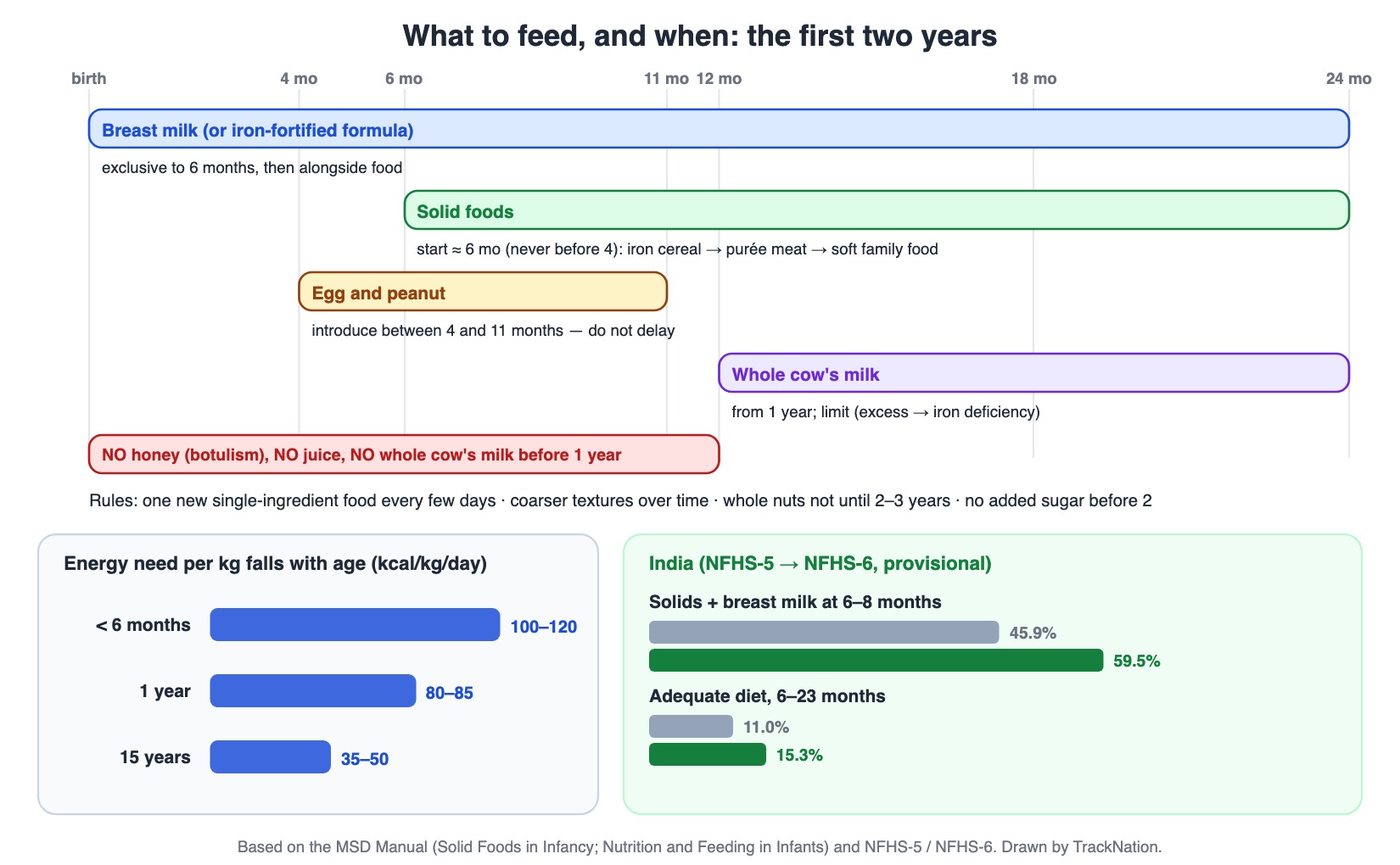
What to feed and when in the first two years, foods to avoid, energy needs and India's NFHS figures. Drawn by TrackNation.
Starting Solids (MSD)
Exclusive breastfeeding until solids at about 6 months, when the baby is developmentally ready — never before 4 months: younger babies do not need solids and the extrusion reflex pushes food out.
Offer solids after a breast or bottle feed at first. Iron-fortified cereal is the traditional first food (non-allergenic, easy to digest, iron). Introduce one new single-ingredient food every few days to spot allergies, moving to coarser textures: cereal → soft table food → chopped table food.
Puréed meat supplies iron and zinc, often short in exclusively breastfed babies; vegetarian babies get iron from fortified cereals, green leafy vegetables and beans.
Do not delay allergenic foods: introduce egg and peanut between 4 and 11 months — this reduces food allergy.
What to Avoid, Milk and Appetite (MSD)
No honey before 1 year (infant botulism). Avoid choking foods — whole nuts or beans, round sweets, popcorn, unpuréed meat, whole grapes; whole nuts not until 2–3 years. Vegetables grown with fertiliser-contaminated water can carry high nitrates and cause methaemoglobinaemia.
Whole cow's milk from 1 year (it is incomplete and can cause occult intestinal bleeding earlier); limit it — too much crowds out food and causes iron-deficiency anaemia.
No juice under 1 year; no added sugar under 2; after 2, added sugar under 10% of calories.
After 1 year growth slows and appetite drops — judge intake over a week, not a meal; worry only if the child leaves the growth curve.
Formula and Energy Needs (MSD)
Infant formula is the only acceptable alternative to breast milk in year 1 — not water (hyponatraemia) or whole cow's milk. Use iron-fortified formula (iron-free is not recommended); cow's milk-based formula is standard.
Cow's-milk-protein allergy: some babies also react to soy → hydrolysed formula; the few who react to that need elemental (amino-acid) formula.
Formula digests more slowly — feeds every 3–4 hours; about 90 mL six times a day gives ≈120 kcal/kg/day for a 3-kg baby. Breastfed newborns take only 15–30 mL per feed in the first days.
Energy need per kg falls with age: 100–120 kcal/kg/day under 6 months, 80–85 at 1 year, 35–50 at 15 years. Spitting mucus in the first 48 hours is common; bilious vomiting needs urgent evaluation.
India's Numbers (NFHS)
Children aged 6–8 months getting solid or semi-solid food plus breast milk: 45.9% (NFHS-5) → 59.5% (NFHS-6, provisional).
Children aged 6–23 months getting an adequate diet: only 11.0% → 15.3%.
Traps the Examiner Sets
Solids never before 4 months; the target is about 6 months.
Allergenic foods like egg and peanut should not be delayed beyond the first year.
Honey is banned in year 1 because of infant botulism.
Whole cow's milk waits until 1 year; excess causes iron deficiency.
Only about 15% of Indian children aged 6–23 months get an adequate diet.
Memory Hooks & Shortcuts
Shortcuts to lock in this article's numbers and lists. Each one only re-packages facts proven above.
🧠 'Four is the Floor, Six is the Fix' — solids never before 4, ideally at 6 months — timing
🧠 'Honey waits for the first Birthday' — infant botulism — avoid
🧠 'Cow's milk at One, and not a Ton' — from 1 year, limited — cow's milk
🧠 'Egg and peanut: Early, not late (4–11 months)' — allergy
🧠 Calories per kg '120 → 80 → 40' — infant, 1 year, teenager — energy
Rapid-Revision Cards
Start solids
≈ 6 months; never before 4.
Before 4 months
Extrusion reflex; not needed.
First food
Iron-fortified cereal.
New foods
One single-ingredient every few days.
Meat purée
Iron + zinc.
Egg, peanut
Between 4 and 11 months.
Honey
Not before 1 year (botulism).
Whole nuts
Not before 2–3 years.
Nitrates
Methaemoglobinaemia.
Cow's milk
From 1 year; excess → iron deficiency.
Juice / sugar
None < 1 yr / no added sugar < 2.
Picky toddler
Judge over a week; check growth.
Year-1 substitute
Infant formula only.
Water as feed
Hyponatraemia, undernutrition.
Formula iron
Iron-fortified; not iron-free.
CMPA + soy allergy
Hydrolysed → elemental.
Formula feeds
Every 3–4 h.
kcal/kg/day
<6 mo 100–120; 1 yr 80–85; 15 yr 35–50.
Bilious vomiting
Evaluate for GI anomaly.
NFHS 6–8 mo solids
45.9 → 59.5%.
NFHS adequate diet
11.0 → 15.3%.
Sources
Facts in this article were checked against these documents.
MSD Manual Professional: Solid Foods in Infancy; Nutrition and Feeding in Infants; Formula Feeding — Merck & Co., 2026 (link)
National Family Health Survey (NFHS-6) 2023–24: India Fact Sheet (provisional) — International Institute for Population Sciences / MoHFW, 2026
Test Yourself: Practice Questions
Thirty questions in NEET PG style, many of them clinic scenarios.
Practice Questions (NEET PG pattern)
Original questions written in the style of the exam: +4 for a correct answer, −1 for a wrong one. Every answer was checked against the sources listed above. NEET PG papers are not published by NBEMS, so these are not past-paper questions.
Q1. Complementary (solid) foods should usually be introduced at about
(a) 2 months
(b) 6 months
(c) 12 months
(d) 9 months
Show answer
Answer: (b) — Never before 4 months.
Q2. Solids are difficult to feed before 4 months mainly because of the
(a) rooting reflex
(b) Moro reflex
(c) gag reflex
(d) extrusion reflex
Show answer
Answer: (d) — Tongue pushes food out.
Q3. The traditional first solid food is
(a) iron-fortified cereal
(b) fruit juice
(c) eggs
(d) cow's milk
Show answer
Answer: (a) — Non-allergenic, easily digested.
Q4. New foods should be introduced
(a) one single-ingredient food every few days
(b) only as mixed meals
(c) only after 1 year
(d) all at once
Show answer
Answer: (a) — To identify allergies.
Q5. Puréed meat is a good early complementary food because it provides
(a) iron and zinc
(b) fibre
(c) vitamin C
(d) calcium only
Show answer
Answer: (a) — Often short in exclusive breastfeeding.
Q6. To reduce food allergy, egg and peanut should be introduced
(a) only after 3 years
(b) never in year 1
(c) between 4 and 11 months
(d) at birth
Show answer
Answer: (c) — Do not delay.
Q7. Honey is avoided before 1 year because of the risk of
(a) allergy
(b) dental caries
(c) diabetes
(d) infant botulism
Show answer
Answer: (d) — MSD.
Q8. Whole nuts should be avoided until
(a) 10 years
(b) 2–3 years
(c) 1 year
(d) 6 months
Show answer
Answer: (b) — Aspiration risk.
Q9. Vegetables grown with fertiliser-contaminated water can cause infant
(a) hypothyroidism
(b) botulism
(c) methaemoglobinaemia
(d) scurvy
Show answer
Answer: (c) — Nitrates.
Q10. Whole cow's milk can be started at
(a) 1 year
(b) 3 months
(c) 6 months
(d) 2 years
Show answer
Answer: (a) — Not in year 1.
Q11. Excess cow's milk in toddlers contributes to
(a) scurvy
(b) obesity only
(c) iron-deficiency anaemia
(d) rickets
Show answer
Answer: (c) — Crowds out other food.
Q12. Whole cow's milk before 1 year is a problem because it
(a) is too high in iron
(b) is nutritionally incomplete and may cause occult intestinal bleeding
(c) causes botulism
(d) causes rickets
Show answer
Answer: (b) — MSD.
Q13. Fruit juice for infants under 1 year is
(a) the best first food
(b) needed for vitamin C
(c) not recommended
(d) recommended daily
Show answer
Answer: (c) — No added sugar under 2.
Q14. A healthy 15-month-old refuses some meals and parents worry. The best advice is to
(a) start appetite stimulants
(b) give extra milk
(c) judge intake over a week and watch the growth curve
(d) force-feed
Show answer
Answer: (c) — Growth slows after 1 year.
Q15. The only acceptable alternative to breast milk in the first year is
(a) whole cow's milk
(b) rice water
(c) goat's milk
(d) infant formula
Show answer
Answer: (d) — MSD.
Q16. Giving plain water as a substitute for milk to a young infant can cause
(a) hypernatraemia
(b) botulism
(c) hyponatraemia and undernutrition
(d) obesity
Show answer
Answer: (c) — MSD.
Q17. Regarding iron in infant formula,
(a) iron causes colic so avoid it
(b) iron is added only after 1 year
(c) iron-free is preferred
(d) iron-free formulas are not recommended
Show answer
Answer: (d) — MSD.
Q18. An infant with cow's-milk-protein allergy who also reacts to soy should get
(a) lactose-free cow's milk
(b) goat's milk
(c) whole cow's milk
(d) hydrolysed formula
Show answer
Answer: (d) — Elemental if that fails.
Q19. A baby allergic even to hydrolysed formula needs
(a) cow's milk
(b) elemental (amino-acid) formula
(c) rice milk
(d) soy formula
Show answer
Answer: (b) — MSD.
Q20. Compared with breastfed babies, formula-fed babies initially feed every
(a) 8 hours
(b) 30 minutes
(c) 12 hours
(d) 3–4 hours
Show answer
Answer: (d) — Formula digests more slowly.
Q21. Energy needs of a term infant under 6 months are about
(a) 35–50 kcal/kg/day
(b) 60 kcal/kg/day
(c) 200 kcal/kg/day
(d) 100–120 kcal/kg/day
Show answer
Answer: (d) — 80–85 at 1 year.
Q22. At 15 years, energy need is about
(a) 80–85 kcal/kg/day
(b) 150 kcal/kg/day
(c) 35–50 kcal/kg/day
(d) 100–120 kcal/kg/day
Show answer
Answer: (c) — Per kg needs fall with age.
Q23. Relative protein and energy needs per kg
(a) peak at 10 years
(b) rise steadily
(c) are constant
(d) fall from infancy through adolescence
Show answer
Answer: (d) — Absolute needs rise.
Q24. A newborn's intake per feed in the first few days may be only
(a) 5 mL
(b) 15–30 mL
(c) 250 mL
(d) 150 mL
Show answer
Answer: (b) — MSD.
Q25. A 2-day-old has bilious vomiting. The correct step is
(a) give ORS
(b) switch formula
(c) full evaluation for a congenital GI anomaly
(d) reassure — spitting is normal
Show answer
Answer: (c) — Mucus spitting settles in 48 h.
Q26. At first, solid foods should be given
(a) after a breast or bottle feed
(b) before every feed
(c) instead of milk
(d) only at night
Show answer
Answer: (a) — To ensure nourishment.
Q27. From age 2, added sugars should be limited to
(a) 10% of calories
(b) 25% of calories
(c) 50% of calories
(d) zero, for life
Show answer
Answer: (a) — None under 2.
Q28. In NFHS-6 (provisional), the share of Indian children aged 6–23 months on an adequate diet was
(a) 45.9%
(b) 15.3%
(c) 55.8%
(d) 59.5%
Show answer
Answer: (b) — 11.0% in NFHS-5.
Q29. Timely solids with breast milk at 6–8 months rose in India from 45.9% to
(a) 80%
(b) 59.5%
(c) 35%
(d) 15.3%
Show answer
Answer: (b) — NFHS-6 provisional.
Q30. The standard formula choice, unless there is intolerance, is
(a) hydrolysed formula
(b) soy formula
(c) elemental formula
(d) cow's milk-based formula
Show answer
Answer: (d) — MSD.
Active Recall
From memory: say when and how to start solids, the first foods and order, allergenic foods, foods to avoid, cow's milk and juice rules, formula choices, energy needs per kg by age, and India's NFHS complementary feeding figures.